 By
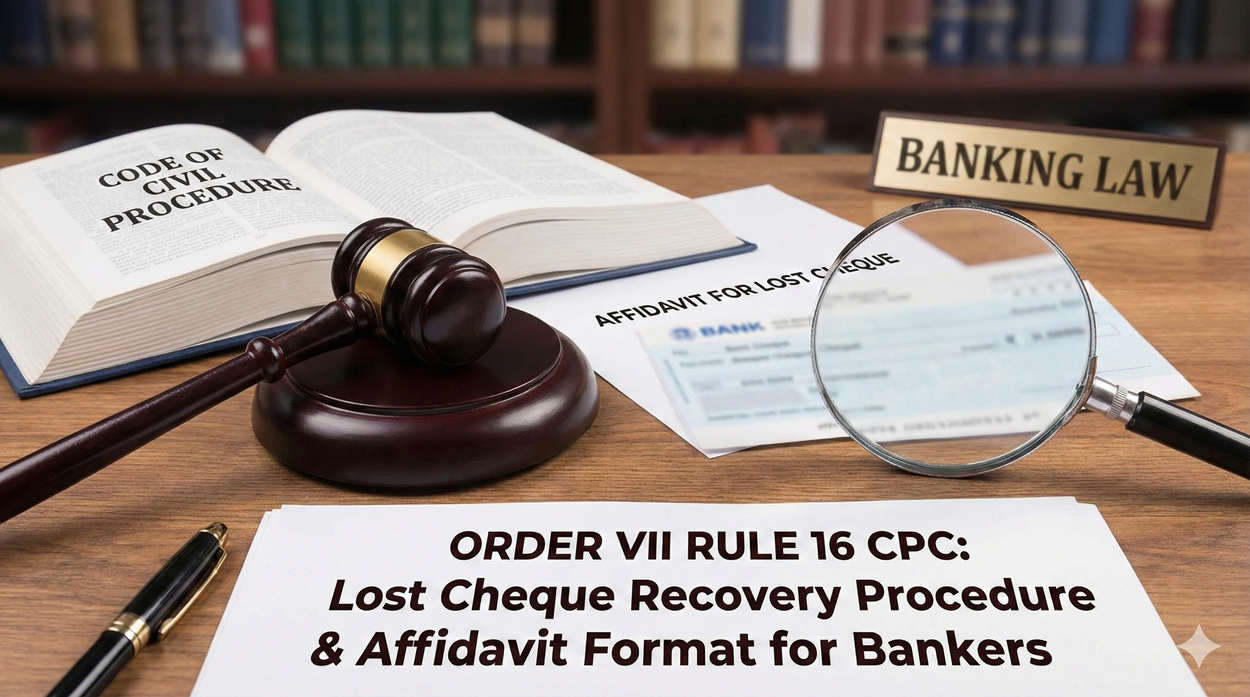
By When a physical cheque disappears during transit or clearing, the underlying debt remains valid, but the legal route to recovery shifts. A criminal complaint under Section 138 of the Negotiable Instruments Act often fails without the original document, leaving bankers with one specific civil remedy: Order VII Rule 16 of the Code of Civil Procedure, 1908.
This provision allows a plaintiff to sue on a lost instrument by creating a legal fiction—treating the missing document as if it were present in court. Success depends on proving “loss” rather than negligence and establishing the bank’s status as a “Holder for Value” instead of a mere collection agent. The following guide details the procedural requirements, from securing secondary evidence under Section 65 to drafting the mandatory indemnity bond, ensuring the suit survives the limitation period despite the missing paper trail.
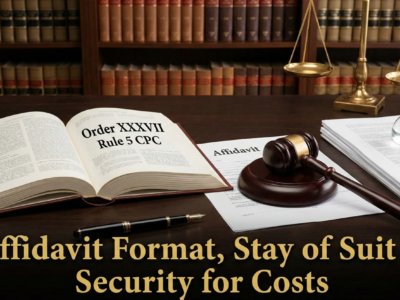
Affidavit Under Order VII Rule 16 CPC
When a negotiable instrument vanishes, the debt does not. A comprehensive guide for bankers to recover funds using the specific relief mechanisms of the Code of Civil Procedure.
The loss of a negotiable instrument presents a unique legal paradox. The instrument functions as both the evidence of the debt and the title to the money. Order VII Rule 16 of the Code of Civil Procedure (CPC) 1908 provides the bridge across this gap. It allows a plaintiff to sue on a lost instrument as if it were present, provided they satisfy specific statutory conditions.
The Core Mechanism
The court creates a legal fiction. If loss is proved and an indemnity is given, the suit proceeds as though the original document sits on the judge’s bench.
The Procedural Workflow
The path from loss to decree requires strict adherence to three phases: Proof, Status, and Security. The diagram below illustrates the mandatory steps a banker must take under Rule 16.
Figure 1: Visualizing the Order VII Rule 16 Lifecycle
Legal Strategy: Holder for Value
A common error in banking litigation is suing as a mere agent. To succeed under this affidavit, the bank must establish itself as a “Holder for Value”. This distinction determines standing.
Collecting Agent
- Bank receives cheque only for collection.
- No funds advanced to customer.
- Risk: Loss falls on the customer.
- Standing: Bank cannot sue the drawer on the instrument.
Holder for Value
- Bank allows withdrawal against uncleared effects.
- Bank effectively purchases the instrument.
- Risk: Bank owns the asset.
- Standing: Bank can sue in its own name.
The Pre-Litigation Drill
Before filing the suit, you must create a “paper trail of loss” to satisfy the court that the instrument was not merely hidden or sold.
Step 1: The Police Diary Entry (GD)
Immediately file a General Diary (GD) entry at the local police station where the loss occurred. Obtain a stamped copy. This is the primary document to prove “Loss” versus “Theft”.
Step 2: Stop Payment Instruction
Issue a formal letter to the Drawee Bank to “Stop Payment” of the specific instrument number to prevent misuse. This demonstrates “bona fides” (good faith).
Step 3: Public Notice (Optional but Recommended)
For high-value instruments, publish a “Lost & Found” notice in a local daily. This strengthens the claim that the bank took all reasonable steps to recover the instrument.
The Limitation Watchdog
The loss of the instrument complicates the calculation of the limitation period. Under the Limitation Act, 1963, a suit for recovery must be filed within 3 years.
The Section 18 Trap
Often, banks rely on the date of the cheque to calculate limitation. If the cheque is lost, proving that date becomes secondary evidence.
Corrective Action:
- Secure a Balance Confirmation Letter from the borrower immediately upon noticing the loss.
- This letter acts as an “Acknowledgment of Debt” under Section 18, resetting the 3-year clock.
- Do not wait for the “Duplicate Cheque” to restart limitation; the duplicate may never arrive.
The Section 138 Dilemma
Bankers often ask: “Can we file a criminal complaint under Section 138 NI Act using a photocopy of the lost cheque?”
CRITICAL ALERT: Section 138 is likely barred.
The majority view of Indian High Courts is that the original instrument is a sine qua non (essential condition) for a Section 138 prosecution. Section 138 is a penal statute and must be construed strictly. Without the original cheque to present to the bank and return “dishonored,” the cause of action rarely survives.
Result: Order VII Rule 16 Civil Suit is often the only viable legal remedy remaining for a lost instrument, making the drafting of this affidavit critical.
The Evidence Protocol (Section 65)
Merely stating “the cheque is lost” is insufficient. Under Section 65(c) of the Indian Evidence Act, 1872, you must lay a foundation to lead secondary evidence (photocopies or ledger entries).
Establish Existence
You must prove the cheque existed. Attach the “Inward Register” or the “Cheque Deposit Slip” stamped by the bank official. This proves the instrument entered the bank’s custody.
Prove Loss (Not Neglect)
The court differentiates between ‘loss’ and ‘hiding’. Produce the postal receipt and the subsequent letter from the postal department/courier confirming non-delivery or loss in transit.
Demand Duplicate
Under Section 45A of the NI Act, the holder must ask the drawer for a duplicate. Attach the Legal Notice sent to the drawer demanding a replacement cheque.
The Banker’s Evidence Protocol (BBEA)
When the instrument is lost, the Ledger becomes the primary proof of the debt’s existence. For a bank, a simple printout is inadmissible without specific certification.
1. The Section 2A Certificate
Under the Bankers’ Books Evidence Act, 1891, a certified copy of the ledger entry is prima facie evidence. The certificate must state that the entry was made in the ordinary course of business.
2. The 65B Certificate
Since modern ledgers are electronic, a certificate under Section 65B of the Evidence Act is mandatory. It must confirm the computer system was operating properly at the time of data entry.
The Digital Exception (CTS-2010)
Not all “lost” cheques require Rule 16 litigation. If the cheque was processed under the Cheque Truncation System (CTS), digital laws may save you.
Scenario: Lost AFTER Scanning
If the cheque was physically lost after it was scanned at the presenting bank’s branch:
- The Electronic Image is deemed to be the “cheque” under the amended NI Act.
- You can rely on the Clearing House printout/image certified under the IT Act.
- Action: You may proceed with standard recovery or even Section 138 (arguably) relying on the digital image as the “Truncated Cheque”.
Note: If lost BEFORE scanning, Rule 16 is mandatory.
The Prayer Architect
In a Rule 16 suit, the relief sought must be specific. A generic prayer for recovery may be returned by the Registry. Use this specific structure to prevent technical objections.
// Recommended Prayer Clause format
“Pass a judgment and decree directing the Defendant to pay the Plaintiff the sum of Rs. [Amount], together with interest @ [Rate]% p.a., subject to the Plaintiff furnishing an indemnity bond to the satisfaction of this Hon’ble Court against the claims of any other person upon the said lost instrument.”Why this matters: The words “subject to…” signal to the judge that you are aware of the Rule 16 requirement, often pre-empting the need for a separate hearing on maintainability.
The Defense Matrix
Without the physical cheque, defendants often raise specific defenses. Use this matrix to prepare your Replication (Reply to Written Statement).
| Defendant’s Argument | Banker’s Rebuttal Strategy |
|---|---|
| “I never issued this cheque.” | Rely on the Inward Clearing Register or the Pay-in Slip. Even if the cheque is lost, the bank’s internal record of receiving a specific instrument number acts as corroborative evidence of issuance. |
| “It was a Security Cheque, not for debt.” | Shift focus to the Underlying Loan Agreement. In a civil suit (unlike 138), the cheque is just one piece of evidence. Prove the debt via the Loan Account Statement (BBEA Certified), rendering the nature of the cheque secondary. |
| “The Bank was negligent in losing it.” | Negligence is a tort, not a defense to debt. Argue that while the bank may be liable for “deficiency of service” (consumer court), it does not extinguish the borrower’s liability to repay the loan in a civil court. |
The Surety Standard
The Indemnity Bond required by Rule 16 must be backed by a Surety. Who qualifies?
- For Individuals: A solvent third party (not a family member) with a Net Worth Certificate.
- For Banks (Plaintiffs): Courts typically accept a Corporate Indemnity signed by an authorized officer, without insisting on a third-party surety, due to the bank’s inherent solvency.
Pro Tip: Corporate Undertaking
If the court insists on a surety, file an application stating: “The Plaintiff is a Public Sector/Scheduled Bank with perpetual solvency. A Letter of Indemnity by the Branch Manager acts as sufficient security.” This saves the hassle of finding external guarantors.
Anatomy of the Indemnity Bond
While the Affidavit promises the bond, the Indemnity Bond itself is a separate non-judicial stamp paper document. It must contain these three critical clauses:
1. The Hold Harmless Clause
“The Bank hereby indemnifies the Defendant against all losses, damages, costs, charges, and expenses which they may sustain by reason of the original cheque being presented by a third party.”
2. The Return Clause
“The Bank undertakes to deliver the original instrument to the Court or the Defendant immediately if it is ever found or traced in the future.”
3. The Surety’s Covenant
“We, the Sureties, guarantee the performance of this bond jointly and severally with the Plaintiff Bank.” (If external surety is used).
Jurisdiction Matrix
Since the instrument (and its place of payment) is technically “lost,” defendants often challenge territorial jurisdiction. Use this matrix to determine the safe filing location under Section 20 CPC.
| Scenario | Preferred Court | Risk Level |
|---|---|---|
| Defendant resides/works in City A | Court in City A | Low (Safest) |
| Loan Disbursed at Branch B | Court in City B | Medium |
| Cheque Drawn on Bank C (Remote) | Court in City C | High (Avoid) |
*Note: In civil suits for recovery (unlike Section 138), the residence of the defendant is the most unassailable jurisdiction.
Key Legal Precedents
Standard Chartered Bank vs. A.B.C. (2016)
Held that a bank suing on a lost instrument must provide an indemnity bond before the decree is passed, not necessarily at the time of filing, though filing an affidavit of willingness is mandatory with the plaint.
State Bank of India vs. Munni Lal
Clarified that the indemnity is for the drawer’s protection. If the drawer has not faced a double claim, the court should not use technicalities of the indemnity bond to deny the bank’s legitimate claim.
Pre-Filing Compliance Checklist
Ensure these requirements are met before filing the affidavit.
The Affidavit Template
This template is modernized for 2026 practice. Placeholders are indicated in brackets. Ensure you replace archaic references with current entity names.
Instrument Comparison
| Feature | Affidavit (Order XIX) | Indemnity Bond |
|---|---|---|
| Purpose | Establishes fact of loss | Secures defendant against future claims |
| Signatory | Bank Officer (Deponent) | Bank (Entity) + Surety |
| Court Fee/Stamp | Minimal Affidavit Fee | Non-Judicial Stamp Paper (Ad Valorem) |
| Timing | With Plaint | Before Decree |
Frequently Asked Questions
Generally, the bank acts as an agent. However, if the bank has already credited the customer’s account (as a holder for value), the loss effectively impacts the bank. While the bank can blame the postal service to avoid “deficiency of service” claims from the customer, for recovery purposes, the bank must still follow Rule 16 procedures to sue the drawer.
It is legally permissible but practically difficult. Summary suits rely on the document being produced. Defendants often obtain “Leave to Defend” easily by questioning the terms of the missing document. Order VII Rule 16 suits are safer as regular suits, though slower.
The plaintiff is under a sworn undertaking (Paragraph 10 of the Affidavit) to produce it in court immediately. It cannot be presented for payment again if a decree has already been passed or if the matter is sub-judice.