 By
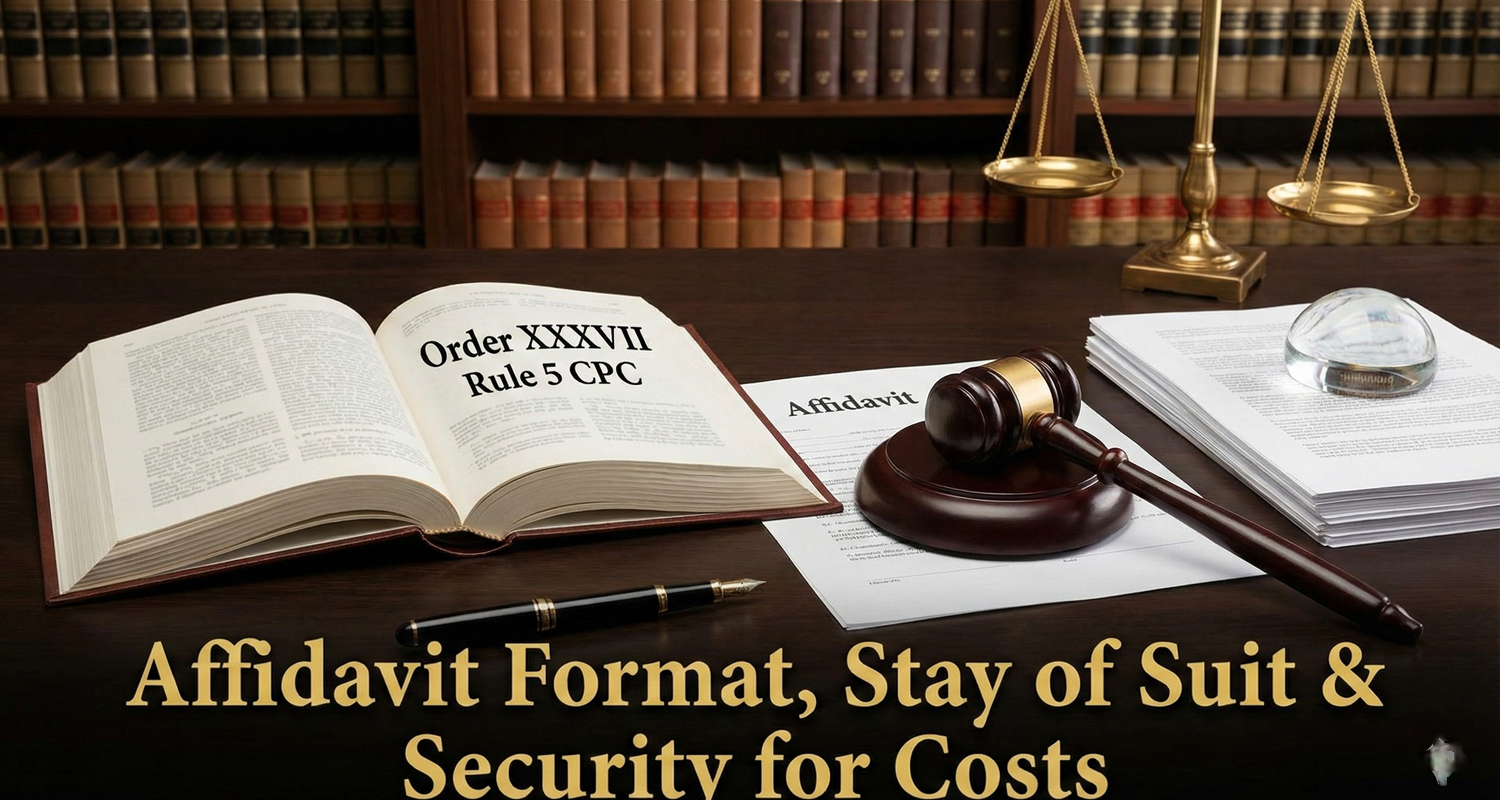
By Summary suits prioritize speed. While efficient, this accelerated process poses risks when a plaintiff lacks local assets or relies on questionable documents. Order XXXVII Rule 5 of the Code of Civil Procedure, 1908, functions as a procedural safeguard.
It authorizes the Court to impound the negotiable instrument—whether a physical promissory note or a digital record—and stay the suit until the plaintiff furnishes security for costs.
This guide examines the strict legal standards for invoking Rule 5, details the “Mirror Image” protocol for digital evidence, and supplies verified drafting templates for immediate use.
Procedural Law Series
Order XXXVII Rule 5: The Shield Against Frivolous Summary Suits
A definitive guide to impounding instruments and securing costs in commercial litigation. Updated January 2026.
Contents
- 1. The Framework
- 2. Jurisdictional Scope
- 3. Mechanics of Rule 5
- 4. Strategic Timeline
- 5. Visual Analysis (Fixed)
- 6. Judicial Precedents
- 7. Special Circumstances
- 8. Digital Instruments
- 9. Appeal & Revision
- 10. Anatomy of Affidavit
- 11. Drafting Checklist
- 12. Legal Templates
- 13. FAQ
Quick Stat
Courts invoke Rule 5 in less than 15% of summary suits. Primarily when the plaintiff is a foreign entity without local assets.
Jurisprudential Framework
Civil justice often struggles to balance speed with fairness. The Code of Civil Procedure (CPC) uses Order XXXVII as a fast track for debt recovery. It stops courts from getting clogged with weak defenses. However, this speed creates risks. To balance this, Order XXXVII Rule 5 acts as a safety valve. It allows the Court to demand the deposit of the negotiable instrument and stay proceedings until the plaintiff provides security for costs.
Constitutional validity remains intact because classifying suits based on negotiable instruments is reasonable. Yet, the Supreme Court of India holds that speed must not become oppression. Rule 5 ensures plaintiffs on the “fast track” prove their financial accountability.
Jurisdictional Applicability
High Courts
Applicable to High Courts with Original Jurisdiction (e.g., Delhi, Bombay, Madras, Calcutta) where the suit value exceeds pecuniary limits.
City Civil Courts
Fully applicable. Often the primary battleground for summary suits involving promissory notes and commercial contracts.
Small Causes Courts
Applicable for lower-value recovery suits. Procedural rigor is maintained despite the summary nature.
The Mechanics of Deposit & Stay
The Statute
“In any proceeding under this Order the Court may order the bill, hundi or note on which the suit is founded to be forthwith deposited with an officer of the Court, and may further order that all proceedings shall be stayed until the plaintiff gives security for the costs thereof.”
Power to Impound
Ensures the physical integrity of the evidence. It prevents the plaintiff from altering the document (like changing dates to fix limitation issues) or endorsing it to a third party during the trial.
Power to Stay
Ensures financial accountability. If a foreign plaintiff or insolvent entity loses a frivolous suit, the defendant needs a way to recover costs. This rule preempts that risk.
Strategic Filing Timeline
Institution of Plaint
Plaintiff files suit under Order XXXVII. Summons issued in Form 4.
Appearance
Defendant must enter appearance within 10 days of service.
The Rule 5 Wedge (Critical Window)
Optimal Filing Time: Before Summons for Judgment is taken out. Filing here arrests the speed of the summary procedure. It forces the court to decide on the safety of the instrument before discussing the merits of the debt.
Summons for Judgment
If Rule 5 is rejected, Plaintiff proceeds to ask for judgment. If allowed, proceedings stay.
Visual Analysis
Procedural Flowchart
Figure 1.1: The Judicial Decision Matrix for Rule 5 Applications
Risk Factors Triggering Rule 5
Judicial Precedents & Case Law Matrix
Courts have refined the interpretation of Rule 5 over decades. The discretion to order security for costs is not automatic. It requires specific triggers. Below is a matrix of controlling authorities relevant to the 2026 landscape.
The “Commercial Certainty” Doctrine
Supreme Court Principles
While analyzing Summary Suits (IDBI Trusteeship case reference), the Apex Court implies that procedural safeguards like Rule 5 must not defeat the purpose of the summary nature. The defendant must show a “reasonable probability” that the plaintiff is a flight risk or asset-less.
Foreign Entities & Costs
Bombay High Court Trends
In suits where the plaintiff is a foreign corporation with no registered office or immovable property in India, courts are more inclined to invoke Rule 5. This prevents a scenario where a successful Indian defendant is left with a “paper decree” for costs.
The Tampering Threshold
Delhi High Court Observation
Mere allegation of forgery in the Leave to Defend application is insufficient to trigger Rule 5 impounding. The defendant must point to specific visible defects (e.g., ink differences, overwriting) on the certified copy to demand the deposit of the original.
Limitation & Impounding
Procedural Tactic
If a Promissory Note is nearing the 3-year limitation expiration, Defendants use Rule 5 to force the document into Court custody immediately. This freezes the evidence, preventing the Plaintiff from fabricating a “part payment” endorsement to extend limitation.
The “Special Circumstances” Test
Rule 5 is not a routine procedure. It acts as an exception to the general rule that a plaintiff is master of their suit. To succeed, the Applicant (Defendant) must satisfy the “Special Circumstances” test. The Court asks three primary questions before granting a stay:
- Asset Verification: Does the Plaintiff possess realizable assets within the territorial jurisdiction?
- Document Integrity: Is there a visible ambiguity on the face of the negotiable instrument?
- Bona Fides: Is the application merely a tactic to delay the summary judgment?
Risk Calculation Table
Digital Instruments & The “Mirror Image” Rule
With the rise of Fintech, many summary suits in 2026 are based on electronic contracts or digitized negotiable instruments. Physical impounding under Rule 5 faces a challenge here: How do you deposit a digital file?
The Hash Value Protocol
Courts now order the Plaintiff to generate a cryptographic hash (SHA-256) of the electronic record and file it via affidavit. This acts as the “deposit.” Any alteration to the file later changes the hash, proving tampering.
The Server Logs
Instead of physical custody, the Court may direct the preservation of server logs. The Plaintiff is restrained from deleting or modifying database entries related to the debt during the pendency of the suit.
Appellate Remedies: If Rule 5 is Rejected
An order rejecting an application under Order 37 Rule 5 is an interlocutory order. It does not finally dispose of the suit. Therefore, the remedy lies in the hierarchy of revision, not a regular appeal.
| Remedy | Section/Article | Scope of Interference |
|---|---|---|
| Civil Revision | Section 115 CPC | Limited. Only if the rejection causes “irreparable injury” or failure of justice. |
| Writ Jurisdiction | Article 227 (Constitution) | Broader supervisory power. Can challenge “perversity” in the lower court’s refusal to impound. |
| Appeal from Order | Order XLIII (Not Listed) | Not Maintainable. Rule 5 orders are not appealable orders under Order 43. |
Anatomy of the Affidavit
A Rule 5 application often fails due to vague drafting. To survive judicial scrutiny, the affidavit must contain specific “jurisdictional facts.” Below is a breakdown of the three non-negotiable pillars of a successful affidavit.
1. The “Specific Apprehension” Clause
Do not simply say “Plaintiff might misuse the note.” You must aver: “The instrument bears signs of erasure on the date field, raising a reasonable apprehension that the Plaintiff seeks to manipulate the limitation period.”
2. The “Financial Vacuum” Clause
Vital for securing costs. You must state: “The Plaintiff has no immovable assets within the jurisdiction of this Hon’ble Court, rendering any future decree for costs in favor of the Defendant unenforceable.”
3. The “Prejudice” Clause
Connect the stay to the ends of justice. “Unless the proceedings are stayed until security is furnished, the Defendant will suffer irreparable financial injury defending a frivolous suit instituted by a shell entity.”
Practitioner’s Drafting Checklist
Ensure these elements are verified before filing an application under Rule 5. This module helps avoid dismissal on technical grounds.
Interactive Legal Templates
Select the template type below to generate the format.
IN THE COURT OF THE DISTRICT JUDGE AT [LOCATION]
CIVIL SUIT (SUMMARY) NO. ______ OF 2026

IN THE MATTER OF:
[Plaintiff Name] ... Plaintiff
VERSUS
[Defendant Name] ... Defendant

APPLICATION UNDER ORDER XXXVII RULE 5 CPC

MOST RESPECTFULLY SHOWETH:

1. That the Plaintiff has instituted the captioned summary suit based on an alleged Promissory Note.
2. That the Defendant has a reasonable apprehension that the original instrument is liable to be tampered with to cure legal defects regarding limitation.
3. That the Plaintiff is a foreign entity and possesses no assets within the jurisdiction of this Court.
4. That if the Defendant succeeds, they will be unable to realize costs.

PRAYER:
a) Direct the Plaintiff to deposit the original instrument with the Court Officer;
b) Stay proceedings until security for costs is furnished.

FILED BY:
[Advocate Name]