 By
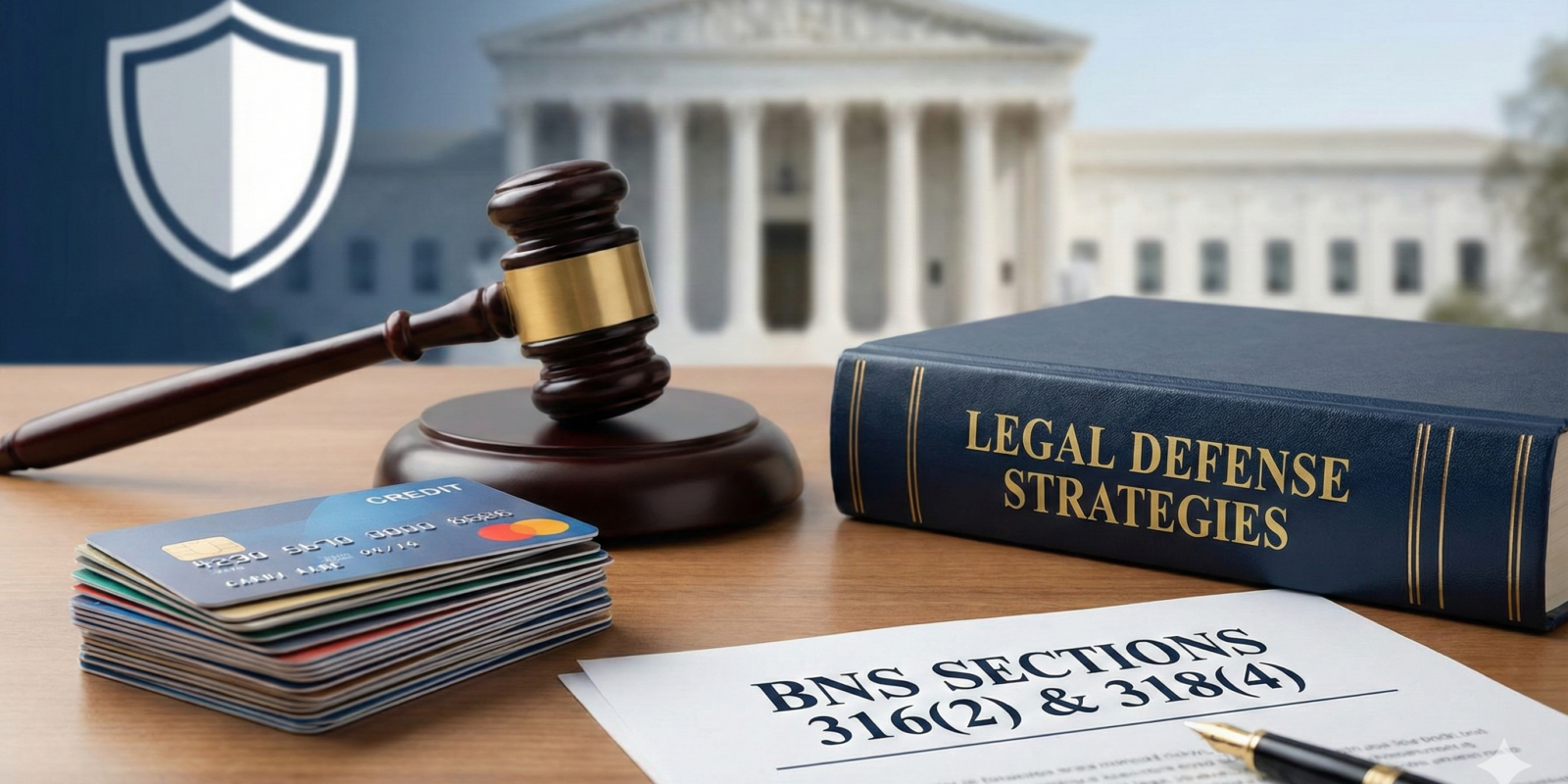
By Losing a job or facing business failure is a financial crisis, not a criminal act. Yet, recovery agents frequently weaponize legal jargon to induce panic, citing Sections 316(2) (Criminal Breach of Trust) and 318(4) (Cheating) of the Bharatiya Nyaya Sanhita (BNS) 2023. These notices often threaten up to seven years of imprisonment for credit card dues or personal loan defaults.
Indian law maintains a strict boundary between civil liability and criminal intent. A borrower unable to pay due to genuine hardship is not a “cheater” under the eyes of the court. This guide deconstructs the statutes used against debtors, explaining the “Timing Test” that proves the absence of criminal intent.
It outlines your procedural rights under BNSS Section 35(3) regarding police notices, provides calculators for One-Time Settlements (OTS), and details the RBI Fair Practice Code for 2025-26 to help you stop harassment and resolve the debt legally.
The Debt Trap &
Criminal Defense
Deconstructing BNS Sections 316(2) and 318(4). Why financial default is not a crime and how to defend against aggressive legal threats.
The Scenario
CRIMINAL VS CIVIL DYNAMICS
The “Intent” Timeline
Visual Proof: Intent is judged at the starting point (Inception). Job loss (May) is an external event that breaks the chain of “Criminal Intent.”
The Legal Distinction
| Feature | Civil Default | Criminal Fraud |
|---|---|---|
| Root Cause | Inability to Pay | Dishonest Intention |
| Timing | Post-Disbursement | At Inception |
| Remedy | Asset Recovery | Punishment/Jail |
| Police Role | None (No Jurisdiction) | Investigate Deception |
BNS Statutory Deconstruction
| Section (BNS 2023) | Allegation Name | The Missing Link in Debt |
|---|---|---|
| 316(2) | Criminal Breach of Trust | Requires Entrustment. Credit card debt is a debtor-creditor contract, not entrustment of property. |
| 318(4) | Cheating | Requires Deception at Inception. If you intended to pay when you used the card, subsequent inability is not cheating. |
Decoding Recovery Scripts
The Counter-Offensive
If agents cross the line, you are not helpless. You can file a Station Diary (GD Entry) using these BNS provisions.
Threatening physical harm
Section 351(2) BNS
Criminal Intimidation (Punishable up to 2 years).
Abusive Language / Insult
Section 352 BNS
Intentional insult to provoke breach of peace.
Calling at odd hours
RBI Master Direction
Violation of Para 5(2) (Harassment Guidelines).
Detecting Fake “Court” Notices
Agents often create documents that look like court orders or “Lok Adalat” summons and send them via WhatsApp to panic you into paying immediately. This is forgery (Section 336 BNS).
The Red Flags 🚩
- Delivery Mode: Courts do not serve summons via WhatsApp without prior email/post.
- Language: Contains urgent threats like “Arrest within 24 hours” (Courts don’t talk like that).
- Payment Link: Includes a QR code or personal bank account details for settlement.
The Verification Test ✅
- CNR Number: Every real case has a 16-digit CNR number. Ask for it.
- eCourts Website: Check the case status on ecourts.gov.in. If it’s not there, it doesn’t exist.
Police Station SOP (Standard Operating Procedure)
If you receive a legitimate call (Station Landline) or Notice u/s 35(3) BNSS, do not panic. Follow this checklist.
Never Go Alone
Always take a family member or a lawyer. If you enter the IO’s (Investigating Officer) room, your companion should wait outside the door or with the Duty Officer.
Submit a “Written Representation”
Do not just talk. Submit a letter stating: “I have a civil dispute regarding a credit card. I am willing to pay via EMI but lack funds currently. I have not cheated anyone.” Get a stamped receipt.
No Blank Signatures
Police may pressure you to sign a “Consent Letter” agreeing to pay in 2 days. Refuse. You cannot be forced to sign an agreement under duress.
Jurisdiction Check
If the bank is in Mumbai and you are in Delhi, the local Delhi police station technically has no jurisdiction to settle the debt unless an FIR is transferred. Point this out politely.
The Settlement Exit: Lok Adalat & OTS
What is Lok Adalat?
A statutory forum under the Legal Services Authorities Act, 1987. It is non-adversarial and designed for compromise settlements.
- No Court Fees.
- Award is final and binding (Deemed Decree).
- Ends the litigation instantly.
Strategic Advantage
Banks clean their balance sheets before quarter-end (March, June, Sept, Dec). This is the best time to negotiate.
The Mathematics of One-Time Settlement (OTS)
Total Due (With Interest)
₹ 1,15,000
Principal (Approx)
₹ 80,000
Target Settlement (30-40%)
₹ 35k – 45k
The Thin Line: Supreme Court Precedents
Vesa Holdings P. Ltd. vs. State of Kerala (2015)
The Court held that every breach of contract does not give rise to a criminal offense of cheating. To constitute cheating, there must be a fraudulent or dishonest intention at the time of making the promise.
Inder Mohan Goswami vs. State of Uttaranchal (2007)
The Court cautioned against the growing tendency to convert purely civil disputes into criminal cases to pressure borrowers.
Procedural Safeguards: BNSS Section 35(3)
01
Mandatory Notice
Formerly Section 41A of CrPC, Section 35(3) of BNSS mandates that for offenses with less than 7 years punishment, the police must issue a notice of appearance. Arrest is the last resort.
02
The Reason Test
The investigating officer must record in writing why an arrest is necessary. In debt cases, where evidence is documentary, arrest is rarely justified.
03
Compliance Shield
As long as you comply with the notice and appear before the officer to state your financial facts, you cannot be arrested without a specific judicial order.
Response Templates
Draft Reply to Legal Notice (Extract)
Subject: Reply to Notice Dated [Date] Re: Card No [XXXX]1. My client categorically denies any dishonest intention or deception at the inception of the credit facility.
2. The default is purely due to involuntary unemployment (May) and business failure, which are civil matters.
3. Reliance is placed on Vesa Holdings v. State of Kerala where SC held a breach of contract is not cheating unless intent is shown at the start.
4. Criminal threats for civil recovery are an Abuse of Process and will be challenged in High Court under Section 528 BNSS.
5. Any further harassment will be reported to the RBI Banking Ombudsman for violating the Fair Practice Code.
6. (If applicable) The appointment of a unilateral arbitrator is objected to in view of the Perkins Eastman judgment.
Frequently Asked Questions
Can they really put me in jail for 1.15 Lakhs?
Practically, no. For a debt default, the bank must prove you intended to cheat them at the moment you applied for the card. With a history of job loss and requests for EMIs, proving criminal intent beyond reasonable doubt is extremely difficult.
Should I go to the police station if called?
If you receive a formal notice under Section 35(3) of BNSS, you must attend. However, always go with a lawyer. Most police officers recognize debt as a civil matter and will suggest mediation.