 By
By The Indian Succession Act allows a property owner to change the beneficiaries in their Will at any time before death. Life events like marriage, divorce, or the death of an original heir require updating testamentary documents.
Altering a Will involves drafting a new document, executing a Codicil, or physically destroying the old paperwork. The rules vary significantly based on religion, the type of Will created, and the residency status of the new heirs.
Recent legislative changes in 2025 removed mandatory probate requirements in major cities like Mumbai, Chennai, and Kolkata. The guide explains the exact procedures for reassigning assets, handling joint documents as a surviving spouse, and protecting updated agreements against legal challenges from disinherited family members.
Evaakil.com
Changing Beneficiaries in Indian Wills
Updated rules, the 2025 legislative shifts, and the legal constraints on surviving spouses.
The Law of Revocation
The Indian Succession Act of 1925 regulates testamentary succession. A person can distribute their self-acquired property through a legal document. This document takes effect only upon death. A maker of a Will can alter or cancel it at any time while they are alive and possess mental competence. Section 62 of the Act outlines this right.
Four Methods to Change a Will
Marriage automatically revokes existing Wills under Section 69 of the Act. This rule applies to Indian Christians, Parsis, and those married under the Special Marriage Act. Individuals following Hindu, Buddhist, Sikh, or Jain religions are exempt from this automatic revocation. Their pre-marital Wills remain valid after marriage unless specifically altered.
Execution Formalities
Section 63 demands strict procedures for altering documents. The maker must sign the document. Two witnesses must attest the signature. Witnesses must not be beneficiaries. Section 67 voids any specific property given to an attesting witness.
Survivor Rights and Types of Wills
A surviving spouse often wants to change beneficiaries after the first spouse dies. Their legal right to do this depends entirely on the type of document they executed together.
| Legal Feature | Joint Will | Mutual Will |
|---|---|---|
| Structure | A single document executed by multiple people. | Can be a single joint document or separate mirror documents. |
| Core Rule | Treated as separate wills combined for convenience. | Based on a binding legal agreement. |
| Revocability by Survivor | The survivor can freely change beneficiaries at any time. | Irrevocable in equity after the first death if benefits are accepted. |
| Legal Mechanism | Operates individually upon each death. | Constructive Trust prevents fraud by the survivor. |
The Supreme Court of India analyzed this in the Dr. K.S. Palanisami case. The Court ruled that a surviving spouse who accepts financial benefits under a Mutual Will cannot rewrite the agreed succession plan. The assets are held in a Constructive Trust for the original beneficiaries.
Cross-Border Rules
Survivors altering Indian assets must carefully draft revocation clauses. A general statement canceling all previous documents might accidentally invalidate foreign assets. The case of Sangha v Sangha demonstrated that broad clauses can trigger unintended international intestacy. Revocation language must specifically target Indian territory.
The 2025 Legislative Shifts
The Repealing and Amending Act of 2025 removed Section 213 from the Indian Succession Act. Beneficiaries in Kolkata, Mumbai, and Chennai no longer require mandatory probate from a High Court to claim assets. The rules are now uniform across India.
Legal professionals still recommend voluntary probate. Changing beneficiaries increases the risk of disputes from disinherited relatives. A probate order provides judicial confirmation of the document and limits future litigation.
Fiscal Data for West Bengal
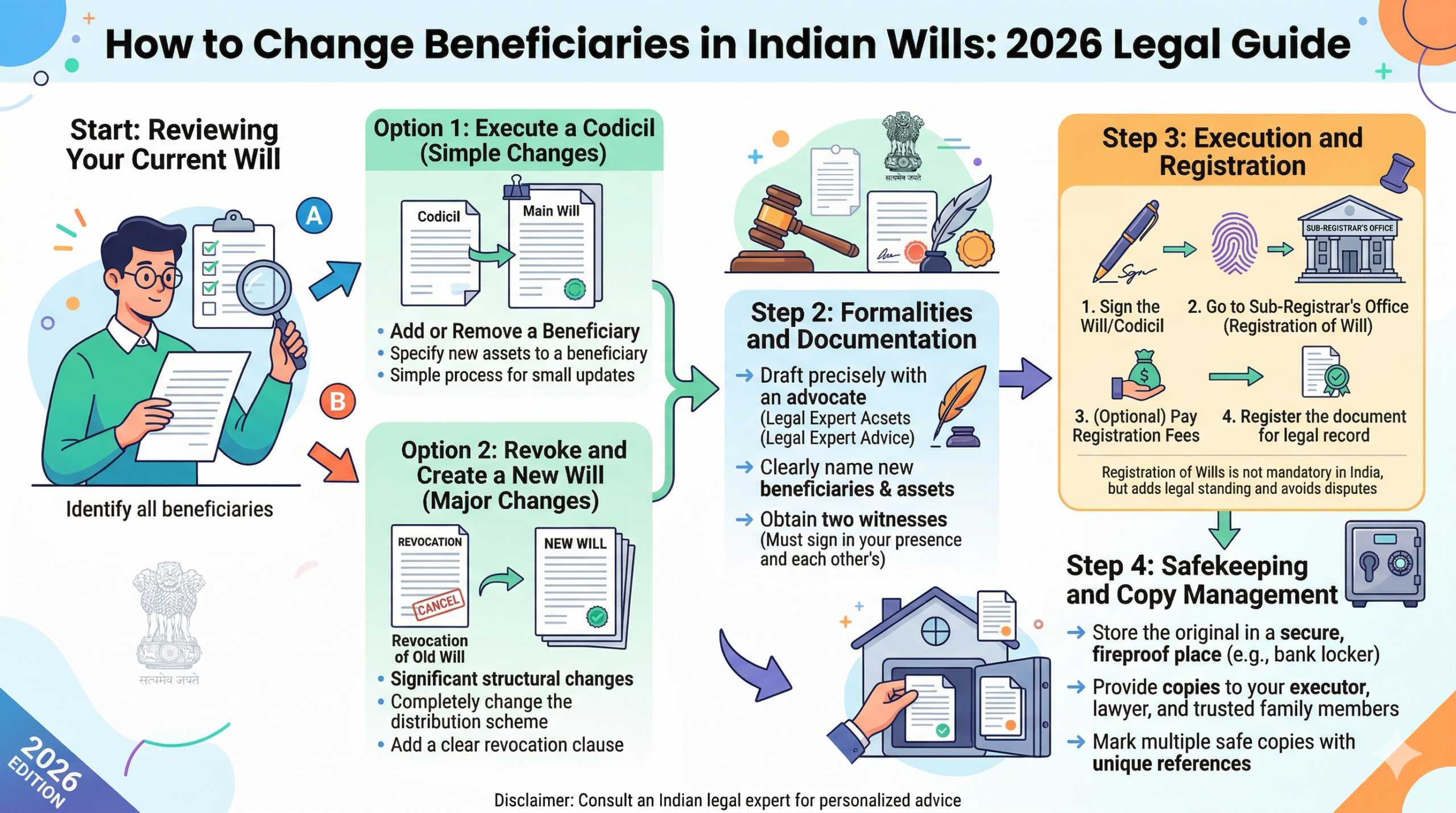
Registering a Will at the Sub-Registrar office requires physical presence, biometrics, and two witnesses. A medical certificate proving sound mind is recommended. Wills are exempt from the heavy taxes applied to living property transfers.
Property Transfer Costs in West Bengal
Drafting a Codicil
A Codicil modifies a specific part of an existing document without rewriting the entire text. It requires the exact same execution procedures as the original document.
Sample Codicil Format
This is the first Codicil to the Last Will and Testament of me, [Full Name], residing at [Address], which Will is dated the [Day] of [Month], [Year].
I declare that I am of sound disposing mind, memory, and understanding, and I am acting free from undue influence or coercion.
I hereby revoke Clause [Number] of my Will, which bequeathed the sum of INR [Amount] to [Original Beneficiary Name], and I substitute it with the following: I bequeath the sum of INR [Amount] to [New Beneficiary Name] absolutely and forever.
In all other respects not specifically altered by this Codicil, I hereby confirm, ratify, and republish my said Will.
IN WITNESS WHEREOF, I have set my hand to this Codicil on this [Day] day of [Month], [Year].
Signature of Testator: ___________________________
SIGNED by the above-named Testator in our presence, and we, in his/her presence and in the presence of each other, have hereunto subscribed our names as witnesses.
Witness 1 Signature: ______________ Name: ______________
Witness 2 Signature: ______________ Name: ______________
NRI Beneficiaries and FEMA Regulations
Changing a beneficiary to a Non-Resident Indian requires compliance with the Foreign Exchange Management Act. Section 6 of FEMA governs how NRIs can inherit and hold property in India.
An NRI can inherit immovable property from an Indian resident. Agricultural land, plantation property, or farmhouses have strict repatriation limits. The Reserve Bank of India permits NRIs to remit up to one million USD per financial year from inherited assets. You must state the residency status of the new beneficiary clearly in the Codicil.
Tax Status on Inherited Wealth
Section 56 of the Income Tax Act exempts inherited property from taxation during the transfer. The new NRI beneficiary will only pay taxes on the income generated from that property later.
Contesting an Altered Document
Disinherited family members frequently challenge altered documents in civil courts. Section 61 of the Indian Succession Act states that a Will or Codicil made through fraud, coercion, or undue influence is void.
The burden of proof falls on the person claiming the document is invalid. Courts look for suspicious circumstances. A sudden change in beneficiaries shortly before death raises judicial scrutiny. The presence of a medical certificate confirming the maker’s mental capacity at the exact time of signing the Codicil is the best defense against these claims.
| Ground for Challenge | Legal Definition | Prevention Strategy |
|---|---|---|
| Testamentary Incapacity | Lack of mental soundness to understand the document’s effect. | Attach a registered doctor’s certificate. |
| Undue Influence | A beneficiary forcing the maker to change the document. | Draft the Codicil privately with a lawyer. |
| Improper Execution | Failing to meet the two-witness requirement. | Video record the signing process. |
Assigning Digital Assets in 2026
Modern estates include cryptocurrency, dematerialized shares, and monetized social media accounts. The Information Technology Act covers electronic records but lacks specific succession rules.
You must list the specific account identifiers and assign a dedicated executor for digital properties. Major platforms now have legacy contact features. You should align the legacy contact settings on these platforms with the updated beneficiaries in your written document.
Registering Document Alterations
The Registration Act of 1908 governs document recording. Registering a testamentary document remains optional in India. Legal experts strongly advise registering any changes to your beneficiaries. An unregistered Codicil modifying a previously registered document invites intense suspicion from civil courts.
Sub-Registrar Process Requirements
- Physical presence of the document maker at the exact office of original registration.
- Two new independent witnesses with valid government identification.
- A medical certificate issued within forty-eight hours of the registration appointment.
- Payment of state-specific processing fees and biometric verification.
Protecting Vulnerable Heirs
Direct transfers to beneficiaries with severe disabilities can cause legal complications. A person lacking legal capacity cannot manage inherited assets independently. The National Trust Act provides strict guidelines for guardianship and asset control.
A safer strategy involves setting up a Private Family Trust within your document. You name a reliable trustee to manage the funds. The disabled family member becomes the sole beneficiary of the trust income. This structure prevents misuse of funds and ensures continuous financial care for their lifetime.
Nominees Versus Legal Heirs
People frequently confuse nominees with legal beneficiaries. Changing a bank account nominee does not override a written testamentary document. The Supreme Court established that a nominee acts merely as a trustee or caretaker.
The Caretaker Rule
The nominee collects the assets from the bank or insurance company and holds them for the legal heirs named in your document. You must update your actual document to legally change who owns the money. Relying solely on bank nomination forms causes severe family disputes.
Muslim Personal Law Limitations
The Indian Succession Act does not apply to Muslims regarding testamentary succession. Islamic law strictly limits testamentary power to one third of the total estate. A Muslim maker cannot leave more than this fraction to beneficiaries without the explicit consent of the legal heirs.
If you change your beneficiaries to exclude a legal heir or give them more than their fixed Quranic share, the document becomes invalid under Sharia law. The alteration only holds up in civil court if the other heirs provide their consent after the maker passes away.
The Role of the Executor
An executor is the person you name to carry out your instructions. When you alter your beneficiaries, you should immediately inform your executor. They are legally responsible for paying off any outstanding debts before distributing the remaining property to the new beneficiaries.
If old beneficiaries file a lawsuit against the newly named ones, the executor must secure the assets. They gather bank statements, lock physical properties, and pause distributions until the court resolves the dispute. Naming a neutral professional as an executor prevents family bias during these conflicts.
Frequently Asked Questions
Can a survivor change a Joint Will? +
Yes. A Joint Will is treated as two separate documents. The survivor can execute a new document to change beneficiaries for their share of the assets at any time.
What happens if a witness is also a beneficiary? +
Section 67 of the Indian Succession Act states that the document remains valid, but the specific property given to the attesting witness becomes void. They lose their inheritance.
Is probate mandatory in Mumbai in 2026? +
No. The Repealing and Amending Act of 2025 deleted Section 213. Probate is no longer a statutory requirement in Mumbai, Chennai, or Kolkata, though it is recommended to prevent disputes.