 By
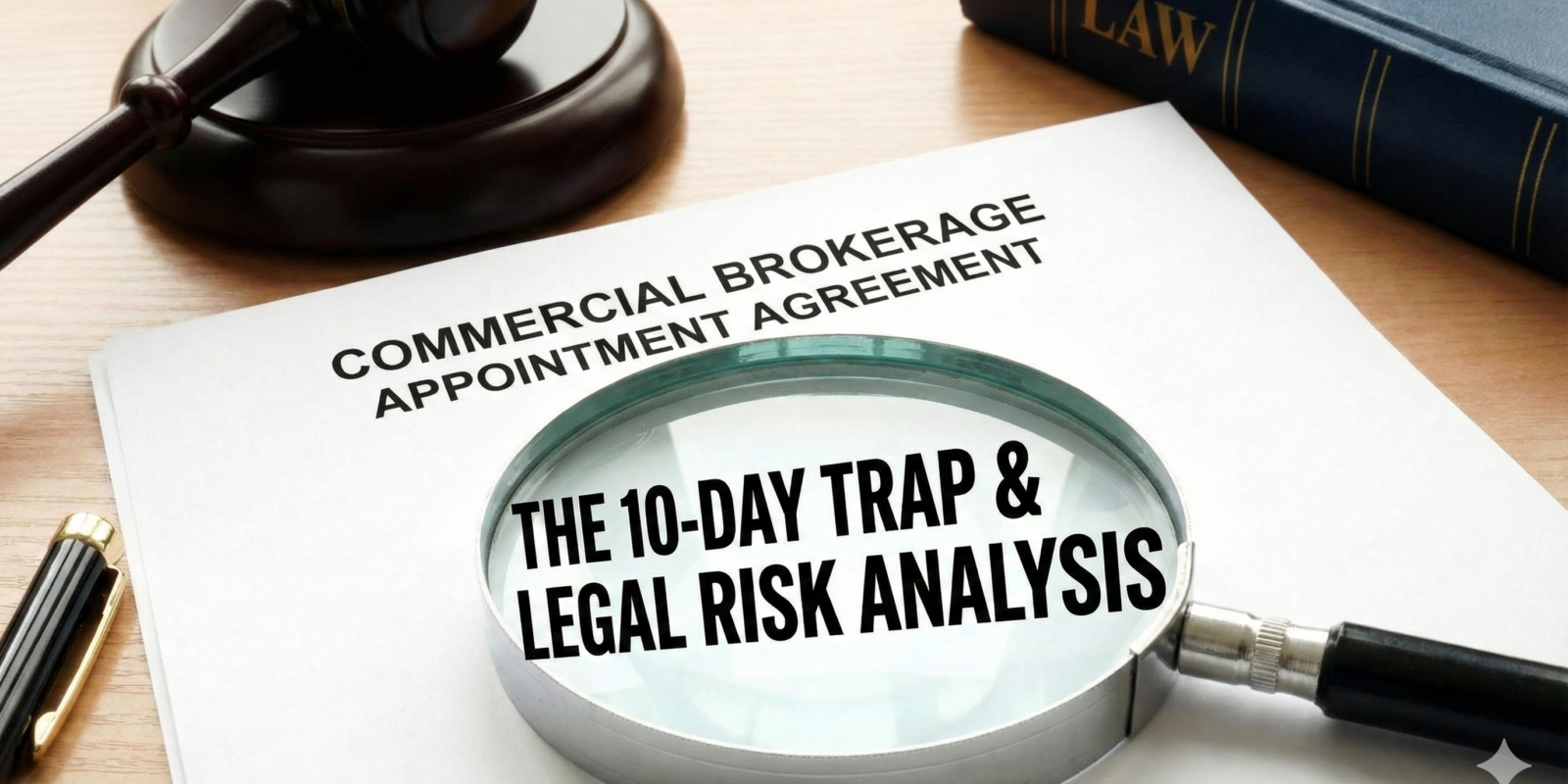
By Commercial real estate transactions often hinge on the fine print, but this specific “Agreement Appointing Broker” introduces a uniquely rigid constraint: a 10-day authority window that voids all commission rights upon expiry.
This compressed timeline, combined with the complexities of selling both immovable property (the shop) and movable assets (stock-in-trade) in a single deed, creates immediate financial exposure for both owners and agents.
The analysis below dissects these split-asset structures, exposes the tax pitfalls of lump-sum consideration, and provides the drafting modules necessary to secure your position before the clock starts ticking.
The 10-Day Trap: Analyzing the Brokerage Appointment Agreement
This document governs the relationship between an owner and a partnership firm for the sale of a commercial shop and its inventory. The draft contains strictly defined time limits and bifurcated assets (immovable property and movable goods) that create significant legal exposure if not managed correctly. We break down the risks, financial structures, and required clauses below.
Visual Risk Timeline
The agreement grants authority for exactly 10 days. The chart below illustrates the compressed timeline against standard real estate procedural norms.
Critical Analysis Points
The 10-Day Hard Stop
Clause 11 voids all authority after 10 days. If a buyer is found on Day 9 but the paperwork delays to Day 11, the broker receives zero commission. A “Tail Period” clause is required to protect revenue.
Partnership Registration
The broker is defined as a partnership firm. Under Section 69 of the Partnership Act, the firm must be registered to enforce this contract in court. Unregistered firms cannot sue for unpaid dues.
Total Consideration
The commission is 2% of “total consideration.” This term is ambiguous. Does it include the inventory value? Owners must clarify if commission applies to the stock-in-trade or only the real estate.
Asset Schedule Precision
A postal address is insufficient for the “First Schedule.” The deed requires cadastral data (Mouza, Khatian, Dag numbers) to be registerable. Without this, the agreement is technically defective.
Expense Reimbursement
The agreement allows reimbursement if the owner cancels early. The current draft leaves the cap blank. Brokers should negotiate a specific figure (e.g., INR 25,000) to cover marketing outlays.
GST & TDS Liability
Sale of used furniture attracts GST under the Margin Scheme. Property sale over INR 50 Lakhs requires 1% TDS. These tax liabilities must be factored into the final pricing structure.
Dual Agreements Strategy
To optimize Stamp Duty, split the transaction: one agreement for the Shop (Registered) and a separate Invoice/Delivery Note for the Goods. Merging them attracts Stamp Duty on the goods’ value unnecessarily.
Abstract of Title
Clause 14 mandates the owner to deliver title abstracts within 7 days of Earnest Money. Failure to do so is a “Breach of Contract,” allowing the purchaser to potentially sue for specific performance.
Negotiation Leverage Analysis
This agreement is heavily skewed due to the 10-day clause. The meter below visualizes the power dynamic.
Owner’s Edge
Can cancel authority immediately after 10 days with zero liability if no sale is registered. Retains 100% control over price acceptance.
Broker’s Risk
High sunk cost (marketing) with short ROI window. 100% risk of losing commission if registration is delayed by bureaucracy.
Clause Decoder
Translating the dense legal phrasing of this specific agreement into commercial reality.
The “Earnest Money” Commission Trigger
Text: “0.5% on receipt of the earnest money…”
Meaning: The broker gets paid 25% of their total fee the moment the buyer pays the deposit. If the buyer defaults later, the broker usually keeps this 0.5%, creating a sunken cost for the owner.
The “Sunset” Provision
Text: “…after the said period, the said authority will be cancelled.”
Meaning: This is a “Time is of the Essence” clause. Unlike standard listings that roll over, this one self-destructs. It puts immense pressure on the broker to close, often at a lower price.
The “Clean Title” Warranty
Text: “…free from mortgage, charge, lien or any encumbrance.”
Meaning: The owner is personally liable if a hidden loan or tax due pops up later. This includes municipal tax arrears or electricity dues.
Smart Clause Alternatives
The standard draft is rigid. Use the tabs below to see how to modify critical clauses to favor either the Owner or the Broker.
Gap Analysis & Remedies
| Current Clause / Issue | The Legal Risk | Recommended Remedy |
|---|---|---|
| Lump Sum Consideration Price covers Shop + Goods |
High Tax Leakage. Paying 5-7% Stamp Duty on the value of old furniture and stock is wasteful. | Bifurcate Price. Assign X amount to Shop (Sale Deed) and Y amount to Goods (Handover Receipt). |
| 10-Day Validity Strict expiry |
Broker Disengagement. Broker may stop working on Day 8 realizing closure is impossible. | Add Tail Clause. “Broker is entitled to commission if a buyer introduced during the 10 days purchases within 3 months.” |
| “Stock-in-trade” Vague definition |
Valuation Dispute. Stock levels fluctuate daily. Owner may sell stock before handover. | Freeze Stock. Attach a signed inventory list dated to the agreement day or agree to a “Unit Rate” valuation. |
| Commission on “Receipt” Payable on Earnest Money |
Clawback Risk. If the deal cancels due to Title Defect, owner pays broker for a failed deal. | Condition Precedent. “Commission payable only upon successful registration of Sale Deed.” |
The “Silent” Risks (Missing Modules)
The following standard protections are completely missing from the uploaded draft. Their absence creates significant exposure.
Indemnity Clause
Missing: No protection if the Broker makes false promises to a Buyer (e.g., “You can build a mezzanine floor”).
Fix: Add a clause indemnifying the Owner against unauthorized representations by the Broker.
Force Majeure
Missing: What if the shop is sealed by the Corporation or damaged by fire during the 10 days?
Fix: Add a clause suspending the 10-day count during “Acts of God” or civil unrest.
Dispute Resolution
Missing: No Arbitration clause. Any dispute goes directly to slow civil courts.
Fix: Insert a standard Arbitration clause with a named seat (e.g., Mumbai/Delhi).
Exclusivity
Missing: The draft implies, but does not state, that this Broker is the only agent.
Fix: Clarify if this is a “Sole Selling Agency” or if the Owner can hire multiple brokers.
Commission & Tax Estimator
Pre-Signing Intelligence Checklist
Verify Broker’s Registration
Ask for the “Form C” issued by the Registrar of Firms. Ensure the partnership is currently valid.
Stock Take Auditing
Has a physical count of the “First Schedule” (Goods) been done today? Is the list attached?
Original Title Deeds
Does the Owner (Mr. A) physically possess the original deed? Banks may hold it if mortgaged.
Electricity & Maintenance Dues
Obtain a “No Dues Certificate” from the Society/Association and Electricity Board.
Drafting the Schedules
Use these templates to fill the blank schedules in the agreement. Click copy to grab the text.