 By
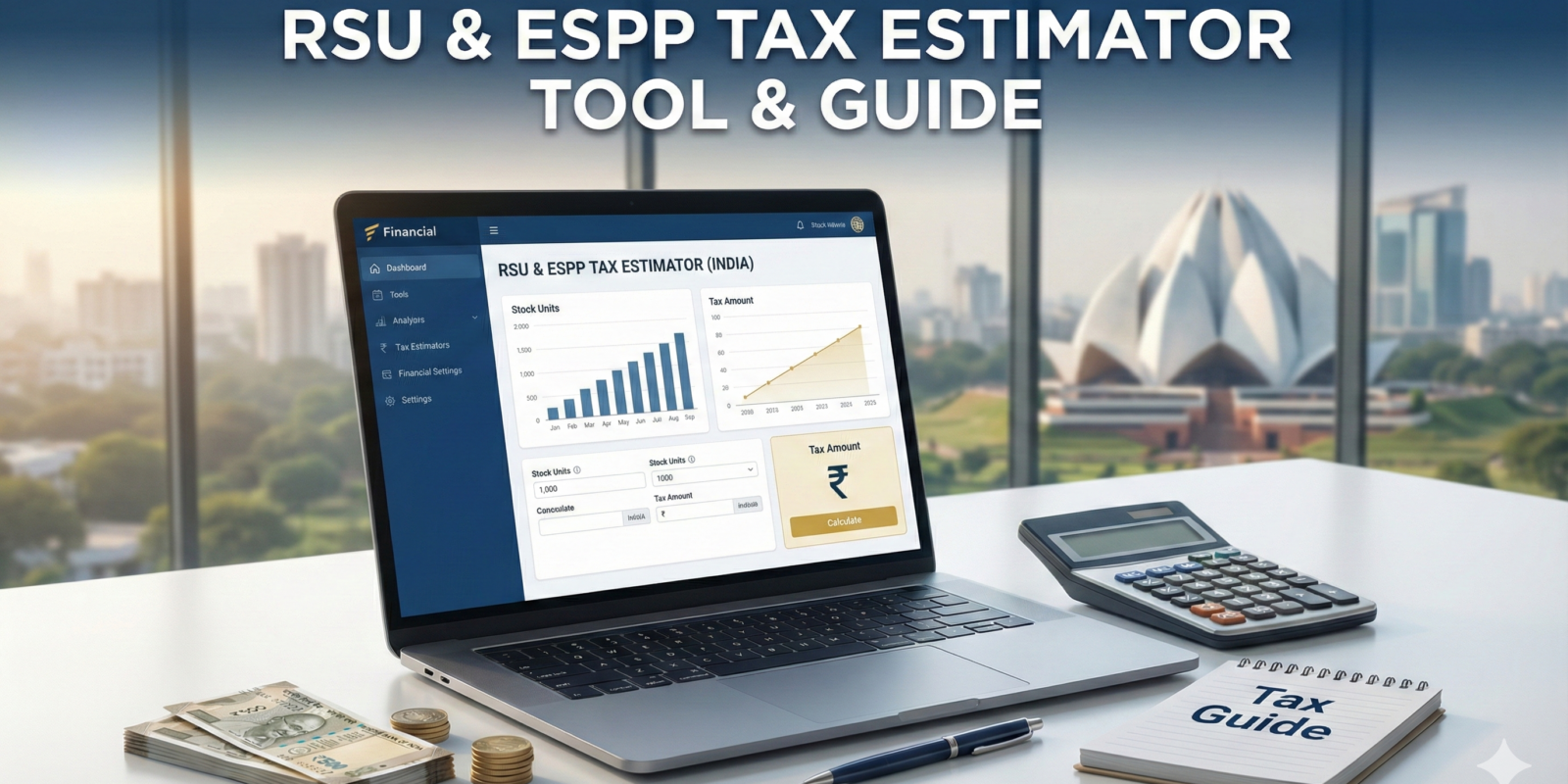
By Multinational companies compensate Indian resident employees with US equity like Restricted Stock Units and Employee Stock Purchase Plans. Managing these foreign assets requires strict compliance with the Income Tax Act of 1961.
This guide details the exact mechanics of cross border taxation. You will read factual breakdowns covering perquisite valuation, statutory State Bank of India exchange rates under Rule 115, and the updated 2026 capital gains rules.
The text also explains how to handle tax withholding mechanisms like sell to cover transactions and how to claim foreign tax credits using Form 67. This information ensures accurate tax filing and compliance regarding your Schedule Foreign Assets.
Evaakil.com
CROSS-BORDER EQUITY TAX CALCULATOR
Grant & Acquisition
Tax Profiles & Rates
Liquidation / Cap Gains
Payout Analysis
Legal Disclaimer
THIS TOOL IS PROVIDED BY EVAAKIL.COM FOR EDUCATIONAL AND ESTIMATION PURPOSES ONLY AND DOES NOT CONSTITUTE FINANCIAL, TAX, OR LEGAL ADVICE. Cross-border taxation is highly complex and subject to change. The calculations assume basic residency status in India. Variations in exchange rates, intermediary bank fees, missing W-8BEN forms, and individual surcharges will alter final payouts. Always consult a qualified Chartered Accountant (CA) or CPA before executing trades.
Evaakil.com
US Equity Taxation Guide For Indian Employees
Taxation and Payout Mechanics of US Equity Compensation
A factual analysis of Restricted Stock Units and Employee Stock Purchase Plans for Indian residents under the Income Tax Act of 1961.
Multinational corporations headquartered in the United States use equity participation models to compensate employees. Restricted Stock Units and Employee Stock Purchase Plans act as primary instruments for talent acquisition and retention. Indian resident employees face specific cross border taxation rules, foreign exchange regulations, and statutory reporting mandates when receiving these benefits.
Minor discrepancies in the application of statutory exchange rates or the failure to disclose assets in the appropriate tax schedules can trigger scrutiny from the Central Board of Direct Taxes. This document explains the lifecycle of US based equity for Indian residents. It provides facts regarding perquisite and capital gains taxation, tax withholding protocols like sell to cover, dual taxation avoidance using Form 67 and the W-8BEN, and the logic required to calculate net payouts.
Structural Differences of Equity Compensation
Restricted Stock Units represent an employer promise to deliver company shares at a future date based on vesting conditions. These conditions rely on time based tenure or performance milestones. The grant date signifies the moment the employer commits to the award. The grant date is a non taxable event under Indian law because no monetary value is transferred. Upon meeting the conditions, the units vest into actual shares. This transfer of value constitutes the primary taxable event. The final phase is the sale date, occurring when the employee disposes of the vested shares on the open market.
An Employee Stock Purchase Plan permits employees to purchase company shares using accumulated payroll deductions at a discounted price. The plan lifecycle begins with an offering period where an elected percentage of post tax salary is withheld. On the purchase date, accumulated funds acquire shares at a predetermined discount. For Indian tax purposes, this purchase date acts as the primary taxable event because the employee receives a financial benefit equivalent to the discount. The subsequent disposal of these shares initiates the secondary taxable event under capital gains frameworks.
Equity Comparison Table
| Feature | Classification | Details |
|---|---|---|
| Acquisition Cost | RSU | Zero value. Granted directly as compensation. |
| Acquisition Cost | ESPP | Discounted purchase using post tax payroll deductions. |
| Primary Tax Event | RSU | Vesting Date. |
| Primary Tax Event | ESPP | Purchase Date. |
| Taxable Value Base | RSU | Full Fair Market Value on vest date. |
| Taxable Value Base | ESPP | Discount received. Calculated as Fair Market Value minus purchase price. |
Visualizing The Equity Lifecycle
The timeline of foreign equity compensation requires tracking specific dates for compliance. The flowchart below maps the standard progression from grant to final sale.
Perquisite Valuation and Salary Income
The Indian Income Tax Act classifies the acquisition of shares through employer sponsored plans as a perquisite under Section 17(2). The value of this benefit is aggregated with the standard salary and taxed under the Income from Salaries category.
For Restricted Stock Units, the perquisite value is calculated based on the Fair Market Value of the shares on the vesting date. The entirety of the Fair Market Value constitutes the taxable perquisite. For Employee Stock Purchase Plans, the taxable value is defined as the difference between the Fair Market Value on the purchase date and the discounted exercise price paid by the employee. The total income is subjected to the applicable marginal income tax slab rate, including surcharges and the mandatory health and education cess. The Indian employer must deduct Tax Deducted at Source on this perquisite amount at the time of vesting or purchase.
The Exchange Rate Rules
The conversion of foreign currency income for taxation purposes in India is governed by Rule 115 and Rule 26 of the Income Tax Rules. The applicable exchange rate for converting foreign currency income into Indian Rupees is the Telegraphic Transfer Buying Rate issued by the State Bank of India.
Rule 115(2)(a) mandates that for income chargeable under Salaries, the specified date is the last day of the month immediately preceding the month in which the salary is due or paid. If an equity unit vests on August 15 in the year 2026, the legally mandated exchange rate for converting the perquisite value to Indian Rupees is the State Bank of India Telegraphic Transfer Buying Rate as it stood on July 31 in the year 2026.
Tax Withholding Mechanisms
The employee incurs a tax debt but receives shares rather than liquid cash to settle it. Multinational corporations utilize specific tax withholding mechanisms to resolve this issue.
The most common mechanism is the Sell to Cover transaction. The foreign broker automatically sells a portion of the newly vested shares on the open market to generate cash to cover the estimated tax liability. The cash proceeds are remitted to the employer, who deposits the funds with the Indian government as Tax Deducted at Source. The employee is credited with the net remaining shares in their foreign brokerage account. The gross sale proceeds of the shares sold to cover taxes must be listed in Schedule Capital Gains in the tax return. The cost of acquisition is reported as a value identical to the sale consideration, resulting in a net zero capital gain.
Capital Gains Taxation
When the employee liquidates the retained shares, a secondary taxable event occurs under the Capital Gains category. Because the shares are issued by a United States corporate entity, they are classified as Unlisted Equity Shares under Indian tax jurisprudence.
The critical threshold defining the holding period is twenty four months, calculated from the date of vesting or purchase. If shares are sold within twenty four months, the profit is classified as a Short Term Capital Gain. This gain is aggregated with ordinary income and taxed at the applicable marginal income tax slab rate. If shares are held for a period exceeding twenty four months, the profit is categorized as a Long Term Capital Gain. Under the updated legal framework effective up to February 2026, Long Term Capital Gains on unlisted foreign shares are taxed at a flat rate of 12.5 percent without indexation benefits.
Dual Taxation Avoidance
The United States Internal Revenue Service subjects non resident aliens to a flat thirty percent withholding tax on US source income. To avoid this withholding on capital gains from the sale of shares, the Indian resident must submit Form W-8BEN to their broker. This formally certifies the employee non US tax residency status.
If the US corporation issues dividends while the Indian employee holds the shares, this income is taxable in the US and simultaneously taxable in India. The India US Double Taxation Avoidance Agreement provides relief. Under Article 10, the maximum withholding rate the US can apply to dividend payments made to Indian residents is capped at twenty five percent. Sections 90 and 90A of the Indian Income Tax Act allow taxpayers to claim a Foreign Tax Credit. The taxpayer must electronically file Form 67 to offset the tax paid in the United States against their Indian tax liability.
Compliance and Schedule Reporting
Indian resident taxpayers who qualify as Resident and Ordinarily Resident must declare all foreign equity holdings within Schedule Foreign Assets of their Income Tax Return. Vested shares become reportable foreign assets from the exact date beneficial ownership transfers to the employee.
The data required for Schedule Foreign Assets strictly adheres to the Calendar Year running from January 1 to December 31. Taxpayers must report the Initial Value of Investment, the Peak Value of Investment during the year, and the Closing Value on December 31. Each value must be converted to Indian Rupees using specific statutory exchange rates. Furthermore, if total global income surpasses fifty lakh rupees, the value of the foreign shares must be redundantly reported in Schedule Assets and Liabilities.
Frequently Asked Questions
Do unvested Restricted Stock Units need to be reported?
No. Unvested units remain promises of future compensation. Because the employee does not hold a tangible beneficial interest, unvested options are not reportable in Schedule Foreign Assets.
Can I use the exchange rate on the day of vesting?
No. Rule 115 dictates that you must use the State Bank of India Telegraphic Transfer Buying Rate from the last day of the month immediately preceding the month of vesting or purchase.
Will Form 67 give me a cash refund?
No. The Foreign Tax Credit is restricted to the lower of the tax paid in the US or the tax payable on that specific income block in India. It serves purely to prevent double taxation.
What is the Long Term Capital Gain rate for foreign shares?
As per regulations applicable through February 2026, the Long Term Capital Gain rate for unlisted foreign shares held longer than 24 months is a flat 12.5 percent. There are no indexation benefits.
Tracking Template Formats
Maintain a spreadsheet with the following columns to ensure accurate tax filing compliance.
Update this ledger for every vest, ESPP purchase, dividend payout, and market sale. Separate the data strictly by Calendar Year for Schedule Foreign Assets reporting.