 By
By Establishing a distribution network across India demands precision. For manufacturers, the choice between a “Selling Agent” and a “Distributor” dictates tax liabilities and risk ownership. While these terms often appear interchangeable in casual trade, Indian law treats them differently.
A true agency creates privity of contract between the manufacturer and the final buyer, whereas distributorship functions on a principal-to-principal basis. This distinction directly impacts GST liability under Schedule I.
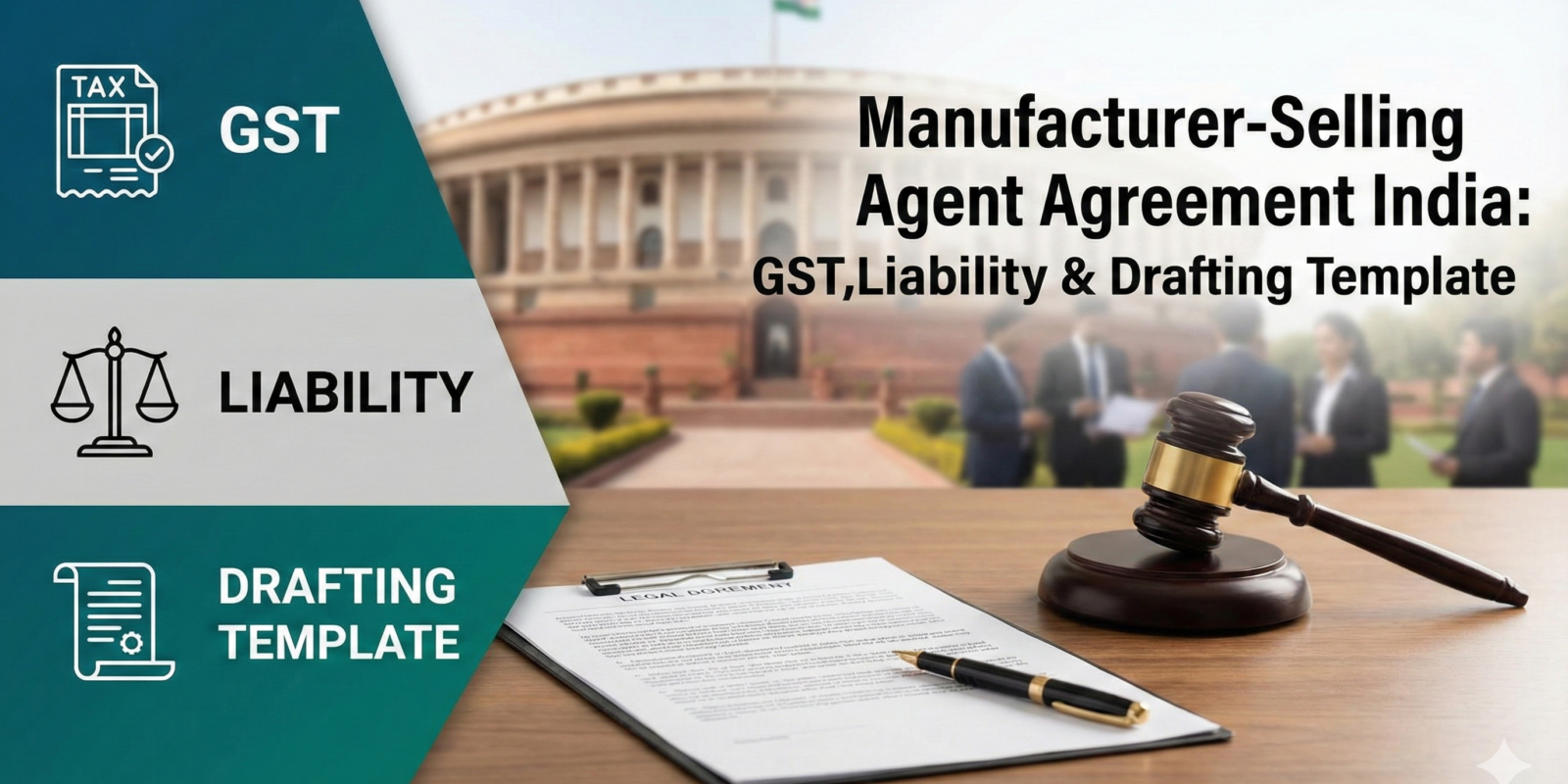
This analysis breaks down the regulatory requirements for 2025, covering the Competition Act, the new BUDS Act on security deposits, and the DPDP Act, alongside a structured drafting template.
Manufacturer-Selling Agent Agreements: The 2025 Indian Playbook
The distinction between a “Selling Agent” and a “Distributor” defines the flow of title, risk, and liability in Indian commerce. This report analyzes the 2025 regulatory landscape, focusing on GST Schedule I mechanics, Competition Act boundaries, Consumer Protection liability, and the new data privacy norms.
India’s commercial geography demands effective distribution networks. For manufacturers, the challenge lies in distribution rather than production. The “Agency” relationship serves as a primary instrument for market penetration. This legal construct allows a manufacturer (Principal) to reach third-party buyers through an intermediary (Agent).
The distinction between a “Selling Agent” and a “Distributor” remains the primary fault line. While often used interchangeably, the legal consequences differ significantly. An agent acts on behalf of the principal and creates privity of contract between the manufacturer and the buyer. A distributor acts on a principal-to-principal basis. This distinction dictates GST liability under the Schedule I regime introduced in 2017.
Calling a partner an “Agent” does not make them one if the substance of the relationship is that of a “Distributor.” Courts apply a substance test based on the transfer of title and risk.
Agent vs. Distributor: The Structural Dichotomy
Litigation frequently arises from misclassification. The table below outlines the critical commercial differences necessary for determining the correct engagement model.
| Feature | Selling Agent | Distributor / Dealer |
|---|---|---|
| Privity of Contract | Between Manufacturer & Customer | Between Manufacturer & Distributor |
| Title to Goods | Remains with Manufacturer until sale | Passes to Distributor on purchase |
| Commercial Risk | Manufacturer bears inventory risk | Distributor bears inventory risk |
| Remuneration | Commission (% of sales) | Margin (Sale Price – Purchase Price) |
| GST Liability | Agent pays GST on Commission | Distributor pays GST on full value |
The Fiscal Labyrinth: GST Schedule I
The 2017 GST regime introduced the “deemed supply” provision. This taxes stock transfers to agents who issue invoices in their own name. This mechanism effectively blocks working capital.
The “Invoicing Test” (Circular No. 57/31/2018-GST) determines the tax treatment. Use the tool below to determine your classification.
GST Classification Tool
How does the Agent interact with the end customer?
The Antitrust Boundary: Competition Act, 2002
Drafting exclusivity or territory restrictions requires caution. Section 3(4) of the Competition Act, 2002 regulates “Vertical Restraints” between manufacturers and agents. Unlike cartels, these are not per se void but are tested under the “Rule of Reason.”
1. Radius Restrictions & Exclusivity
Agreements often contain clauses prohibiting the manufacturer from appointing another agent within a specific radius (e.g., “within 2000 yards of the Agent’s shop”).
Legal Status: Generally enforceable unless the manufacturer holds a dominant market position. If a dominant player imposes strict territorial exclusivity that causes an “Appreciable Adverse Effect on Competition” (AAEC) in India, the clause—and potentially the entire agreement—may be void.
2. Resale Price Maintenance (RPM)
In a pure agency model, the Principal retains title to the goods. Therefore, the Principal can dictate the final selling price. This is a critical exception to the general prohibition against RPM. However, if the “Agent” effectively bears the risk (making them a distributor), dictating the price becomes illegal anti-competitive behavior.
Financial Architecture: Security Deposits
The standard agreement often requires the Agent to deposit a sum (e.g., ₹50,000) as security. In the current regulatory climate, this simple clause can trigger the Banning of Unregulated Deposit Schemes Act, 2019 (BUDS Act).
The Rule: Security deposits taken for the “performance of contract” are exempt from the ban. However, if the Manufacturer pays interest on this deposit, or if there is no underlying written contract defining the supply, it may be classified as an illegal deposit scheme.
Drafting Mandate: The agreement must explicitly state that the deposit is “interest-free” and is held “solely for the due performance of the Agent’s obligations.”
Data Governance: The DPDP Act 2023
Retail agents collect vast amounts of customer data (names, phone numbers for billing). Under the Digital Personal Data Protection Act, 2023, the liability flows upward.
- Manufacturer as Data Fiduciary: If the Manufacturer determines the purpose of data collection (e.g., for warranty or loyalty programs), they are the Fiduciary.
- Agent as Data Processor: The Agent collects data on behalf of the Manufacturer.
Compliance Action: The agreement must include a Data Processing Addendum (DPA) requiring the Agent to implement security safeguards. If the Agent leaks customer data, the Manufacturer faces fines up to ₹250 Crore.
Exit Management & Inventory Liquidation
Termination is the most litigated phase of an agency. Clause 11 of standard agreements often mandates “mutual adjustment of accounts within one month.”
The Inventory Trap
Upon termination, who owns the unsold stock lying at the Agent’s godown?
- Pure Agency: The stock belongs to the Manufacturer. They must bear the cost of lifting it back.
- Distributorship: The stock belongs to the Distributor. The Manufacturer has no legal obligation to buy it back unless explicitly agreed.
Strategic Clause: Insert a “Sell-Through Period” clause allowing the Agent to sell remaining stock for 60 days post-termination, after which the Manufacturer may (at their discretion) repurchase good-condition stock at 80% of the invoice value.
The Liability Shield: Consumer Protection Act, 2019
The 2019 Act fundamentally shifted the liability framework for defective products. Manufacturers can no longer hide behind layers of distribution. However, where does the Agent stand?
“Product Seller” Liability
Under Section 84, a “product seller” (which includes agents selling goods) is liable for a defective product only if:
- The seller exercised substantial control over the designing, testing, manufacturing, packaging, or labeling; OR
- The seller altered or modified the product; OR
- The manufacturer is untraceable or not subject to Indian law.
Requirement: Ensure the agreement explicitly prohibits the Agent from opening, repackaging, or modifying the product (e.g., “Baniyans must be sold in original factory sealed boxes”). This clause is your primary defense against product liability claims directed at the Agent.
Brand Guardianship: Trademark Rights
Agents invariably use the Principal’s trademark for marketing. Without specific covenants, this usage can lead to long-term dilution or “Passing Off” claims post-termination.
The “Permitted User” Clause: The agreement must clarify that the Agent is a “Permitted User” under the Trade Marks Act, 1999, and acquires no goodwill in the brand.
The Criminal Shield: IPC Section 409
Since an agent holds goods (or sale proceeds) in trust for the Principal, any misappropriation—such as selling stock and using the funds for personal use—triggers Section 409 of the Indian Penal Code (IPC).
Offence: Criminal Breach of Trust by Agent.
Section: 409 IPC.
Nature: Cognizable and Non-Bailable.
Punishment: Imprisonment for life, or up to 10 years.
Digital Commerce: The E-Agent Model
If the Agent lists products on marketplaces (Amazon/Flipkart), new tax vectors emerge.
- TCS (Tax Collected at Source): The marketplace deducts 1% TCS. Who claims this credit? In a pure agency model, the credit belongs to the Principal.
- Price Parity: Ensure the Agent does not discount products online below the offline dealer price, causing channel conflict.
Drafting the Instrument of Authority
A robust agreement must navigate the Contract Act rights and GST procedural requirements.
1. Clause Autopsy: The “Bar Association” Trap
Many legacy agreements contain a dangerous arbitration clause. Below is a breakdown of why this specific formulation fails in court.
Fail Point 1 (Uncertainty): The “President” is an elected official changing annually. It is unclear if the arbitrator is the person holding office at the time of contract or time of dispute.
Fail Point 2 (Conflict of Interest): A local Bar President may have professional ties to the local Agent, creating inherent bias against an out-of-town Manufacturer.
Fail Point 3 (Fee Fixation): Unilateral fee determination violates the Fourth Schedule of the Arbitration Act, which suggests model fees.
The Fix: Refer disputes to a specialized institution (MCIA, DIAC) or name a specific retired judicial officer. Specify the “Seat” of arbitration explicitly (e.g., “The Seat of Arbitration shall be Kolkata”).
The “Del Credere” Option
In high-risk markets, a manufacturer may wish to insulate themselves from bad debts. This creates a Del Credere Agency. A Del Credere agent guarantees the solvency of the third party buyers.
Tax Implication: The Del Credere commission is a separate service. If the Agent extends a loan to the buyer to clear dues to the Principal, the interest earned by the Agent is an exempt supply, but the commission attracts GST.
Compliance Ecosystem: West Bengal Data
Compliance varies by state. The chart below illustrates the comparative compliance costs for a standard Selling Agent in Kolkata (West Bengal) for the fiscal year 2025-26.
Fig 1. Estimated Annual Compliance Costs (INR) excluding GST.
Pre-Contract Due Diligence Checklist
Before signing, run this quick diagnostic to identify red flags in your proposed structure.
Risk Assessment
Standard Agreement Template
The following template is derived from standard formats used in the textile and hosiery sectors. Note: Clauses regarding Arbitration (No. 10) and Commission (No. 5) should be updated based on the legal analysis provided above.
AGREEMENT BETWEEN A MANUFACTURER AND SELLING AGENT
AN AGREEMENT made on this ______ day of ______ BETWEEN ABC & Co. Ltd. having its registered office at __________________ (hereinafter called the Manufacturer) of the one part AND PN son of __________________ resident of __________________ (hereinafter called the Agent) of the other part.
WHEREAS
- The Manufacturer carries on the business of manufacturing baniyans, underwears, hosiery and other wearing apparel of all kinds.
- The Manufacturer is desirous of opening retail shops in various towns of India and is willing to appoint agents for this purpose who shall have to act exclusively as the selling agents of the products of the Manufacturer.
- The said Agent has approached the Manufacturer and expressed his consent to act as such agent on the terms and conditions mutually agreed upon.
NOW, THEREFORE, THIS AGREEMENT WITNESSES as follows:
- That the Agent shall deposit a sum of Rs. ______ as security for the due fulfillment of the terms of this agreement as well as for the adjustment thereof against the price of the goods supplied to the Agent by the Manufacturer from time to time.
- That the Manufacturer shall supply an assortment of goods manufactured by it approximately of the value of Rs. ______ in the first instance and thereafter shall furnish to the Agent at his request in writing such further goods as may be so requisitioned by him or as the Manufacturer may think expedient to supply to the Agent to be kept in the shop run by the Agent, so that the total value thereof at any time may not, if requisitioned by the Agent, exceed the value of Rs. ______ but it shall be at the option of the Manufacturer to supply further goods of its manufacture, which it may deem expedient, subject, however, to the compliance with the requisition made to the Manufacturer by Agent as aforesaid to replenish the stock which, in the opinion of the Agent, finds a ready market for its sale.
- That the Agent shall keep proper account and shall issue cash voucher for every article sold by him, which shall be prepared in triplicate, one legible copy whereof shall be submitted to the Manufacturer by the Agent every Friday or the next day on which the shop is opened by the Agent in case Friday should be a close-day. The copies of such vouchers shall be accompanied with a statement of account showing the goods received by the Agent from the Manufacturer during the previous week ending with Saturday previous to Friday on which the return is so submitted.
- That all the goods supplied by the Manufacturer shall be deemed to be in trust with the Agent for the purposes of sale on behalf of the Manufacturer and any willful omission or non-mention thereof in the return of the sale and receipt of goods submitted to the Manufacturer weekly as aforesaid shall be deemed to be a misappropriation thereof unless such omission when pointed out and notified by the Manufacturer is not rectified or appropriately explained within one week of such notification.
- That the Manufacturer shall pay to the Agent a commission of ______ per cent on the sale of the goods so supplied to the Agent. The Agent shall be entitled to deduct the commission out of the sale-proceeds and shall be bound to remit to the Manufacturer the balance of the sale-proceeds receive by the Agent up to Saturday previous, which shall be so remitted on or before Friday next ensuing. The Agent, however, shall, at his discretion, be entitled to sell not more than 10 per cent of the sales effected during the week on credit and he shall be bound to realize such outstanding within two months of the sale be bound to pay in cash from his own pocket for the price of the goods so sold on credit. The return submitted by the Agent shall show in a separate account the sales so made on credit and the realizations made thereon from time to time.
- That the Agent shall not sell any article at a price less than the one marked thereon by the Manufacturer or fixed in respect of the article by the Manufacturer from time to time. Any article which becomes soiled or partly broken or otherwise unfit for sale or otherwise apparently diminished in value shall not be exposed for sale by the Agent except with the prior approval of the Manufacturer, and at prices to be mutually settled between the parties. The Agent shall be entitled to give a concession of not more than 5 per cent of the saleable value of any article to any old customer of the Agent or any relation of the Agent. The Agent shall indicate in the return submitted by him weekly as provided in the agreement the fact of such sale at concessional rates.
- That the Agent shall take reasonable care of the goods supplied by the Manufacturer and in case of any theft or injury thereto destruction thereof, he shall make a report to the police in case of a cognizable offence having been committed in respect thereof and forward a copy thereof to the Manufacturer or submit a report in respect thereof within three days of the occurrence or its cognizance by the Agent. The Agent shall assist the Manufacturer in the apprehension of the offender or in alleviating or removing the cause of such injury, if any. In the event of the Manufacturer making a claim for compensation or otherwise from any insurance company the Agent shall assist the Manufacturer as if the Agent was himself the assured.
- That the Agent shall keep the goods of the Manufacturer for sale in a premises approved by the Manufacturer which shall kept clean and well equipped with furniture and other conveniences for the customers.
- That this agreement is made to run for a period of two years liable, however, to be terminated earlier, ipso facto in the event of bankruptcy or death of the Agent or at the expiry of a notice of a fortnight served on or delivered to the Agent at his address aforementioned or sent by registered post to him at the said address in case of default of or breach committed by the Agent in respect of any of the terms of this agreement. The Agent may also terminate this agreement after giving one months notice to the Manufacturer in any of the aforementioned modes in case the Manufacturer should fail to comply with or commit a breach of the terms of this agreement.
- That any dispute arising between the parties touching the interpretation or compliance or non-compliance with the terms or conditions of this agreement shall be referred to the arbitration of the President of the District Bar Association who may determine the dispute himself or refer the dispute to the arbitration of any other member of the Bar Association at ____________. The fees of the arbitrator shall be determined by the said President with the assent of the parties, failing which by Court having jurisdiction at ____________ to try and decide the dispute.
- That at the termination of this agreement, the accounts between the parties shall be mutually adjusted within one month of such termination. In case any party fails to assist in such examination or adjustment of accounts and the taking of stock, the other party may refer the examination and taking of accounts to the determination of the President of the District Bar Association at ____________ and the provision of CI. 9 aforesaid shall apply thereto.
- That no commission shall be payable to the Agent after the termination of the agreement whether by efflux of time or otherwise under this agreement, except when this agreement is renewed and the parties mutually further agree thereto or the arbitrator in the event of reference thereto, thinks fit to allow such commission either by interlocutory award or finally subject to such terms as the arbitrator may deem proper.
- That the Agent shall not, during the period of two years fixed in the agreement (and notwithstanding prior determination thereof by any party thereto), sell goods of any other Manufacturer or person and the Manufacturer shall not appoint any other selling agent within a radius of ____________ Yards of the shop of the Agent.
IN WITNESS WHEREOF the parties have signed this agreement on the day and year first above written.
(Agent)
(Manufacturer)
Drafting Assistant
Generate a preliminary clause structure for your agreement based on the inputs below.