 By
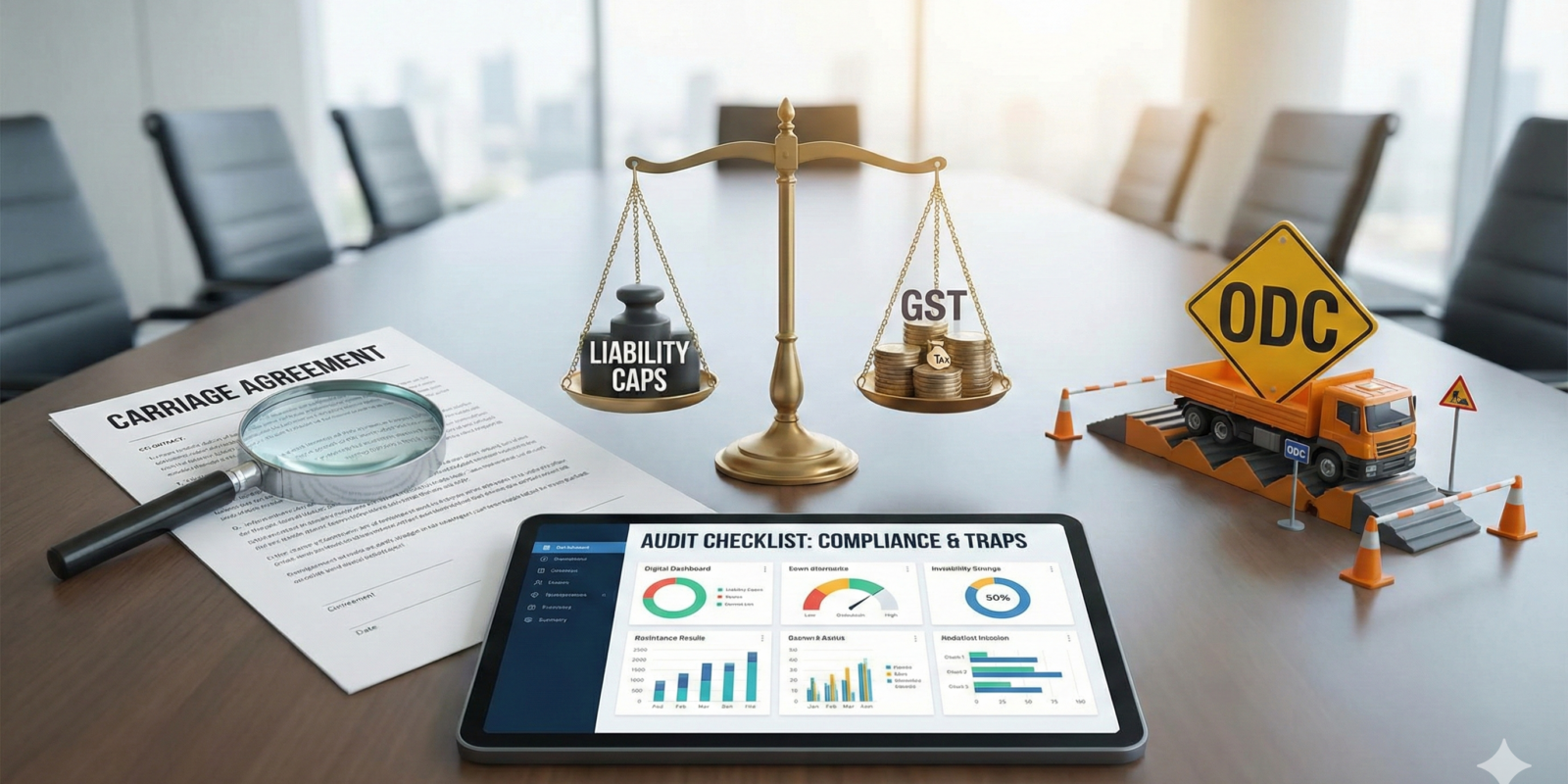
By Many manufacturers still operate on logistics contracts drafted before the GST rollout or the 2018 axle load revisions. These “zombie agreements” often reference dead statutes like the Companies Act, 1956 or demand obsolete permits like Octroi, creating a legal deadlock during transit. More dangerously, they offer a false sense of security regarding cargo liability.
While a contract may state the transporter is “wholly liable” for damage, Indian courts strictly enforce the statutory cap under the Carriage by Road Act, 2007—often leaving shippers absorbing the majority of the loss.
This audit dissects those specific failures, calculates the hidden costs of outdated dimension clauses, and provides a corrected 2025 framework to secure your supply chain against uninsured losses.
The Zombie Contract. Why Your 2018 Logistics Agreement is a Legal Liability.
We audited a standard “Agreement for Carriage of Goods” used by manufacturers. The result? It relies on dead taxes, repealed laws, and exposes companies to massive uninsured losses. Here is how to fix it for 2025.
Risk Exposure Analysis
Visualizing the gap between the submitted contract and 2025 statutory requirements.
The Statutory Vacuum
The reviewed agreement anchors itself to the Companies Act, 1956. While companies incorporated under the 1956 Act still exist, governing a commercial relationship in 2025 using a repealed statute is dangerous. It muddles definitions of “Control” and “Subsidiary” which are crucial for assignment clauses.
More critically, the agreement calls the transporter a “Contractor” but ignores their statutory status as a Common Carrier under the Carriage by Road Act, 2007. This is not just semantics. Common Carriers have specific registration numbers (CCRN) that must be cited to validate insurance claims.
The Fix
Replace all references to the “Companies Act 1956” with “Companies Act, 2013”. Mandate the inclusion of the transporter’s Common Carrier Registration Number in the Preamble.
The Width Trap: Clause 26
Clause 26 is a financial landmine. It defines any load exceeding 7 feet (2.13 meters) in width as “Over-Dimensional Cargo” (ODC). However, the Central Motor Vehicles Rules (CMVR), Rule 93, allows a standard truck width of 2.6 meters (approx. 8.5 feet).
By artificially lowering the “normal” limit, the transporter can charge you premium ODC rates for loads that are actually legally standard.
Contract vs. Legal Width Comparison
The 25% “Phantom Freight” Tax
The contract is from 2018. In August 2018, MoRTH Notification No. S.O. 3467(E) increased “Safe Axle Weights” across India. If your contract still uses pre-2018 weight limits (e.g., 9T for a 6-wheeler), you are paying for full trucks but shipping partial loads.
Disclaimer: This calculator uses GVW limits per MoRTH S.O. 3467(E). Actual payload capacity depends on vehicle tare weight and RTO registration. This is an estimation tool, not legal advice.
Money wasted paying for trucks that aren’t fully loaded to legal capacity.
The Ghost of Taxes Past
Clause 6 demands an “Octroi Exemption Certificate” and a “Bihar Sales Tax Permit.” Both are legally extinct. Octroi was abolished with GST (2017). Bihar permits were replaced by E-Way Bills.
GST Compliance: The 5% vs 12% Dilemma
The contract is silent on GST status. This is critical because Goods Transport Agencies (GTA) offer two tax regimes. If the contract doesn’t specify, the default liability for paying tax falls on YOU (The Service Recipient) under the Reverse Charge Mechanism (RCM).
Option A: Forward Charge (FCM)
Charged by Transporter on Invoice.
- ✓ Transporter claims Input Tax Credit (ITC).
- ✓ You simply pay the invoice.
- ✓ Action: Require a Declaration Annexure.
Option B: Reverse Charge (RCM)
Paid directly by You to Govt.
- ℹ Transporter charges 0% on invoice.
- ⚠ You must self-invoice and pay Govt.
- ⚠ Risk: Forgot to pay? 18% Interest penalty.
The Liability Illusion
The contract says the contractor is “wholly liable” for any loss. The law disagrees. Under Section 10 of the Carriage by Road Act, 2007, liability is capped at 10 times the freight amount unless a higher risk rate is paid.
Liability Gap Calculator
Disclaimer: This calculation is based on Rule 12 of the Carriage by Road Rules, 2011. Courts may interpret liability differently based on negligence proof. This tool does not substitute professional legal advice.
The Subrogation Firewall
Even if you have Marine Insurance, your claim can be rejected if your contract accidentally waives the Insurer’s right to sue the carrier (Subrogation).
The Incident
Truck overturns. Goods worth ₹10L damaged.
The Claim
You claim ₹10L from your Insurance Company.
The Rejection
Insurer checks your Contract. Sees “Liability limited to freight” or missing “Subrogation Letter”. Claim Denied.
Clause 25: The Detention Cash Leak
Clause 25 mandates “Stay Charges” if a vehicle waits more than 6 working hours. The industry standard is 24 hours. This aggressive clause drains cash for minor warehouse delays.
Cost Simulator
See how much extra you pay per truck compared to market standards.
Operational Compliance
The “Goods Receipt”
The contract asks for a signed “Challan.” This is insufficient for insurance. You must demand a Goods Receipt (Form 8).
- ✓ Contains GSTIN of both parties
- ✓ Declares Owner’s vs Carrier’s Risk
- ✓ Prima facie evidence in court
The “Blank” Jurisdiction
Clause 27 is left blank. If a dispute arises, the carrier can sue you in their remote home jurisdiction.
- ⚠ Risk of litigation in remote courts.
- ✓ Fix: “Exclusive Jurisdiction of [Your City] Courts.”
- ✓ Use Digital Notices (Email/WhatsApp) in contracts.
Modernized Agreement Template (2025)
Based on your uploaded document, but corrected for legal compliance.
AGREEMENT FOR CARRIAGE OF GOODS
THIS AGREEMENT is made on this [Day] day of [Month], 2025
BETWEEN
[YOUR COMPANY NAME], a company registered under the Companies Act, 2013, having its registered office at [Address] (hereinafter referred to as the “EMPLOYER”) of the One Part;
AND
[TRANSPORTER NAME], a company/firm registered as a Common Carrier under the Carriage by Road Act, 2007 (CCRN No: [Insert Number]), having its registered office at [Address] (hereinafter referred to as the “CONTRACTOR”) of the Other Part.
WHEREAS:
A. The Employer manufactures and deals in structural engineering and mechanical equipment.
B. The Contractor is a Logistics Service Provider owning/operating a fleet of vehicles and represents that it holds valid Permits and Licenses to transport goods across India.
NOW THIS AGREEMENT WITNESSETH AS FOLLOWS:
1. TERM: This agreement shall be valid for a period of One Year starting from [Start Date] to [End Date], unless terminated earlier in accordance with the terms herein.
2. SECURITY DEPOSIT: The Contractor shall deposit an interest-free Security Deposit of Rs. [Amount], which shall be refundable upon successful completion of the contract, subject to deductions for any loss/damage caused to the Employer.
3. COMPLIANCE & GST:
a) The Contractor shall comply with the GST Act, 2017. The Contractor exercises the option to pay GST under [Forward Charge @ 12% / Reverse Charge @ 5%].
b) The Contractor shall ensure valid E-Way Bills are generated and updated (Part B) for all consignments. Any penalty under Section 129 of the CGST Act due to expiry or error in the E-Way Bill shall be borne solely by the Contractor.
4. PLACEMENT OF VEHICLES: The Contractor guarantees to supply vehicles as per the Employer’s requisition within [24] hours of notice. Failure to place vehicles may result in the Employer hiring from the open market, with the cost difference debited to the Contractor.
5. LIABILITY & INSURANCE:
a) The Freight Rates agreed herein are inclusive of the ‘Higher Risk Rate’ as envisaged under Section 11 of the Carriage by Road Act, 2007.
b) The Contractor accepts liability for the full declared value of the consignment in the event of loss, damage, or theft, notwithstanding the limits prescribed under Section 10 of the said Act.
c) The Contractor shall issue a Certificate of Facts (COF) within 7 days of any accident to facilitate Insurance Claims.
6. DETENTION CHARGES: Detention charges shall only be payable if the vehicle is detained at the loading/unloading point for more than 24 hours. The rate of detention shall be Rs. [Amount] per day.
7. OVER-DIMENSIONAL CARGO (ODC): Standard Vehicle dimensions shall be as per CMVR Rule 93 (2.6m Width). Any cargo within these limits shall not attract ODC charges.
8. PAYMENT TERMS: Bills shall be submitted in triplicate with the proof of delivery (POD). Payment shall be made within [30/45] days of submission. (Note: Ensure compliance with MSME Act if Contractor is registered).
9. DISPUTE RESOLUTION & JURISDICTION:
All disputes arising out of this agreement shall be subject to the exclusive jurisdiction of the Courts at [YOUR CITY]. Digital notices sent via email to registered addresses shall be considered valid.
IN WITNESS WHEREOF the parties have signed this agreement on the date first above written.
For EMPLOYER
For CONTRACTOR
Specific Clause Replacements
To replace “Bihar Permit” clauses: