 By
By Standard commercial templates rarely account for India’s specific statutory realities. A single drafting oversight regarding “commission” versus “discount” can inadvertently shift tax liability, while copying an outdated arbitration clause might render your entire dispute resolution mechanism void.
Many business owners sign agreements assuming “Sale or Return” clauses protect them, unaware that Section 31(7) of the CGST Act creates a hard invoicing deadline that triggers tax demands regardless of actual sales. Similarly, dictating resale prices—a common practice in older contracts—now invites severe penalties from the Competition Commission of India.
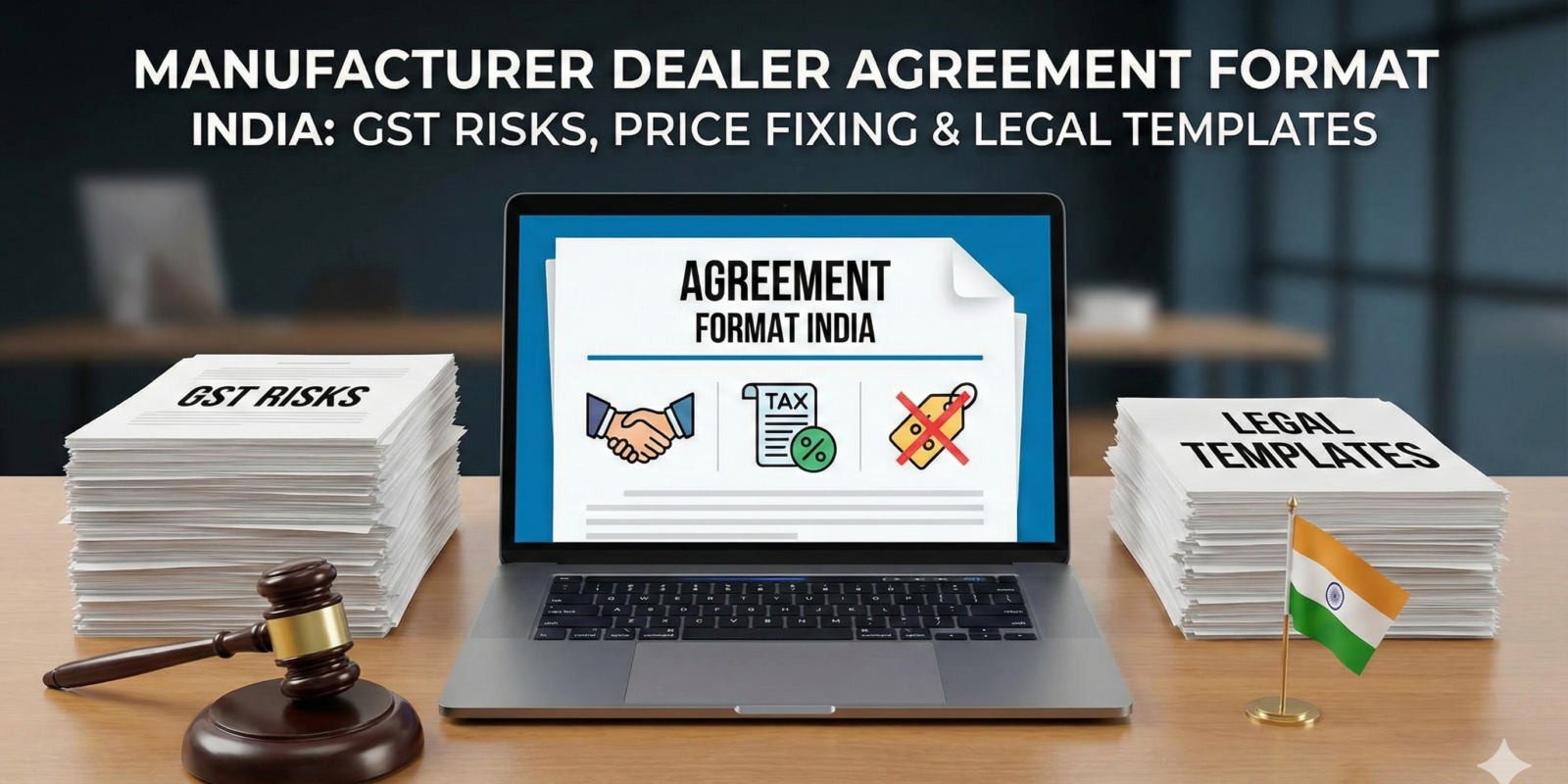
This analysis dissects a specific Manufacturer-Dealer agreement format to expose these financial threats. We examine the legal distinction between “Principal-to-Principal” and “Agency” relationships, identify the hidden “inventory avalanche” risks, and provide a corrected, legally robust template ready for use.
Manufacturer Dealer Agreement Format India
A complete breakdown of commercial contracts. We analyze the hidden risks in standard templates. Updated January 2026.
Commercial templates often fail to account for the specific statutory environment of India. The distinction between a “Principal-to-Principal” relationship and an “Agency” relationship defines your liability. A simple drafting error can expose a manufacturer to vicarious liability for a dealer’s actions or result in unexpected tax demands.
This guide examines a standard agreement format. We identify four critical legal failures regarding Goods and Services Tax (GST), the Competition Act, and the Arbitration and Conciliation Act.
Visualizing Contractual Risk
Explore how specific clauses impact the liability balance between Manufacturer and Dealer.
Risk Engine
Real-time Liability Calc.
Visualization based on liability principles from Tata Motors v. Antonio Paulo Vaz and Schedule I CGST Act.
The “Hybrid” Trap
The Problem: “Commission”
Many agreements use the word “Commission” (Clause 2) while also demanding “Minimum Sales” (Clause 4). This creates a legal hybrid.
- ⚠ Tax Risk: Tax authorities may treat the Dealer as an Agent. This triggers TDS under Section 194H.
- ⚠ GST Risk: Transfers to agents are taxable supplies even without consideration (Schedule I).
The Fix: “Trade Discount”
Replace “Commission” with “Trade Discount.” Explicitly state the relationship is Principal-to-Principal.
- ✓ Result: No TDS liability on margins.
- ✓ Result: Manufacturer is insulated from third-party consumer claims.
The Inventory Avalanche
“…Manufacturer shall be supplying and the dealer shall sell the whole of the seller’s subsisting stock… and other goods as manufactured hereafter without any exception…”
This is a “Take-All” clause. In standard supply chain contracts, dealers place orders based on market demand (Pull System). Clause 1 creates a “Push System” where the Manufacturer can dump unlimited inventory on the Dealer.
The Risk
If the Manufacturer overproduces defective or low-demand units, the Dealer is contractually bound to buy them. This destroys the Dealer’s working capital and storage capacity.
The Fix
Change to: “The Manufacturer shall supply goods against written Purchase Orders raised by the Dealer, subject to acceptance by the Manufacturer.”
CRITICAL The 180-Day GST Timebomb
Clause 3 of the agreement states: “If any part of goods shall remain unsold for over… Months… the dealer shall return the stock.”
This clause, often called “Sale or Return,” triggers Section 31(7) of the CGST Act. The law does not wait for you to decide. You have a hard deadline to issue an invoice.
The Statutory Timeline
Day 0: Goods Removed
Goods leave factory on Delivery Challan (Not Invoice). No GST paid yet.
Day 1 – 179: Sales Window
If dealer “accepts” or sells the goods, you issue Tax Invoice immediately.
Day 180: Deemed Supply
The Trap: Even if the dealer hasn’t sold the item, the law deems it supplied. The Manufacturer MUST issue a Tax Invoice and pay GST on the 180th day.
The Logistics & Freight Void
Clause 2 states: “exclusive/inclusive of all railway freight (as may be consented).” This ambiguity (“as may be consented”) is the root of many disputes.
Statutory Risk (S.39 Sale of Goods Act)
Under Indian law, delivery to a carrier (Railway/Truck) is prima facie deemed delivery to the Buyer.
Consequence: If the goods are damaged or lost in transit, the Dealer must still pay the Manufacturer unless the contract explicitly says “F.O.R. Destination” (Free on Road).
Recommended Clause
“The Supply shall be on F.O.R. Destination basis. The Manufacturer bears the risk of loss until the goods are delivered at the Dealer’s godown. Insurance during transit shall be the Manufacturer’s responsibility.”
The “Heirs” Trap
The agreement defines the manufacturer and dealer to “include heirs and assigns.” This sounds standard, but in a Dealership Agreement, it is dangerous.
Risk for Manufacturer:
Dealerships are often based on personal trust and the specific business acumen of the individual. If the Dealer passes away, this clause forces you to accept their heir (who may be unqualified) as your new partner.
Risk for Dealer:
The word “Assigns” allows the Manufacturer to transfer their obligations to a third party. You might find yourself dealing with a completely different company without your consent.
Fix: Change of Control Clause
Draft a “Change of Control” clause. It should state that any change in management or ownership requires prior written consent.
Structure Comparison
| Legal Aspect | Agency Model | Distributorship Model |
|---|---|---|
| Title to Goods | Remains with Manufacturer | Passes to Dealer on Invoice |
| Risk of Loss (Fire/Theft) | Manufacturer bears loss | Dealer bears loss |
| Consumer Liability | Vicarious Liability applies | Manufacturer Insulated |
| Income Tax (TDS) | TDS on Commission | No TDS on Margins |
The Price Fixing Violation
Clause 2 of the analyzed text states: “The goods… shall be sold by the dealer strictly at listed prices.”
Competition Act Alert
This is Resale Price Maintenance (RPM). Under Section 3(4)(e) of the Competition Act 2002. Manufacturers cannot dictate the minimum resale price. The Competition Commission of India (CCI) penalizes this heavily.
The Exclusivity Paradox
Clauses 5 and 6 create a “Double Lock”:
- Clause 5: Manufacturer cannot supply anyone else in the area.
- Clause 6: Dealer cannot sell similar products from others.
This is an “Exclusive Supply Agreement” combined with “Exclusive Distribution.” Is it legal? That depends entirely on your market share.
Legal Validity Checker
The “Renovated” Goods Trap
“The manufacturer shall not… appoint any other wholesale dealer concerning identical or renovated products…”
The inclusion of “renovated” (refurbished/seconds) creates a massive strategic blockage.
- Factory Outlets Blocked: Manufacturers often sell damaged/refurbished goods through separate channels or factory outlets. This clause prevents that, forcing you to sell “seconds” through your premium dealer.
- Brand Dilution: If the premium dealer sells “Renovated” goods alongside new ones, customers may get confused, leading to Consumer Protection complaints for “defective goods.”
The Force Majeure Gap
Clause 4 mandates a “Minimum Sale Valuation.” If sales fall short by 25%, the contract is cancelled. But what if the shortfall is due to a pandemic, strike, or flood?
The current draft lacks a Force Majeure clause. Under Section 56 of the Contract Act (Doctrine of Frustration), proving impossibility is very difficult. Commercial difficulty is not impossibility.
Result: The Dealer could lose the contract for “poor performance” even during a nationwide lockdown.
The Silent Risks
Missing IP Shield
The agreement allows the dealer to use your brand name (“doing business as…”). It fails to state that the Dealer has no ownership rights to the Trademark.
Add Clause: “The Dealer acknowledges the Manufacturer’s sole ownership of the Trademarks. The Dealer shall not register any similar mark or domain name.”
Product Liability Deficit
Under the Consumer Protection Act 2019, “Product Sellers” can be liable for defective goods unless they can prove the defect originated in manufacturing.
Add Clause: “The Manufacturer shall indemnify the Dealer against claims arising solely from manufacturing defects. The Dealer indemnifies the Manufacturer for defects caused by improper storage.”
The Termination Cliff
Clause 4 allows termination if sales fall short by 25%. Clause 6 limits the term to 5 years. However, the agreement is silent on the Exit Protocol. A contract without an exit strategy creates a hostage situation for inventory and capital.
Missing “Winding Up” Provisions:
Stock Buyback
Does the Manufacturer buy back unsold inventory upon termination? If not, the Dealer might dump stock at cheap prices, damaging the brand image.
Account Reconciliation
The agreement should specify that a “No Dues Certificate” must be issued within 45 days of termination to prevent lingering disputes.
The Jurisdiction Vacuum
The document ends with “PLACE: __________”. This is not a legal jurisdiction clause.
Why this is dangerous (CPC Section 20)
In India, if the contract is silent on jurisdiction, the Plaintiff (the person suing) can file the case in:
- Where the Defendant resides/works.
- Where the cause of action arose (wholly or in part).
Scenario: If your Manufacturer is in Mumbai and Dealer is in Chennai. Without an exclusive jurisdiction clause, the Dealer can sue you in Chennai, forcing you to travel for every hearing.
Drafting Fix: “The Courts at [City Name] shall have exclusive jurisdiction to try and entertain any disputes arising out of this Agreement.”
The Stamp Duty Trap
The “Place” Field Matters
The document has a blank for “PLACE”. This determines the Stamp Duty Act applicable (e.g., Maharashtra Stamp Act vs Indian Stamp Act).
Recent Supreme Court Ruling (N.N. Global): An unstamped or insufficiently stamped agreement is not enforceable in law. This means the Arbitration Clause (Clause 7) is dead until the penalty (up to 10x duty) is paid.
Remedial Drafting
1. Resale Price Clause
Clause 2Original (Dangerous)
“The goods so supplied shall be sold by the dealer strictly at listed prices…”
Revised (Compliant)
“The Dealer shall sell the goods at prices determined by the Dealer. Provided that such prices shall not exceed the Maximum Retail Price (MRP). Any price lists provided by the Manufacturer are recommendatory only.”
2. Arbitration Clause
Clause 7Original (Invalid)
“…referred to sole arbitrator Mr………., for settlement whose award shall bind…”
Why: Unilateral appointment is void under Perkins Eastman.
Revised (Enforceable)
“Any dispute shall be referred to arbitration by a Sole Arbitrator to be appointed by the mutual consent of the parties. The Seat of Arbitration shall be Mumbai.”