 By
By You secured a high-paying remote role with a company in Hong Kong or the US. The funds hit your Indian bank account, and you file under Section 44ADA to pay tax on just 50% of your income. It appears seamless until a statutory notice arrives.
A dangerous myth circulates among independent consultants: “If I opt for presumptive taxation, I do not need GST.” This is legally incorrect. The moment your aggregate turnover crosses ₹20 Lakhs, the GST Act mandates registration—regardless of your Income Tax filing status. Failing to register prevents you from filing a Letter of Undertaking (LUT), technically making your “tax-free” exports liable for 18% IGST.
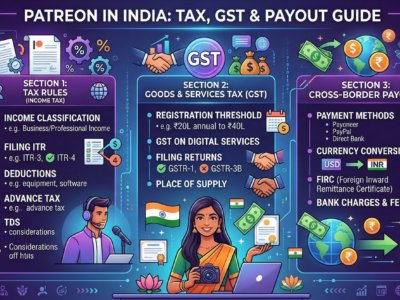
This portal corrects that course. We analyze the specific regulatory intersection of Income Tax, GST Zero-Rating, and FEMA guidelines for Indian software professionals. From generating the correct export invoice to handling the “Data Bridge” risk between your bank and the tax department, this is your operational manual for legally retaining your foreign earnings.
Compliance Systems for Global Service Remittance.
A structured analysis on Section 44ADA (Income Tax), GST Export Protocols, and FEMA Banking requirements for software engineers.
Compliance Audit Tool
Input your expected receipts to check mandatory filing status.
Include all payments received between April 1 and March 31.
The Data Bridge Risk (AIS vs GST)
How You Get Caught
Freelancers often believe they can fly under the radar. However, CBDT (Income Tax) and CBIC (GST) now have a data-sharing MOU. Here is the automated sequence that triggers a notice:
- 1. The Trigger Your Bank reports foreign inward remittances to Income Tax via Form 61A (SFT).
-
2. The Mismatch
The system checks:
Income Tax AIS Turnover > ₹20 LakhsANDGSTIN = Not Found. - 3. The Notice (ASMT-10) A notice is automatically dispatched asking why GST wasn’t paid on the receipts shown in your bank statement.
“There is no secrecy. If it hit your bank, it’s on your AIS. If it’s on your AIS, the GST network knows about it.”
Advance Tax Protocol
The March 15th Deadline
Unlike regular businesses that pay tax quarterly (15%, 45%, 75%, 100%), professionals opting for Section 44ADA have a unique privilege and burden:
Pay 100% of annual tax liability in one shot by March 15.
1% interest per month for deferment if missed.
Rough Calculation for 36 LPA (New Regime)
*Disclaimer: Calculate exact liability based on your investments and regime.
FEMA & Banking Guardrails
Purpose Code Accuracy
When foreign funds hit your account, the bank requires a purpose code to report to the RBI. Incorrect coding can trigger FEMA violations or disqualify your GST zero-rated claim.
Recommended Code for Software Engineers:
P0802Software consultancy, implementation, and data processing services.
The FIRA Requirement
The Foreign Inward Remittance Advice (FIRA) is the only statutory document that proves your payment was received in convertible foreign exchange.
- Required for GST Refund claims (if any).
- Evidence for 44ADA eligibility for foreign income.
Hidden Liability: RCM on Imports
The “GitHub & AWS” Trap
If you purchase software subscriptions (e.g., JetBrains, GitHub, AWS) from foreign entities for your business, you are legally an “Importer of Services”. Under Section 5(3) of IGST Act, you must pay 18% tax in cash and claim it back as credit.
Unlocking Capital: GST Refunds
The Accumulated Credit Logic
Since your output tax is 0% (Export), the GST you pay on business purchases (Laptops, Internet, Office Rent) sits unused. You can claim this back in cash via form RFD-01.
Refund Formula
Refund = (Export Turnover ÷ Total Turnover) × Net ITC
Refund Eligibility Checklist
- ✓ Active GST Registration & Valid LUT
- ✓ FIRA/FIRC available for proceeds
- ✓ GSTR-1 and GSTR-3B filed accurately
Structure Strategy: The Entity Trap
Sole Proprietorship
The only entity structure compatible with Section 44ADA.
- ✓ Flat 50% Expense Assumption
- ✓ Simple Compliance (ITR-4)
Private Limited Company
Often oversold. Incompatible with 44ADA.
- ✕ Cannot use Presumptive Taxation
- ✕ Mandatory Statutory Audit
Contractual Defense Mechanisms
To ensure your service is treated as an “Export” (Zero Rate) and not an “Intermediary Service” (18% Tax), your contract with the Hong Kong entity must explicitly contain these clauses:
Clause 1: Principal to Principal
“The relationship between the Parties is that of independent contractors. Nothing in this Agreement shall be construed to create a partnership, joint venture, or employer-employee relationship.”
Why: Negates “Employee” status risks.Clause 2: No Agency
“The Consultant shall not act as an agent or intermediary for the Client and has no authority to bind the Client in any manner whatsoever.”
Why: Avoids “Intermediary” classification (18% GST).The Invisible Mandate: SOFTEX
RBI Master Direction Compliance
While GST governs the tax aspect, the RBI governs the foreign exchange aspect. Technically, every software export requires filing a SOFTEX form with the STPI, even for non-STP units.
Tip: If annual turnover > $25,000, banks may freeze inward remittances without SOFTEX validation.
Invoicing Protocol
Currency Rules
Always invoice in Client’s Currency (USD/HKD) to prove export intent.
The 30-Day Rule
Tax invoices must be issued within 30 days of service provision.
Forex Rate
Use CBIC Notification Rate (not Google Rate) for GST conversion.
Statutory Calendar
Report Sales / Pay Tax
100% Liability Payment
Form RFD-11 for Next Year
ITR-4 for Presumptive
Corrective Action Plan
Step 1: Obtain GSTIN Retrospectively
Apply for registration immediately. The effective date will be the application date, but you can file past invoices as export supplies if payment proof exists.
Step 2: Pay Advance Tax (Urgent)
Calculate your 100% tax liability on 50% of receipts and deposit via Challan 280 (Code 100) before March 15th to avoid interest.
Step 3: Annual LUT Renewal
File LUT (RFD-11) for the current year. Ensure you file the new LUT for the 2026-27 period before April 1st.
The Documentation Vault
Maintain these records for a minimum of 8 years to ensure safety during statutory assessments.
Executed agreement with the Hong Kong entity clearly defining roles and deliverables.
Tax Invoices issued with the mandatory “Export under LUT” declaration.
Foreign Inward Remittance Advice issued by your bank for every single credit.
The PDF receipt of Form RFD-11 filed for the current financial year.