 By
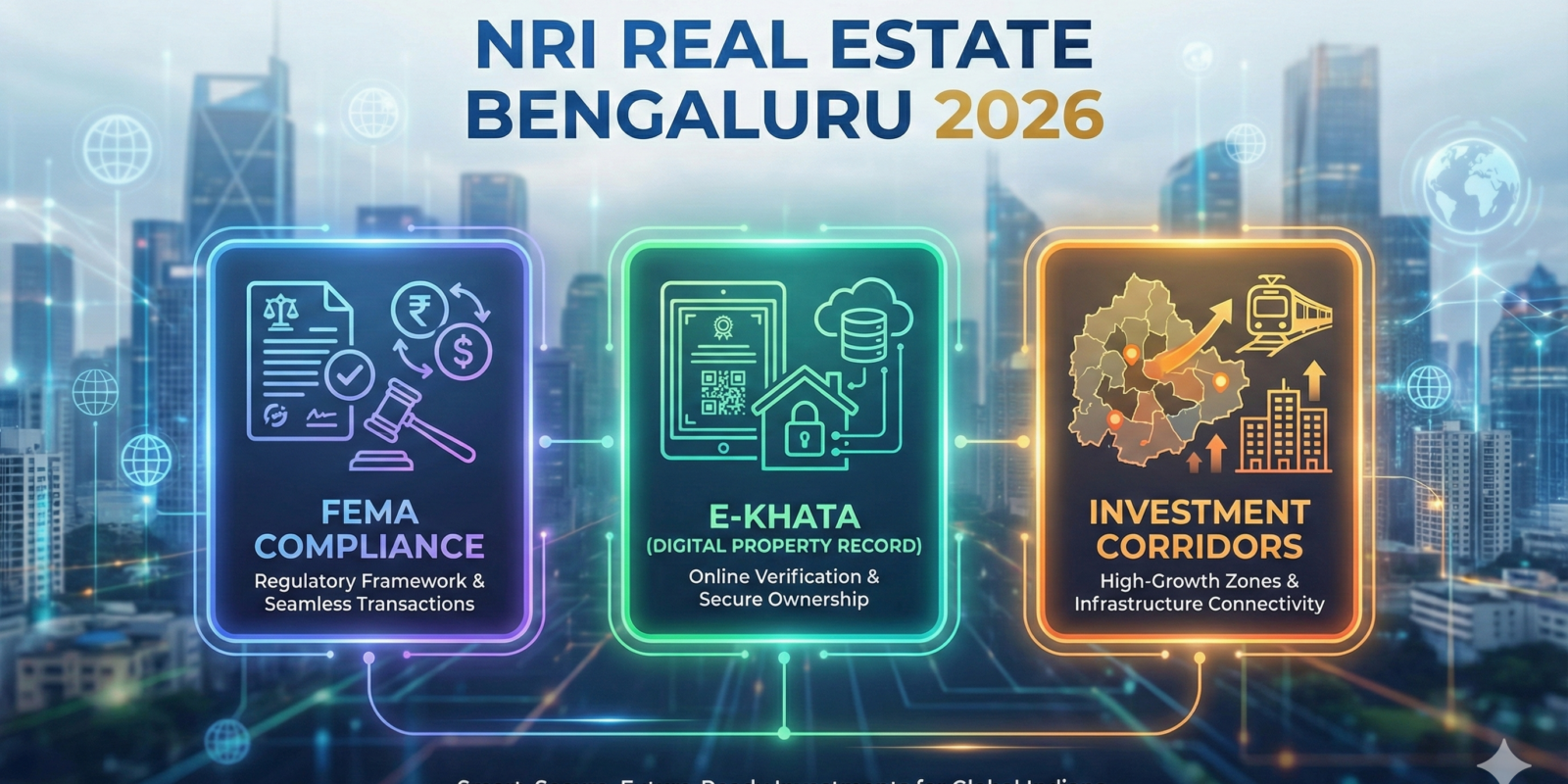
By Bengaluru commands a significant share of foreign capital entering Indian real estate, driven by the expansion of Global Capability Centers and infrastructure projects like the Airport Metro corridor.
For Non-Resident Indians (NRIs) and Overseas Citizens of India (OCIs), however, the investment process involves strict adherence to federal and municipal protocols. The 2025-2026 fiscal cycle introduced mandatory E-Khata digitization and revised TDS norms, altering the compliance landscape.
This report outlines the operational requirements—from FEMA regulations and NRE funding channels to the specific legal due diligence required for safe asset acquisition in North and East Bengaluru.
Bengaluru Real Estate: A 2026 Guide for Non-Resident Indians
Strict federal regulations and new municipal laws have changed how foreign capital enters Bengaluru. Here is the operational protocol for purchasing property safely.
Bengaluru remains a primary destination for foreign capital. NRIs and OCIs continue to invest in the city due to its infrastructure expansion and the growth of global capability centers. These factors sustain demand for residential and commercial assets. However, investing as a non-resident requires following specific rules. A mix of federal foreign exchange regulations, state laws, and municipal protocols governs every purchase.
Buyers must understand the Foreign Exchange Management Act (FEMA), Reserve Bank of India (RBI) rules, and local documentation like the BBMP Khata. The environment has shifted in the 2025 and 2026 fiscal cycles. Changes include mandatory E-Khata digitization, B-Khata regularization schemes, and revised tax laws. This report details the necessary legal verifications, cash transfer protocols, and due diligence steps.
Strategic Micro-Markets: North vs. East
Investment viability in Bengaluru is dictated by two corridors: the Airport corridor (North) and the IT corridor (East). Capital appreciation varies significantly based on infrastructure completion dates.
| Parameter | North Bengaluru (Hebbal/Devanahalli) | East Bengaluru (Whitefield/Sarjapur) |
|---|---|---|
| Primary Driver | Kempegowda International Airport (KIA) | IT Parks & Metro Phase 2 |
| Entry Price (Avg) | ₹9,500 – ₹13,000 / sq.ft | ₹11,000 – ₹16,000 / sq.ft |
| Rental Yield | 2.8% – 3.2% (Moderate) | 3.5% – 4.2% (High Demand) |
| Infrastructure Risk | Low (Roads completed) | Medium (Metro traffic ongoing) |
Analysis: While North Bengaluru offers better long-term land value appreciation due to the Aerotropolis project, East Bengaluru provides immediate and higher rental yields due to the density of the workforce.
Infrastructure Investment Corridors (2026-2030)
Property valuation in Bengaluru is heavily correlated with mass transit connectivity. Two major infrastructure projects will dictate price appreciation over the next 48 months.
Metro Blue Line (Airport Line)
Connecting Central Silk Board to KIA Airport. Properties within 2km of stations like Hebbal, Nagavara, and KR Puram are expected to see a 15-20% appreciation premium over non-metro connected assets.
Satellite Town Ring Road (STRR)
This 280km expressway connects Devanahalli, Hoskote, and Doddaballapur. It bypasses city traffic, making plotted developments in these peripheral towns viable for long-term land banking.
The “Real Cost” Simulation
Investors often miscalculate the total outlay by ignoring statutory dues. Below is an accurate cost breakdown for a standard premium apartment in Bengaluru priced at ₹1.5 Crores.
Total Outlay Calculator (₹1.5 Cr Unit)
*Stamp duty includes cess and surcharge. Rates vary slightly based on Gram Panchayat vs BBMP limits. This calculation assumes BBMP limits.
The Secondary (Resale) Market Protocol
Buying a resale property offers immediate rental income and no GST liability. However, the legal complexity is higher. NRIs must adhere to specific protocols when buying from an existing owner.
| Step | Action Required | Critical Note |
|---|---|---|
| 1. Agreement to Sell | Draft a Sale Agreement (not Sale Deed) paying 0.1% Stamp Duty. | Include an indemnity clause for undisclosed loans. |
| 2. Bank Foreclosure | If the seller has a loan, pay directly to their bank to close it. | Collect the original property documents directly from the bank. |
| 3. Transfer Fee | Payable to the Builder/Association for name transfer. | Negotiate who pays this (Buyer/Seller). Can range from ₹50k to ₹2 Lakhs. |
| 4. TDS Deduction | Deduct 1% (Resident Seller) or 20%+ (NRI Seller). | Failure to deduct TDS makes the Buyer liable for the tax. |
The FEMA Regulatory Framework
FEMA (1999) dictates cross-border property investments. The law facilitates foreign investment in urban infrastructure while protecting agricultural land.
Permitted and Prohibited Assets
NRIs and OCIs can purchase unlimited residential and commercial properties. This includes apartments, villas, offices, and retail outlets. No prior permission from the RBI is needed. This reduces bureaucratic delays.
However, purchasing agricultural land, plantation properties, or farmhouses is prohibited. This rule applies even if the buyer holds Indian citizenship but resides abroad. The state can confiscate assets bought in violation of this rule. The only exception is inheritance. NRIs can inherit agricultural land but must sell it to a resident Indian citizen.
| Asset Class | Purchase Eligibility | Repatriation Rules |
|---|---|---|
| Residential (Apartments/Villas) | Allowed (Unlimited) | Max 2 properties per lifetime |
| Commercial (Offices/Retail) | Allowed (Unlimited) | Allowed (No quantity cap) |
| Agricultural Land | Prohibited | N/A |
| Inherited Farm Land | Inheritance Only | Non-Repatriable (Must sell to resident) |
Repatriation Caps: Residential vs Commercial
Commercial assets offer superior liquidity for foreign investors as they lack the two-property repatriation cap.
Financial Mechanics and Banking
Transactions must occur through authorized banking channels. Cash, foreign currency notes, or informal networks are prohibited. Use NRE, NRO, or FCNR accounts.
Account Types
- NRE Account: Funds are fully repatriable. Interest is tax-free in India. Best for funding the purchase.
- NRO Account: Used for income generated in India (rent, sale proceeds). Funds are subject to restricted repatriation limits.
- FCNR Account: Holds foreign currency to avoid exchange rate risk.
The Foreign Inward Remittance Certificate (FIRC)
The FIRC is essential. It proves foreign capital entered India legally. When you transfer funds, the bank issues an Inward Remittance Message (IRM) which generates the e-FIRC. Without this document, you cannot repatriate funds when you eventually sell the property. Always request the e-FIRC immediately after the transfer.
Credit Access: Loans for NRIs
Indian banks readily fund NRI purchases, but the terms differ from resident loans. The Loan-to-Value (LTV) ratio is capped strictly.
- Max Funding: 80% of the Agreement Value (not market value).
- Tenure: Typically restricted to 15 years (vs. 20-30 for residents) based on retirement age in the country of residence.
- Documentation: 6 months of overseas bank statements, employment contract, and NRE/NRO account details.
- Power of Attorney: A resident PoA holder is often mandatory for executing loan documents.
Hidden Ownership Costs: CAM & Corpus
Beyond the purchase price, owning a premium asset in Bangalore incurs specific operational costs.
- Corpus Fund (Sinking Fund): A one-time deposit (usually ₹100-₹250/sq.ft) collected by the builder. It generates interest used for major repairs (e.g., painting, lift replacement) after 10 years. Ensure this is transferred to the Association upon handover.
- Common Area Maintenance (CAM): Charged monthly on “Super Built-up Area”. If the monthly maintenance exceeds ₹7,500 per member, an additional 18% GST is levied on the entire amount, increasing holding costs.
Repatriation Limits
NRIs can repatriate up to USD 1 million per financial year from their NRO accounts. This includes sale proceeds from assets. You must submit Form 15CA and Form 15CB (certified by a Chartered Accountant) to the bank. Amounts exceeding USD 1 million require special RBI approval.
Taxation Protocols: TDS and GST
TDS (Tax Deducted at Source) rules depend on the residency of the seller. Confusing these rules can lead to penalties.
Buying from a Resident vs. Buying from an NRI
If buying from a resident Indian, deduct 1% TDS if the property value exceeds ₹50 Lakhs. Use Form 26QB. If buying from an NRI, the rules are stricter. You must deduct 20% to 30% (plus cess) on the gross value unless the seller produces a Lower Deduction Certificate (LDC).
| Parameter | Seller is Resident (Sec 194-IA) | Seller is NRI (Sec 195) |
|---|---|---|
| TDS Rate | 1% | 20% (LTCG) to 30% (STCG) + Cess |
| Threshold | > ₹50 Lakhs | No Minimum Threshold |
| Calculation Base | Total Sale Price | Total Sale Price (or Capital Gains with LDC) |
| Requirement | PAN Card | TAN (Tax Deduction Account Number) |
The Exit Strategy: Capital Gains Tax
When selling the property, the tax implication depends on the holding period.
- Short Term Capital Gains (STCG): If sold within 24 months of purchase. Taxed according to your income slab in India.
- Long Term Capital Gains (LTCG): If sold after 24 months. Taxed at 20% with indexation benefits (adjusting purchase cost for inflation).
Note: NRIs can save on LTCG by reinvesting in another residential property in India (Section 54) or Capital Gains Bonds (Section 54EC) within 6 months of the sale.
Goods and Services Tax (GST)
GST applies to under-construction properties. Completed properties with an Occupancy Certificate (OC) are exempt. Most NRI investments fall into the 5% GST slab as “Affordable Housing” (1% rate) is capped at ₹45 Lakhs and 60 sqm, which is rare in Bengaluru’s premium market.
The Municipal Paradigm: Khata and Digitization
The “Khata” is the municipal assessment record. It is not a title deed but is vital for legality.
A-Khata vs. B-Khata
A-Khata: Signifies the property follows all zoning and building laws. It allows for bank loans and construction permits.
B-Khata: Indicates deviations or unauthorized layouts. Banks generally reject these properties. NRIs should avoid B-Khata assets despite the 2026 regularization schemes.
E-Khata and Digital Systems
Physical Khata documents are obsolete. The E-Khata is mandatory for registration. While the system initially required Aadhaar, NRIs can now use passports or PAN cards via a caseworker login. This manual verification takes 15 to 30 days.
RERA Karnataka Verification Protocol
The Real Estate Regulatory Authority (RERA) is the primary safeguard for buyers of under-construction property. Before paying a booking amount, verification on the Karnataka RERA portal is mandatory.
The 3-Step RERA Check
- Project Status: Search the project on the RERA Karnataka website under “Project Status”. Ensure it is marked “Ongoing” or “Completed” and not “Lapsed” or “Under Investigation”.
- Litigation List: Check the “Complaint List” to see if existing buyers have filed cases against the developer for delay or quality issues.
- Financial Progress: Download the latest “Quarterly Progress Report (QPR)”. If the percentage of work completed is significantly lower than the percentage of money collected, it is a red flag.
Visualizing the Acquisition Workflow
The following diagram illustrates the critical path for a safe acquisition, highlighting the “Safe” vs “Risky” decision points.
Due Diligence Checklist
Do not rely on verbal assurances. Verify these 10 documents.
- Title Deed / Mother Deed: Trace ownership back 30 years.
- Encumbrance Certificate (EC): Ensure 13-30 years of nil encumbrance.
- Land Conversion Order: Confirm agricultural to non-agricultural conversion.
- Approved Layout Plan: Verify BDA/BMRDA approval.
- E-Khata: Ensure digital migration is complete.
- Tax Receipts: Check for outstanding dues.
- Power of Attorney: If used, must be adjudicated in India.
- Bhoomi RTC: Verify historical land records.
Environmental Zoning
Bengaluru has strict buffer zones for lakes and storm water drains (Rajakaluves). Act 33 of 2025 introduced size-dependent buffers (3m to 30m). Use the Dishaank App to physically verify that the land does not encroach on these zones. Encroachment leads to demolition.
The Handover & Possession Protocol
Taking possession is the most overlooked risk phase. Builders often push for handover before 100% completion. NRIs must enforce a strict “Snagging Protocol” before signing the satisfaction note.
The Pre-Possession Snagging Checklist
- Carpet Area Verification: Hire a surveyor to measure the actual carpet area. RERA mandates that you pay only for the carpet area, not the super built-up area. If there is a deficit >3%, the builder must refund the difference.
- Electrical Earthing: Test every socket. Improper earthing destroys expensive electronics.
- Plumbing Slope: Pour water in balconies and bathrooms to ensure it drains to the outlet, not the corners. Water stagnation leads to seepage.
- Window Seals: Check silicone sealants on aluminum/UPVC windows to prevent monsoon leakage.
Vaastu Compliance for Resale Liquidity
Even if you do not believe in Vaastu, the Bangalore secondary market does. Properties with poor Vaastu trade at a 5-10% discount and are harder to sell.
The “Non-Negotiable” Checklist:
- Entrance: Should face East, North, or North-East. Avoid South-facing entrances unless rectified.
- Kitchen: South-East corner (Agni) is preferred.
- Master Bedroom: South-West corner is ideal for stability.
Post-Registration: Utility Transfer Guide
Once the Sale Deed is registered, the utilities are not automatically transferred. You must manually transfer the meter ownership to avoid legal liability.
- BESCOM (Electricity): Submit ‘Form A’, the Registered Sale Deed, and the latest paid bill to the local sub-division office. Usually takes 7-14 days.
- BWSSB (Water): Required for independent houses. Apartments typically have a bulk connection in the Association’s name.
- Property Tax Name Change: Apply via the BBMP Sahaaya portal or physically at the ARO (Assistant Revenue Officer) office. This triggers the mutation of the Khata into your name.
Post-Acquisition: Property Management
For NRIs, the asset cycle does not end at purchase. Managing a vacancy from abroad requires local adherence to Karnataka’s security laws.
Tenant Verification
Karnataka law mandates police verification for all tenants. This is now digital via the Seva Sindhu Portal. Failure to verify tenants can result in legal liability if criminal activity occurs on the premises.
Rental Agreements
Execute an 11-month agreement to avoid the stricter Rent Control Act. Agreements >11 months must be registered at the Sub-Registrar’s office, incurring higher stamp duty.
Execution and Costs
The Power of Attorney (PoA) Adjudication
For NRIs unable to travel to Bengaluru for registration, a Specific Power of Attorney (PoA) is the standard solution. However, a simple signature is insufficient.
The Protocol:
- Drafting: Create a “Specific PoA” restricted to the purchase of the specific unit. Avoid “General PoA” to prevent misuse.
- Embassy Attestation: Sign the PoA in the presence of an official at the Indian Embassy or Consulate in your country of residence. They will stamp it.
- Adjudication in Bengaluru: Send the physical document to India. The PoA holder must take it to the District Registrar’s Office in Bengaluru (Shivajinagar or Gandhinagar) for “Adjudication” (stamping and validation) within 3 months of receipt.
Critical: Registrars will reject a PoA that is only notarized abroad but not adjudicated in Karnataka.
The “Day of Registration” Protocol
On the specific day of registration at the Sub-Registrar’s Office (SRO), accuracy is vital to prevent cancellation.
- Witnesses: You need two witnesses who must carry their original Aadhaar cards.
- Demand Drafts (DD): While Stamp Duty is paid online via Kaveri 2.0, carry backup DDs for minor surcharges or scanning fees.
- PAN/Passport: The PoA holder must carry their original ID and the original Adjudicated PoA.
Stamp duty in Karnataka is high. For properties above ₹45 Lakhs, the base rate is 5%, plus a 10% cess and 2% surcharge on the duty. Registration fees are 2%. The total cost is approximately 7.6% of the property value.
Use the Kaveri 2.0 portal for deed drafting and payment. This digital system reduces time spent at the Sub-Registrar’s office.
Succession and Inheritance
Succession laws in India depend on religion. However, for NRIs holding assets in India, a Will is the only way to ensure smooth transfer to heirs.
If you die intestate (without a will), the property is distributed according to religious personal laws, which is complex. NRIs should execute a separate Will for Indian assets, registered in India. This avoids the requirement for a “Probate” order from a court, which can take 1-2 years to process.
Operational Protocols
Mandatory Actions (DOs)
- Route capital via NRE/FCNR accounts.
- Demand the e-FIRC immediately.
- Verify A-Khata and E-Khata status.
- Use the Dishaank App for zoning checks.
- Adjudicate the PoA within 3 months of arrival in India.
- Check the developer’s litigation history on RERA.
- Register a Will for Indian assets specifically.
Critical Hazards (DON’Ts)
- Never use cash or ‘hawala’ networks.
- Avoid agricultural land.
- Do not buy B-Khata properties.
- Do not service loans from overseas accounts directly (use NRE/NRO).
- Do not sign general Power of Attorneys.
Templates & Tools
Copy these templates to communicate with sellers or banks.
Email to Builder/Seller for Documents
Dear [Name],
To proceed with the due diligence for Unit [Number], kindly provide the following documents:
1. Copy of the Mother Deed and all link deeds for the last 30 years.
2. Current E-Khata Certificate and Extract.
3. Copy of the approved layout plan and building license.
4. Latest Property Tax receipts.
5. Encumbrance Certificate for the last 15 years.
6. NOCs from BESCOM, BWSSB, and Fire Department.
7. RERA Registration Number and QPR status.
Regards,
[Your Name]
Frequently Asked Questions
Can I buy agricultural land in Bengaluru? ▼
No. NRIs are strictly prohibited from purchasing agricultural land, farmhouses, or plantation properties. You can only inherit such land.
Do I need an Aadhaar card for E-Khata? ▼
No. While the system prefers Aadhaar, NRIs are exempt. You must use your passport or PAN card. However, this requires manual verification by a BBMP caseworker, which takes longer.
What is the total tax impact when buying? ▼
Plan for approximately 7.6% of the property value for Stamp Duty and Registration. Additionally, if the property is under construction, add 5% GST.
Does a Power of Attorney need to be registered? ▼
Yes. A PoA executed abroad must be attested by the Indian Embassy and then “adjudicated” at the District Registrar’s office in Bengaluru within 3 months of the document reaching India.
Disclaimer: The information provided on Evaakil.com is for educational purposes only and does not constitute legal or financial advice. Real estate laws and tax regulations in India are subject to change. Investors should consult with qualified legal counsel and chartered accountants before executing any transaction. Evaakil.com is not responsible for any financial losses incurred based on this information.