 By
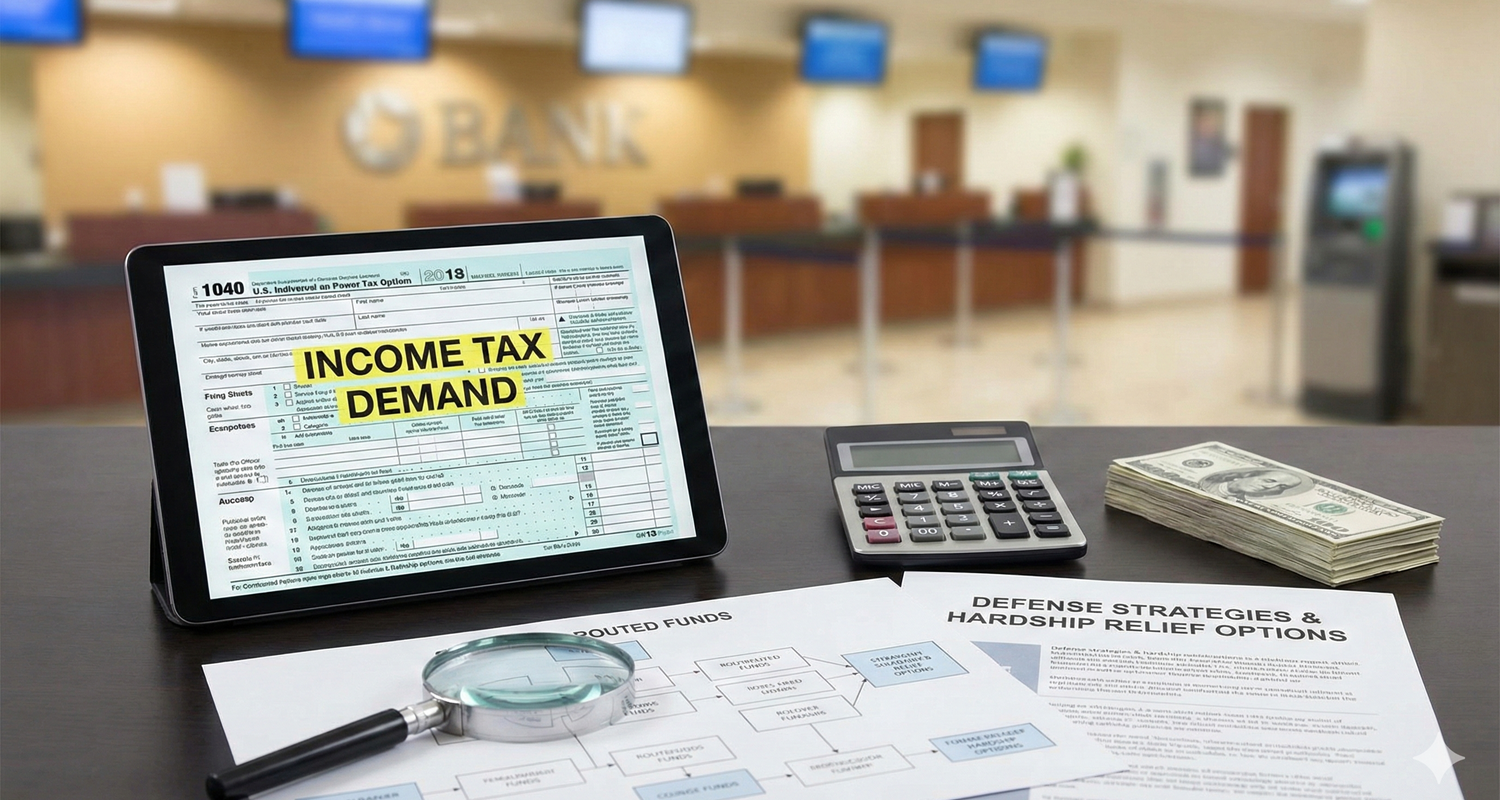
By Families often face sudden financial crises when the Income Tax Department issues massive tax demands for transactions dating back several years. A common scenario involves an individual allowing a business acquaintance to route funds through their personal bank account.
Years later, after business failures and address changes cause them to miss statutory notices, automated systems generate ex parte assessment orders taxing the entire gross deposit amount. For households relying on a single earning member with zero savings, paying these multi lakh demands is impossible.
This guide details the exact legal steps available to challenge these automated assessments. It explains how to file delayed appeals, prove physical non receipt of notices, utilize the peak credit defense, and secure a complete waiver of pre deposit requirements based on severe poverty.
Income Tax Assessments Involving Routed Funds, Defective Notice Service, and Financial Hardship
Tax disputes frequently emerge when individuals allow business acquaintances to route funds through their personal bank accounts. The Income Tax Department relies on automated systems to flag high volume transactions. When nominal account holders relocate and miss statutory notices, assessing officers issue substantial tax demands based entirely on algorithmic data. Families facing absolute financial depletion require specific statutory remedies to pause recovery actions and dispute the legal basis of the taxation.
Time Limits and Notice Service Rules
The Income Tax Act imposes strict limitation periods for reopening assessments. Under Section 149, the normal time limit to issue a notice is three years and three months from the end of the assessment year. If the tax authority possesses evidence that unreported income exceeds INR 50 lakhs, this period extends to five years and three months based on the 2024 legislative amendments.
A central complication arises when individuals change residences. Section 282 and Rule 127 govern the delivery of legal communications. Officers must send notices to the address available in the PAN database or the most recent tax return. The Supreme Court established that taxpayers bear the responsibility to update their PAN records. If a taxpayer moves but leaves the database unchanged, notices sent to the old address are legally valid.
Filing Late Appeals
Taxpayers must submit an appeal to the Commissioner of Income Tax Appeals within thirty days of receiving a demand notice. Section 249 grants appellate authorities the power to admit delayed appeals if the applicant demonstrates sufficient cause. Courts dictate that natural justice principles require admitting appeals delayed by genuine financial ruin and loss of primary residence. The taxpayer must submit a sworn affidavit detailing the exact timeline of their displacement.
Validity of the Reassessment Notice
Tax authorities often reopen past assessments mechanically based on automated financial reports. The Supreme Court dictates that an assessing officer must independently evaluate the information before issuing a notice under Section 148. Simply receiving a system generated alert about high value transactions does not constitute a valid legal reason to reopen a file. Taxpayers must demand a copy of the recorded reasons and file formal objections before proceeding with the main appeal. Proving that the officer applied no independent thought can invalidate the entire assessment procedure.
The Peak Credit and Conduit Defenses
When algorithmic systems detect large deposits, assessing officers often tax the total sum. Indian appellate tribunals reject this method for running business accounts. The Peak Credit principle requires officers to track continuous deposits and immediate withdrawals. Tax applies strictly to the highest unexplained balance available on a single day, preventing double taxation of recycled money.
The Commission Theory offers stronger protection for individuals who acted merely as conduits. When an individual provides banking channels for a third party without keeping the funds, they are an accommodation entry provider. Tribunals rule that taxing the entire principal amount violates real income principles. Only the actual profit is taxable. Courts typically estimate this commission between 0.15 percent and 5 percent of the total volume.
Tax Liability Comparison Chart
Comparison of taxing gross deposits under Section 115BBE versus taxing estimated commission income.
| Assessment Method | Basis of Taxation | Effective Tax Rate | Expected Outcome |
|---|---|---|---|
| Gross Addition (Section 68) | Total sum of all inward remittances | Up to 88 percent (Section 115BBE) | Ruinous demands in crores |
| Peak Credit Theory | Highest daily balance only | Standard slab rates | Substantial reduction |
| Conduit Commission | Estimated fee (0.15 to 5 percent of volume) | Standard slab rates | Nominal tax liability |
Managing Financial Hardship and Debt Recovery
Submitting an appeal does not suspend the legal right of the department to collect the debt. The taxpayer must file a distinct application under Section 220 to hold the demand in abeyance. Internal tax department rules usually require depositing 20 percent of the disputed amount upfront.
High courts and the Supreme Court consistently rule that officers can waive this pre deposit requirement completely. To secure a waiver, the applicant must prove three conditions exist. First, they must show a strong legal case based on peak credit or conduit principles. Second, they must demonstrate the assessment is unreasonably high compared to actual income. Third, they must provide evidence of absolute financial hardship.
Protection of Family Assets
The Income Tax Act strictly enforces individual liability. The tax recovery officer possesses zero legal authority to attach the salary or bank accounts of a dependent daughter to satisfy the tax debts of her living father. The financial autonomy of separate family members remains secure under law.
Post Demise Liability
If the primary taxpayer passes away, Section 159 dictates that legal representatives inherit the tax dispute. The liability of the surviving daughter is strictly limited to the value of the estate she actually inherits. The state cannot seize her personal wealth to settle her father’s tax debt.
Penalty Proceedings and Immunity
The tax department routinely initiates penalty proceedings under Section 270A for underreported income alongside the main tax demand. The law requires the authority to prove a deliberate attempt to conceal income. In cases involving bank routing by a nominal account holder, the element of intentional tax evasion is usually absent. Taxpayers can file an application under Section 270AA to seek immunity from these penalties if they meet specific statutory conditions and cooperate with the appellate process.
The Prohibition of Benami Property Transactions Act
Taxpayers face extreme risks if they attempt to obtain written declarations from the business acquaintance who owned the funds. Allowing third party money to route through a personal account meets the exact legal definition of a Benami transaction. The true owner is the beneficial owner, while the account holder is the Benamidar.
The Prohibition of Benami Property Transactions Act mandates severe criminal prosecution for both parties. Submitting proof of this arrangement to the tax department triggers immediate confiscation of connected assets and carries a prison sentence of up to seven years. Legal defense must rely solely on the mathematical evidence present in bank statements to prove immediate fund clearance.
Retrieving Closed Bank Records
Reconstructing the financial trail is mandatory to prove the funds were immediately cleared. Banks archive statements for closed accounts for up to ten years under Reserve Bank of India guidelines. The father must submit a physical application to the home branch manager detailing the closed account number and current KYC documents. If the branch refuses or delays the request beyond thirty days, the family should file a formal complaint with the Banking Ombudsman through the official Reserve Bank of India portal to compel the release of the documents.
Alternative Grievance Redressal
While legal appeals are pending, families facing immediate financial threats can utilize administrative grievance portals. The e-Nivaran system on the income tax portal and the centralized CPGRAMS platform allow citizens to escalate extreme hardship cases directly to higher administrative officers. These channels do not replace the formal legal appeal but act as a parallel method to request intervention against aggressive recovery actions by junior officers who ignore documented poverty.
Proving Source under Section 68
Section 68 governs unexplained cash credits. When fighting additions under this section, the legal burden rests entirely on the taxpayer. The courts require proof of three specific elements. First, the taxpayer must prove the identity of the person sending the funds. Second, they must establish the financial capacity of that sender. Third, they must prove the genuineness of the specific transaction. If the taxpayer acted as a conduit, they must present the bank statements of the original sender to satisfy these three legal requirements.
Bank Account Attachment and Section 226
The assessing officer possesses the power to attach bank accounts under Section 226 of the Income Tax Act. They issue a direct notice to the bank manager. The bank must freeze all outward clearing. To lift this freeze, the taxpayer must submit the stay of demand application discussed earlier. Once the officer grants the stay or the appellate authority intervenes, the officer issues a formal defreeze order to the bank.
Credit Reporting Autonomy
Families often worry about the impact of tax demands on credit scores. The Reserve Bank of India regulates credit information bureaus like CIBIL. Tax defaults do not currently report to consumer credit bureaus. The personal credit rating of the daughter remains completely isolated from the tax liabilities of the father. She can continue to secure home loans or personal credit without interference from the income tax recovery process.
High Pitched Assessment Committees
The Central Board of Direct Taxes created Local Committees to deal with high pitched assessments. If an assessment is exceptionally arbitrary, the taxpayer can file a grievance petition with this specific committee. The committee operates independently of the regular appellate process. They hold the authority to direct the assessing officer to review the demand. This administrative route provides rapid relief when officers flagrantly ignore peak credit rules.
Best Judgment Assessments Under Section 144
When taxpayers fail to respond to statutory notices, the assessing officer finalizes the demand ex parte. This process is governed by Section 144. It relies entirely on the material currently available on record. In cases of routed funds, the record only shows massive deposits. The officer holds no legal obligation to assume the funds were withdrawn for business purposes without documentary proof. The resulting best judgment assessment always taxes the maximum possible gross amount. To counter this in appeal, the taxpayer must present fresh evidence under Rule 46A of the Income Tax Rules. They must formally justify why this evidence was not submitted during the original assessment proceedings.
AIS and Automated Intelligence Gathering
Modern tax administration relies heavily on the Annual Information Statement and the Taxpayer Information Summary. Banks automatically report cash deposits exceeding ten lakhs and high value digital transfers to the Central Board of Direct Taxes through Statement of Financial Transactions filings. The automated system matches these reports against the PAN of the account holder. If the system detects a mismatch between the reported transactions and the filed income tax return, it automatically generates a scrutiny flag. The assessing officer rarely applies human review before the initial notice is issued.
The e-Dispute Resolution Scheme
For taxpayers facing specific types of additions, the e-Dispute Resolution Scheme offers a digital alternative to standard appeals. This system reduces litigation for smaller disputes. However, the scheme contains strict eligibility criteria based on the returned income and the disputed variation. Cases involving multi crore bank deposits usually exceed the jurisdictional limits of the e-DRS. Families must verify the exact quantum of the demand before attempting this route. Pursuing an ineligible administrative remedy wastes the statutory thirty day appellate window.
Forensic Audit Requirements
Bank statements alone may not convince a skeptical appellate authority. Securing a formal certificate from a practicing Chartered Accountant adds massive weight to the peak credit claim. The accountant conducts a forensic review of the inward and outward remittances to verify that the dates and amounts align perfectly. This professional certification acts as independent verification. It shifts the burden back to the tax department to legally disprove the arithmetic facts presented in the appeal.
Procedural Steps for Dispute Resolution
Procure Bank Records
Obtain complete chronological statements for the closed account. This serves as the primary forensic evidence to prove immediate inward and outward clearing.
File Form 35
Submit the statutory appeal electronically to the Commissioner of Income Tax Appeals. Include the affidavit requesting delay condonation.
Request Stay
File the petition under Section 220 directly with the assessing officer. Attach proof of current income and lack of assets to justify the waiver of the pre deposit.
Seek Free Legal Aid
Approach the District Legal Services Authority. Citizens below certain income thresholds qualify for free professional representation.
Draft Templates
Below are basic structural formats for required legal submissions. Legal counsel should adapt these to specific facts.