 By
By Outdoor advertising functions as a high-stakes commercial instrument where property owners often face statutory liabilities for structural safety and municipal compliance.
A poorly drafted agreement can inadvertently create a tenancy protected by rent control or trigger punitive ad valorem stamp duty under Article 35.
This resource examines the legal architecture required to ring-fence property owners from third-party claims while ensuring compliance with the Kolkata Municipal Corporation Advertisement Policy 2025 and recent Digital Out-of-Home (DOOH) power regulations.
Legal and Commercial Dynamics of Advertising Rights Agreements in India
A comprehensive guide for property owners and advertisers on the convergence of property rights, municipal regulations, and commercial media.
The outdoor advertising landscape in India involves complex legal, regulatory, and commercial agreements. It functions as a hybrid commercial instrument. Property owners are no longer passive recipients of rental income. Statutory frameworks hold them liable for structural safety, content decency, and municipal taxes. The “Advertising Rights Agreement” acts as a sophisticated legal shield designed to secure revenue and ring-fence liability.
The Lease Versus License Dichotomy
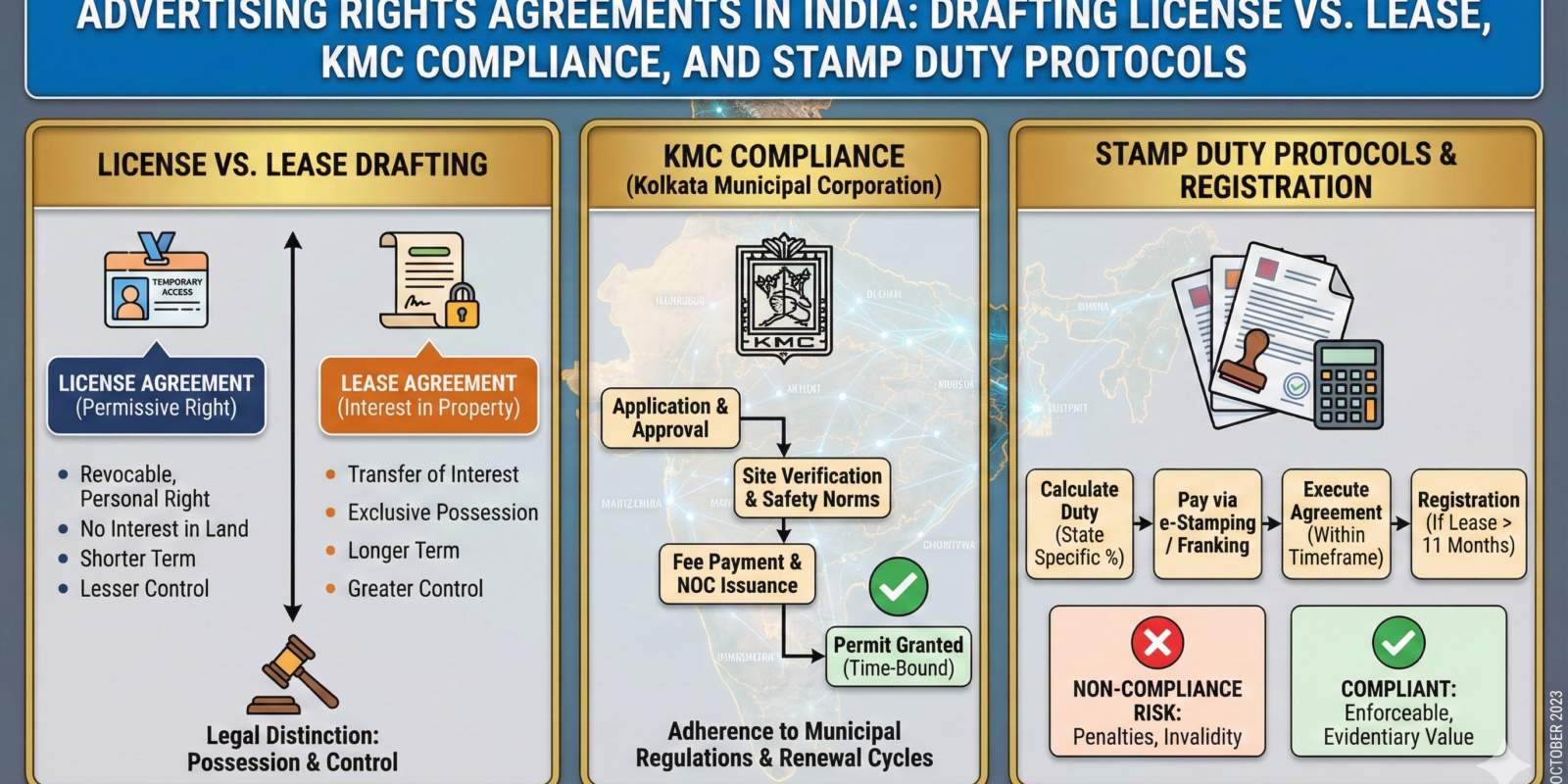
The classification of the agreement as a “Lease” or a “License” determines rights, security of tenure, and stamp duty liability.
Under Section 105 of the Transfer of Property Act, 1882, a lease transfers an interest in property. This includes the right to exclusive possession. If a court construes an agreement as a lease, the advertiser acquires statutory protection against eviction. The owner cannot revoke the agreement at will.
A license, under Section 52 of the Indian Easements Act, 1882, grants a right to do something on the property that would otherwise be unlawful. It does not transfer interest. A license is revocable. This provides the property owner with greater control.
Strategic Drafting for “License” Classification
To keep the agreement as a “License,” drafting must be precise. The agreement should state that the Licensor retains legal possession. The Licensee is granted only a permissive right of use. Terminology like “rent” or “tenant” should be avoided. Use “license fee” and “licensee” instead.
Drafting Insight
Courts examine the substance of the transaction. If an agreement grants the advertiser the sole key to the terrace or excludes the landlord, a court may reclassify it as a lease. This reclassification can lead to impounding for insufficient stamp duty.
| Feature | Lease (Tenancy) | License (Permissive Use) |
|---|---|---|
| Legal Basis | Transfer of Property Act (Sec 105) | Easements Act (Sec 52) |
| Possession | Exclusive Possession | Legal possession stays with Owner |
| Stamp Duty (WB) | High (~6-7% + Reg Fee) | Lower (Article 5 rates) |
| Revocability | Protected by Rent Control | Revocable at will |
The Digital Pivot: DOOH Regulations
Digital Out-of-Home (DOOH) advertising replaces vinyl with LEDs, introducing new legal variables. Owners must account for high-voltage electricity lines, luminance pollution norms, and cyber security.
1. Luminance and Traffic Safety
Under the IRC:46-1972 guidelines and recent municipal bylaws, digital screens facing traffic junctions face strict brightness caps (measured in Nits). Agreements must place the burden of “Dimming Compliance” on the advertiser. If a screen is deemed a traffic hazard and switched off by police, the owner should not lose revenue.
2. Power Infrastructure
DOOH screens consume significant power. The agreement must specify:
- Sub-metering: Installation of a dedicated sub-meter for the hoarding.
- Load Enhancement: Costs for increasing the sanctioned load of the building must be borne by the Advertiser.
- Fire Safety: Mandatory installation of industrial-grade circuit breakers (MCBs/ELCBs) to prevent short circuits from affecting the main building.
Regulatory Landscape: Kolkata Case Study
Municipal corporations hold powers to regulate and demolish outdoor media. The Kolkata Municipal Corporation Act, 1980 provides a rigorous template. Ignorance of these provisions renders private agreements void.
The KMC Advertisement Policy 2025
The 2025 Policy introduces stringent norms. Agreements in “No Advertisement Zones” are prohibited. Ads are banned near heritage buildings, places of worship, hospitals, and educational institutions. Property owners must warrant that their building does not fall into restricted categories.
Key Physical Limits:
- Roof Height: The top of the hoarding must not exceed 41 feet from the terrace level.
- Ground Clearance: Must be at least 11 feet for pedestrian movement.
- Spacing: A minimum distance of 16 feet between two hoardings.
Financial Architecture & Stamp Duty
Commercial viability depends on understanding fiscal burdens. In West Bengal, stamp duty rates and municipal levies shape the financial landscape.
Stamp Duty Analysis
Most short-term contracts use the “Agreement” route under Article 5 of Schedule IA. This attracts a nominal or low ad valorem duty. If structured as a lease under Article 35, the duty is punitive. For a term less than 5 years in urban areas, the duty is roughly 6% to 7% of the total rent. The West Bengal government removed the rebate on stamp duty effective July 1, 2024.
Duplicate Copies
Standard clauses often state: “This agreement shall be executed in duplicate.” In many jurisdictions, the duplicate copy also attracts stamp duty (often a fixed nominal fee or a percentage of the original duty). The agreement must clarify that the Advertiser bears the cost for both the original and duplicate, as they typically retain the original for municipal filings.
The “Make Good” & Exit Protocol
The end of an advertising agreement is often more contentious than the beginning. Removal of iron structures damages walls and waterproofing. A “Restoration Clause” is non-negotiable.
The “Self-Help” Restoration Mechanism
Relying on standard partnership templates, a robust agreement should include a “Self-Help” clause. If the Advertiser fails to remove the structure within 15 days of termination:
- The Owner is authorized to dismantle the structure.
- The Owner can sell the scrap to recover costs.
- If costs exceed scrap value, the Owner can claim the difference.
- Holding Over Fee: The Advertiser must pay a penalty (often 2x the license fee) for every day the structure remains after termination.
Operational Access & Factory Security
Agreements often involve factories or secure commercial complexes. Advertisers require access for maintenance (changing vinyl, repairing lights), but factory owners have strict safety and secrecy protocols. The agreement must bridge this gap.
Access limited to 10:00 AM – 5:00 PM. No entry during night shifts unless emergency repair is required and prior written permission is granted.
Advertiser staff must carry valid ID cards. The Owner reserves the right to frisk workers and inspect materials entering or leaving the factory premises.
Strict prohibition on advertiser staff entering production floors. Movement restricted solely to the designated staircase leading to the terrace/wall.
Force Majeure & Regulatory Risk
The standard “Act of God” clause is insufficient for outdoor media. The primary risk is not an earthquake, but a Government Notification. Elections, city beautification drives (e.g., G20 summits), or court orders can force hoardings to go blank.
The “Abatement of Rent” Clause:
The agreement should specify that if a competent authority (Election Commission, High Court) orders the removal or covering of ads, the License Fee shall abate pro-rata for that specific period. However, the agreement should not terminate automatically unless the suspension exceeds 60 continuous days.
Notice Protocols: Modernizing Clause 13
Traditional agreements often mandate “Registered Post” to the Factory Manager. In an era of remote work and instant communication, strict adherence to physical posts can defeat legal notices if the office is closed.
Hybrid Notice Clause
Modern drafting recommends a “Deemed Service” model:
- Primary: Speed Post with A/D to registered address.
- Concurrent: Email to a designated official (e.g., director@advertiser.com).
- Validity: Notice is deemed served 48 hours after dispatch of post OR immediately upon email delivery receipt, whichever is earlier.
Liability and Indemnity
Advertising hoardings create tortious liability risks. Under the rule in Rylands v. Fletcher, a property owner is prima facie responsible for safety.
Agreements must impose obligations on the Advertiser:
- Structural Stability: Mandatory submission of a Stability Certificate from an empanelled engineer.
- Insurance: “Public Liability Insurance” covering third-party injury and property damage.
- Indemnity: A specific “Structural Indemnity” clause protecting the owner from claims arising from collapse or debris.
Execution Authority
A common error in litigation is the challenge to the signatory’s authority. Agreements must be executed by authorized personnel.
Signatory Due Diligence Checklist
Must be signed by a Director or authorized signatory backed by a specific Board Resolution. A simple letter of authority is often insufficient in court.
Signed by the Managing Partner or a partner authorized by the Partnership Deed. Require a copy of the Firm Registration Certificate.
Signed by the Trustee/Secretary as empowered by the Trust Deed or Bye-laws.
The Lifecycle of an Ad Agreement
Understanding the chronological flow from negotiation to exit prevents procedural lapses.
Templates
Use these snippets as a foundation for drafting robust agreements.