 By
By Corporate staff transportation relies on a split procurement model: buying a chassis and hiring a fabricator. This structure saves costs but opens significant liability gaps regarding tax, insurance, and safety compliance.
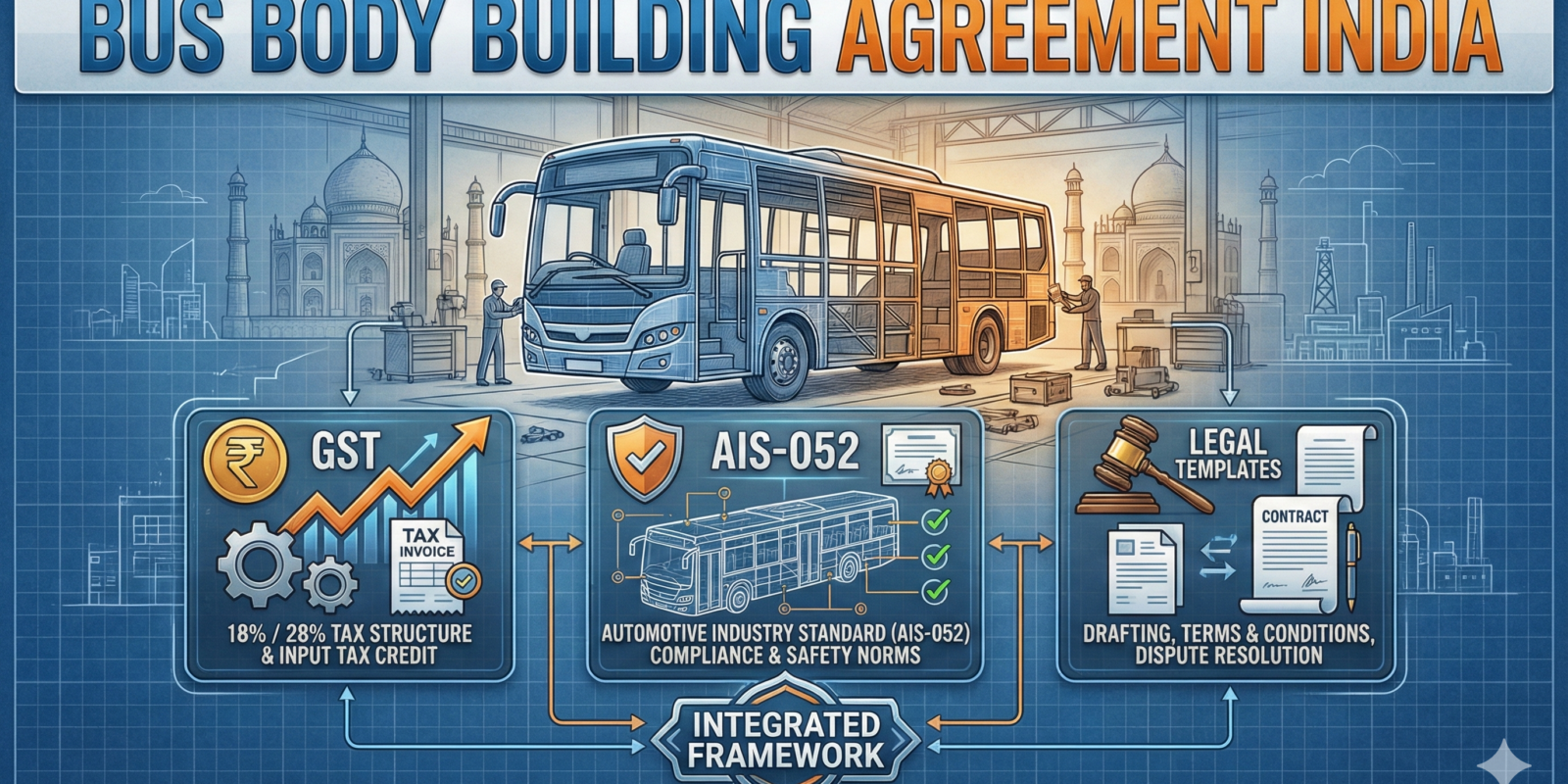
This guide examines the commercial and legal mechanics of the Bus Body Building Agreement. It details the financial advantage of the ‘Job Work’ model over outright purchase, outlines mandatory AIS-052 and AIS-140 specifications, and provides actionable templates for risk mitigation.
From structuring payment milestones to enforcing ‘Held in Trust’ insurance policies, this resource addresses the specific challenges of managing fleet fabrication contracts in India.
The Bus Body Building Agreement: A Corporate Shield
Staff transportation in India defines operational continuity. For manufacturing units in SEZs or tech parks on city outskirts, the daily commute is a logistical backbone. Companies rarely buy buses off the shelf. They buy a chassis from an OEM like Tata or Ashok Leyland and hire a contractor to build the body.
This split procurement saves costs but introduces liability. A chassis is an incomplete vehicle. Until the body is built and certified, it cannot be registered. The legal instrument governing this transformation is the Bus Body Building Agreement. This document must navigate the Indian Contract Act, the Sale of Goods Act, and the complex “Bus Code” (AIS-052).
Why This Matters
A weak agreement leads to unregistrable vehicles, tax leakage, and uninsured losses. This guide breaks down the legal mechanics required to secure your fleet.
The Tax Arbitrage: Sale vs. Service
The financial structure of the deal defines the tax. You have two options. Option A is the Sale Model where the contractor buys the chassis and sells you a bus. Option B is the Works Contract Model where you provide the chassis. Option B is the industry standard for a reason. It shifts the transaction from a “Sale of Goods” to “Job Work.”
Visualizing Tax Impact (GST Rates)
Figure 1: Comparison of GST incidence between outright purchase and the job work model.
| Feature | Sale Model | Job Work Model |
|---|---|---|
| Chassis Ownership | Contractor | Company (You) |
| Legal Concept | Transfer of Title | Bailment & Service |
| GST Rate | 28% + Cess | 18% (SAC 998881) |
The Chassis Handover Protocol
The most contentious moment in the contract lifecycle is the physical handover of the chassis. OEM chassis often arrive with minor transit damages (scratches on the cowl, minor electrical issues). If undocumented, the Body Builder will later claim these were “manufacturing defects” to avoid liability for delays.
Mandatory: The Joint Inspection Report (JIR)
-
1
Inventory Check Verify the Stepney (spare tyre), Toolkit, and Battery Serial Numbers. These are frequently pilfered or swapped at workshops.
-
2
Odometer Reading Record exact km. Unscrupulous contractors may use the chassis for local errands before body mounting.
Material Specs: GI vs. MS
The agreement must specify materials. A generic term like “High Quality Steel” is legally insufficient and functionally disastrous.
The Standard: GI Tubular Structure
Galvanized Iron (GI) tubes resist rust. For coastal cities or high-humidity zones, GI is non-negotiable. It increases longevity by 5-7 years.
The Cost Cutter: MS Angle/Tube
Mild Steel (MS) is cheaper but rusts quickly once the paneling hides it. If using MS, the agreement must mandate “Red Oxide Primer” application before paneling.
Fire Safety: Specify FR Grade (Fire Retardant) plywood for flooring and FR grade upholstery. This is a critical safety norm under the Motor Vehicles Act.
The Financial Architecture
Structuring payment milestones is your primary lever for quality control. Do not pay 100% on delivery. Standard agreements utilize a staggered approach that incentivizes speed without sacrificing leverage. The RTF document explicitly links the “Security Deposit” repayment to the expiration of the defect liability period.
Upon signing and chassis delivery. Fully secured against a Bank Guarantee.
Upon framing, paneling, and flooring completion. Verified by Stage-1 Inspection.
After final inspection, shower test, and Type Approval verification.
Held for 12 months (Defect Liability Period). Released only after warranty expiry.
The “Cure or Pay” Mechanism: Your agreement (Clause 7) introduces a powerful remedy. If the contractor fails to fix defects within 7 days, the Company can fix them internally or via a third party. The cost incurred is recoverable from the Contractor with 15% interest per annum. This turns a passive warranty into an active debt obligation.
The Three-Stage Inspection Protocol
Payments should never be released based on a phone call. The agreement must mandate physical inspections at critical “No-Return” points in the fabrication process.
Stage 1: The Skeleton Check (Structural)
Trigger: Completion of framing, before paneling starts.
Checklist: Verify tube thickness (using vernier calipers), weld penetration quality, and application of anti-rust primer on joints. Ensure chassis cross-members are not cut or drilled (which voids OEM warranty).
Stage 2: The Skin Check (Paneling)
Trigger: Exterior paneling done, interior insulation placed.
Checklist: Verify usage of ‘Thermocol’ or ‘Glass Wool’ insulation. Check panel gaps for flushness. Inspect wiring harnesses for proper sleeving (protection against short circuits).
Stage 3: The Shower Test (Final)
Trigger: Fully painted and seats installed.
Checklist: The “Shower Test” is non-negotiable. The bus must be subjected to high-pressure water jets for 30 minutes to detect roof and window leaks. Only then is the “Pre-Dispatch” payment released.
The Warranty Hierarchy
A blanket “1-Year Warranty” is insufficient for a capital asset like a bus. The agreement should split the warranty into three distinct tiers to match the degradation curve of the materials.
Covers welding failures, frame cracks, and chassis mounting points. Critical for safety.
Covers fading, peeling, and bubbling. Specify “PU Paint” in the specs to enforce this.
Zero-tolerance for roof or window leaks during the first rainy season post-delivery.
Termination & Step-in Rights
What happens if the contractor goes bankrupt or halts work indefinitely? Standard termination clauses are weak because the chassis is stuck in their yard. You need Step-in Rights.
This clause allows the Company to enter the premises, seize the semi-finished vehicle, and either remove it or employ a third-party contractor to finish the work in situ or elsewhere. The cost differential is legally recoverable from the original contractor’s pending dues or Security Deposit.
Regulatory Compliance: The Bus Code & AIS-140
The days of roadside fabrication are over. The Central Motor Vehicles Rules (CMVR) mandate adherence to AIS-052. Your agreement must specify a Type III bus body for staff transport. This classification dictates seat spacing, aisle width, and comfort.
The New Frontier: AIS-140. Since 2019, all public service vehicles, including staff buses, must be equipped with a Vehicle Location Tracking Device (VLTD) and Panic Buttons. The agreement must explicitly state that the Contractor is responsible for installing AIS-140 compliant hardware and ensuring it is integrated with the specific State Government’s backend monitoring center. Failure here means the RTO will refuse the fitness certificate.
The “Lien” Trap & Exit Strategy
In the event of a dispute or insolvency, contractors often attempt to exercise a “General Lien” over the chassis, refusing to release it until disputed dues are paid. Since the chassis legally belongs to you (under the Job Work model), this is a wrongful detention.
However, to avoid police intervention or court orders, the agreement must explicitly Waive the Right to Lien. Furthermore, the agreement should contain a “No Subcontracting” clause to ensure the chassis doesn’t end up in an unknown third-party shed, complicating recovery.
Risk Allocation Matrix
A robust agreement anticipates disaster. The table below outlines how liability shifts during the lifecycle of the build.
| Risk Event | Liability Holder | Mitigation Strategy |
|---|---|---|
| Fire/Theft of Chassis | Contractor (Bailee) | “Held in Trust” Insurance Endorsement |
| Design Non-Compliance | Contractor | Indemnity against RTO rejection |
| Accident during Transit | Contractor | Temporary Registration (TR) & Transit Insurance |
| Delayed Delivery | Contractor | Liquidated Damages (0.5% per week) |
The “Held in Trust” Insurance Clause
This is the most frequent point of failure. Your corporate motor policy likely excludes coverage when the vehicle is stripped down in a workshop. The contractor must hold a specific policy.
Section 148 of the Contract Act defines this as Bailment. You are the Bailor; the contractor is the Bailee. The contractor must carry a “Standard Fire and Special Perils Policy” endorsed for Goods Held in Trust. If the workshop catches fire, a standard policy will not pay for your chassis because the contractor does not own it. The “Held in Trust” endorsement bridges this gap.
Smart Clause Checklist
Filter by category to verify your agreement covers the essentials.
Drafting Templates
Use these verified text blocks to fortify your agreement.
Clause: Scope of Job Work (Tax Efficiency)
The Parties agree that this Agreement constitutes a contract for services (Job Work) under SAC 998881. The Company provides the Chassis to the Contractor solely for fabrication. The Contractor acknowledges it has no title to the Chassis and holds it strictly as a Bailee under Section 148 of the Indian Contract Act, 1872.
Clause: Step-in Rights (Termination)
In the event of termination due to breach or insolvency, the Company shall have the right to enter the Contractor's premises and take possession of the Chassis and Bus Body in its 'as-is' condition. The Company may engage a third party to complete the works, and any excess cost incurred shall be recoverable from the Contractor's dues or Security Deposit.
Clause: Waiver of Lien & Subcontracting
The Contractor hereby irrevocably waives any right of lien (General or Particular) over the Chassis or the constructed Bus Body under any circumstances. The Contractor shall not subcontract the fabrication work, in whole or in part, to any third party without prior written consent from the Company.
Clause: Defect Cure & Interest Penalty (Strict)
If the Contractor fails to cure defects within 7 days of written notice, the Company shall be entitled to rectify such defects through a third party. The Contractor shall reimburse the Company for all costs incurred in such rectification, together with interest at the rate of 15% per annum calculated from the date of expenditure until the date of reimbursement.
Clause: Liquidated Damages
Time is of the essence. If the Contractor fails to deliver within the Delivery Period, they shall pay Liquidated Damages at 0.5% of the Job Work Charges per week of delay, capped at 10% of the Contract Value. This amount is a genuine pre-estimate of losses including alternative transport costs.
Clause: Regulatory Indemnity
The Contractor warrants that the Bus Body conforms to AIS-052 (Code of Practice for Bus Body Design). Any penalty, seizure, or refusal of registration by the RTO due to non-compliance with CMVR or AIS standards shall be the sole liability of the Contractor.
Visual Template: Joint Inspection Report (JIR)
Use this standardized paper-style form for the physical handover of the chassis. This format is designed to be printed and signed on-site.
Joint Physical Verification Report
(Chassis Handover Protocol)
Part A: The Chassis Details
| Item | Details / Serial No. | Verified? |
|---|---|---|
| Chassis Number | ________________________________ | |
| Engine Number | ________________________________ | |
| Odometer Reading | ________________________ Kms |
Part B: Inventory (Loose Items)
| Category | Status / Serial No. | Condition |
|---|---|---|
| Battery (Make/Sr No.) | ________________________________ | Good / Dead |
| Spare Tyre (Stepney) | Make: ________________________ | New / Used |
| Toolkit & Jack | Qty: _________________________ | Present / Missing |
| Missing Items / Notes | ______________________________________________________ | |
Part C: Condition Acknowledgement
“The Contractor acknowledges receipt of the Chassis in the condition described above. Any scratches, dents, or missing items not noted in this report shall be deemed to have occurred at the Contractor’s workshop, and the Contractor shall be liable for the same.”
Frequently Asked Questions
Can we use the ‘Sale’ model to avoid complexity?
Yes, but it is expensive. The ‘Sale’ model attracts 28% GST plus Cess. The ‘Job Work’ model attracts only 18% GST. On a fleet of 10 buses, the difference is substantial.
What happens if the chassis is damaged at the workshop?
Unless you have the “Held in Trust” clause in the contractor’s insurance policy, you might face a total loss. Your own motor policy usually doesn’t cover the vehicle while it is under modification.
Who provides the AIS-140 Panic Buttons?
The body builder/contractor must install them during fabrication. Installing them post-delivery is messy and involves cutting into new paneling. Ensure this is in the Scope of Work.
What is the Joint Inspection Report (JIR)?
It is a document signed by both parties when the chassis is handed over to the contractor. It records existing scratches, battery serial numbers, and accessories to prevent theft or false damage claims later.
Why is the Shower Test mandatory?
Bus bodies often leak at the roof joints or window sealants. A 30-minute high-pressure shower test reveals these leaks before you pay the final installment. Fixing leaks after taking delivery is notoriously difficult.