 By
By Indian exporters frequently encounter a regulatory dead end when attempting to replace a lost license using outdated legal formats. If your compliance team is holding an affidavit addressed to the “Department of Supply,” the document is procedurally void. That administrative body was dissolved in 2000, and its functions were absorbed by the Ministry of Commerce.
Under the Foreign Trade Policy 2023, the Directorate General of Foreign Trade (DGFT) acts as the sole authority for issuing duplicate authorizations. The current protocol treats transferable licenses like financial instruments, requiring rigorous safeguards.
Obtaining a replacement now demands specific digital evidence, a filed First Information Report (FIR), and a financial indemnity bond rather than simple sworn statements.
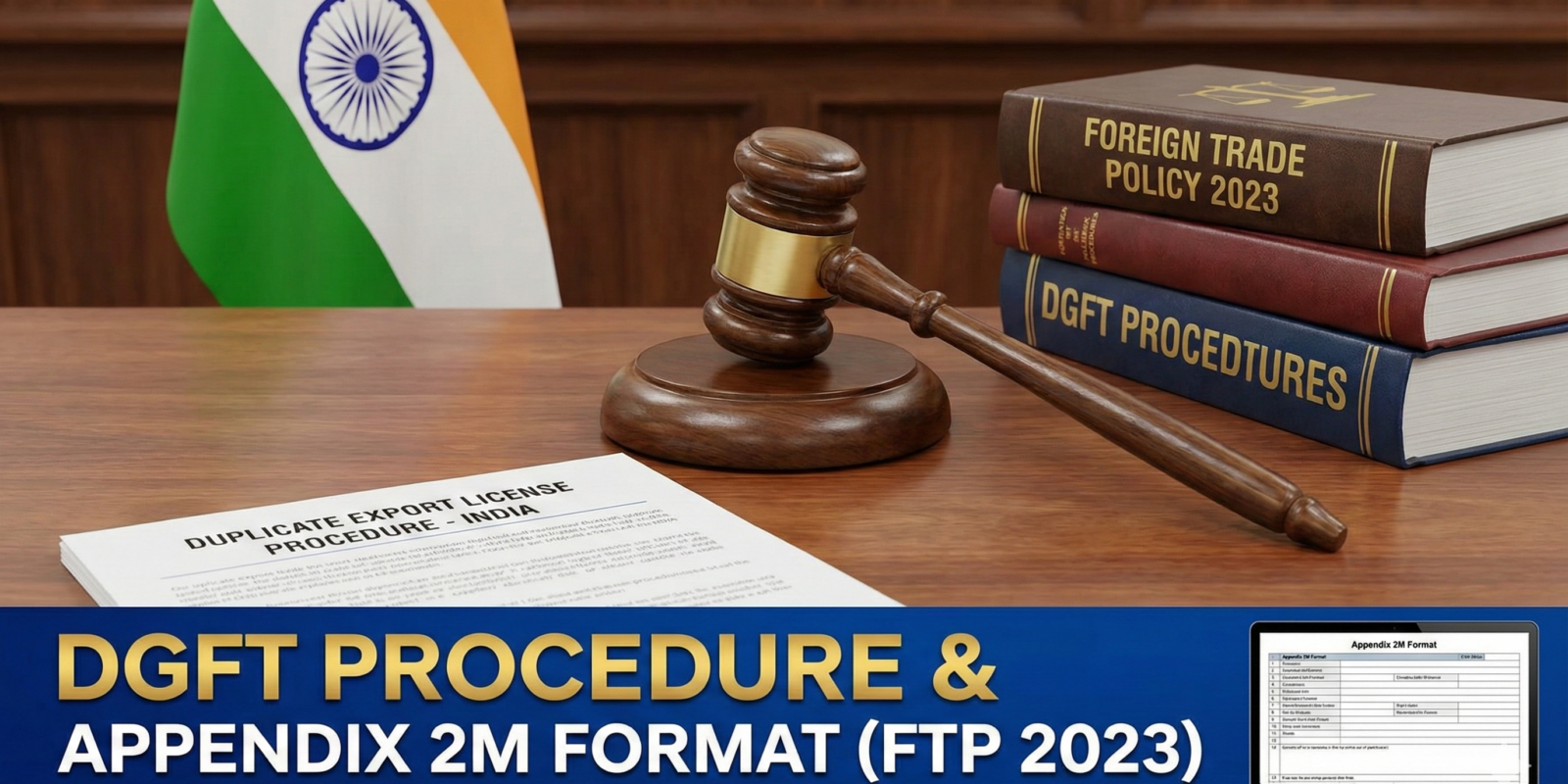
This guide outlines the exact regulatory steps, fee calculations, and the mandatory Appendix 2M self-declaration format required to secure a duplicate license without facing rejection at the Regional Authority.
Duplicate Export Licensing in India: A Modern Compliance Guide
The administration of international trade in India has shifted from a rigid command-and-control system to a digital-first framework. Yet legacy documentation persists in many corporate archives. If you are holding an affidavit addressed to the “Department of Supply” for a lost export license, you are looking at a relic of the past.
This guide clarifies the transition from the Chief Controller of Imports and Exports (CCI&E) to the Directorate General of Foreign Trade (DGFT) and outlines the precise procedure for obtaining duplicate authorizations under the Foreign Trade Policy 2023.
The Obsolescence of the “Department of Supply”
The “Department of Supply” was the logistical backbone of British Indian administration during World War II, primarily tasked with mobilizing war resources. It exercised strict control over “iron goods” and other strategic materials. In the post-independence era, this department functioned alongside the Ministry of Commerce.
However, the Department of Supply was abolished in 2000. Its functions were merged into the Department of Commerce. The Directorate General of Supplies and Disposals (DGS&D), the department’s executive arm, was wound up in 2017 and replaced by the Government e-Marketplace (GeM). Addressing a legal affidavit to this entity today renders the document procedurally invalid.
Current Regulatory Framework: FTP 2023
Under the Foreign Trade Policy (FTP) 2023, the Directorate General of Foreign Trade (DGFT) is the sole nodal authority for export licensing. The process for obtaining a duplicate license is governed by Chapter 2 of the Handbook of Procedures.
The modern process distinguishes between simple permissions and “freely transferable authorizations” (like Advance Authorizations or EPCG). The latter are treated as financial instruments. Losing one is equivalent to losing a bearer bond; thus the safeguards are stringent.
Comparative Analysis: Old vs. New Requirements
| Feature | Historical Affidavit (Old Regime) | Current Requirement (FTP 2023) |
|---|---|---|
| Authority | Department of Supply | Regional Authority (RA) of DGFT |
| Proof of Loss | General mention | Copy of FIR (Mandatory) |
| Indemnity | Promise to return if found | Financial Indemnity Bond |
| Fee | Stamp duty | 10% of Duty Saved / Unutilized Credit |
| Format | Judicial Affidavit | Appendix 2M (Self Declaration) |
Step-by-Step Procedure for Duplicate License
If you have lost a license, follow this strict protocol to ensure compliance and avoid liability.
1. Immediate Reporting
File a First Information Report (FIR) with the police. The FIR must cite the License Number and Date. Simultaneously, notify the Customs authority at the port of registration to prevent unauthorized use.
2. Documentation
Prepare Appendix 2M. This is a specific self-declaration format. You must also execute an Indemnity Bond on non-judicial stamp paper. This bond legally binds you to repay the government if the lost license is used fraudulently by a third party.
3. Fee Payment
Calculate 10% of the unutilized duty credit or duty saved. This fee acts as a processing charge and a deterrent against negligence.
4. Online Submission
Submit the application via the DGFT portal. Physical files are no longer accepted for this process.
Interactive Assessment Tool
Templates and Formats
Do not use outdated affidavit formats found in old company records. Below is the correct structure for the Appendix 2M Self Declaration required today.
To: The Regional Authority, DGFT
Subject: Self Declaration for obtaining Duplicate Copy of Licence / Authorisation
I/We hereby solemnly affirm and declare that:
- The Licence / Authorisation No. [Number] dated [Date] issued to us has been lost/misplaced.
- The said Licence has [not been registered with Customs] / [been registered with Customs and utilized to the extent of Rs. [Amount]].
- The said Licence has not been cancelled, pledged, transferred, or handed over to any other party.
- We further indemnify the Government of India to recover the amount, if any, for any revenue loss which may occur due to the issuance of this duplicate.
[Signature of Authorized Signatory]
Name:
Designation:
IEC Number:
Frequently Asked Questions
Generally, yes. Most iron and steel goods (Chapter 72 and 73) are “Free” under the ITC (HS) classification. However, if you are exporting high-grade iron ore or specialized alloys listed under SCOMET, you need a license. You may also need a “duplicate” if you lost the Advance Authorization used to import the raw materials for those iron goods.
No duplicate will be issued. The validity of a duplicate authorization is co-terminus with the original. If the original validity period has lapsed, the license is dead, and no duplicate can revive it.
Typically, no. The fee covers the administrative cost of verification and issuance. If you find the original license later, you must surrender it to the Regional Authority for cancellation immediately.