 By
By Most new exporters get stuck on a simple question: Do I apply for the IEC first or open a bank account? Government portals often list requirements alphabetically, creating a loop where the bank asks for an IEC, but the DGFT demands a bank account to issue it.
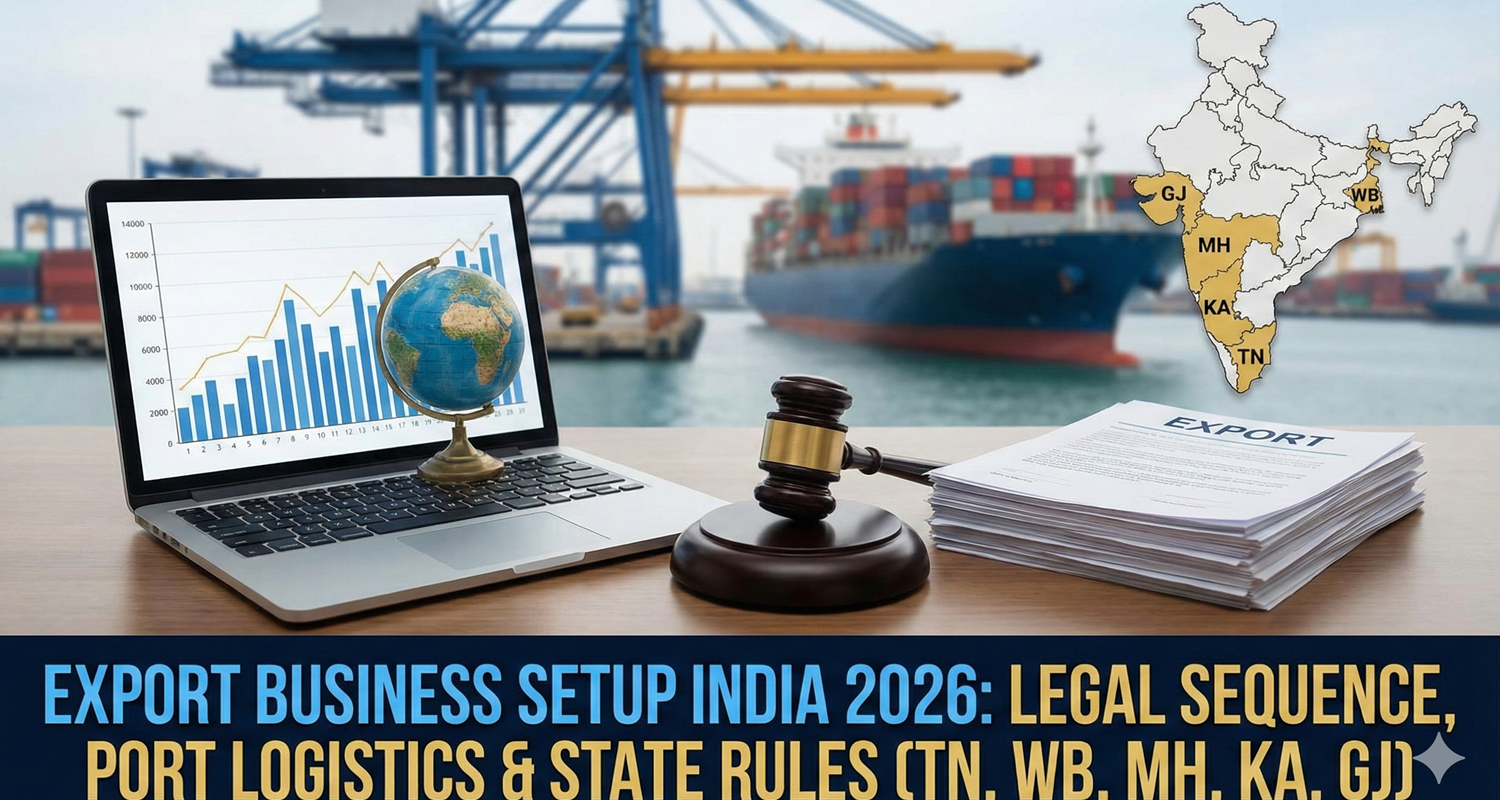
This guide fixes that timeline. We map the exact linear path—from renting your office to shipping your first container. You will find specific logistical data for local ports, a breakdown of hidden costs like terminal handling charges, and a calculator to set your FOB price without losing money. Stop guessing the paperwork sequence and follow the proven legal order.
Establishing and Scaling an Export Enterprise in India
You have the product idea. You have the rental agreement. Now comes the paperwork. This guide cuts through the noise to give you the exact legal sequence for starting an export business in Tamil Nadu and beyond.
Direct Answer to Your Confusion
You asked: “Does the sequence matter?”
Yes. The sequence is critical. If you apply for an IEC before you have a bank account, you might get rejected. If you try to open a current account without a government registration, the bank will refuse.
The Golden Rule: Identity → Tax → Bank → Trade License.
The Logical Sequence (Step-by-Step)
Follow this exact order to minimize friction with government portals and banks.
Select Your Structure
Decide between a Sole Proprietorship or a Private Limited Company. Since you are starting alone in your 30s to “test waters,” a Proprietorship is faster. However, a Private Limited Company offers liability protection if you take loans.
| Feature | Sole Proprietorship | Private Limited Company |
|---|---|---|
| Liability | Unlimited (Personal assets at risk) | Limited (Personal assets safe) |
| Setup Cost | Low (₹2,000–₹5,000) | Higher (₹7,000–₹30,000) |
| Compliance | Minimal (Personal ITR) | High (Annual Audits, RoC filings) |
Local Registration (The Proof)
Since you already have a rental agreement in Tamil Nadu, you must register under the Tamil Nadu Shops and Establishments Act, 1947. This is your primary “proof of business” for the bank. Apply via the TN Labor Department portal within 30 days of starting.
Apply for GST
Use your PAN (personal for Proprietorship) and your Rental Agreement + Shops Act registration to apply for GST. This is mandatory for exports.
Open Current Account
Now walk into a bank. With your GST certificate and Shops Act license, they will open a Current Account. Do not skip this. You need a bank account in the business name for the next step.
Udyam Registration (MSME)
Register on the Udyam portal. It is free. This registration (URN) is linked to your GST and PAN. It unlocks cheaper loans and government subsidies later.
Importer-Exporter Code (IEC)
Apply on the DGFT website. Since you have a GST and a Bank Account, this is easy. Your IEC will likely be the same alphanumeric string as your PAN.
Warning: You must update/confirm your IEC details annually between April and June, even if nothing changes. Failure to do so deactivates your ability to export.
RCMC & AD Code
RCMC: Register with an Export Promotion Council (e.g., FIEO or AEPC) to claim benefits.
AD Code: Get a letter from your bank and register it on the ICEGATE portal. This allows your goods to pass through customs digitally.
Before You Manufacture: The Validation Check
Before you spend money on inventory, you must validate that the product can legally enter your target country. Many beginners skip this and have goods seized at foreign customs.
1. HS Code Precision
Do not guess. A “Cotton Shirt” has a different HS Code than a “Cotton/Polyester Blend Shirt”. Use the ITC HS Tracker to find the exact 6-8 digit code. The wrong code leads to penalties.
2. Non-Tariff Barriers (NTBs)
Tariffs are taxes, but NTBs are rules.
– EU: Requires CE Marking or REACH compliance.
– USA: FDA registration for food/cosmetics.
– Middle East: Halal Certification for edibles.
Market Intelligence: Finding Buyers
Registration is the easy part. Finding buyers is the actual business. Do not rely on “Export Data Sellers” who spam you with lists. Use these legitimate methods.
1. Trade Map (ITC)
Geneva-based Global DatabaseThe gold standard. Register for free. Input your HS Code (first 6 digits) to see which countries are importing your product in bulk. Target markets where demand is rising.
2. Indian Embassy Data
Diplomatic NetworkVisit the website of the Indian Embassy in your target country (e.g., Indian Embassy in Germany). Look for the “Commercial Wing.” They often publish lists of local importers.
3. Reverse Engineering
Port Data AnalysisCheck ICEGATE or subscription tools to see who your competitors in India are shipping to. If a company in Vietnam buys Yarn from Tirupur, they are a potential lead.
Digital Verification Strategy
Before you email a potential buyer, perform this 3-step digital audit:
- Domain Age Check: Use tools like Whois.com. If their website was registered last month but they claim 20 years of experience, walk away.
- Geo-Tagging: Search their office address on Google Maps/Earth. Does it look like a warehouse/office, or is it a residential apartment?
- LinkedIn Cross-Ref: Search for employees of the company on LinkedIn. A real company usually has staff profiles, not just a CEO profile.
State-Specific Export Ecosystems
While central laws (IEC/Customs) are the same, state logistics and product hubs vary. Select a region to see specific details.
West Bengal: The Gateway to the East
Key Export Hubs
- Kolkata (Bantala): Leather Goods & Accessories (Council: CLE).
- Hooghly/Howrah: Jute Products & Engineering Goods.
- Darjeeling/Siliguri: Tea (Tea Board of India).
- Petrapole: Largest land port for trade with Bangladesh.
Logistics & Rules
Ports: Kolkata Port (Riverine, depth issues) & Haldia.
Unique Compliance: Exports to Bangladesh via land require specific “Car Pass” and border coordination via Petrapole. Jute exports often require “Jute Commissioner” certification.
Maharashtra: The Export Powerhouse
Key Export Hubs
- Mumbai (SEEPZ): Gems, Jewellery & Electronics.
- Pune/Nashik: Auto Components & Engineering (EEPC).
- Ichalkaranji: Textiles & Powerlooms.
- Nashik: Onions, Grapes & Wine (APEDA).
Logistics & Rules
Ports: JNPT (Nhava Sheva) handles the bulk of India’s container traffic. Mumbai Port for bulk cargo.
Advantage: Best connectivity to Europe and US East Coast. High warehousing costs near Panvel.
Karnataka: Tech & Textiles
Key Export Hubs
- Bangalore: IT Services, Aerospace Components, Readymade Garments.
- Coorg/Chikmagalur: Coffee (Coffee Board).
- Mysore: Silk & Incense sticks (Agarbatti).
Logistics & Rules
Ports: New Mangalore Port (NMPT).
Logistics Challenge: Bangalore is landlocked. Most exporters use ICD Whitefield to rail containers to Chennai or NMPT. Factoring in rail haulage time is critical for deadlines.
Gujarat: The Trade Capital
Key Export Hubs
- Surat: Diamonds (GJEPC) & Synthetic Textiles.
- Morbi: Ceramics & Tiles (70% of India’s production).
- Jamnagar: Petroleum & Brass parts.
- Alang: Ship Recycling & Steel.
Logistics & Rules
Ports: Mundra (Private, very efficient) & Kandla (Deendayal Port).
Advantage: Mundra often offers lower handling charges and faster turnaround than JNPT. Preferred for heavy bulk and ceramic shipments.
Tamil Nadu: Manufacturing & Textiles
Refer to the specific sections below for detailed analysis of Tirupur, Tuticorin, and Chennai logistics.
Tamil Nadu Export Hubs (Base Guide)
Since you are in TN, leverage the existing supply chains. These towns have established ecosystems for specific products.
| Town/District | Product Specialization | Export Council (EPC) |
|---|---|---|
| Tirupur | Knitted Garments (T-shirts) | AEPC |
| Karur | Home Textiles (Curtains, Linens) | HEPC |
| Ambur / Vaniyambadi | Leather & Shoes | CLE (Council for Leather Exports) |
| Tuticorin | Marine Products, Salt, Spices | MPEDA / Spices Board |
| Coimbatore | Engineering Goods, Auto Components | EEPC |
Tamil Nadu Port Logistics
Your location in Tamil Nadu dictates your profit margin. Choosing the wrong port can eat up 5-10% of your margin in domestic trucking costs.
Chennai Port / Kattupalli / Ennore
Best For: Northern TN (Chennai, Kanchipuram, Vellore, Ambur).
Pros: High frequency of vessels to Europe and US East Coast.
Cons: High traffic congestion for trucks entering the city. Kattupalli is often faster for container movement.
VO Chidambaranar Port (Tuticorin)
Best For: Southern TN (Madurai, Tirupur, Karur, Sivakasi).
Pros: Closer to the main East-West shipping route (Colombo). Lower trucking costs for textile/matchstick exporters in the south.
Cons: Fewer direct vessels to US West Coast compared to Chennai.
The Invisible Barrier: Quality & Packaging
Product rejection is the exporter’s nightmare. Adhere to these global standards.
Pre-Shipment Inspection (PSI)
Many buyers will insist on a PSI certificate from agencies like SGS, Bureau Veritas, or Intertek. They visit your factory, check the goods against the invoice, and seal the container. This certificate triggers the bank payment.
ISPM 15 (Wood Packaging)
If you use wooden pallets or crates, they MUST be heat-treated or fumigated and stamped with the ISPM 15 mark (the “wheat stamp”). If you miss this, US/EU customs will destroy your entire shipment at your cost.
Incoterms 2020: Your Responsibility Map
Incoterms define who pays for shipping and who takes the risk. As a beginner, you must understand where your liability ends.
EXW (Ex Works)
You do least.
Buyer picks up goods from your factory in TN. You just pack it.
FOB (Free on Board)
Recommended.
You pay to move goods to Chennai Port and clear Indian Customs. Risk transfers to buyer once on ship.
CIF (Cost, Ins, Freight)
Intermediate.
You pay for sea freight and insurance to foreign port. But risk transfers to buyer once loaded in India.
DDP (Delivered Duty Paid)
Avoid.
You pay everything, including foreign customs and taxes. High risk of hidden costs.
Financial Mechanics & Risks
Understanding how you get paid is as important as the paperwork. The chart below illustrates the relationship between your risk and the payment terms you offer buyers.
Figure 1: The Export Payment Risk Matrix
Safety Net: ECGC Policy
Do not ship without this. The Export Credit Guarantee Corporation (ECGC) offers insurance against non-payment by foreign buyers. If a buyer in the UK goes bankrupt after receiving your goods, ECGC covers up to 90% of your loss. For small exporters, ask for the “Small Exporter’s Policy”.
Common Export Scams to Avoid
1. The “Big Order” Sample Scam: A buyer from West Africa or Southeast Asia asks for expensive samples (e.g., 5 leather jackets) for a “huge government contract.” They pay for shipping but never place the order.
Solution: Always charge full price for samples + courier.
2. The Payment Swap Hack: Hackers monitor your email. Just before payment, they email the buyer from a similar address (e.g., exports@gmaiI.com vs gmail.com) saying “Our bank account changed, please wire here.”
Solution: Tell buyers you will NEVER change bank details via email.
3. The Overpayment Scam: Buyer sends a fake check for $10,000 instead of $2,000 and asks you to “wire back the difference.”
Solution: Never wire money back until funds have fully cleared (takes weeks).
The Paperwork Stack
Missing a single document can hold up your payment or get your cargo stuck at customs. Here is your checklist.
Pre-Shipment (For Customs)
Post-Shipment (For Bank/Payment)
The Exporter’s Year: Compliance Calendar
Exporting is a continuous cycle of compliance. Miss these dates and your IEC or GST status could be suspended.
GST Filing
File GSTR-1 (Sales) by the 11th and GSTR-3B (Summary) by the 20th of the following month.
IEC Update (Mandatory)
You must log in to the DGFT portal and confirm your IEC details, even if nothing has changed. Deadline: June 30th.
RCMC Renewal
Pay your annual membership fee to your Export Promotion Council (e.g., FIEO, AEPC) to keep your registration valid.
EDPMS Closure
Ensure your bank updates the EDPMS system within 9 months of export, confirming that payment has been received.
Export Costing Calculator
Many beginners lose money because they forget to account for domestic transport or bank charges. Use this calculator to estimate your FOB (Free on Board) price.
FOB Price Estimator
Interactive Checklist
Filter tasks based on your current stage.
Ready-to-Use Templates
Communication in exports must be precise. Use these formats to avoid ambiguity.