 By
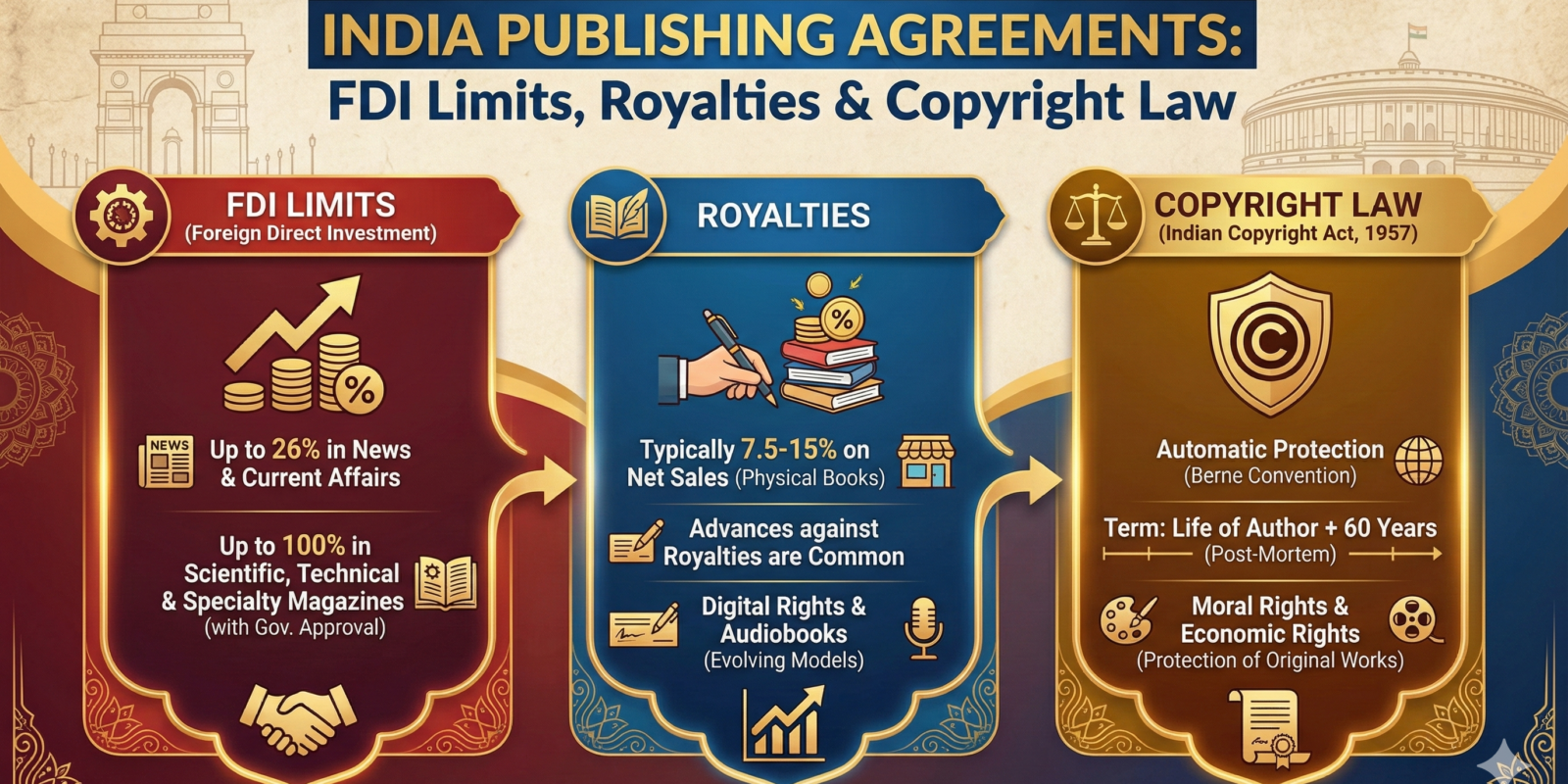
By Foreign publishers entering India face a fragmented regulatory environment. While scientific and technical sectors permit full foreign ownership, news and current affairs entities are restricted to a 26% equity cap.
Beyond entry routes, the validity of a publishing agreement rests on specific statutory requirements under the Copyright Act, 1957.
Contracts that fail to define territory or duration trigger automatic reversion of rights to the Indian author after five years. This guide examines the legal and fiscal framework governing licensing, assignments, and digital content distribution in the Indian market.
Cross-Border Publishing Agreements in India: The 2025 Playbook
Navigating FDI caps, Copyright assignments, and the GST tax traps for digital content.
The Indian publishing industry stands at a defining moment. It is characterized by robust demand for educational content, a burgeoning digital media landscape, and a complex regulatory framework. For foreign publishers seeking to enter the Indian market, and for Indian publishers expanding their global footprint, the legal terrain requires careful study. The validity of an agreement depends on strict adherence to the Foreign Direct Investment (FDI) policy, the Copyright Act 1957, and the Goods and Services Tax (GST) regime.
Key Takeaway
Agreements must navigate a regulatory bifurcation between “news” and “non-news” sectors. The distinction between “assignment” and “licensing” of rights is critical. Recent fiscal amendments regarding “making available” technical services versus pure royalty licensing have changed the profit equation.
1. The FDI Wall
The government creates two distinct worlds: the regulated “News” sector and the liberalized “Non-News” sector. Understanding this dichotomy is essential for structuring the corporate vehicle.
26% CAP
Strict government approval route. Applies to newspapers and periodicals dealing with news and current affairs.
- ●Majority Indian Board required.
- ●CEO must be a resident Indian.
- ●Security clearance mandatory.
2. Assignment vs. Licensing
The distinction between “Assignment” and “Licensing” alters the ownership structure. Indian law contains specific “deeming provisions” that can trap unwary foreign publishers.
| Feature | Assignment (Sec 18) | Exclusive License (Sec 30) |
|---|---|---|
| Ownership Title | Transfers to Assignee | Retains with Licensor |
| The 5-Year Trap | Deemed 5 years if unspecified | Governed by contract terms |
| Right to Sue | Assignee sues as Owner | Exclusive Licensee can sue |
| Reversion | Difficult; requires reconveyance | Easier; upon breach/expiry |
Critical Warning
If an assignment agreement does not explicitly state the territory, it is presumed to extend only within India. If duration is omitted, it defaults to 5 years.
3. Territoriality & Parallel Imports
Market segmentation relies on the ability to prevent Parallel Imports. Indian courts have consistently intervened to protect the territorial sanctity of publishing agreements.
The ‘John Wiley’ Protection Flow
Visual representation of how territorial restrictions block unauthorized exports (based on John Wiley & Sons v. Prabhat Chander Kumar Jain).
4. The Tax Architecture
Withholding Tax (TDS)
Base rate under Finance Act 2023.
Strategy: Use DTAA (Treaty) to reduce to 10-15%. Requires TRC and Form 10F.
Digital GST (OIDAR)
Standard rate for audio/video/software.
Exception: E-books (purely digital text) attract a concessional 5% rate.
5. The Money Trail: FEMA Compliance
Signing the contract is easy; getting paid requires navigating the Foreign Exchange Management Act (FEMA). Remittances for royalties are current account transactions but subject to documentation hurdles.
The Remittance Checklist
The remitter (Indian Publisher) must file this online with the Income Tax Department declaring the payment details.
A certificate from a Chartered Accountant (CA) certifying the tax rate and DTAA applicability. Mandatory for large sums.
The actual instruction to the Authorized Dealer (Bank) to effect the transfer of foreign currency.
6. Dispute Resolution Matrix
While standard templates often cite the Indian Council of Arbitration (ICA), New Delhi, foreign publishers typically prefer neutral venues.
The “New Delhi” Clause
“Any… disputes… shall be finally settled by arbitration to be conducted in New Delhi in accordance with the Rules of Indian Council of Arbitration…”
Why it matters:
- Cost Effective: Cheaper than Singapore/London.
- Domestic Award: Easier to enforce within India under the Arbitration Act, 1996.
- Delay Risk: Domestic arbitration can sometimes face judicial delays in appointment of arbitrators.
Venue Comparison
| Venue | Speed | Cost |
|---|---|---|
| New Delhi (ICA) | Moderate | Low |
| Singapore (SIAC) | High | High |
| London (LCIA) | High | Very High |
*SIAC is preferred for contracts > $1 Million USD.
7. Digital Rights & The “WhatsApp” Threat
In India, the primary threat to publishing revenue is not traditional counterfeiting but the mass circulation of PDF copies via instant messaging apps. Standard “anti-piracy” clauses from US/UK templates are often ineffective here.
The PDF Epidemic
Academic and reference books are particularly vulnerable. A single PDF can be forwarded to thousands of students instantly, bypassing Digital Rights Management (DRM).
Required Legal Remedy:
- John Doe Orders: Empower the Indian publisher to seek “Dynamic Injunctions” from High Courts.
- Digital Watermarking: Mandate “Social DRM” for all direct sales.
E-Book & Audio Licensing
Defining “Out of Print” in the digital age is tricky. If a book is available as a Print-on-Demand (POD), is it “in print”?
8. Content Liability: The Indian Context
Foreign publishers must be aware that “Freedom of Speech” in India (Article 19(1)(a)) is subject to “reasonable restrictions”. Content that is acceptable in New York or London may trigger criminal liability in New Delhi.
Religious Sentiments
Deliberate and malicious acts intended to outrage religious feelings. Non-bailable offense.
Obscenity
Sale of obscene books. The “Hicklin Test” has been modified, but risks remain for graphic novels.
Territorial Integrity
Incorrect depiction of India’s external boundaries (e.g., Kashmir) is a serious offense.
9. Execution: Wet Ink vs. Digital
While the IT Act, 2000 recognizes electronic contracts, the Indian Stamp Act, 1899 presents a practical hurdle. Admissibility of unstamped documents in arbitration is a frequent litigation point.
-
1
Stamp Duty is Mandatory: Copyright assignment deeds attract stamp duty (varies by state). Digital agreements are harder to “frank”.
-
2
The “Duplicate” Rule: Ideally, execute physical copies with “wet ink” signatures and pay the nominal stamp duty for seamless enforceability.
10. The “Sell-Off” Safety Valve
Termination of an agreement does not instantly evaporate physical inventory. The “Sell-Off” (or Sell-Through) clause is a critical operational buffer that prevents capital destruction for the Indian publisher while protecting the foreign licensor from “dumping.”
Standard Practice
A 6 to 12-month non-exclusive period post-termination to liquidate existing stock.
Condition: Sales must be at full price (not remaindered) and subject to standard royalty payments.
The “Dumping” Risk
If the agreement ends acrimoniously, a publisher might flood the market with cheap copies, destroying the brand value for the new licensee.
11. Trust but Verify: Audit Rights
In cross-border deals, the Licensor has no visibility into the Licensee’s warehouse or ledger. An “Audit Clause” is the only mechanism to ensure royalty reports match actual sales.
The Trigger
Typically once per calendar year, with 15 days’ written notice.
Who Pays?
Error < 5%: The Licensor bears the cost of the professional audit.
Error > 5%: The Indian Publisher (Licensee) pays the audit fees plus the unpaid royalty with interest.
12. The Vernacular Goldmine
India has 22 scheduled languages. Foreign publishers often make the mistake of bundling “Indian Language Rights” with the English reprint license for free. This leaves significant revenue on the table.
Translation vs. Adaptation
A translation is a faithful reproduction. An adaptation (e.g., changing examples in a textbook to Indian contexts) creates a derivative work with separate copyright implications.
Sub-Licensing Model
Instead of the English publisher printing Hindi copies, they often sub-license to regional specialists (e.g., Manjul Publishing for Hindi).
Revenue Share
Standard split for sub-licensing revenue is 50/50 or 60/40 (in favor of Licensor) between the Indian English publisher and the Foreign Licensor.
13. Data Privacy: The New Frontier
Digital Personal Data Protection Act, 2023
If the publishing agreement involves an online platform (LMS, e-library) where the Indian entity collects subscriber data and shares it with the US/UK parent, this is now a regulated activity.
- Cross-Border Transfer: Permitted to most countries unless restricted by the Government (Blacklist approach).
- Notice & Consent: The Indian user must be explicitly informed that their data is being processed by a foreign entity.
- Data Fiduciary: The publisher determines the purpose of processing and carries significant liability for breaches (up to INR 250 Crores).
Simulator: Net Royalty Calculator
Estimate the actual remittance after Indian withholding taxes.
*Excludes bank transfer charges.