 By
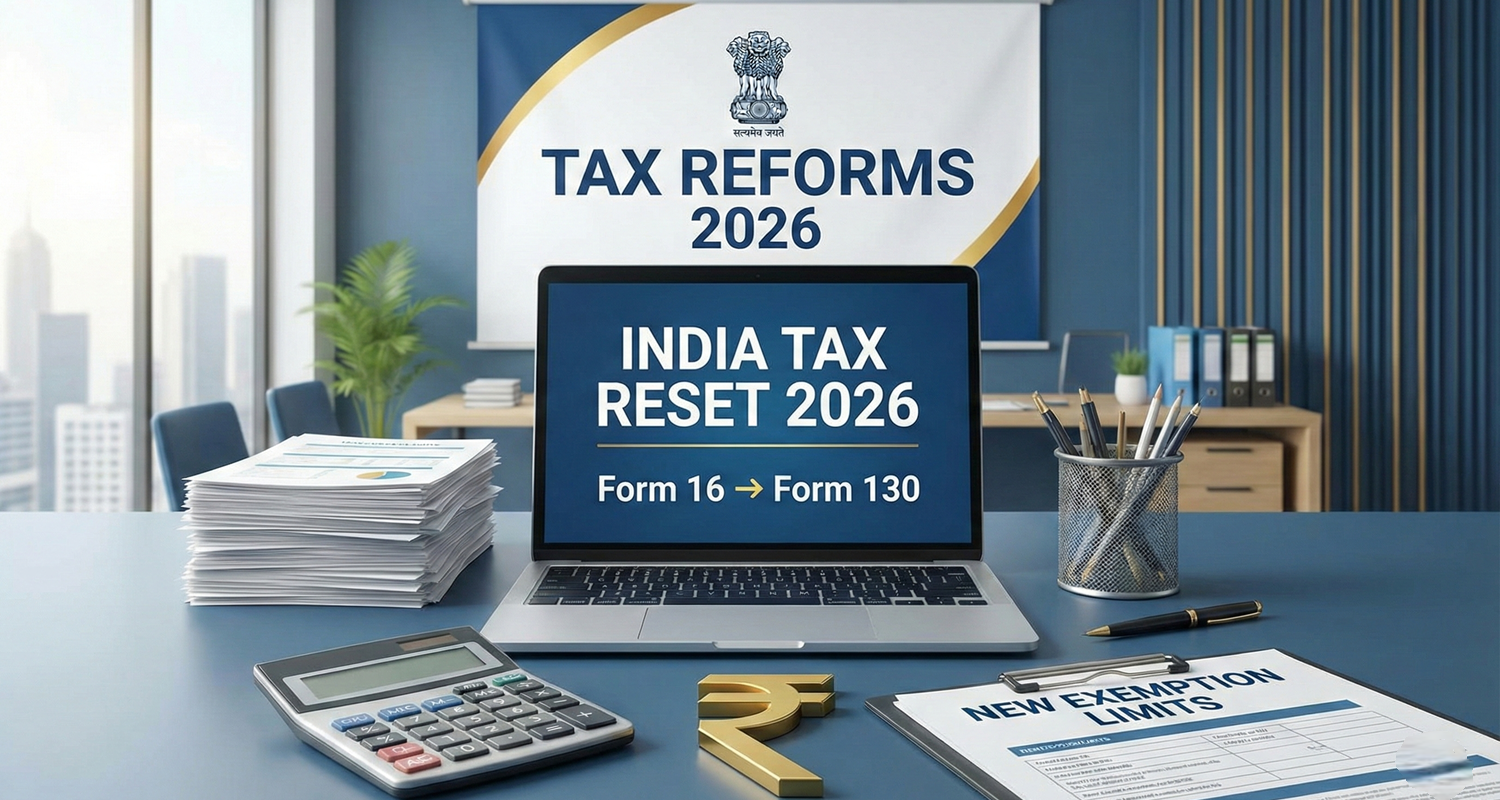
By On April 1, 2026, India’s tax compliance structure undergoes a complete reindexing. The familiar “Assessment Year” terminology is abolished, replaced by a singular “Tax Year” logic under the Income-tax Act 2025.
For taxpayers and payroll departments, the immediate impact is the retirement of standard documents: Form 16 is renumbered as Form 130, and the Annual Information Statement (Form 26AS) becomes Form 168.
This breakdown analyzes the draft rules, the updated perquisite valuations for salaried employees, and the specific compliance risks for real estate buyers and freelancers.
The Great Reset: Form 16 Becomes Form 130 and Form 26AS Exits
India’s 64-year-old tax framework retires on April 1, 2026. Here is the definitive guide to the new “Tax Year” logic and the massive renumbering of your compliance documents.
The landscape of Indian direct taxation is shifting. On April 1, 2026, the Income-tax Act 1961 will be formally succeeded by the Income-tax Act 2025. This is not merely an administrative update; it is a structural overhaul that removes the confusing “Assessment Year” terminology and reindexes the entire library of statutory forms.
For corporate payroll teams, chartered accountants, and individual taxpayers, the Draft Income-tax Rules 2026 introduce a new lexicon. The universally recognized Form 16 is now Form 130. The Annual Information Statement (AIS) replaces Form 26AS as Form 168. This guide breaks down the transition mechanics and the new algorithmic compliance environment.
The End of “Assessment Year”
Since 1962, Indian taxpayers have juggled two timelines: the “Previous Year” (when income is earned) and the “Assessment Year” (when it is taxed). This duality caused persistent friction and confusion.
The Form Renumbering Matrix
The consolidation of 819 sections into 536 sections in the new Act necessitated a complete renumbering of the forms. We have compiled a searchable comparison table below to navigate this change.
| Legacy Form (Pre-2026) | New Form (Post-2026) | Function |
|---|---|---|
| Form 16 | Form 130 | Salary TDS Certificate for Employees |
| Form 16A | Form 131 | Non-Salary TDS Certificate (Freelancers/Vendors) |
| Form 26AS | Form 168 | Annual Information Statement (Tax Passbook) |
| Form 24Q | Form 138 | Quarterly Salary TDS Return |
| Form 26Q | Form 140 | Quarterly Non-Salary TDS Return |
| Form 26QB/QC | Form 141 | Property Purchase/Rent TDS Statement |
| Form 3CD | Form 26 | Unified Tax Audit Report (Merges 3CA/3CB/3CD) |
| Form 29B | Form 66 | MAT (Minimum Alternate Tax) Report |
| Form 61A | Form 165 | Statement of Financial Transactions (SFT) |
| Form 15CA | Form 145 | Foreign Remittance Declaration |
| Form 15CB | Form 146 | Accountant Certificate for Foreign Remittance |
| Form 3CEB | Form 48 | Transfer Pricing Audit Report |
New Salary Exemption Limits
While tax rates remain stable, the valuation of perquisites has been modernized to reflect inflation. The 2026 Draft Rules introduce significant hikes in exemption limits for allowances, which will directly impact the “Net Taxable Income” calculated on the new Form 130.
Meal Vouchers
₹200Increased from ₹50. Annual tax shield rises to over ₹1 lakh.
Child Education
₹3,000Per month per child. A massive jump from the archaic ₹100 limit.
Car Perquisite
₹5,000Taxable value for small cars (≤1.6L) jumps from ₹1,800.
Input your details to see the annual increase in tax-free income under the new rules.
The Gig Economy & Form 131
The 2025 Act formally recognizes “Gig and Platform Workers” as a distinct tax category. Previously, freelancers relied on Form 16A, a generic document used for bank interest, lottery winnings, and professional fees alike.
Form 131 is context-aware. If the payer is a designated “Digital Platform Intermediary” (like Uber, Upwork, or Zomato), Form 131 will contain specific fields for:
- Platform Service Fees (Deducted before payout)
- Device/Asset Rental Costs (if provided by the platform)
- Incentive & Bonus Breakdowns
This granularity allows freelancers to claim expenses more accurately under Section 57, reducing the burden of maintaining minute-by-minute expense logs.
Real Estate: The Form 141 Trap
One of the most litigated areas in the previous regime was the 1% TDS on property sales over ₹50 Lakhs (previously Form 26QB). This is now Form 141, but with a sting.
The new section 194-IA (renumbered to Section 120 in the 2025 Act) mandates the buyer to verify the seller’s status via the utility. If the seller is a “Specified Person” (a non-filer of returns for 2 years), the TDS rate spikes from 1% to 20%. Buyers failing to deduct this higher rate will receive automated demand notices within 30 days of registration.
MSME Payments: Section 43B(h)
The controversial 45-day payment rule for MSMEs remains intact but is now monitored via Form 26 (Unified Audit). Auditors must explicitly flag invoices from Micro and Small enterprises pending beyond 45 days. These amounts are disallowed as business expenses and added back to taxable profits, resulting in a significantly higher tax liability for corporate payers.
Virtual Digital Assets (VDA) in Form 168
Form 26AS was often blind to crypto transactions unless TDS was deducted under Section 194S. The new Form 168 integrates directly with exchange APIs. It features a dedicated “Schedule VDA” which captures:
- Buy/Sell Timestamps: To separate long-term vs. short-term holdings (if indexation benefits are reintroduced).
- Wallet Transfer Fees: Recognizing gas fees as a “Cost of Transfer,” a long-standing demand of the crypto community.
- Airdrop Valuation: Auto-populated based on the token’s Fair Market Value (FMV) at the time of receipt.
Compliance Timeline 2026-27
The shift to a single “Tax Year” alters the compliance calendar. The window for issuing Form 130 is tighter than the legacy Form 16 timeline.
The Penalty Matrix
The new Act simplifies penalties but increases the cost of negligence. The “reasonable cause” defense is now codified, meaning manual errors are less likely to be forgiven without specific proof.
Calculate the interest liability under Section 201(1A) for delayed deposit of Tax Deducted at Source.
Rule: 1.5% per month (part of a month is treated as a full month).
The NRI Compliance Bridge (Form 145 & 146)
For Non-Resident Indians (NRIs) and businesses making foreign remittances, the familiar 15CA and 15CB forms are retiring. They are replaced by Form 145 (Declaratory) and Form 146 (Accountant Certificate).
This is more than a numbering change. The new forms are linked to the 20% TCS (Tax Collected at Source) regime implemented in late 2023. Form 146 now requires chartered accountants to explicitly validate the “Purpose Code” against the Liberalised Remittance Scheme (LRS) limit of $250,000 via a live API check with the RBI portal before certification.
Unified Audit: Form 26
The redundancy of filing Form 3CA/3CB (Audit Report) and Form 3CD (Statement of Particulars) ends in 2026. These are merged into a single Unified Tax Audit Report (Form 26).
Form 26 introduces a strict “Clause of Variance.” Auditors must now quantify the difference between the inventory value as per books (IndAS) and the value as per Income Tax Computation & Disclosure Standards (ICDS) in a dedicated grid. This removes the ambiguity that previously existed in the “Observations” paragraph of Form 3CD.