
 By
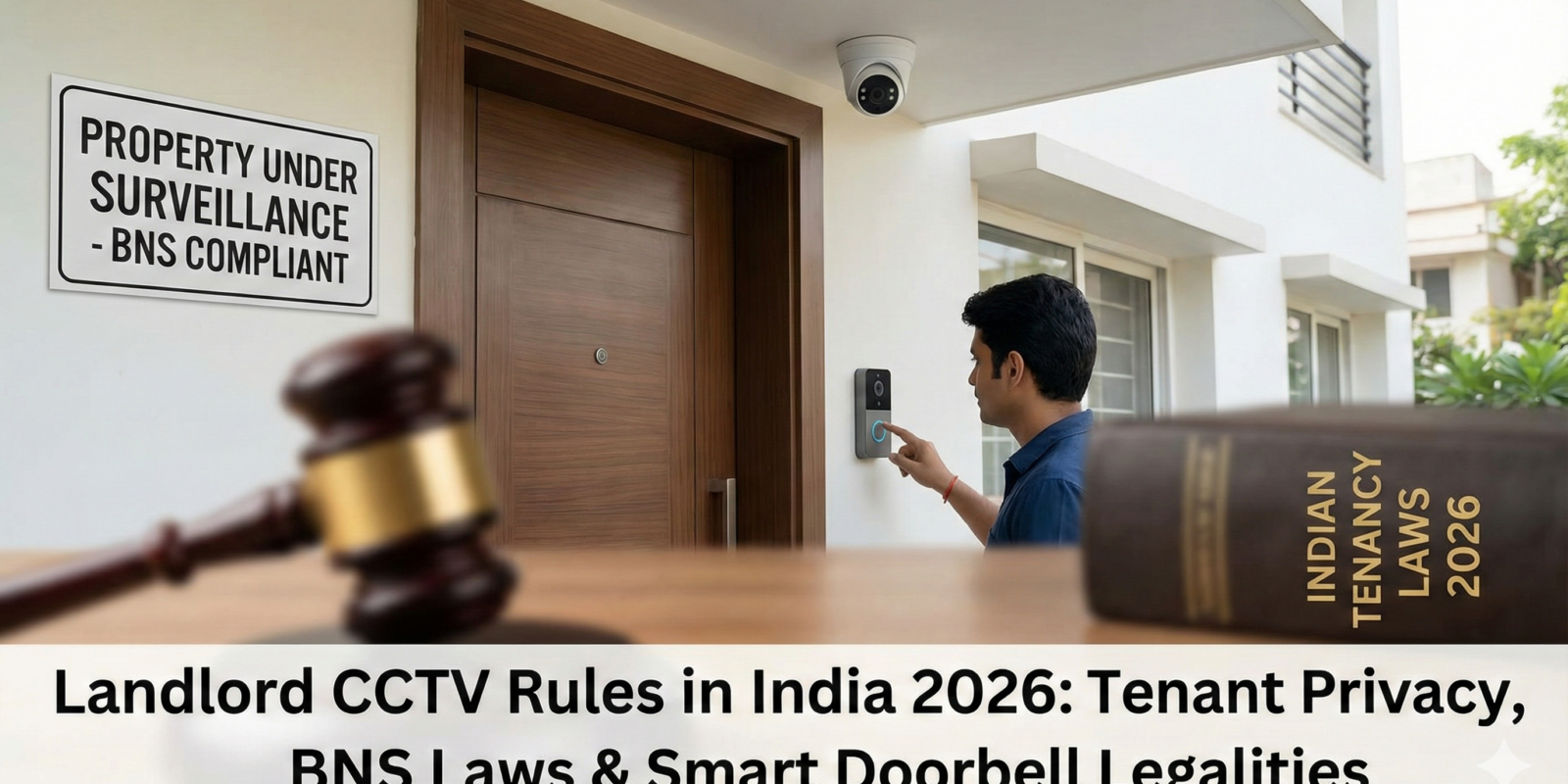
By The rise of affordable surveillance technology has triggered a silent conflict in Indian rental housing. Property owners frequently cite security concerns to justify installing cameras in corridors, stairwells, and driveways, yet tenants often view these devices as tools of harassment that erode their daily privacy.
Unlike many Western nations, India does not enforce a standalone “CCTV Act.” Instead, the legality of a camera lens pointing at a tenant’s door relies on a mix of the new Bharatiya Nyaya Sanhita (BNS), the IT Act, and evolving data protection standards.
This guide examines where legitimate asset protection ends and criminal voyeurism begins, offering practical steps for tenants and landlords to remain on the right side of the law.
The Jurisprudence of Surveillance: Balancing Landlord Property Rights and Tenant Privacy
The rapid proliferation of high-definition surveillance technology has fundamentally altered urban living in India. Property owners, driven by a legitimate desire to protect their assets, increasingly rely on Closed-Circuit Television (CCTV) systems. However, when these properties are leased to third parties, the landlord’s interest in asset protection collides forcefully with the tenant’s fundamental right to privacy and the quiet enjoyment of the premises.
India lacks a dedicated “CCTV Camera Act.” Instead, legality is deciphered through a matrix of constitutional law, penal statutes, and data protection legislation. The central inquiry regarding whether a property owner can unilaterally install CCTV cannot be answered with a simple yes or no. It requires a nuanced spatial and statutory analysis.
The Privacy Spectrum: Visualizing Legal Boundaries
The legality of installation depends heavily on the “reasonable expectation of privacy” in specific zones. We have visualized this risk spectrum below. Areas in red indicate absolute prohibitions, while green indicates permissible security zones.
The Constitutional Substratum
The *Justice K.S. Puttaswamy (Retd.) v. Union of India (2017)* judgment declared privacy as an intrinsic part of the right to life under Article 21. This judgment exerts a horizontal effect on private contracts. A landlord cannot unilaterally contract out of a tenant’s fundamental right to privacy. Any clause permitting unfettered surveillance inside a private dwelling is void and contrary to public policy.
The Shuvendra Mullick Precedent (2024)
In *Shuvendra Mullick v. Indranil Mullick*, the Calcutta High Court ruled that installing cameras in common corridors pointing directly at a specific tenant’s bedroom or entrance constitutes an egregious violation of privacy. The court ordered joint control over such systems, reinforcing that asset protection cannot override individual privacy.
Penal Framework: From IPC to BNS
Unauthorized surveillance is not merely a civil dispute. It is a criminal offense under the Bharatiya Nyaya Sanhita (BNS), 2023, which replaced the IPC. The table below outlines the transition in legal liability.
| Offense Type | Old Law (IPC) | New Law (BNS 2023) | Landlord Liability Context |
|---|---|---|---|
| Voyeurism | Section 354C | Section 77 | Capturing a woman in a private act/area. 1st offense: 1-3 years. 2nd offense: 3-7 years (Non-bailable). |
| Trespass | Section 441/447 | Section 329 | Includes “constructive trespass” via digital intrusion (hidden cameras) into the demised premises. |
| Privacy Violation | N/A | IT Act Sec 66E | Capturing/publishing images of private areas without consent. Up to 3 years imprisonment. |
Audio Surveillance: The Silent Violation
While video surveillance often operates in a gray area regarding common spaces, audio recording is subjected to far stricter scrutiny. Most modern IP cameras come equipped with microphones enabled by default.
⚠️ The Wiretapping Trap
Recording conversations without the consent of at least one participant violates the Indian Telegraph Act, 1885 and the Information Technology Act, 2000. If a landlord’s CCTV records a tenant’s private conversation in a hallway or near their door, it may constitute illegal interception.
Landlords must explicitly disable audio recording features on devices installed in semi-private areas. Unlike video, which tracks movement for security, audio recording captures content of communication, which has no direct nexus with property protection.
The “Ring” Paradox: Video Door Phones (VDP)
Smart video doorbells represent a unique legal challenge. They are tenant-installed security devices that simultaneously act as surveillance tools against neighbors.
Key Legal Considerations for VDPs
- Proximity to Neighbors: If a tenant installs a video doorbell that captures the *insides* of a neighbor’s apartment when their door opens, this constitutes a “Nuisance” under tort law.
- Landlord Control: If the Landlord provides a “Smart Home” with pre-installed cameras, they must transfer the “Admin” access of the app to the tenant. Retaining remote access to a live feed of the tenant’s front door is a breach of the Data Protection Act (Purpose Limitation).
- Cloud Storage: Most smart devices upload to foreign servers. Under DPDP Act 2023, data transfer requires strict adherence to cross-border protocols.
The Data Fiduciary Obligation (DPDP Act 2023)
Under the Digital Personal Data Protection Act, 2023, landlords collecting CCTV footage are classified as “Data Fiduciaries.” The “domestic purpose” exemption is narrowly construed and generally does not apply to commercial renting activity.
Landlords must adhere to strict obligations:
- Notice & Consent: Explicit, written notice is required in English or a Scheduled language.
- Purpose Limitation: Footage collected for security cannot be used to monitor lifestyle or guests.
- Data Retention: Data should not be retained indefinitely. A 30 to 90-day cycle is standard practice. Retaining footage beyond this without a specific security incident violates the principle of “Storage Limitation.”
The Role of RWAs & Housing Societies
A frequent point of friction arises in apartment complexes: Does the Resident Welfare Association (RWA) have greater rights than an individual landlord?
RWAs operate under the cooperative societies acts of respective states. Their jurisdiction is limited to “Common Areas” (main gates, lifts, lobbies). An RWA cannot mandate cameras on individual floors that infringe on the privacy of specific flat owners or tenants. Furthermore, an individual landlord cannot hide behind RWA by-laws to install a camera on a tenant’s specific door without consent.
Police Seizure Rights: BNSS 2023 Updates
Under the Bharatiya Nagarik Suraksha Sanhita (BNSS), 2023, the procedural laws regarding digital evidence have tightened. Landlords and tenants must be aware of their obligations when law enforcement demands footage.
- Notice to Produce (Section 94 BNSS): Police have the power to issue a notice demanding documents or “electronic records” (CCTV footage) if deemed necessary for an investigation. A landlord must comply with this order; refusing can attract penalties under Section 175 IPC (now relevant BNS sections).
- Chain of Custody (BSA Section 63): Under the Bharatiya Sakshya Adhiniyam (BSA), electronic evidence requires a certificate of authenticity. If a landlord provides footage to police, they must also provide certification that the device was working properly, or the evidence may be inadmissible in court.
- Privacy vs. Investigation: While a landlord must provide footage to police, they are not authorized to “leak” this footage to the media or other third parties during an ongoing investigation.
Interactive Guide: Can I Install a Camera Here?
Select a location to see the legal standing based on current Indian jurisprudence.
Main Entrance / Perimeter Wall
Verdict: Allowed. Monitoring ingress and egress points for security is a legitimate aim. Signage must be visible.
Inside the Apartment (Bedroom/Hall)
Verdict: Strictly Prohibited. Violates Article 21, Section 77 BNS, and Section 66E IT Act. No contract can validate this.
Common Corridor / Hallway
Verdict: Conditional. Allowed only for general security. Cannot be pointed specifically at a tenant’s door to track their movement (Refer: Shuvendra Mullick case).
Hidden / Spy Cameras
Verdict: Criminal Offense. Constitutes constructive trespass and voyeurism. Immediate criminal liability applies.
Building Parking Lot
Verdict: Allowed. Generally considered a common area with low privacy expectation. Useful for vehicle security.
Balconies facing inward
Verdict: Prohibited. Balconies are considered private extensions of the living space. Cameras pointed at a tenant’s balcony from a neighbor’s or landlord’s adjacent property constitute a nuisance.
Digital Due Diligence: A Tenant’s Checklist
Before signing a lease agreement, tenants should perform a physical and digital audit of the premises.
Lease Clause Builder
Copy these clauses to insert into your Rent Agreement to ensure legal clarity regarding surveillance.
For Tenants (Privacy Protection)
“Clause X: Privacy & Surveillance
The Landlord covenants that no electronic surveillance devices, including but not limited to video cameras or audio recorders, are installed within the Demised Premises. Any surveillance devices in common areas (such as the main gate) shall not be directed towards the entrance, windows, or balconies of the Demised Premises in a manner that captures private activities. The Landlord agrees to provide the Tenant with the location of all active cameras on the property property prior to possession.”
For Landlords (Security & Asset Protection)
“Clause X: Security Surveillance
The Tenant acknowledges that the building perimeter and parking areas are under CCTV surveillance for the safety and security of the property and its inhabitants. The Tenant consents to the recording of ingress/egress data in these common areas. The Landlord undertakes that such data shall be securely stored, not shared with third parties (except law enforcement), and auto-deleted every 30 days in compliance with the DPDP Act, 2023.”
Remedial Mechanisms for Tenants
Tenants facing invasive surveillance have a multi-tiered hierarchy of remedies available to them.
Level 1 Remedy: Formal Notice Template
Use this text to draft a formal objection to your landlord regarding unauthorized cameras.
Dear [Landlord Name],
I am writing to formally object to the installation of a CCTV camera located at [Location] which is directed towards [Specific Private Area/Door].
This installation violates my right to privacy under Article 21 of the Constitution and constitutes a breach of the covenant of quiet enjoyment. Furthermore, unauthorized recording may attract liability under Section 66E of the IT Act and Section 329 of the BNS.
I request the immediate removal or realignment of this camera within 24 hours.
Regards,
[Tenant Name]
If notice fails, tenants may file an FIR under Section 66E of the IT Act or approach the Rent Tribunal under the Model Tenancy Act, 2021 guidelines for harassment and breach of contract.