 By
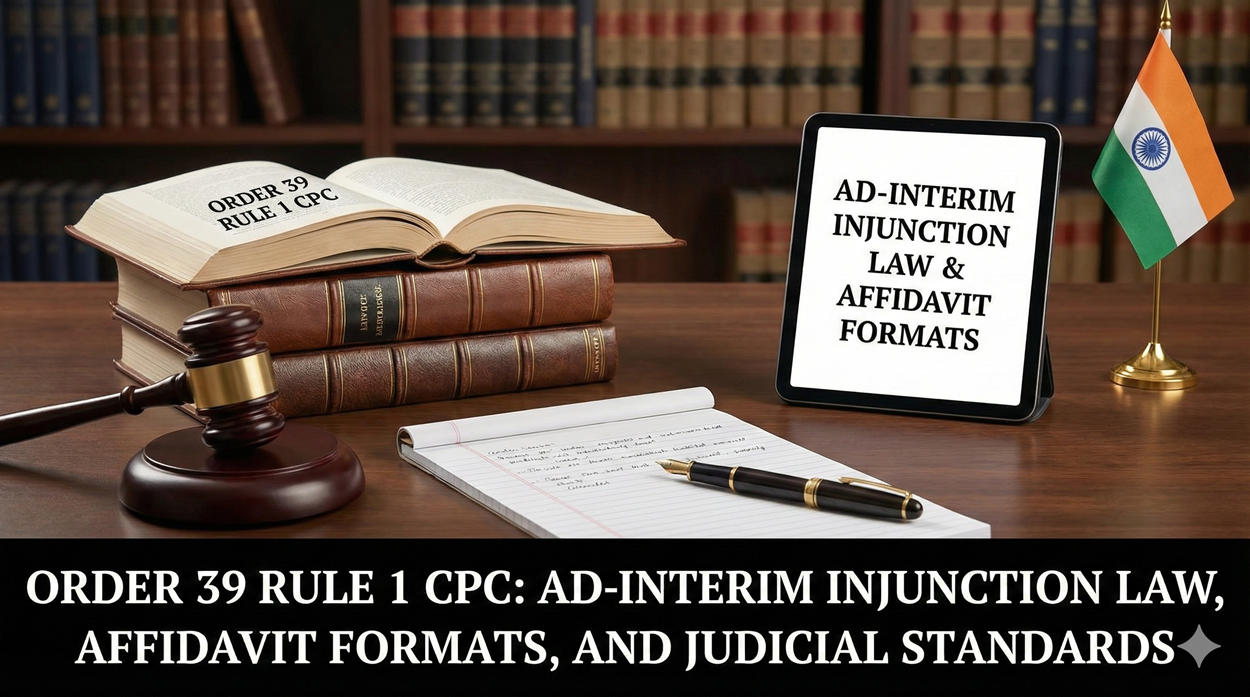
By Civil litigation in India often requires immediate protection for disputed property. Order 39 of the Code of Civil Procedure 1908 provides the statutory framework for temporary and ad-interim injunctions. These orders prevent the waste, damage, or alienation of suit property before the court reaches a final decision. Successful applications rely on three specific tests: a prima facie case, irreparable injury, and the balance of convenience.
Recent judicial shifts place a heavy burden on the quality of the supporting affidavit. Failure to disclose material facts or follow mandatory service rules under Rule 3 leads to the immediate vacation of ex-parte stays. This guide describes the drafting of injunction affidavits, statutory bars under the Specific Relief Act, and the consequences of disobedience. Legal professionals can use the provided templates to maintain compliance with current High Court rules and Original Side requirements.
Ad-Interim Injunctions & Affidavit Standards.
A definitive analysis of Order XXXIX of the Code of Civil Procedure 1908, integrating 2026 procedural standards, commercial disclosure requirements, and specialized judicial orders.
The Judicial Triple Test
Weightage of Interlocutory Factors
This visualization represents the proportional focus of the court during a contested hearing. While a prima facie case is the threshold, the balance of convenience often dictates the final discretionary choice.
Pillar I
Prima Facie Case
The existence of a serious question to be tried and a probability of success upon the evidence provided.
Pillar II
Irreparable Injury
Potential damage that cannot be cured by financial compensation; vital in intellectual property and heritage suits.
Pillar III
Balance of Convenience
Determining which party will suffer more significant hardship if the injunction is granted versus if it is refused.
Legal Research Modules
The Affidavit Foundation
Affidavits for injunctions allow for statements based on belief. However, under the 2026 standards, courts now strictly enforce the separation of “Knowledge” and “Belief.”
- Source of belief must be disclosed
- Verification must be specific to paragraphs
- False statements trigger Sec. 340 CrPC
Suits Against the Government
Normally requires a 60-day notice. To obtain an urgent injunction, the Plaintiff must file a separate application seeking leave of the court to waive the notice period under Section 80(2).
“The court shall not grant relief without giving the Government a reasonable opportunity of showing cause.”
Landmark Citations
Reasons for ex-parte injunctions are a mandatory jurisdictional requirement.
Defined ex-parte standards for commercial and securities litigation.
Inherent Judicial Powers
Used to bridge gaps in the CPC. However, Section 151 cannot be invoked if there is an express prohibition under Order 39. It serves as a tool for equity when the statute is silent.
Specialized Injunction Framework
Digital Law
John Doe Orders
Commonly known as ‘Ashok Kumar’ orders. These protect intellectual property against unknown infringers, allowing the plaintiff to stop mass piracy or trademark violations by unidentified parties.
Real Estate
Rule 7 Inspections
Allows the court to appoint a Local Commissioner for the detention, preservation, or inspection of any property forming the subject matter of the dispute.
Infrastructure
Section 20A Bar
Statutory prohibition under the Specific Relief Act prevents courts from staying infrastructure projects if it causes a delay in completion.
Jurisdiction & Appeals
Original Side Variations
High Courts in Delhi, Bombay, Calcutta, and Madras have specific internal rules for interlocutory applications. These often require a “Caveat Search” before moving an ex-parte application.
The Remedy of Appeal
Orders under Rule 1, 2, 4, or 10 are appealable under Order XLIII Rule 1(r). This is a statutory right, distinct from a Revision.
- » Limited interference by appellate courts
- » Focus on “Perversity” or “Legal Error”
- » Right to apply for variation under Rule 4
Statutory Deep Dive
Mandatory Injunctions
To compel a positive act, the court applies the “Dorab Cawasji” test. This requires a standard of proof significantly higher than the standard “Prima Facie” case.
Standard: Compelling necessity to prevent grave injury and restoration of the status quo.
Commercial Disclosure (Order XI)
Under the Commercial Courts Act, seeking an injunction requires a “Statement of Truth.” Parties must disclose every document in their possession related to the suit.
Suppression leads to immediate vacation of stay.
Doctrine of Restitution (Sec. 144)
Courts have the inherent power to undo the benefits of a wrongful injunction. This includes restitution of property, profits, and interest for the period of the stay.
The Equity Standard
Injunction is an equitable relief. A plaintiff who conceal previous litigation or fails to disclose a prior refusal of stay will face exemplary costs under Section 35A.
Rule 2A: Disobedience & Breach
Willful breach of an injunction order triggers quasi-criminal proceedings.
Sanction I
Civil Imprisonment
Detention in a civil prison for a term not exceeding three months. Requires strict proof of willful intent.
Sanction II
Attachment of Property
Property may be attached for one year. If the breach continues, the property may be sold to compensate the aggrieved party.
Post-Order Compliance Flow (Rule 3)
Recording Reasons
The Court must record specific reasons why delay would defeat the object of the injunction.
Immediate Service
Serve the Defendant with the Plaint, Application, Affidavit, and Order via speed post/email on the same day.
Filing Affidavit
File a Compliance Affidavit in Court on the day of service or the next working day without fail.
Comparative Order Analysis
| Order Classification | Trigger Rule | Hearing Standard | Validity Limit |
|---|---|---|---|
| Ad-Interim | Urgent relief; Rule 3 | Ex-parte (One side) | Until next hearing date |
| Temporary Injunction | Rule 1 and Rule 2 | Bi-parte (Both heard) | Until final disposal |
| Status Quo | Inherent Powers | Preservation of state | Discretionary duration |
Master Templates
1. Affidavit for Ad-Interim Injunction (Consolidated)
Expert FAQ
Can an injunction be granted against unknown persons?
Yes. In India, these are commonly referred to as “Ashok Kumar” or “John Doe” orders. They are vital in intellectual property and internet piracy cases to stop unidentified infringers.
Is a Statement of Truth mandatory for all suits?
It is mandatory for “Commercial Suits” as defined under the Commercial Courts Act, 2015. For non-commercial suits, a standard verification under Order VI Rule 15 is sufficient.
What is the remedy against a wrongful ex-parte stay?
The Defendant can move an application under Order 39 Rule 4 for variation or discharge. Alternatively, an appeal can be filed under Order 43 Rule 1(r).
Can an injunction be granted to stop a bank guarantee?
Courts rarely stay bank guarantees. An injunction is only granted in cases of “established fraud” of which the bank has notice, or to prevent “irretrievable injustice.”