 By
By The rules governing employment background verification in India have changed. Human Resources departments face strict new privacy laws when conducting candidate reference checks.
The Digital Personal Data Protection Act of 2023 and the latest 2025 EPFO regulations place heavy compliance burdens on employers. Companies can no longer scrape personal data or demand the personal phone numbers of previous managers without explicit consent.
This guide explains the exact legal requirements for corporate background screening. It details the specific actions employers must take to avoid severe financial penalties and regulatory action from the Data Protection Board of India.
Legal Update | Updated February 2026
Legal Framework for Pre-Employment Background Verification in India
Understanding the DPDP Act 2023 and the 2025 EPFO Regulations.
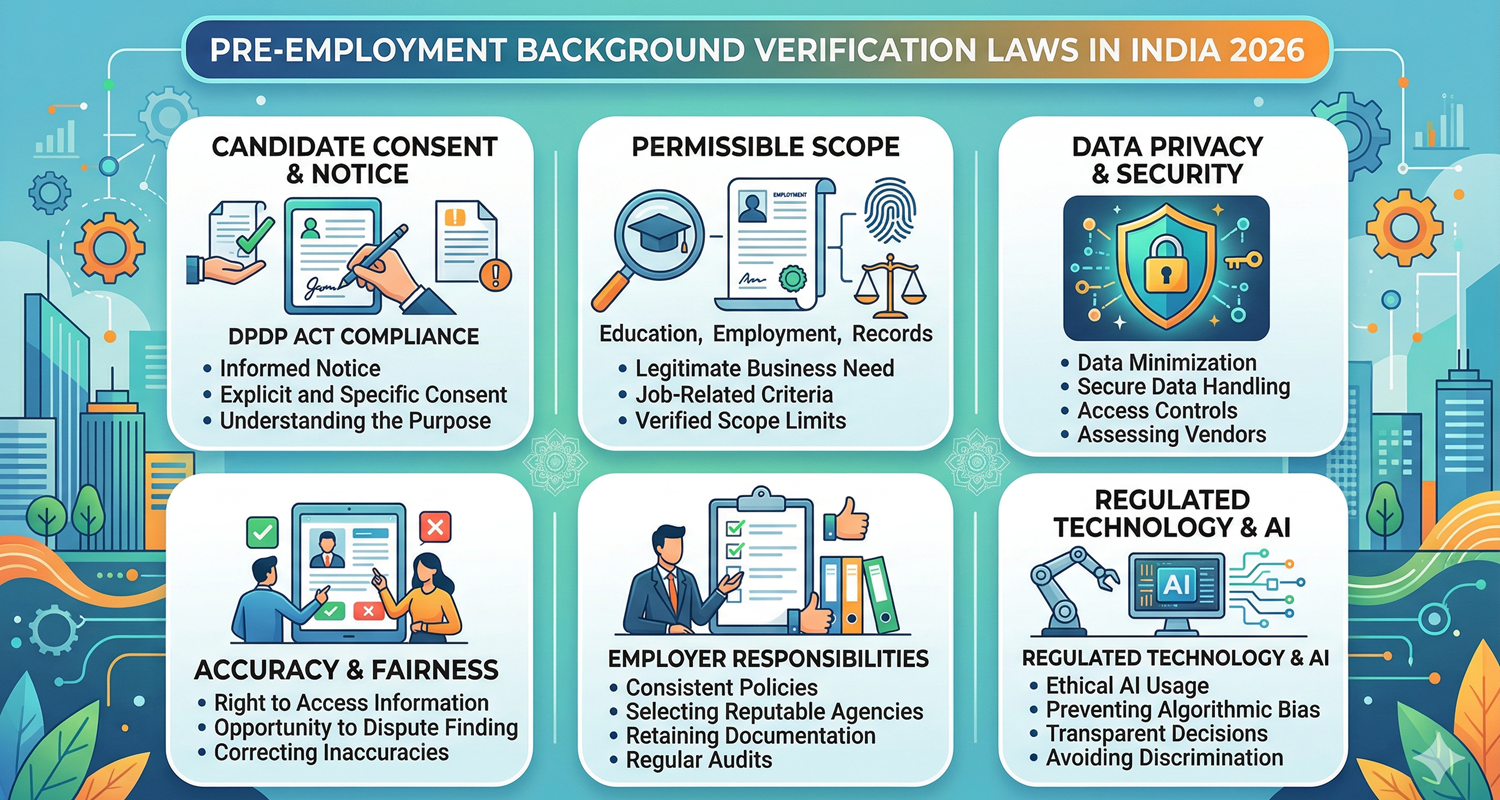
The process of employment background verification in India has changed significantly. Companies must follow new privacy laws when checking candidates. The Digital Personal Data Protection Act of 2023 and the 2025 DPDP Rules regulate these activities. Employers must navigate statutory data protection mandates and common law torts when conducting reference checks.
Human Resources departments frequently demand the personal contact information of a candidate’s previous reporting managers. Employers use this data to conduct professional reference checks. Candidates and privacy advocates argue this practice causes severe legal liabilities related to unauthorized third-party data collection.
Privacy Rights and the DPDP Act
The Supreme Court of India declared privacy a fundamental right in 2017. Before the DPDP Act passed, the Information Technology Act of 2000 governed data privacy. The older regulations allowed companies to collect general personal information without explicit consent. HR departments and third-party vendors routinely scraped data and demanded personal phone numbers from former managers.
The DPDP Act introduced strict rules. No personal data may be processed without a lawful ground. The primary lawful ground is explicit consent. A manager’s name, personal mobile number, professional email address, and subjective feedback all constitute protected personal data.
Fiduciaries and Principals
The employer acts as a Data Fiduciary. The Data Fiduciary determines the purpose and means of processing personal data. Candidates and third-party references act as Data Principals. The law places the burden of compliance entirely on the Data Fiduciary.
Employers must obtain clear consent directly from the Data Principal. Vague clauses in employment offer letters are illegal. Employers must provide an itemized privacy notice. This notice must detail the specific data points collected and the retention period. Candidates can withdraw consent at any time.
Section 7 of the DPDP Act introduces an exemption for legitimate uses. Employers can process data without explicit consent strictly for employment purposes. This exemption applies to the individual actively seeking employment. It does not permit an employer to collect the personal data of third parties without their explicit consent. A candidate cannot legally grant proxy consent on behalf of their former manager.
Compliance Vector Matrix
| Compliance Vector | Pre-DPDP Act Practices | Post-DPDP Act Legal Mandates (2025-2027) |
|---|---|---|
| Consent Mechanism | Vague consent via offer letter clauses. | Standalone, specific, and revocable consent notices. |
| Data Scope | Expansive data collection. | Strict purpose limitation. Role-relevant data only. |
| Data Retention | Indefinite storage in corporate databases. | Mandatory deletion after purpose fulfillment. |
| Vendor Liability | Liability shifted to the background vendor. | Employer retains absolute liability. |
| Candidate Rights | Minimal visibility into the verification report. | Enforceable rights to access, correction, and erasure. |
The Conflict with Corporate Policies
Demanding a manager’s personal mobile number places the candidate in a difficult legal position. The act of a manager speaking to a background verification agency involves processing personal data. The employer and the background vendor operate illegally if they contact a manager without explicit prior consent.
Many large enterprises have strict policies forbidding references. These rules prevent managers from providing subjective feedback about former employees to external parties. Verification requests must route through central Human Resources departments. These departments only confirm objective data points like employment dates and final titles.
When a prospective employer insists on a subjective managerial reference, they ask the manager to breach their employment contract. This exposes the manager to internal disciplinary action.
The 2025 EPFO Policy Change
The Employees’ Provident Fund Organisation issued a circular on March 27, 2025. This regulatory action altered the background verification process in India. Before this date, HR departments used a candidate’s Universal Account Number to access their full provident fund passbook. Employers could view every organization that had deposited contributions.
The EPFO decided that granting unfettered access to a member’s entire past employment history created a privacy risk. The 2025 circular mandated that current employers can only view present employment details. All past historical data is permanently masked on the employer portal.
This restriction forced talent acquisition teams to revert to manual verification methods. Employers began demanding managerial contact details, tax certificates, and detailed bank statements to verify work history.
Tortious Interference
Contacting a candidate’s current reporting manager without written consent is highly dangerous. If this unauthorized contact alerts the current employer and leads to the candidate’s termination, the prospective employer faces direct liability for the tort of interference with prospective economic advantage. Damages can cover lost wages and mental distress.
Defamation and Substantive Fairness
The manager providing the reference also faces legal risks. If a manager provides false or highly subjective negative feedback, they can face civil lawsuits for defamation. Indian courts require that allegations of misconduct be supported by objective evidence. Corporate legal counsel advises employers to restrict employment references to objective, factual data points.
Despite these constraints, organizations must avoid negligent hiring. Companies hold responsibility for the actions of their employees. The industry adopted the BGV Code of India to standardize verification checks. Core checks include identity verification and address verification. Professional reference checks should remain optional and require explicit consent for each specific referee.
Verification Rules by Sector
General IT and Corporate Sector
Governing Body: Self-Regulated
- Identity and Education Verification.
- Standard Objective Employment Check via official HR channels.
- Credit and financial checks are generally impermissible.
- Subjective managerial references require explicit third-party consent.
Legal Risk Matrix for Background Checks
This interactive chart illustrates the financial liability versus the probability of regulatory action for various HR verification practices under the 2026 legal framework.
Vendor Management and Candidate Rights
Most Indian enterprises outsource background verification to third-party agencies. Outsourcing does not transfer legal liability. The employer remains the Data Fiduciary. If a vendor violates the DPDP Act, the Data Protection Board of India holds the employer primarily liable. Penalties for non-compliance can reach massive amounts.
Employers must enter into Data Processing Agreements with their vendors. These agreements must detail the specific categories of personal data processed, mandatory data security standards, and strict data deletion timelines. Vendors must notify employers immediately of any data breach.
The DPDP Act gives candidates enforceable rights over their personal data. Candidates have the right to request a summary of the data processed and the background report generated. Candidates can demand the correction of inaccurate data. They possess the right to erasure once the verification purpose concludes. Employers and vendors must delete raw data and reference feedback.
Every Data Fiduciary must appoint a Grievance Redressal Officer. The DPDP Rules 2025 require this officer to resolve any grievance within a strict 7-day window. If the employer fails to provide a resolution, the candidate can escalate the complaint to the Data Protection Board.
The government plans to introduce Consent Managers by late 2026. These platforms will allow candidates to manage their consent across multiple entities from a single dashboard. Candidates will cryptographically approve data sharing directly from original data sources.
Regulatory Implementation Timeline
August 2023
The Digital Personal Data Protection Act receives presidential assent.
January 2024
Formation of the Data Protection Board of India to oversee compliance.
March 2025
EPFO restricts Universal Account Number portal access to mask historical data.
Late 2026
Mandatory integration of independent Consent Managers for employment data.
Cross-Border Data Processing
Multinational corporations often use global applicant tracking systems. The DPDP Act regulates the transfer of candidate data outside Indian borders. The government maintains a negative list of restricted countries. Employers must ensure international background verification vendors comply with Indian data protection standards. Storing reference check data on foreign servers requires strict contractual safeguards.
Financial Penalties and Enforcement
The Data Protection Board holds the authority to levy severe financial penalties. Breaching the purpose limitation principle can result in multi-crore statutory fines. A failure to prevent a data breach carries maximum financial penalties under the law. The legislation does not cap the financial liability for corporate entities. Human Resources directors face direct accountability for vendor negligence.
HR Operational Directives Checklist
Mandatory Actions
- Issue itemized privacy notices before collecting candidate data.
- Mask historical employment data in internal hiring databases.
- Sign strict Data Processing Agreements with external agencies.
- Establish a clear internal policy for grievance redressal.
Prohibited Actions
- Do not ask candidates for their previous manager’s personal phone number.
- Do not use hidden clauses in employment contracts to assume consent.
- Do not retain background check reports indefinitely.
- Do not contact a current employer without explicit written permission.
Automated Social Media Profiling
Many organizations use automated software to scan candidate social media profiles. The DPDP Act classifies public social media data as personal data. Scraping this information without explicit consent creates legal liabilities. Algorithms that analyze political views or religious affiliations can trigger discrimination claims. Employers must restrict screening to professional networks and require direct authorization before scanning public profiles.
Dual Employment and Moonlighting Investigations
The corporate sector strictly monitors dual employment. The 2025 EPFO restrictions complicate traditional verification methods. Companies previously checked provident fund deposits to find concurrent jobs. Now, HR departments must rely on tax declarations and bank statements. Demanding complete bank records violates the data minimization principle. Employers should only request specific tax certificates or anonymized statements that mask unrelated transactions.
Handling Sensitive Health Data
Pre-employment medical tests process sensitive health data. The law places a higher compliance burden on this category. Employers can only mandate medical checkups if the specific job requires physical fitness. Storing medical reports on general HR servers is illegal. Companies must use encrypted storage systems with strict access controls.
Criminal Record Validation and Judicial Data
Employers rely heavily on the National e-Courts portal for criminal background checks. Indian law distinguishes between a registered First Information Report and a formal judicial conviction. Rejecting a candidate solely based on a pending First Information Report can violate the legal presumption of innocence. Corporate policies must explicitly define which specific criminal offenses disqualify a candidate. Financial crimes are relevant for banking roles. Minor traffic violations generally do not impact standard corporate employment.
Digital Address Verification and Aadhaar Masking
Physical address verification is slow and expensive. Companies now utilize digital APIs linked to Digilocker and Aadhaar Offline XML. The Supreme Court of India restricts private entities from storing core biometric data or the complete Aadhaar number. Employers must exclusively accept and store masked Aadhaar copies. The Unique Identification Authority of India mandates strict financial penalties for the unauthorized retention of unmasked Aadhaar cards. Geo-tagged digital address verification requires specific location-tracking consent from the candidate.
Informal Network Checks and Shadow Profiling
Recruiters sometimes conduct informal reference checks through college alumni groups or shared professional connections. This practice carries severe legal risks. The DPDP Act requires all personal data processing to possess a documented lawful ground. Secretly collecting subjective feedback from mutual connections bypasses the candidate’s explicit consent. This creates an illegal shadow profile. Candidates hold the right to legally demand access to all recruiter notes recorded during the entire hiring lifecycle.
Data Breach Protocols and Vendor Hacks
Third-party verification vendors store massive volumes of sensitive personal information. A vendor data breach immediately exposes the primary employer to severe regulatory penalties. The DPDP Act mandates swift reporting of any personal data breach. Employers must notify the Data Protection Board and every affected candidate without delay. Corporate contracts must compel vendors to report security incidents within hours of detection. Failing to report a breach invites the highest tier of financial fines under the current law.
Automated Decisions and Algorithmic Screening
Companies frequently deploy software to evaluate candidate backgrounds at high volume. The DPDP Act grants individuals the right to request human intervention for automated decisions. If a background screening algorithm automatically rejects an applicant, that applicant can legally demand a manual review by a human resources officer. Software systems that process criminal records or credit histories often produce false positives due to name mismatches. Employers face direct liability if an automated system unfairly denies employment based on inaccurate scraped data.
Gig Economy and Contract Worker Verification
Enterprises enforce different compliance standards for temporary contractors versus permanent staff. The principal employer usually relies on staffing agencies to conduct basic checks. The law treats both the enterprise and the staffing agency as joint fiduciaries regarding data protection. Collecting extensive financial or educational histories from short-term gig workers violates the strict rule of data minimization. Verification for temporary staff must remain limited strictly to basic identity and criminal court record validation.
Standard Template Formats
Template 1: Explicit Consent Clause for Reference Checks
I, [Candidate Name], hereby grant specific and informed consent to [Employer Name] and its authorized Data Processor, [Vendor Name], to contact the individual listed below for the sole purpose of verifying my employment dates and official designation.
Referee Name: [Name]
Official Corporate Email: [Email]
I confirm that I have informed the referee of this request. I understand this data will be retained for a maximum of 180 days post-verification. I retain the right to withdraw this consent at any time by contacting [Grievance Officer Email].
Template 2: Mandatory DPA Deletion Clause
The Data Processor agrees to permanently erase all personal data pertaining to the Data Principal, including identification documents, verification reports, and communication logs, within one hundred and eighty (180) days from the date of final report submission to the Data Fiduciary. The Data Processor shall provide a cryptographic certificate of destruction upon request.