 By
By Long-term capital gains taxation involves a rigid set of compliance hurdles. For investors liquidating assets like equity shares to fund residential property, Section 54F remains the primary mechanism to minimize tax outflow.
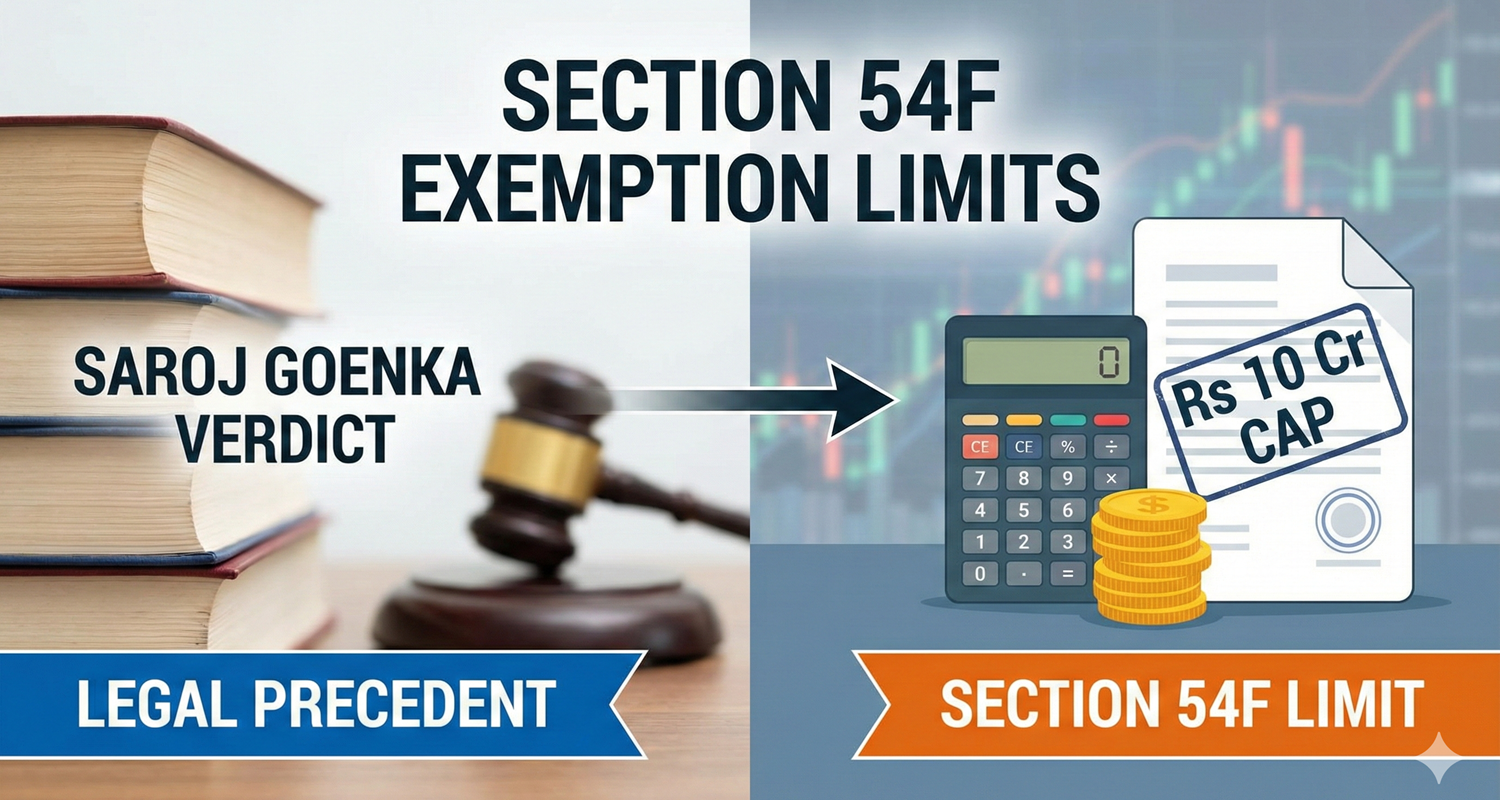
Yet, two opposing forces now dictate the strategy: the strict Rs 10 Crore cap introduced by the Finance Act 2023 and favorable judicial precedents clarifying ownership limits. The Saroj Goenka ruling specifically addresses whether holding fractional shares in ancestral property disqualifies a taxpayer from claiming these exemptions.
This report examines the arithmetic of the proportional exemption method and the specific definitions of a “residential house” that determined the tribunal’s decision.
1 Asset Liquidation
*Enter Indexed Cost if applicable
2 New Residential Property
3 Ownership Eligibility Check
Based on the Saroj Goenka vs ITO ruling logic.
“Fractional ownership in a family property does not constitute exclusive ownership.” – ITAT Kolkata
“Industrial plots with tenant-owned superstructures are not residential houses.” – Saroj Goenka Case
Tax Analysis
Exemption Impact
Capital Gains Exemptions in India: An Exhaustive Analysis of Section 54F
Deconstructing the Saroj Goenka ITAT ruling and the new Rs 10 Crore legislative cap.
Capital gains taxation in India balances state revenue needs with the economic necessity of capital formation. The Income Tax Act 1961 generally taxes gains from long-term capital assets. Legislative changes effective from Financial Year 2024-25 have streamlined this to a flat 12.5% rate on most long-term gains without indexation. While this simplifies compliance, it increases the tax load on investors realizing gains from equities, mutual funds, and real estate.
The legislature provides exemptions to encourage reinvestment. Section 54F stands out as a primary tool for individual taxpayers and Hindu Undivided Families. It stimulates the housing sector by offering tax relief on long-term capital gains from assets other than residential property, provided the proceeds fund a residential home.
Recent judicial interpretations have clarified strict conditions regarding ownership and usage. The ITAT Kolkata ruling in Saroj Goenka vs Income Tax Officer offers a masterclass in these rules. The assessee successfully claimed a tax exemption on approximately Rs 26.77 crore realized from selling shares and deployed into constructing a luxury property.
The Limit
Rs 10 Cr
The new cap on the cost of the new asset for exemption calculations effective FY 2024-25.
The Deadline
3 Years
Time permitted to construct a new property from the date of asset transfer.
The Condition
One House
Assessee must not own more than one residential house (excluding the new one) on transfer date.
Comparative Architecture: Section 54 vs 54F
| Parameter | Section 54 | Section 54F |
|---|---|---|
| Original Asset | Residential House Property | Any Asset (Shares, Gold, Commercial) other than Residential House |
| Reinvestment Target | Capital Gain Amount | Net Sale Consideration |
| Pre-existing Ownership | No Restriction | Max 1 Residential House (excluding new asset) |
| Formula | Investment up to Capital Gain | (Capital Gain × Amount Invested) / Net Consideration |
The Arithmetic of Exemption
Unlike Section 54, Section 54F utilizes a proportional exemption method. The exemption is not based solely on the capital gain amount but on the proportion of the Net Sale Consideration reinvested.
Formula
Exemption = (Capital Gain × Amount Invested) ÷ Net Sale Consideration
Where 'Amount Invested' is capped at Rs 10 Crore for calculation purposes (post-2024).
Scenario A: Full Reinvestment
- Sale Consideration: Rs 10 Crore
- Capital Gain: Rs 2 Crore
- Invested: Rs 10 Crore
- Result: Full Exemption (Rs 2 Cr)
Scenario B: Partial Reinvestment
- Sale Consideration: Rs 10 Crore
- Capital Gain: Rs 2 Crore
- Invested: Rs 5 Crore
- Result: (2 × 5) ÷ 10 = Rs 1 Crore Exempt.
- Taxable: Rs 1 Crore.
The Saroj Goenka Precedent
In Assessment Year 2021-22 the assessee sold equity shares of Emami Ltd for Rs 33.77 crore yielding a capital gain of Rs 26.77 crore. She invested Rs 53.86 crore in constructing a property at Queens Park. The Revenue denied the claim on four grounds: violation of ownership proviso, construction timelines, fund tracing, and use of a colourable device.
Key Judicial Findings
-
01.
Joint Ownership is Not Disqualification: The Tribunal ruled that fractional ownership in an ancestral property (Southern Avenue) does not constitute "exclusive ownership." A joint share does not count as owning a residential house under the proviso.
-
02.
Zoning Matters: A second property (B.T. Road) was deemed industrial land with a tenant-owned factory. Despite the Revenue's claim, an industrial plot cannot be classified as a residential house.
-
03.
Construction Start Date is Irrelevant: The statute requires construction completion within three years. It does not mandate when construction must commence. Projects started years prior are eligible if completed within the window.
-
04.
Money is Fungible: There is no requirement to trace the specific rupees from the share sale to the construction payments. The requirement is to incur the cost, regardless of the fund source.
Defining "Residential House"
The proviso to Section 54F denies exemption if the taxpayer owns more than one residential house (other than the new asset) on the date of transfer. This creates a high-stakes need for precise definitions.
Habitability Test
Courts have held that a dilapidated structure, ruin, or building unfit for human habitation does not qualify as a "residential house." If a property lacks a kitchen or electricity, it may be argued out of the proviso count.
Commercial Usage
Properties used for commercial purposes, or those zoned as commercial/industrial (as seen in the Saroj Goenka B.T. Road property), are excluded from the count, even if they physically resemble a house.
The Rs 10 Crore Cap: A Visual Impact
The Finance Act 2023 introduced a cap of Rs 10 Crore on the investment amount eligible for exemption. This drastically changes the tax liability for high-value transactions. The chart below illustrates the tax impact on a transaction identical to the Saroj Goenka case (Rs 26.77 Cr Gain) if it occurred today versus 2021.
The CGAS Compliance Protocol
Taxpayers frequently misunderstand the utilization deadline. While the construction period is three years, the Income Tax Return (ITR) filing deadline is typically July 31st of the assessment year.
If the capital gain amount is not fully utilized for construction/purchase by the ITR filing date, the unutilized portion MUST be deposited into a Capital Gains Account Scheme (CGAS) account.
Type A: Savings Account
Similar to a regular savings account. Highly liquid, suitable for imminent payments to contractors or builders. Interest rates are comparable to standard savings accounts.
Type B: Term Deposit
Similar to a Fixed Deposit. Higher interest rates but imposes penalties for premature withdrawal. Suitable if construction is delayed or in early stages.
Frequently Asked Questions
Legal Documentation Templates
Use these structures to clarify ownership status in property documents to defend against Section 54F disqualification.