 By
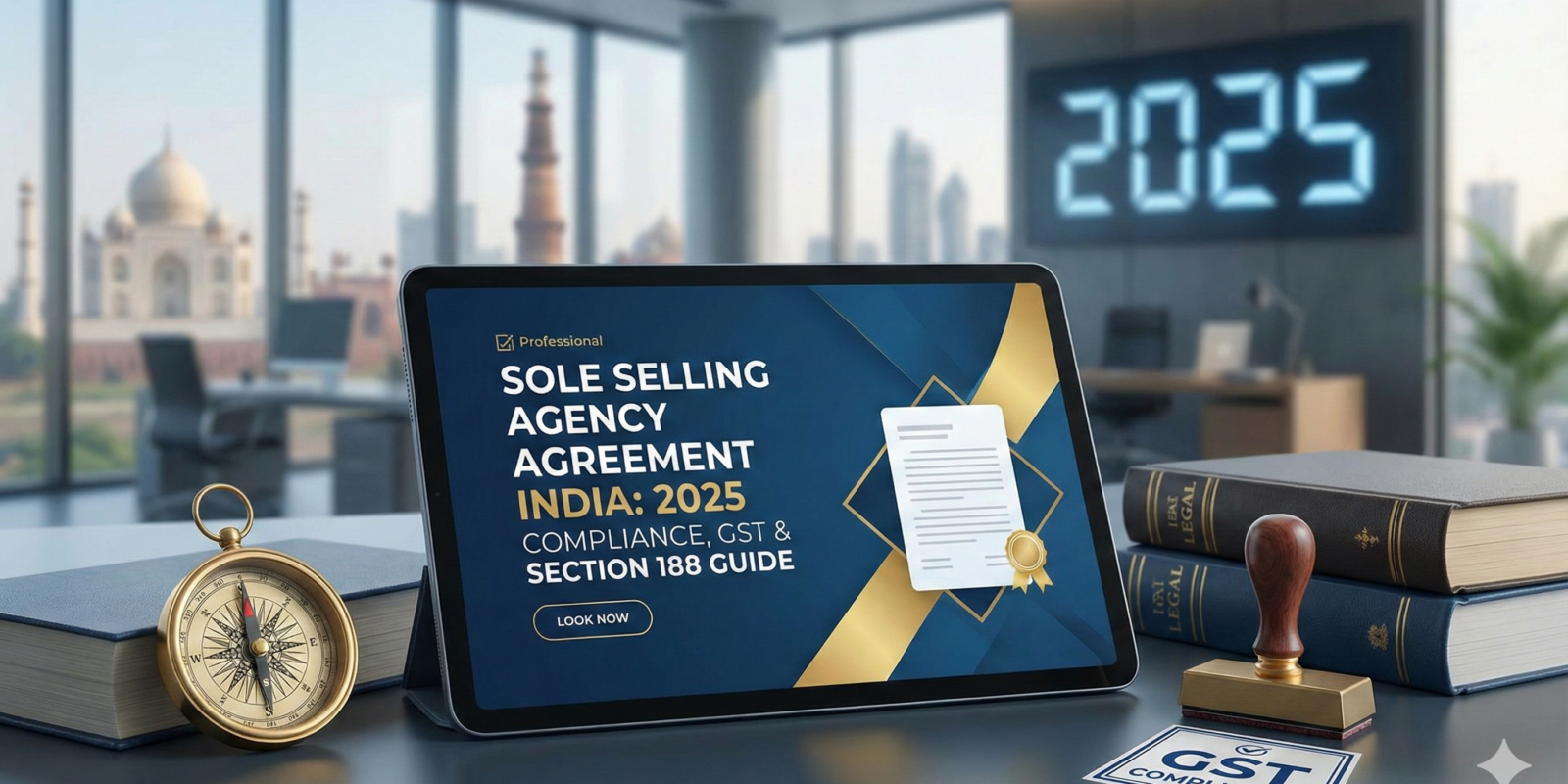
By Appointing a sole selling agent drives market penetration for Indian manufacturers, yet the regulatory framework has fundamentally shifted.
The repeal of the 1956 Companies Act’s rigid government approvals did not deregulate the sector; it transferred oversight to the Boardroom under Section 188. In 2025, the legal distinction between a ‘Sole Agent‘ and a ‘Distributor’ carries heavy tax and compliance weight, clarified recently by the Supreme Court in Union of India v. Future Gaming.
This guide breaks down the statutory requirements, GST liabilities on stock transfers, and critical drafting protocols to prevent digital channel conflicts.
Sole Selling Agency Agreements in India: Statutory Evolution and Compliance 2025
The appointment of a sole selling agent remains a central strategy for manufacturers in India to secure market dominance. Yet the legal ground shifted beneath this practice with the Companies Act 2013 and recent judicial interpretations in 2025. The repeal of rigid government controls from the 1956 Act did not deregulate the sector. It moved the compliance burden to corporate governance frameworks involving Related Party Transactions and Board oversight.
This guide examines the statutory requirements, the critical distinction between “Agency” and “Distributorship” affirmed by the Supreme Court, and the fiscal implications under GST and Stamp Duty regimes.
1. The Statutory Framework: Companies Act 2013
The historical requirement for Central Government approval under Section 294 of the 1956 Act is obsolete. The current regime focuses on transparency and conflict management under Section 188.
Is the proposed Agent a “Related Party”?
Figure 1: Decision matrix for appointing a Sole Selling Agent under Section 188.
Section 188: Related Party Transactions
If the agent falls under the definition of a “Related Party” (e.g., a director’s relative or a firm where a director is a partner), the appointment triggers strict scrutiny. Board approval is mandatory. If the transaction value exceeds 10% of turnover, shareholder approval via an Ordinary Resolution is required. Interested members cannot vote.
2. Agency vs. Distributorship: The 2025 Legal Pivot
In February 2025, the Supreme Court of India delivered a judgment in Union of India v. Future Gaming Solutions Pvt. Ltd. This ruling settled the debate on characterizing intermediaries. The Court held that if the title to goods passes to the intermediary and they bear the risk of unsold inventory, the relationship is Principal-to-Principal.
True Sole Selling Agent
Legal Status: Fiduciary relationship under Section 182, Contract Act.
Title to Goods: Remains with Company until sold to consumer.
Risk: Company bears risk of fire, theft, or unsold stock.
Tax: Earns Commission (GST @ 18%, TDS u/s 194H).
Sole Distributor (Principal-to-Principal)
Legal Status: Contractual Buyer-Seller relationship.
Title to Goods: Transfers to Distributor upon invoice/delivery.
Risk: Distributor bears all risks after delivery.
Tax: Earns Trading Margin (Profit). No TDS on margin.
| Feature | Sole Selling Agent | Sole Distributor |
|---|---|---|
| Privity of Contract | Between Principal and Consumer | Between Distributor and Consumer |
| Competition Law | Principal can set price | Principal cannot set minimum resale price (RPM violation) |
| Section 188 | Directly applicable (sec 188(1)(e)) | Applicable only as supply of goods (sec 188(1)(a)) |
3. Fiscal Implications: GST and Stamp Duty
The GST regime ignores contract labels in favor of substance. Stock transfers to an agent are deemed “supply” under Schedule I even without consideration. Valuation under Rule 29 must be at Open Market Value.
Input Tax Credit (ITC) Reversal Risks
A frequent compliance gap arises with unsold inventory. If goods sent to an agent are returned or written off after the time limit (typically 6 months under pre-GST norms, now governed by strict “Time of Supply” rules), ITC reversals may be triggered. Agents must issue a delivery challan or tax invoice strictly within timelines to avoid tax leakage.
4. The Competition Law Minefield: RPM and Exclusivity
Agreements often contain clauses that allow the Principal to dictate the final selling price. While this is legal in a strict Agency model, it is a violation of Section 3(4)(e) of the Competition Act, 2002, if the relationship is actually Principal-to-Principal.
Avoid clauses like: “The Distributor shall not sell below the list price determined by the Company.” Instead, use: “The Company may recommend a maximum retail price, but the Distributor is free to sell at any price below that maximum.”
5. The “Cut-and-Paste” Trap: Legacy Clause Analysis
Many agreements circulating in 2025 still rely on pre-2013 templates. A common error is referencing Government Approval.
We analyzed a standard template often used in textile sectors (North India) which contains this clause:
“…the Central Government has also approved the appointment of the said sole-selling agents vide letter NO…”
Why this fails: This refers to Section 294 of the 1956 Act. Including this in a modern contract suggests a lack of application of mind.
6. The Digital Frontier: E-Commerce & Territorial Rights
The most common dispute in 2025 is Channel Conflict. Traditional agreements define territory geographically (e.g., “North India”). But does “North India” include a customer in Delhi buying from Amazon.in?
Clause: Online Sales Exclusion
“The Agent’s territory is strictly limited to Brick-and-Mortar retail outlets within [Region]. The Company reserves the exclusive right to sell products through online marketplaces (Amazon, Flipkart) and its own D2C website. No commission shall be payable to the Agent for sales originating online, regardless of the delivery address.”
Failure to clarify this leads to agents claiming commission on all goods delivered to their region, even if the sale was generated by the Principal’s digital marketing team.
7. Interactive Risk Assessment
Use this calculator to assess the regulatory risk of your current draft agreement.
Agreement Health Check
Select all that apply to your current draft:
0-20%: Low Risk | 21-50%: Moderate Risk | 50%+: High Compliance Danger
8. Dispute Resolution: The “Named Arbitrator” Trap
Older agreements often named a specific person as the sole arbitrator (e.g., “Shri X, Director of the Company”). Under the Arbitration and Conciliation (Amendment) Act, this is now legally perilous.
The Supreme Court in Perkins Eastman Architects DPC v. HSCC (India) Ltd. held that a person who has an interest in the outcome of the dispute (like a Director/MD) is ineligible to be an arbitrator. Furthermore, they cannot even appoint the sole arbitrator.
Recommendation: Replace specific names with “Arbitration under the Rules of the Delhi International Arbitration Centre (DIAC)” to ensure neutrality and enforceability.
9. Drafting Paradigms: Essential Clauses
Clause: Exclusivity and Reservation
“The Company hereby appoints the Agent as its Sole Selling Agent for the Territory. The Company shall not appoint any other agent in the Territory. Notwithstanding the foregoing, the Company reserves the right to effect direct sales to Institutional Clients and Government entities without payment of commission to the Agent.”
10. Standard Draft Template
Below is a modernized draft based on industry standards, stripped of obsolete 1956 Act references. Copy to your word processor to finalize.
- APPOINTMENT: The Company appoints [AGENT NAME] Ltd. as the Sole Selling Agents for North India (including the States of ________) for the products manufactured by the Company. The Agent shall have the exclusive right to procure orders for the sale of said products in the defined territory.
- TERM: The appointment shall take effect from the 1st day of ________, 20__, and shall operate for a period of five years. This term is renewable subject to mutual consent and fresh approval by the Board/Shareholders as required by law.
- COMMISSION: The Sole Selling Agents shall be paid a commission at a rate not exceeding ____% on sales effected by them. This rate is subject to review at the commencement of every year.
-
COVENANTS OF THE AGENT:
- The Agent shall exclusively engage in the sale of the Company’s products and shall not deal in competing products.
- The Agent shall protect and preserve the patents and trademarks of the Company.
- The Agent shall maintain complete accounts of sales, stock, and realization, submitting quarterly reports to the Company.
- COVENANTS OF THE COMPANY: The Company shall provide catalogues and promotional material. The Company shall not execute direct orders from the assigned territory without passing a commission of ____% to the Agent (excluding specific institutional sales).
- TERMINATION: This agreement may be terminated by either party by giving six months’ written notice. No compensation under Section 205 of the Indian Contract Act, 1872, shall apply if termination is due to material breach.
- DISPUTE RESOLUTION: Any dispute shall be referred to arbitration in accordance with the rules of the Delhi International Arbitration Centre (DIAC). The seat of arbitration shall be New Delhi.
| Turnover Slab (INR) | Commission Rate (%) | Incentive Bonus (%) |
|---|---|---|
| Up to 10 Crores | ____ % | Nil |
| 10 Crores – 50 Crores | ____ % | ____ % |
| Above 50 Crores | ____ % | ____ % |
_________________________
SIGNED FOR THE COMPANY
(Director)
_________________________
SIGNED FOR THE AGENT
(Authorized Signatory)