 By
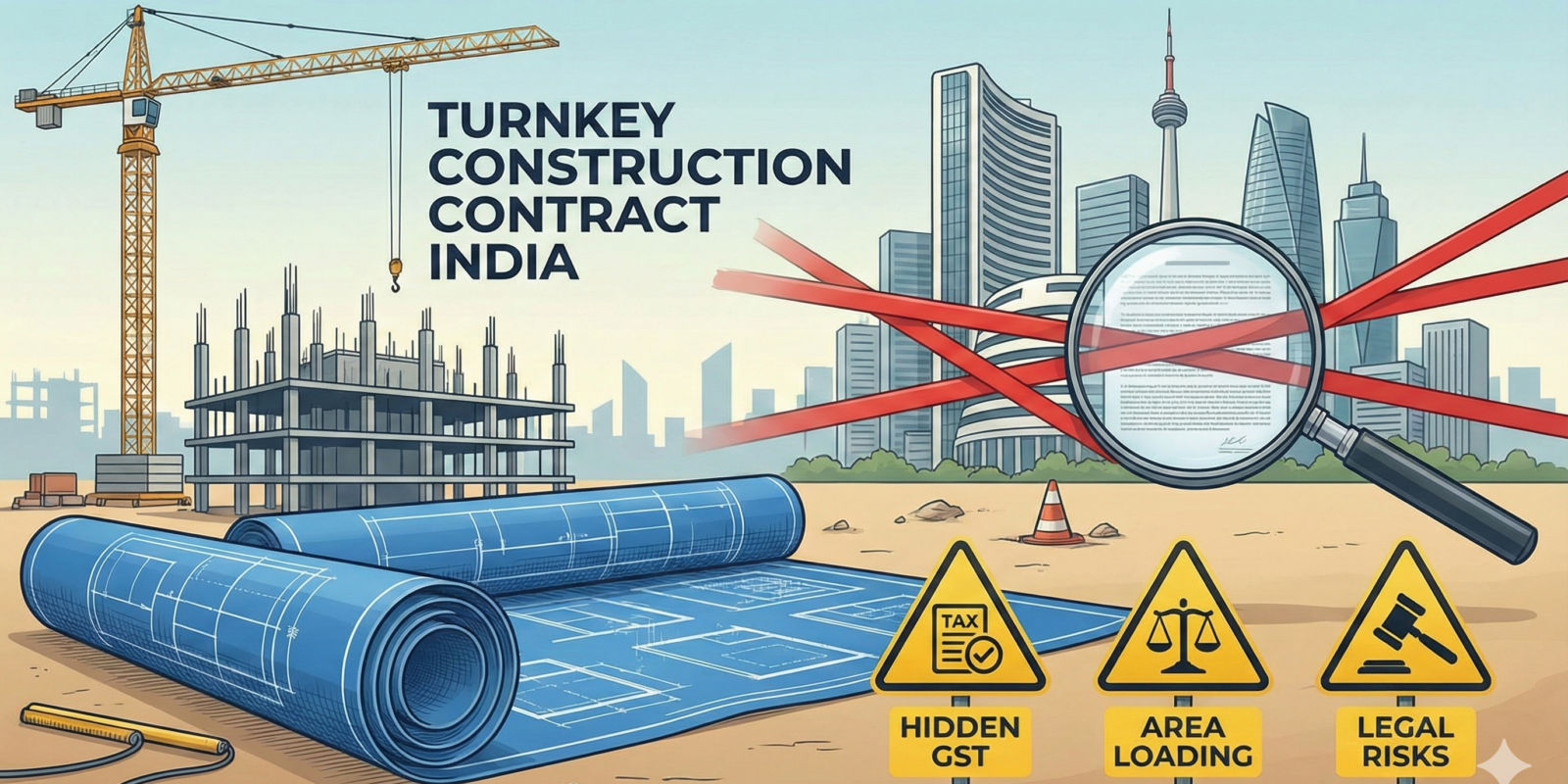
By Building a house in India often starts with a handshake and a “standard” agreement. But that standard agreement is frequently a copy-paste job from twenty years ago. Contractors often use templates referencing the repealed Companies Act of 1956 while ignoring the very real 18% GST liability applicable today.
Signing these documents without scrutiny exposes landowners to massive financial leaks—from paying for “super built-up” air instead of usable carpet area, to funding contractor delays without penalty.
We analyzed a typical Turnkey Construction Agreement to expose the specific clauses that drain your budget and jeopardize your ownership rights. Here is the detailed breakdown of what your contractor is likely hiding in the fine print.
The Dangerous Silence in Your Turnkey Construction Contract
The construction sector in India has evolved rapidly over the last decade. Yet many contractors still operate using contract templates that date back to the early 2000s. We analyzed a standard “Agreement for Construction on Turnkey Basis” often used in cities like Kolkata and Mumbai. The findings were alarming.
From citing repealed laws to ignoring the 18% GST reality, these documents are not just outdated; they are financial traps. This report deconstructs the legal format to show you exactly where the risks lie.
The “Built-up” vs. “Carpet” Area Trap
The most expensive clause in any construction contract is the definition of the billable area. The reviewed document uses “Built-up Area” which includes the thickness of external walls, balconies, and staircases.
Why does this matter? RERA introduced “Carpet Area” as the standard for transparency. It forces builders to charge for usable space. By sticking to “Built-up Area,” contractors charge you premium construction rates for the 12-inch brick walls and semi-finished balconies.
Visualizing the Cost Leakage
How much extra are you paying for “Super Built-up” loading?
Figure 1: Comparison of Billable Area vs Usable Area costs.
The “Or Equivalent” Brand Scam
Clause 5(g) of the contract references “general specifications in Annexure III”. This is where profit margins are manipulated. Most standard Annexures list premium brands followed by two dangerous words: “Or Equivalent.”
The Substitution Ladder
Contractors often bid low hoping to recover margins through material substitution. Here is the typical downgrade path:
- Cement: Ultratech (Promised) → Local Mini-Plant Brands (Delivered).
- Plumbing: Jaguar/Kohler (Promised) → “Jaguar-type” unbranded brass fittings.
- Wires: Havells/Finolex (Promised) → Local non-ISI marked cables.
The Payment Schedule Trap
The contract snippet states payments are payable “at the times… specified in Annexure II.” This vagueness allows contractors to insert “Time-linked” schedules rather than “Progress-linked” ones.
Risk: Contractor gets paid even if work stops or slows down.
Benefit: Aligns cash flow with actual work done.
The “Variation” Protocol (Change Orders)
Construction projects rarely finish exactly as planned. You might move a wall or change floor tiles. Standard contracts often lack a “Change Order” clause. Without it, contractors charge “Spot Rates” for deviations—often 200% higher than market rates.
The Hidden Insurance Liability
The contract mentions “Wages of labour” but is silent on accidents. In India, if a laborer is injured on your site, the primary liability often falls on the landowner under the Employee’s Compensation Act, 1923, if the contractor fails to pay.
WC Policy
Workmen’s Compensation
₹4,000* Approx premium for 10 workersCovers injury/death of workers.
CAR Policy
Contractor’s All Risk
0.2% Of Project ValueCovers fire, theft, and collapse.
*Premiums are estimates and vary by insurer.
Liquidated Damages (Delay Penalties)
If the project is delayed by 6 months, who pays for your rent? Without a “Liquidated Damages” (LD) clause, the contractor has no financial pressure to finish on time.
A standard LD clause deducts 0.5% of the Total Contract Value for every week of delay, capped at 5% or 10%.
Delay Penalty Calculator
Estimate the financial impact of a delay clause.
Based on standard 0.5% per week deduction.
The “Annexure Vacuum”
Legal documents like the one you uploaded rely heavily on attached Annexures (I, II, and III). In 80% of disputes, these Annexures are found to be either blank, vaguely filled, or missing entirely.
The Mandatory Checklist
Before signing, ensure these Annexures contain specific details, not just generic text.
Must specify who pays for: Electricity connection, Water borewell, Liaison fees, and Watchman salary.
Must list 10-12 distinct stages (Plinth, Lintel, Roof, Plaster, Flooring). Reject any schedule with fewer than 5 stages.
Must list Brand, Grade (e.g., OPC 53 Cement), and Basic Price (e.g., Tiles @ ₹60/sq.ft).
The “Sanction vs. Reality” Gap
The document mentions “preparation of layout plans… approved by Municipal Corporation.” Here lies a common trap. Contractors often prepare two sets of drawings:
- Sanction Plan: Minimalistic, strictly follows rules (setbacks, height), submitted to the Municipality.
- Working Drawing: What is actually built. Often encroaches on setbacks or adds unapproved balconies.
Who Owns the Drawings?
Clause 5(a) of your document states that the Contractor prepares the architectural drawings. This creates an Intellectual Property risk. If you fire the contractor halfway, they can legally claim copyright over the design and prevent another builder from using those plans to finish your house.
The “Red Pen” Analysis
We took the snippet from your uploaded document and marked it up to show exactly how a legal expert reads this text.
…XYZ Co. Ltd., a company incorporated under the Companies Act, 1956 ERROR: Repealed Act. Must be Companies Act, 2013. Check Director Identification Number (DIN).
…contractors have offered to construct the same on a ‘turnkey basis’ VAGUE: Define ‘Turnkey’. Does it include Municipality Liaison? Electrical Connection fees? Boundary walls?
…cost of all materials for construction. RISK: No “Basic Rates” defined. If steel prices jump 20%, contractor will stop work or demand escalation.
Arbitration: The Cost Trap
The RTF version of your agreement contains a standard Arbitration clause. While arbitration is faster than civil courts, it is not cheap. The clause says “cost… in the discretion of the arbitrators.”
In India, arbitrator fees can run into lakhs per session. For a small residential dispute (e.g., ₹5 Lakhs withheld), the cost of arbitration might exceed the dispute amount.
Recommendation: For projects under ₹50 Lakhs, specify a “Sole Arbitrator” to be appointed by mutual consent, rather than a panel of three, to keep costs down.
Contract Model Comparison
| Feature | Turnkey (The Analyzed Doc) | Item Rate Contract | Labour Only |
|---|---|---|---|
| Pricing Basis | Fixed Area Rate (High Risk) | Per Unit (Safe) | Daily/Sq.ft Labour |
| Material Price Risk | Contractor Bears Risk | Owner Pays Actuals | Owner Buys Material |
| Quality Control | Hard to Monitor | High Transparency | Owner Controls Material |
| GST (2025/26) | 18% on Total Value | 18% on Service Fee | Exempt (Conditions Apply) |
| Hidden Costs | High (Area Loading) | Low | High (Wastage/Pilferage) |
Recommended Clauses (Copy & Paste)
Update your draft with these modern, legally robust clauses.
“The Contractor shall be responsible for rectifying any defects in the structure, workmanship, or materials that arise within 12 (twelve) months from the date of Handover (Defect Liability Period). Such rectification shall be carried out at the Contractor’s sole cost within 7 days of notice.”
“The Agreed Rate is exclusive of Goods and Services Tax (GST). GST shall be paid by the Employer at the applicable rate (currently 18%) over and above the bill value, subject to the Contractor providing a valid GST Tax Invoice.”
“The Employer reserves the right to terminate this Agreement if the Contractor delays the work by more than 30 days without valid cause, or fails to adhere to the material specifications. In such event, the Employer may forfeit the Retention Money and complete the work through a third party at the Contractor’s risk and cost.”
Full Reference Template
Below is the raw text of the standard agreement you uploaded. It is provided here for reference to check the “Whereas” clauses and standard legal boilerplate.
Note: This text is from an older format and requires the legal updates mentioned in the sections above.
Frequently Asked Questions
Generally, no. If the construction is for self-use and not for sale to the public, RERA registration is not required. However, the legal principles of “Unfair Trade Practice” regarding area measurement still apply under Consumer Law.
It does not make the contract void, but it is legally sloppy. It raises questions about the authority of the person signing the contract, as officer definitions changed in the 2013 Act. Always insist on updating it.
Usually, the Owner provides the connection point (meter), but the Contractor pays the usage bills. The clause in your document is vague (“inclusive of… supply of power”). You must clarify if this includes the monthly bill or just the temporary wiring.
For a pure construction agreement where no land or flats are transferred to the contractor, the stamp duty is nominal (typically under Article 5(c) or 21 of the WB Stamp Act). However, if you give the contractor rights to sell units, it becomes a Development Agreement with much higher duty.