 By
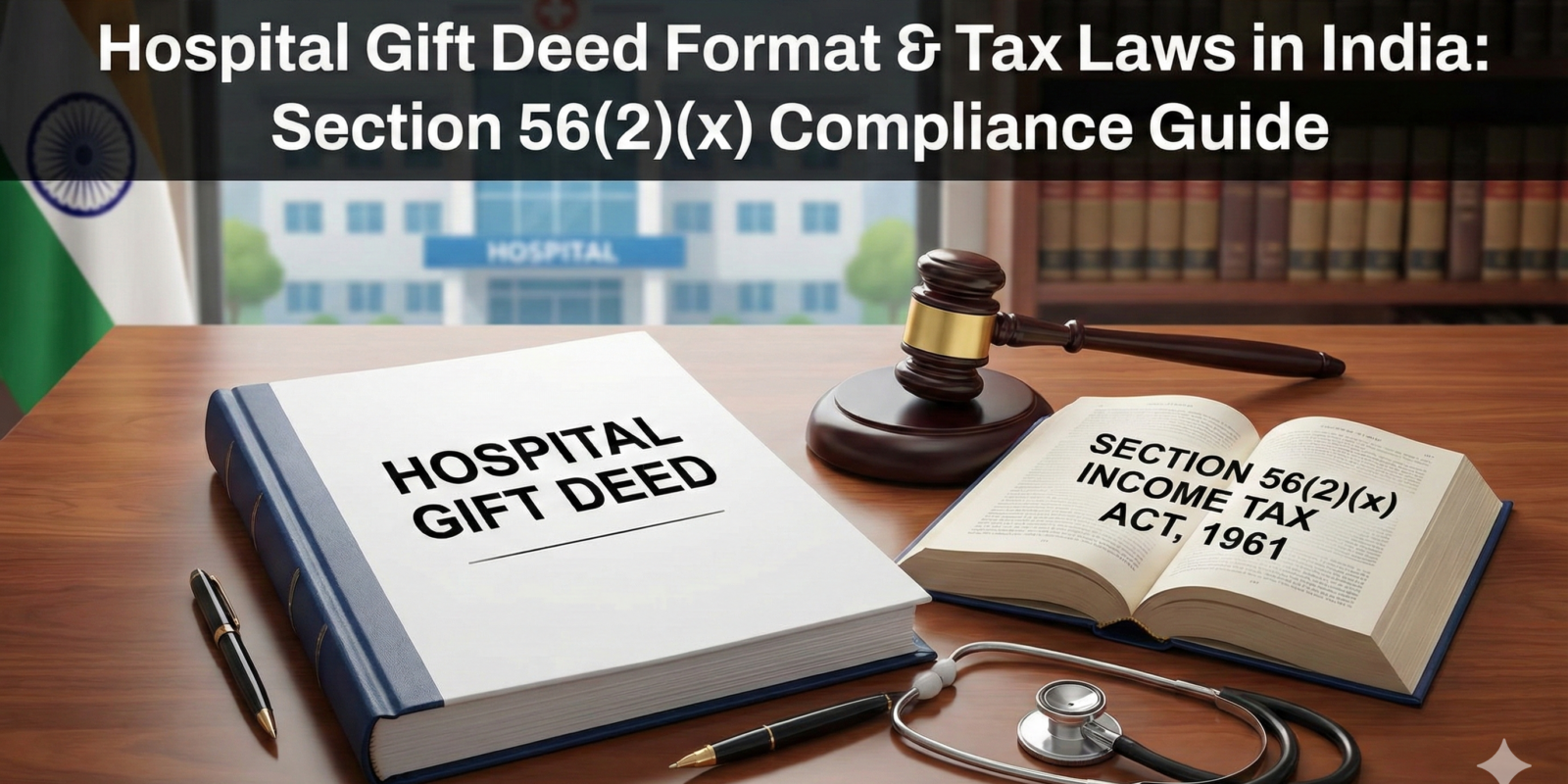
By Donating land to build a hospital is often seen purely as a charitable act, yet Indian tax authorities frequently view it through a commercial lens. If a donor transfers immovable property to an unregistered entity or an individual doctor, the transaction triggers a steep tax liability under Section 56(2)(x) of the Income Tax Act—often amounting to 30% of the land’s market value.
Beyond immediate taxation, the structure of the deed itself determines the project’s survival. Standard legal templates often include a “Reversion Clause”—stating the land returns to the donor if the hospital isn’t built.
While this protects the donor’s intent, it disastrously exposes the Trust to “Revocable Transfer” penalties, potentially stripping its 12A tax-exempt status. This guide examines the legal architecture required to donate land safely, comparing Gift Deeds against Settlement Deeds and providing a tax-robust drafting format.
Deeds of Gift for Hospitals in India: The 2026 Guide
Donating land for a hospital is a noble act; however, the tax authorities treat it like a commercial transaction unless structured perfectly. Here is why the “Deed of Gift” might be the wrong instrument for your charity project.
The intersection of private property rights and public welfare law creates a complex environment for philanthropists. When a donor transfers land for a hospital, they create a legal ecosystem that must sustain the institution in perpetuity while satisfying tax authorities and land revenue departments.
A simple “Gift Deed” often fails to navigate the nuances of the Income Tax Act, 1961 and the Transfer of Property Act, 1882. This analysis examines the structural validity of such deeds, the enforceability of construction conditions, and the tax implications under Section 56(2)(x).
The Anatomy of a Valid Gift
Under Section 122 of the Transfer of Property Act (TPA), a gift is the transfer of existing property made voluntarily and without consideration. For a hospital project, three elements are non-negotiable:
- Existing Property: You cannot gift future property. The donor must hold a present title to the specific plot described in the schedule.
- Acceptance: The donee must accept the gift during the donor’s lifetime. For a hospital, acceptance is often evidenced by taking possession of title deeds or applying for building permits.
- No Consideration: The transfer must be gratuitous. “Spiritual benefit” is not considered monetary consideration by Indian courts, so it does not invalidate the gift nature.
The “Failure to Construct” Trap
Donors often want the land back if the hospital is not built. While Section 126 of the TPA allows for revocation on a specific event, including a simple “Reversion Clause” can be fatal for tax exemptions. The Income Tax Department views reversion clauses as evidence that the trust is revocable, leading to the denial of 12A registration.
Section 56(2)(x): The Donee-Based Tax
The Finance Act, 2017 radically altered gift taxation. If any person receives immovable property without consideration, the entire Stamp Duty Value (SDV) is taxable as “Income from Other Sources.”
Tax Liability on ₹5 Crore Land Gift
Comparison of tax impact on different recipient types.
Scenario A: You gift land worth ₹5 Crore to an individual doctor. The doctor must pay income tax on ₹5 Crore (approx. ₹1.5 Cr).
Scenario B: You gift the same land to a Registered Public Charitable Trust. The receipt is fully exempt under the specific exclusions in Section 56(2)(x).
Gift Deed vs. Settlement Deed
Stamp duty varies wildly across states. In jurisdictions like Maharashtra and West Bengal, a “Deed of Settlement” for charitable purposes attracts significantly lower duty than a standard “Gift Deed.”
State-Specific Duty Optimizer
| State | Gift Deed (Standard) | Settlement (Charity) | Strategic Verdict |
|---|---|---|---|
| Maharashtra | ~5-6% (Market Value) | ~2-3% (Art. 55) | Use Settlement Deed |
| Karnataka | ~5.6% (inc. Cess) | Fixed / Concessional | Register Trust First |
| West Bengal | ~5-7% | ~0.5% (Caps apply) | Use Settlement Deed |
The “Safe” Cy-près Clause
To satisfy the Transfer of Property Act without triggering Income Tax violations, do not let the land revert to the donor. Use the following clause to ensure the asset remains in the charitable stream.
Trust vs. Society vs. Section 8 Company
Before drafting the gift deed, the Donee entity must be correctly formed. For hospitals, the choice of entity dictates the ease of FCRA (Foreign Contribution) registration and corporate CSR funding.
| Feature | Public Trust | Section 8 Company | Verdict for Hospitals |
|---|---|---|---|
| Formation Speed | Fast (10-15 days) | Slow (30-60 days) | Trust is faster for land transfer. |
| Compliance | Low (State Acts) | High (MCA & ROC) | Section 8 offers more transparency. |
| CSR Funding | Moderate Appeal | High Appeal | Corporates prefer Section 8. |
| Control | Autocratic (Life Trustees) | Democratic (Board) | Trust keeps family control better. |
From Drafting to Mutation
Executing a Gift Deed for a hospital is not a single-day event. It requires sequential clearance from multiple authorities.
Step 1: Trust Registration (Day 1-15)
Register the Public Charitable Trust with the Charity Commissioner. Obtain the Registration Certificate.
Step 2: 12A & 80G Application (Day 16-45)
Apply for Provisional 12A registration immediately. Without this, the Gift is taxable.
Step 3: Valuation & Adjudication (Day 46-50)
Submit the draft Gift Deed to the Collector of Stamps for adjudication of proper stamp duty (concessional rates apply).
Step 4: Registration (Day 51)
Donor and Trustees appear before the Sub-Registrar with two witnesses. Pay registration fees.
Step 5: Revenue Mutation (Day 60+)
Apply to the Tehsildar/Municipality to update the Record of Rights (7/12 extract) reflecting the Trust as the new owner.
The “Revocable Transfer” Risk
Many standard templates contain a clause stating: “If the hospital is not built within 5 years, the land reverts to the Donor.”
⚠️ Why this is Dangerous
Section 61 of the Income Tax Act states that if a transfer is revocable, all income arising from that asset is clubbed with the transferor’s income.
If your Gift Deed contains a Reversion Clause, the Income Tax Department may:
- Deny the Trust’s 12A exemption.
- Tax the “notional income” of the land in the hands of the Donor.
- Treat the transfer as a lease rather than a gift.
Solution: Use the “Cy-près” clause provided in Section 04. If the hospital fails, the land must go to another charity or the Government, never back to the donor.
The Agricultural Land Restriction
Most hospital projects begin on cheaper agricultural land on the city outskirts. However, Section 63 of the Bombay Tenancy and Agricultural Lands Act (and similar laws in Karnataka and Gujarat) prohibits the transfer of agricultural land to a “Non-Agriculturist.”
The “Trust” is a Non-Agriculturist
Even if the trustees are farmers individually, the “Trust” as a legal entity is not. Therefore, a direct gift of farmland to a Trust is often void ab initio.
The Correct Procedure:
- Step 1: Apply for permission from the District Collector under Section 63 to buy/receive land for “Bonafide Industrial/Institutional Use.”
- Step 2: Execute the Gift Deed only after receiving this permission.
- Step 3: Apply for N.A. (Non-Agricultural) Conversion Order under Section 44 of the Land Revenue Code within 6 months of the gift.
Section 13(1)(c) Compliance
It is common for donors to request: “Two beds shall be reserved free of cost for the Donor’s family.” Including this in the Gift Deed is a fatal error.
Section 13(1)(c) of the Income Tax Act states that if any part of a charity’s income or property is used for the benefit of an “Interested Person” (Author of the trust, substantial contributor, or their relatives), the entire tax exemption is forfeited.
| Clause Type | Typical Wording | Tax Consequence |
|---|---|---|
| Prohibited | “Free treatment for Donor’s family” | 100% Tax on Trust Income (MMR) |
| Allowed | “Preference for 10% Indigent Patients” | Allowed (Meets Public Charity norms) |
| Grey Area | “Naming Rights for Donor” | Generally Allowed (Not a monetary benefit) |
Real Estate Benefits of Registration
Beyond tax, a properly registered Gift Deed for a “Public Purpose” (Hospital) unlocks significant real estate potential under Unified Development Control Regulations (UDCPR).
- Additional FSI: Registered charitable hospitals often qualify for 3.0 to 4.0 FSI (Floor Space Index) compared to the standard 1.1 for residential zones.
- Premium Waivers: Government land granted for hospitals often comes with waivers on development premiums, provided the deed explicitly mentions “Charitable Hospital” as the user.
- Height Relaxations: Special fire NOC norms apply to hospital buildings, often allowing greater floor heights for Operation Theaters (OTs) which must be accounted for in the deed’s “Schedule of Property.”
A comparison of the standard template (uploaded) versus a tax-robust version.
🚫 The Risky Draft (Uploaded)
Critique: Triggers Section 61 (Revocable Transfer). Income from land becomes taxable in Donor’s hands.
✅ The Robust Draft
Verdict: Satisfies “Perpetuity” rule. Safe for 12A/80G Registration.
🚫 The Risky Draft (Uploaded)
Critique: Vague. “Poor” is subjective. Can lead to disputes with Charity Commissioner over quotas.
✅ The Robust Draft
Verdict: Aligns with State Health Act definitions (e.g., BPLC/MPJAY schemes).
Pre-Registration Compliance
Ensure these items are cleared before visiting the Sub-Registrar.
No. Explanation 5 to Section 80G clarifies that no deduction is allowed unless the donation is a “sum of money.” Gifting land does not qualify for the 50% deduction. To claim 80G, one would technically need to sell the land (paying capital gains) and donate the cash proceeds.
To retain tax exemption, the hospital must serve the public. While it can charge fees, it must not exist solely for profit. Many states require charitable hospitals to reserve 10-20% of beds for indigent patients to maintain their land lease or tax status.
Generally, no. Trusts are considered non-agriculturists. You must obtain permission under relevant state laws (like Section 109 of Karnataka Land Reforms Act or Section 63 in Maharashtra) before executing the gift. Transferring without permission renders the deed void.
Based on the provided sample, but upgraded with “Strong Clauses” to ensure Section 12A/80G compliance and prevent tax leakage under Section 56(2)(x).
DEED OF GIFT FOR ESTABLISHING A CHARITABLE HOSPITAL
THIS DEED OF GIFT is made at City Name on this __ day of Month, 2026.
BETWEEN
MR. DONOR NAME, s/o Father’s Name, Aged about __ years, Residing at Address (hereinafter called “THE DONOR”, which expression shall unless repugnant to the context include his heirs, executors, and administrators) of the ONE PART.
AND
TRUST NAME, a Public Charitable Trust registered under the Public Trusts Act, having Registration No. E-12345, represented by its Managing Trustee MR. TRUSTEE NAME (hereinafter called “THE DONEE”, which expression shall include its successors-in-office and assigns) of the OTHER PART.
WHEREAS
- The DONOR is the absolute owner and in possession of the Non-Agricultural land bearing Survey No. 101, situated at Village/City, more particularly described in Schedule-I hereunder (hereinafter referred to as “THE SAID PROPERTY”).
- The DONEE is a registered Public Charitable Trust established with the primary object of providing medical relief to the public irrespective of caste, creed, or religion.
- The DONOR, out of natural love and affection for the cause of public charity and without any monetary consideration, is desirous of gifting the Said Property to the DONEE for the construction and running of a Charitable Hospital.
- The DONEE has accepted the said gift by a Resolution passed in the meeting of Trustees dated Date.
NOW THIS DEED WITNESSETH AS UNDER:
- TRANSFER: The DONOR hereby voluntarily transfers, conveys, and assigns unto the DONEE all rights, title, and interest in the Said Property, TO HOLD the same forever.
- PURPOSE (User Clause): The DONEE shall use the property strictly for the construction and operation of a Hospital/Medical Center for the benefit of the general public.
- IRREVOCABILITY (Anti-Reversion Clause): This Gift is absolute and irrevocable. Under no circumstances shall the title of the property revert to the DONOR or his legal heirs. The DONOR hereby extinguishes all his rights over the property.
- CY-PRÈS DOCTRINE (Tax Safety): In the event the DONEE Trust is dissolved or fails to function, the property shall NOT revert to the DONOR. Instead, it shall be transferred to another Public Charitable Trust having similar objects (medical relief) or vest in the State Government, ensuring the asset remains dedicated to public charity in perpetuity.
- INDEMNITY: The DONOR covenants that the property is free from all encumbrances, liens, or litigations. The DONOR indemnifies the DONEE against any defect in title existing prior to this date.
- VALUATION: The Stamp Duty Value (Government Market Value) of the property is declared as Rs. __________ for the purpose of Stamp Duty, paid herewith.
SIGNED AND DELIVERED by
the within named DONOR
_________________________
(Signature of Donor)
ACCEPTED by the within named
DONEE TRUST
_________________________
(Managing Trustee)
WITNESSES:
- _________________________ (Name & Address)
- _________________________ (Name & Address)