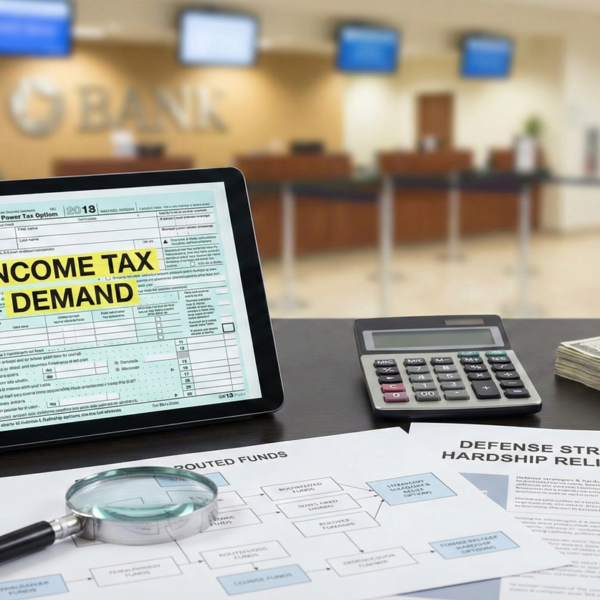
Receiving an income tax demand notice after a Section 143(3) scrutiny assessment requires a prompt response. Assessing Officers sometimes reject statutory deductions. These commonly include Section 80GGC political donations, House Rent Allowance exemptions, and Section 80D medical claims.
When authorities ignore documentary evidence and raise a tax demand based on human probabilities, taxpayers must file a statutory appeal. This guide explains the steps to contest an assessment order.
Readers will find specific evidentiary requirements, the procedure to file a CIT appeal, methods to keep the tax recovery in abeyance under Section 220(6), and defense strategies against misreporting penalties.
Evaakil.com
Updated till Feb 2026Legal and Strategic Analysis of Section 143(3) Scrutiny Assessments and Demand Notices
A scrutiny assessment under Section 143(3) of the Income Tax Act examines a tax return to verify income declarations and deductions. A severe issue occurs when an Assessing Officer ignores submitted documentary evidence and raises a tax demand based on assumptions.
This post examines a specific situation involving a rejected INR 10,00,000 political donation under Section 80GGC, disallowed House Rent Allowance paid in cash, and rejected medical expenditure for an elderly parent under Section 80D.
Procedural Violations
The Assessing Officer must afford the taxpayer an opportunity to present evidence and must objectively evaluate that material. An assessment order that ignores corroborated documentary evidence violates the right to a fair hearing. This provides a strong basis for an appeal.
Section 80GGC: Political Donations
The officer disallowed a donation made to a Registered Unrecognised Political Party by applying the doctrine of human probabilities. The officer also cited notices issued to the party by the Election Commission of India.
This approach lacks a legal basis when banking channels are used. The assessing authority must prove the transaction was a sham. They must demonstrate the funds returned to the taxpayer in cash. Without evidence of round tripping, the transaction remains valid. Regulatory notices from the Election Commission do not mean a party is deregistered. The taxpayer claims the deduction based on the legal registration status at the exact time of the transfer.
House Rent Allowance Exemptions
Paying rent to a parent is legal under Section 10(13A). Cash payments create a massive burden of proof. The taxpayer must show matching cash withdrawals from their bank account. The parent receiving the rent must declare this income in their personal income tax return. Failing to provide the parent’s tax return usually leads to a rejected claim.
Section 80D: Medical Expenditure
Section 80D(2)(c) allows a deduction of up to INR 50,000 for medical costs incurred for a senior citizen parent who has no health insurance. The law strictly prohibits cash payments for these expenses. Only digital payments, credit cards, or cheques qualify for this specific deduction. Cash payments will automatically fail during an appeal.
Evidentiary Requirements for Statutory Deductions
The burden of proof lies entirely on the taxpayer to substantiate deductions claimed during a scrutiny assessment. Failing to present a watertight paper trail allows the Assessing Officer to lawfully reject the claims.
Documentation Matrix
| Deduction Claimed | Mandatory Primary Evidence | Secondary Supporting Evidence |
|---|---|---|
| Section 80GGC (Political Donation) | Bank statement showing debited amount, Valid receipt from the political party | Form 16A or Party PAN copy, Confirmation letter from the party treasurer |
| HRA Exemption (Rent to Parent) | Registered Lease Agreement, Monthly rent receipts with revenue stamps | Parent’s Income Tax Return showing rental income, Bank statement showing cash withdrawal or digital transfer |
| Section 80D (Senior Citizen Medical) | Original pharmacy and hospital invoices, Proof of digital payment (Credit Card/UPI/Cheque) | Doctor’s prescription, Parent’s age proof (Aadhar or PAN) |
Addressing the Human Probability Argument
Assessing Officers frequently use the doctrine of human probabilities established in the Sumati Dayal case to reject claims that appear suspicious. To counter this, you must present objective documentary evidence. A recorded bank transaction supersedes subjective assumptions. You must demand the Assessing Officer provide cross-verification reports if they allege the political donation was a round-tripping scheme.
Binding Legal Precedents
Tax tribunals and High Courts have established clear rules regarding Section 80GGC. When a taxpayer makes a donation through banking channels to a registered political party, the deduction is valid under the law.
The revenue department cannot deny the claim based on mere suspicion or third party statements unless they prove the specific taxpayer received cash back. Relying on an Election Commission notice issued to the political party is legally insufficient to penalize the individual donor. The burden shifts to the tax department to prove active collusion.
Appellate Strategy
The taxpayer must file an appeal before the Commissioner of Income Tax (Appeals) within 30 days of receiving the demand notice. This requires filing Form 35 electronically.
Appeal Fee Structure
| Assessed Total Income Bracket | Prescribed Appeal Fee (CIT(A)) | Prescribed Appeal Fee (ITAT) |
|---|---|---|
| Up to INR 1,00,000 | INR 250 | INR 500 |
| More than INR 1,00,000 but less than INR 2,00,000 | INR 500 | INR 1,500 |
| More than INR 2,00,000 | INR 1,000 | INR 10,000 |
Rule 46A Application
Since the Assessing Officer ignored the submitted evidence, the taxpayer must file a formal application under Rule 46A alongside Form 35. This rule forces the appellate authority to admit the ignored documents onto the official record. The officer will have to provide a written response to this newly admitted evidence.
Staying the Tax Demand
Filing an appeal does not stop the tax department from recovering the money. The taxpayer must file a stay application under Section 220(6). While the standard guideline requires a 20 percent deposit, the additions in this specific case likely double the assessed income. This qualifies as a High Pitched Assessment under Instruction No. 96. The taxpayer should demand a complete stay without depositing any money.
Income Tax Appellate Tribunal (ITAT) Procedure
If the Commissioner of Income Tax (Appeals) upholds the Assessing Officer’s demand, the next legal remedy is filing an appeal with the Income Tax Appellate Tribunal. The ITAT is the final fact-finding authority in the income tax hierarchy.
Filing Timelines and Requirements
You have strictly 60 days from the date you receive the CIT(A) order to file your appeal using Form 36. You must submit the appeal in triplicate, accompanied by the original assessment order, the CIT(A) order, and the prescribed fee receipt.
Staying Demand at the ITAT Level
If the CIT(A) rejects your appeal, the stay on your tax demand automatically expires. The department will initiate recovery proceedings immediately. You must simultaneously file a separate stay petition before the ITAT. The ITAT has the statutory power to stay the demand for up to 180 days, provided you can demonstrate extreme financial hardship or a strong prima facie case.
To succeed in an ITAT stay petition, you must prepare a detailed paper book containing your balance sheet, bank account statements, and a summary of your liquid assets to prove financial inability to pay the disputed demand.
Defending Against Section 270A Penalties
After finalizing a demand notice, the Assessing Officer usually initiates penalty proceedings under Section 270A. The department classifies disallowed deductions as misreporting of income. This classification attracts a severe penalty of 200 percent of the tax payable.
The taxpayer must file a detailed reply to the penalty notice. The primary defense strategy relies on proving that all facts material to the computation of income were disclosed in the original tax return. A rejected claim does not automatically amount to misreporting. If the taxpayer provides all legitimate receipts and bank statements, the issue becomes a difference of legal opinion rather than deliberate concealment. Courts consistently rule against applying penalties on debatable legal issues.
Drafting the Documents
Use these formats as a starting point for the legal filings.
Grounds of Appeal (Form 35)
Rule 46A Application
Section 220(6) Stay Application
Frequently Asked Questions
Yes. You must prove the specific source of the cash. You need bank statements showing cash withdrawals matching the exact rent amounts. Your landlord must also declare this rent in their income tax return.
No. Routine compliance notices do not equal statutory deregistration. If the political party was registered under Section 29A and accepting donations at the exact time you made your bank transfer, the deduction is legally valid.
No. The law enforces an absolute ban on cash payments for medical expenses under Section 80D. You can only use cash for preventive health checkups up to a limit of INR 5,000.
No. You must proactively file a separate stay application under Section 220(6) before the 30 day deadline expires. Failure to do this allows the department to attach your bank accounts.