 By
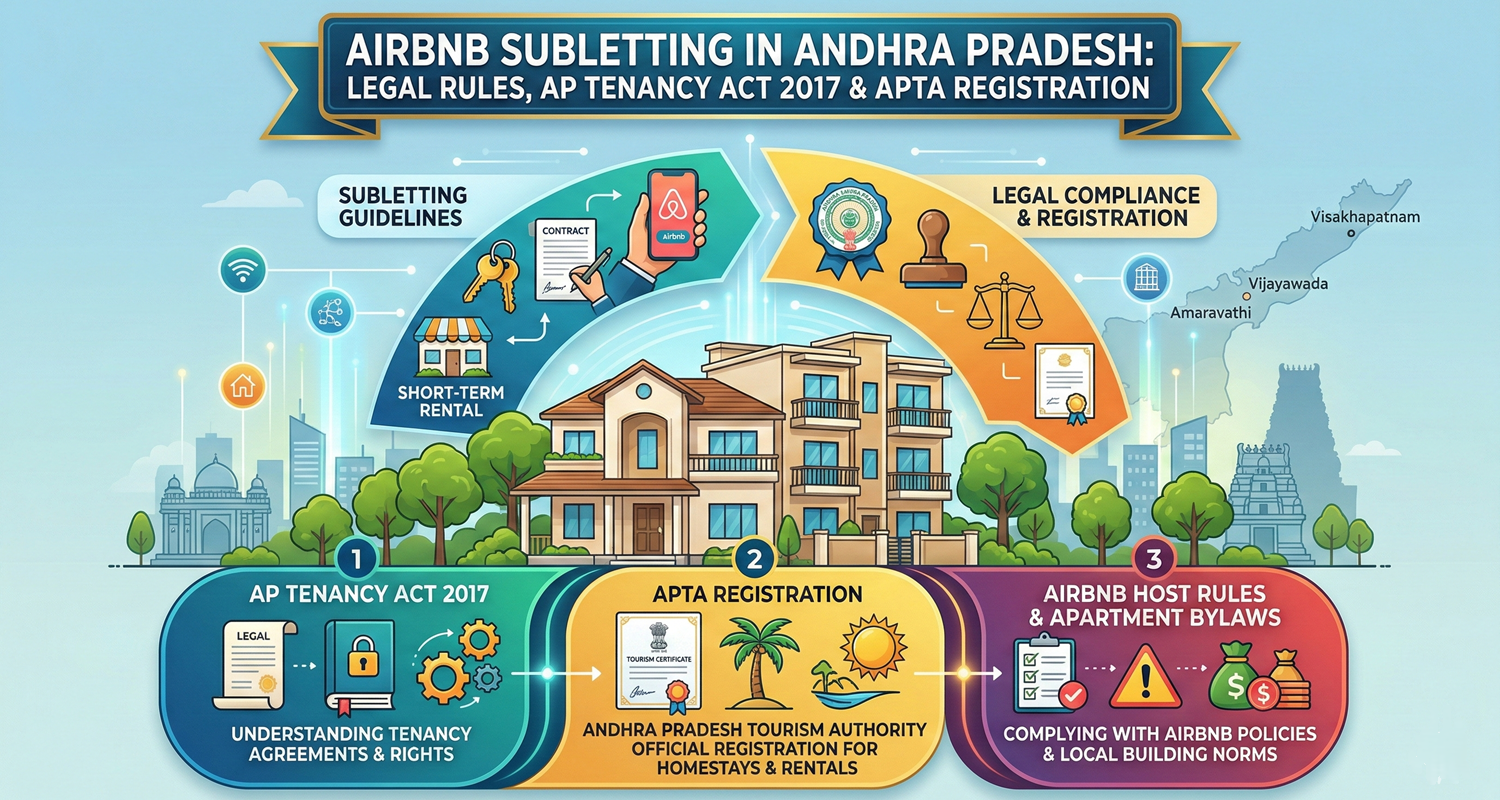
By Property owners and hosts in Andhra Pradesh face a specific legal environment shaped by the AP Residential and Non-Residential Premises Tenancy Act, 2017. Building a short-term rental business requires a registered written lease that explicitly permits commercial use.
Without an APTA license and proper police reporting via the AP Police Seva app, hosts risk eviction and heavy fines. This documentation from Evaakil.com breaks down the local requirements for cities like Visakhapatnam and Vijayawada.
It covers everything from municipal tax shifts to foreigner reporting via Form C, providing the paperwork needed to keep an Airbnb business lawful through 2025.
Andhra Pradesh Real Estate Law & Rentals
Leasing, Subletting & Operating an Airbnb in Andhra Pradesh
Updated September 2025: A Practical Guide into AP Tenancy Act 2017 & APTA Compliance.
I. The Andhra Pradesh Tenancy Framework
The Andhra Pradesh Residential and Non-Residential Premises Tenancy Act, 2017 is the primary legislation. It created a more balanced environment for landlords and commercial operators compared to older statutes.
Operational Rule: Under Section 4 of the AP Act, all tenancies must be evidenced by a written agreement registered with the Rent Authority. Any subletting without a registered Supplementary Agreement is grounds for immediate eviction under Section 21.
II. Practical Contractual Strategy
In Visakhapatnam and Vijayawada, Housing Societies are increasingly vigilant. Your contract must move beyond standard boilerplates to protect against change of use allegations.
Key Arbitrage Clause:
“The Lessee shall have the right to provide hospitality services to third-party guests and is permitted to create Licenses to Occupy for short durations, ensuring the Lessor is indemnified from any guest-related liabilities.”
III. APTA Classification & Registration
The Andhra Pradesh Tourism Authority (APTA) classifies homestays and B&Bs. Registration is mandatory to avoid being flagged as an illegal commercial establishment.
Silver Category
- Basic amenities provided
- Cleanliness & safety focus
Gold Category
- Enhanced furniture
- Air conditioning mandatory
Platinum Category
- Luxury toiletries & linens
- Multiple language support
IV. Utility Tariff Escalation
APCPDCL and APEPDCL can reclassify your unit if it is reported as a commercial rental.
Tariff Impact: Domestic vs. Commercial
V. Taxation & Reverse Charge Mechanism (RCM)
For Airbnb operators in India, GST compliance is vital. If your turnover is above 20 Lakhs, you must register. Under Section 9(5), Airbnb acts as the tax collector for unregistered hosts.
Professional Tax: In AP, any person carrying on a business is liable to pay Professional Tax, typically 2,500 per annum for hospitality units.
VI. Security & Police Protocols
In Andhra Pradesh, the AP Police Seva app handles foreigner reporting. Hosts must maintain identity records of all guests for 3 years.
VII. Dispute Resolution: The Rent Authority
The AP Act 2017 established Rent Authorities to resolve issues within 60 to 90 days.
VIII. Zoning & MA&UD Regulations
The Municipal Administration and Urban Development (MA&UD) regulates land use. Operating in a purely residential zone can trigger municipal notices.
IX. Insurance & Liability Management
Standard home insurance excludes commercial guest liability. Public Liability Insurance is recommended for APTA-classified units.
X. Foreigner Reporting (FRRO)
Hosts must file a Form C within 24 hours of a foreign guest’s arrival. Failure to report can lead to criminal charges under the Foreigners Act, 1946.
XI. Municipal Property Tax Reclassification
In Andhra Pradesh, municipalities like GVMC (Visakhapatnam) and VMC (Vijayawada) use an Annual Rental Value (ARV) system for property tax. When a property is utilized for commercial short-term rentals, it moves from the Residential slab to the Commercial or Special Purpose slab.
Key Impact Points:
- Tax Increase: Commercial property tax can be 200% to 300% higher than residential rates.
- Self-Assessment: Hosts or owners must proactively update their status on the CDMA AP portal.
- Liability: The lease should clarify that the Host (Lessee) indemnifies the Landlord (Lessor) for any retroactive tax hikes triggered by the Airbnb operation.
XII. Digital Infrastructure & Wi-Fi Compliance
Under the Department of Telecommunications (DoT) guidelines and the Information Technology Act, providing internet to public guests carries legal weight. As a host, you are the provider of record.
Compliance Tip: Avoid using a single, static password for all guests. Use a router that allows guest isolation and maintain a log of MAC addresses and guest session timings. In case of cyber-misconduct from your unit, these logs are your primary legal defense.
XIII. Waste Management & Swachha Andhra Rules
Andhra Pradesh has implemented strict Solid Waste Management Rules. Commercial establishments, including homestays, are classified as Bulk Waste Generators if they exceed specific trash volumes.
Ensure your unit follows the three-way segregation (Wet, Dry, Domestic Hazardous) as mandated by the Swachha Andhra Corporation. Commercial collection fees are typically higher than residential user charges and must be paid monthly to the local municipal staff.
XIV. Frequently Asked Questions
XV. Conclusion
The short-term rental market in Andhra Pradesh is shifting from an unorganized sector to a highly regulated hospitality industry. Success in this space requires more than just good interior design; it demands a rigorous legal foundation. By adhering to the Andhra Pradesh Tenancy Act 2017, securing APTA certification, and maintaining meticulous FRRO records, hosts can mitigate the risks of eviction and litigation.
At Evaakil.com, we recommend that all rental arbitrage contracts be registered and include explicit indemnification for utility and tax reclassifications. As 2025 progresses, localized enforcement in cities like Visakhapatnam will only increase, making compliance your most valuable business asset.
XI. Legal Templates
LANDLORD NOC FOR AP TOURISM REGISTRATION
To,
The Commissioner,
AP Tourism Authority (APTA),
Vijayawada, AP.
I, [Landlord Name], declare that I am the owner of [Address]. I have leased this property to [Host Name] and have no objection to them registering this unit as a Homestay/B&B under APTA guidelines.
Signature: __________________