
 By
By A General Power of Attorney allows a principal to grant legal authority to an agent. Indian property and corporate laws strictly dictate how this document functions. Supreme Court judgments and the Registration Bill 2025 altered the rules for property sales and digital execution. This guide details the current registration mandates, NRI procedures, stamp duty exemptions for blood relatives, and the legal steps required to cancel an active power of attorney in India.
Legal Analysis of General Power of Attorney in India
Understanding rights, risks, and recent Supreme Court rulings affecting property transfers and corporate delegations.
A General Power of Attorney (GPA) is a legal document where one person (the principal) grants broad authority to another (the agent or attorney-in-fact) to act on their behalf. In India, this instrument is governed primarily by the Powers of Attorney Act of 1882. Its usage spans property management, corporate operations, and financial transactions. Recent legislative changes and Supreme Court judgments have significantly tightened the rules surrounding GPAs, particularly regarding property sales.
The Myth of GPA Property Sales: Suraj Lamp and Beyond
A common misconception in Indian real estate is that a GPA can transfer property ownership. This practice, often called “GPA Sales” or “SA/GPA/WILL transfers,” was widely used to avoid stamp duty and registration fees. The Supreme Court of India dismantled this practice.
In the landmark case of Suraj Lamp and Industries v. State of Haryana (2011), the Supreme Court ruled that immovable property can only be legally transferred through a registered deed of conveyance. A GPA is not an instrument of transfer. It is strictly an agency arrangement.
This stance has been repeatedly reaffirmed. In a February 2025 judgment (M.S. Ananthamurthy v J. Manjula), the Supreme Court clarified that an agreement to sell combined with a notarized GPA does not transfer title. The court noted that a GPA is revoked upon the principal’s death, even if the document states it is “irrevocable” and backed by consideration. Labeling a PoA as irrevocable does not make it so under the law if it attempts to act as a sale deed.
Valid Methods of Property Transfer vs GPA
Legal validity of different instruments for conveying property title in India.
Registration Requirements (2025-2026 Framework)
The legal requirements for making a GPA valid depend entirely on the powers it grants. The rules have become stricter across states to prevent fraud.
| Purpose of GPA | Registration Mandatory? | Legal Effect |
|---|---|---|
| Transfer, Sale, or Mortgage of Immovable Property | Yes | Must be registered at the Sub-Registrar’s office. Does not transfer title; only authorizes the agent to execute a registered sale deed. |
| General Business Operations / Corporate Representation | Optional (but recommended) | Notarization is usually sufficient. Governed by company resolutions and Indian Evidence Act. |
| Rent Collection & Routine Maintenance | No | Notarization on appropriate stamp paper is sufficient. |
The Registration Bill 2025 and specific state amendments (such as the Registration (Karnataka Amendment) Act, 2025) explicitly list powers of attorney authorizing the transfer of immovable property as compulsorily registrable documents.
Corporate Context: Company to Employee GPA
Companies frequently use GPAs to authorize employees (directors, managers, or specific officers) to conduct business, sign contracts, and represent the company before authorities.
A corporate GPA must be backed by a board resolution authorizing the issuance of the document. The powers granted should be specific to the employee’s role to limit liability. The document must be executed under the common seal of the company (if applicable) and signed by authorized directors.
Standard Template: Company to Employee
Based on standard practices and the reference file GENERAL POWER OF ATTORNE1.docx, here is a structured format for a corporate GPA.
Execution Process and Authentication
Drafting a valid GPA in India involves specific steps regarding execution and authentication. Skipping steps can render the document legally void.
- Drafting: The document must clearly identify the principal and agent, list the precise powers, state the duration, and include revocation conditions.
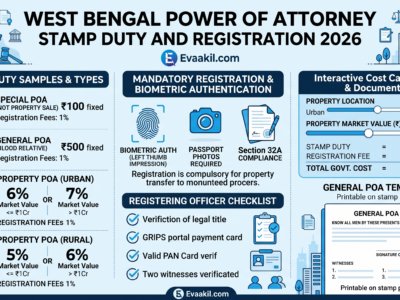
- Stamp Duty: The document must be printed on non-judicial stamp paper or e-stamp. The value depends entirely on the state laws and the purpose of the GPA. A PoA given to a family member without consideration usually attracts nominal stamp duty; a PoA for property sale given to a non-relative may attract stamp duty equivalent to a conveyance deed in some states.
- Execution: The principal must sign the document in the presence of two witnesses, who must also sign and provide identification.
- Authentication: Section 85 of the Bharatiya Sakshya Adhiniyam, 2023 (formerly Indian Evidence Act) raises a legal presumption in favor of a PoA authenticated before a Notary Public.
- Registration: If required (as detailed above), the principal, agent, and witnesses must appear before the Sub-Registrar. Most states now require online appointment booking, Aadhaar verification, and digital photographs.
Non-Resident Indian (NRI) Guidelines for Power of Attorney
Non-Resident Indians frequently use a General Power of Attorney to manage assets in India. The execution process differs significantly when signing outside Indian territory. The principal must sign the document before a Notary Public in their country of residence.
Following notarization, the document requires official authentication to be valid in India. For countries that are members of the Hague Apostille Convention, an Apostille stamp is required. For non-member countries, the Indian Embassy or Consulate must attest the document.
Once the physical document arrives in India by post or courier, it must be presented for stamping within three months of receipt. Section 18 of the Indian Stamp Act mandates this timeframe. The District Registrar or Collector of Stamps will adjudicate and levy the applicable state stamp duty.
Revocation and Cancellation Procedures
A principal retains the right to cancel a General Power of Attorney at any time, provided the document is not explicitly coupled with an interest or part of a valid commercial contract where consideration has passed. The cancellation process requires specific legal steps to ensure third parties are aware of the termination.
- Draft a Deed of Revocation: The principal must execute a formal cancellation deed.
- Register the Revocation: If the original Power of Attorney was registered, the Deed of Revocation must undergo registration at the exact same Sub-Registrar office.
- Notify the Agent: The principal must send a formal legal notice of cancellation to the agent via registered post with acknowledgment due.
- Public Notice: The principal should publish a notice of revocation in two local newspapers. One notice must be in English and the other in the local language of the jurisdiction where the agent operates or the property is located.
State-wise Stamp Duty Calculator (2026 Estimates)
Select a state to view the stamp duty rules for a General Power of Attorney authorizing property sale to a non-relative.
Special vs. General Power of Attorney
A General Power of Attorney grants broad authority to an agent to handle multiple affairs on behalf of the principal. This includes managing properties, signing documents, and handling broad financial matters. A Special Power of Attorney limits the agent to one specific task. Examples include registering a single property, appearing in a specific court case, or collecting a specific debt.
Legal practitioners prefer the Special Power of Attorney to minimize risk. The agent has no legal authority to act outside the exact boundaries defined in the document.
Financial and Medical Representation
Banks follow strict guidelines issued by the Reserve Bank of India regarding third-party account operations. A standard General Power of Attorney is often rejected by bank branches. Banks require the principal to sign specific mandate forms provided by the institution. The appointed agent must also complete full Know Your Customer (KYC) verification before operating the account.
For healthcare decisions, the Supreme Court of India updated the guidelines for Advance Medical Directives and medical representation. An individual can legally appoint an agent to make medical decisions if they lose capacity. The document requires careful drafting and must be executed before a Notary Public or Judicial Magistrate depending on local jurisdiction rules. This legal instrument prevents family disputes during medical emergencies.
Digital Execution and E-Stamping (2026 Protocol)
The Information Technology Act governs electronic signatures and digital execution of legal documents. Corporate powers of attorney for routine business matters are frequently executed digitally using Aadhaar e-Sign or DSC (Digital Signature Certificates). These documents are legal evidence under the Bharatiya Sakshya Adhiniyam 2023.
However, documents authorizing the sale or transfer of real estate are strictly excluded from pure digital execution. State registration authorities mandate physical presence for biometric capturing and photographing of the principal, the agent, and witnesses.
While the execution requires physical presence for property matters, the stamp duty payment process is digitized across India. You can evaluate exact state requirements using the Evaakil e-Stamping Tools. The Stock Holding Corporation of India Limited (SHCIL) generates secure e-stamp certificates with verifiable QR codes to prevent forgery.
Joint Power of Attorney Regulations
A principal can appoint multiple agents to manage their affairs. The legal framework requires the deed to state explicitly how these agents must operate. The two operating methods are “jointly” and “jointly and severally”.
When agents are appointed “jointly”, the law mandates that all appointed attorneys must sign documents and make decisions together. If one agent dies or becomes incapacitated, the entire Power of Attorney becomes invalid.
When agents are appointed “jointly and severally”, any single agent can act independently. One agent can sign a contract without the other agent being present. Legal practitioners recommend this structure to prevent operational delays.
Stamp Duty Exemptions for Blood Relatives
State governments levy heavy stamp duties on a General Power of Attorney granted to an unrelated third party for property sales. The duty is treated identically to a conveyance deed.
States provide massive stamp duty concessions when the agent is a direct blood relative. The legally recognized blood relatives for this exemption typically include the spouse, children, parents, and siblings of the principal. In these specific cases, the stamp duty is reduced to a nominal flat fee, ranging from a few hundred to a few thousand rupees, regardless of the property market value. Documentary proof of the relationship must be submitted to the Sub-Registrar during registration.
Frequently Asked Questions (2026)
Is an online drafted Power of Attorney valid?
Yes, a POA drafted online is legally valid provided it is printed on appropriate stamp paper, signed before two witnesses, and then properly notarized or registered according to the state laws applicable to the powers granted.
Can a GPA holder sell my property?
A GPA holder can execute a sale deed on your behalf if the GPA explicitly grants them that specific power and if the GPA is registered. The resulting sale deed must still be registered to transfer title. The GPA itself is not the sale.
What happens to a GPA if the principal dies?
Under Indian law, a standard Power of Attorney is immediately revoked upon the death of the principal. Any acts done by the agent after the principal’s death are legally void.