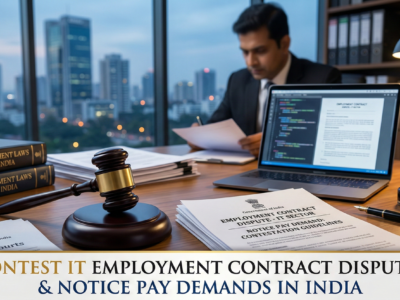
Accepting a new job offer and resigning from your current position, only to have the prospective employer cancel the offer before your joining date, creates immediate financial and career disruption. Under Indian law, an offer withdrawal is not automatically lawful simply because you have not yet started working. Once an unconditional offer is formally accepted in writing, it can form a binding agreement under the Indian Contract Act, 1872.
While Indian courts rarely force a private company to hire a candidate due to restrictions under the Specific Relief Act, 1963, candidates are not left without recourse. If the cancellation breaches a concluded contract, you may be able to claim compensation under Section 73 for direct, foreseeable financial losses—such as lost salary during unemployment, notice period buyouts paid to a former employer, or non-refundable relocation expenses. At the same time, if you are still serving your notice period, recent Supreme Court of India rulings—including Dr. Mrs. Suman V. Jain v. Marwadi Sammelan (2024)—clarify when a prospective resignation can be withdrawn before its effective date.
This guide breaks down how Indian contract law applies to revoked job offers, how to evaluate pending background verification (BGV) or termination clauses, what evidence to preserve, and how to calculate your financial exposure. You will also find interactive case assessment tools, a step-by-step action chronology, and copy-ready formats to withdraw your resignation, request a settlement from HR, or brief an advocate for a legal notice.
Employer withdrawing an offer. Legal options in India.
You accepted a new job offer. You resigned from your current company. Then the new employer withdrew the offer. Here is what Indian law says about the contract, your resignation, possible compensation, and the next steps.
December 2026 has not yet occurred at the time of verification. This page must be reviewed again before it is labelled updated through December 2026.
Accepted does not always mean guaranteed. Revoked does not always mean lawful.
A valid accepted offer may create a binding contract. If the employer breaches it, compensation for proven, foreseeable losses may be available. Private employment is rarely compelled by a court.
When is a job offer binding?
In India, the label on a document does not settle its legal effect. An offer letter, letter of intent or appointment letter must be read with the acceptance email, hiring conditions, recruitment correspondence and other relevant terms.
Sections 4 and 5 of the Indian Contract Act address the communication and revocation of proposals and acceptances. Section 7 addresses absolute acceptance, while section 10 sets out the requirements for an enforceable agreement. If a binding contract has already formed, the employer’s action should be examined as a possible breach, rather than treated automatically as a routine offer withdrawal. [1]
| Document or stage | Question that matters | Possible legal position |
|---|---|---|
| Verbal discussion | Were sufficiently definite terms agreed and can they be proved? | Possible contract in some circumstances, but evidence often difficult. |
| Unaccepted written offer | Was acceptance communicated before valid revocation? | A proposal may ordinarily be revoked within the statutory limits. |
| Accepted unconditional offer | Were contractual essentials settled with no unmet conditions? | Potential binding contract. Withdrawal may amount to breach. |
| Accepted conditional offer | Was the relevant condition fulfilled, waived or genuinely failed? | Outcome turns on the condition and exact wording. |
| Offer with termination clause | Does the clause cover pre-joining cancellation and specify notice or pay? | The clause may affect rights and compensation. It requires careful construction. |
The offer letter, acceptance record and withdrawal clause usually deserve more attention than the word “confirmed” in an HR message.
What changes in your particular situation?
Select the facts that match your case. The result identifies questions to examine. It does not decide whether an employer breached a contract.
Offer withdrawal situation checker
Three facts can change the options available.
Review a possible binding offer
Preserve the accepted offer and check the contractual terms.
This screening tool does not assess contract validity, statutory employment protections or limitation periods.
Compare situations
| Situation | Immediate action | Legal issue to check |
|---|---|---|
| Offer rescinded before acceptance | Request written reasons and keep the correspondence. | Whether the proposal was validly revoked before acceptance. |
| Offer accepted, still employed | Do not resign until position is resolved. Request confirmation. | Whether a concluded contract exists and any loss resulted. |
| Resigned and serving notice | Ask current employer promptly to permit withdrawal of resignation. | Resignation effective date and contractual restrictions. |
| Already relieved from old job | Seek re-employment, preserve job-search records and assess losses. | Breach, causation, foreseeability and mitigation. |
| Background verification pending | Request precise pending items and offer conditions. | Whether the offer was subject to unmet conditions. |
| Paid relocation or notice buyout | Collect invoices, payment proofs and communications. | Whether expenses were foreseeable and reasonably incurred. |
| Offer cancelled after hiring freeze | Request the contractual basis for cancelling the accepted offer. | Whether an express withdrawal or termination term applies. |
Showing all 7 scenarios.
You have resigned. Can you take it back?
If you are still in your notice period, promptly send a written request to withdraw your resignation. The legal analysis depends on when the resignation became effective, your service conditions and any relevant acceptance or withdrawal clause.
The Supreme Court discussed this principle in Dr. Mrs. Suman V. Jain v. Marwadi Sammelan, 2024 INSC 127, decided on 20 February 2024. The case involved its own institutional service conditions and does not guarantee that every private-sector resignation can be reversed. [3]
Still on notice
Seek a written decision from your current employer before the resignation takes effect. Continue meeting existing employment obligations.
Already relieved
Rejoining the former employer is ordinarily a question of agreement. Consider re-employment while assessing any claim against the new employer.
What compensation can you ask for?
Section 73 of the Indian Contract Act addresses compensation for losses caused by breach of contract. It is concerned with losses arising in the ordinary course or those the parties knew were likely, rather than every financial difficulty that follows an offer cancellation. Reasonable opportunities to reduce the loss are relevant. [1]
| Claimed item | What can support it? | Main obstacle |
|---|---|---|
| Lost earnings during unemployment | Payslips, relieving date, vacancy applications, later employment records. | Showing a reasonable loss period and steps to find work. |
| Notice buyout paid to old employer | Buyout demand, payment receipt, HR request to join early. | Whether it followed from the offer and was foreseeable. |
| Non-refundable relocation | Tickets, lease cancellation costs, bills and employer discussions. | Whether expenses were reasonable, necessary and connected. |
| Forfeited earned benefits | Old employer’s scheme rules and proof of forfeiture. | Proving entitlement, causation and amount. |
| Six or twelve months of new-job CTC | Offer document and any applicable contractual pay provision. | No standard automatic statutory payout for pre-joining revocation. |
| Mental distress alone | Case-specific evidence and any separate recognised cause of action. | Ordinary contractual damages do not automatically cover distress. |
Section 74 may also be relevant if the contract names a sum payable on breach. The agreed figure is not necessarily an amount automatically awarded in full. A legal review should also check notice pay, termination rights and any cap or exclusion clause. [1]
Personal financial exposure calculator
Estimate a gap in income and documented one-time costs. Values remain in your browser.
Calculation: max(0, previous monthly take-home pay × months without work − earnings during the gap) plus max(0, buyout + other costs − refunds). This is a budgeting exercise, not a Section 73 damages formula. It omits causation, foreseeability, actual contract terms, reasonable mitigation and legal defences. Do not use it to set a legal demand without review.
Build a dated evidence file
Save the original documents and keep their metadata where possible. A chronology helps a lawyer distinguish a conditional offer from a completed contract and identify which losses followed from the withdrawal.
Your evidence checklist
Tick the records you have retained. The checklist stays on this page.
0 of 8 records checked.
Negotiation, notice, arbitration or civil court?
For an ordinary private-sector candidate whose offer was withdrawn before joining, the likely dispute is contractual. The correct next forum depends on the existence of a contract, any arbitration or jurisdiction clause, the relief sought and applicable statutory protections.
| Route | When to consider | Outcome to seek | Point to check |
|---|---|---|---|
| Written HR escalation | As soon as an offer is cancelled. | Written explanation, reconsideration, deferment or settlement. | Keep all communications and deadlines. |
| Advocate’s legal notice | There is a plausible breach with records of loss. | A reasoned contractual demand and negotiation. | Check limitation and the offer terms. |
| Arbitration | A valid arbitration agreement covers the dispute. | Contractual relief within the agreement and law. | Costs, appointment mechanism and seat. |
| Civil proceedings | Negotiation fails and a viable contractual cause exists. | Damages or other legally permissible relief. | Jurisdiction, court fees, evidence and limitation. |
| Labour or industrial remedies | A qualifying employment relationship and statutory rights exist. | Relief allowed under the governing labour law. | Do not assume pre-joining applicants qualify. |
| Criminal complaint | Independent evidence points to deception or another offence. | Investigation of an alleged criminal offence. | A cancelled job offer alone does not prove cheating. |
The Limitation Act, 1963 generally provides three years for an ordinary compensation suit for breach of contract under Article 55. The start date, any repeated breach, exclusions and dispute-resolution provisions can matter. Do not wait for informal HR discussions to run indefinitely. [5]
What to do after receiving the cancellation email
The following time bands are suggested response intervals, not statutory deadlines.
Preserve the withdrawal email and the accepted offer. Avoid deleting attachments, chat records or earlier versions. If you are on notice, write to your current employer about possible resignation withdrawal.
Ask the new employer for the contractual reason, whether a deferral is possible and whether it will reimburse documented costs.
Prepare a dated chronology, itemised loss schedule and evidence index. Continue seeking suitable employment and keep records.
Ask an Indian employment or contract advocate to assess the notice, the correct forum, limitation and likely cost of proceedings.
What the Labour Codes changed
India’s four Labour Codes were brought into effect from 21 November 2025. Their implementation does not create an automatic fixed payout merely because a candidate’s pre-joining offer was revoked. For these disputes, the contract and applicable employment statutes still need separate analysis. [6]
Two rulings worth knowing
Supreme Court / 20 Feb 2024
Dr. Mrs. Suman V. Jain v. Marwadi Sammelan
Explains when a prospective resignation may be withdrawn before it becomes effective, absent a legal, contractual or constitutional bar. The holding concerned the specific terms and facts of the case.
Supreme Court / 9 Jul 2024
Army Welfare Education Society v. Sunil Kumar Sharma
Revisits the general rule against enforcing a contract of personal service by specific performance and the recognised exceptions. It does not decide every pre-joining offer dispute.
Letters you can adapt
Use the first message if you are serving notice and want to retain your current job. Use the second to request clarity and a settlement from the new employer. The third is a specimen outline for legal review, not a substitute for an advocate’s notice.
Request to withdraw resignation
Address this to your current employer. Send it before the effective date where possible.
Offer revocation clarification and settlement request
State only documented facts. Do not claim a fixed legal entitlement without advice.
Draft legal notice structure
For discussion with an Indian advocate before issue. Remove allegations that the available evidence cannot support.
Answers to common questions
Can I sue a company for revoking an offer after I resigned?
You may have a claim if a binding agreement existed, the withdrawal amounted to a breach and you can establish compensable loss. The offer’s conditions, termination terms and dispute-resolution provisions must be reviewed first.
Is an offer letter valid without a formal appointment letter?
It can be. Contract formation depends on the terms and conduct of the parties. A document titled “offer letter” can sometimes form a contract, while a document labelled “appointment letter” can still include unfulfilled conditions.
Does a hiring freeze excuse the company from liability?
Not automatically. Examine the contractual language and facts. The explanation may help identify why the offer was withdrawn, but it does not on its own decide the legal consequences.
Can I demand three months’ or six months’ salary?
You may propose that as a settlement term. Indian contract law does not provide an automatic three-month or six-month payout for every revoked pre-joining offer. A damages claim must be tied to the applicable law and facts.
Can I withdraw my resignation after it has been accepted?
Sometimes. The effective date and any service rules or contractual restrictions matter. The Supreme Court has recognised the possible withdrawal of a prospective resignation before it becomes effective in the absence of a relevant bar. Private employment facts still require separate review.
What happens if the background check is said to have failed?
Ask which condition failed and whether the reported discrepancy is accurate. A properly invoked and unmet condition can materially change the case. Keep any documents correcting inaccurate information.
Should I approach the Labour Commissioner?
That route depends on whether you fall within the applicable labour law and whether an employment relationship or statutory right exists. An ordinary pre-joining contractual dispute is not automatically an industrial dispute.
Can I file a police complaint?
A revoked offer alone does not establish a criminal offence. Criminal remedies require facts indicating an independent offence, such as dishonest deception from the outset. Seek advice before making criminal allegations.
Can a court order the company to employ me?
Courts generally do not specifically enforce ordinary private contracts of personal service. Recognised statutory and industrial employment exceptions may apply to other facts. Damages are often the more realistic private-contract remedy.
Is there a time limit to bring a claim?
Article 55 of the Limitation Act, 1963 generally provides three years for a suit seeking compensation for breach of contract, subject to the precise cause of action and applicable rules. Get advice early, especially if an arbitration clause exists.
Did the 2025 Labour Codes create a mandatory payout?
No universal fixed payout was introduced for all candidates whose private-sector job offers are withdrawn before joining. The particular contract and any applicable statutory protections need to be examined.
Law and judgments used in this article
The following links point to statutory records, official court judgments and a government notification. Reading the exact wording of the offer remains essential.
- Indian Contract Act, 1872, particularly sections 4, 5, 7, 10, 73 and 74, India Code.
- Specific Relief Act, 1963, particularly section 14, India Code.
- Dr. Mrs. Suman V. Jain v. Marwadi Sammelan, 2024 INSC 127, Supreme Court of India.
- Army Welfare Education Society v. Sunil Kumar Sharma, 2024 INSC 501, Supreme Court of India.
- Limitation Act, 1963, Schedule, Article 55, India Code.
- Government makes four Labour Codes effective from 21 November 2025, Ministry of Labour and Employment, PIB, 21 November 2025.