 By
By The laws governing the legal age of marriage in India present a complex web of overlapping jurisdictions. While secular statutes like the Prohibition of Child Marriage Act establish strict minimum age requirements, these rules frequently collide with religious personal laws, entrenched caste traditions, and regional customs.
Understanding these socio-cultural dynamics requires examining the friction between state mandates and grassroots realities. This guide details the legal architecture across different faiths, the impact of socio-economic factors like poverty and education, and the ongoing judicial debates surrounding underage unions.
Updated February 2026
Socio-Cultural Dynamics of Marriage Age in India across Religions and Castes
The laws governing the age of marriage in India are complex and contradictory. A strict binary age threshold exists in secular law, yet religious personal laws, entrenched caste rules, and constitutionally protected tribal customs frequently collide with state mandates.
National Demographics
Decline of Child Marriage in India (Women aged 20 to 24 married before 18)
Source: National Family Health Survey (NFHS)
According to the National Family Health Survey 5 (2019 to 2021), 23.3 percent of women in India aged between twenty and twenty-four were married before the age of eighteen. This represents a decrease from the 26.8 percent recorded in the previous survey and a drop from 47 percent in NFHS 3. Legislative bans operate in a vacuum if they are not accompanied by socio-economic development. Structural poverty, patriarchal anxieties regarding female sexuality, a lack of access to higher education, and regional customs continue to drive early marriages.
Historical Evolution
From the Sarda Act to the PCMA
The Child Marriage Restraint Act of 1929 originally set the minimum age of marriage at fourteen for girls and eighteen for boys. Lawmakers amended this in 1978 to establish the current limits of eighteen and twenty-one. The legislative roots trace back to the Age of Consent Act 1891.
Colonial administrators hesitated to interfere with religious customs. Post-independence governments faced similar resistance from orthodox groups when attempting to standardize marital age. The transition from the 1929 Act to the Prohibition of Child Marriage Act 2006 marked a shift from mere restraint to strict prohibition and penalization.
The Legal Architecture
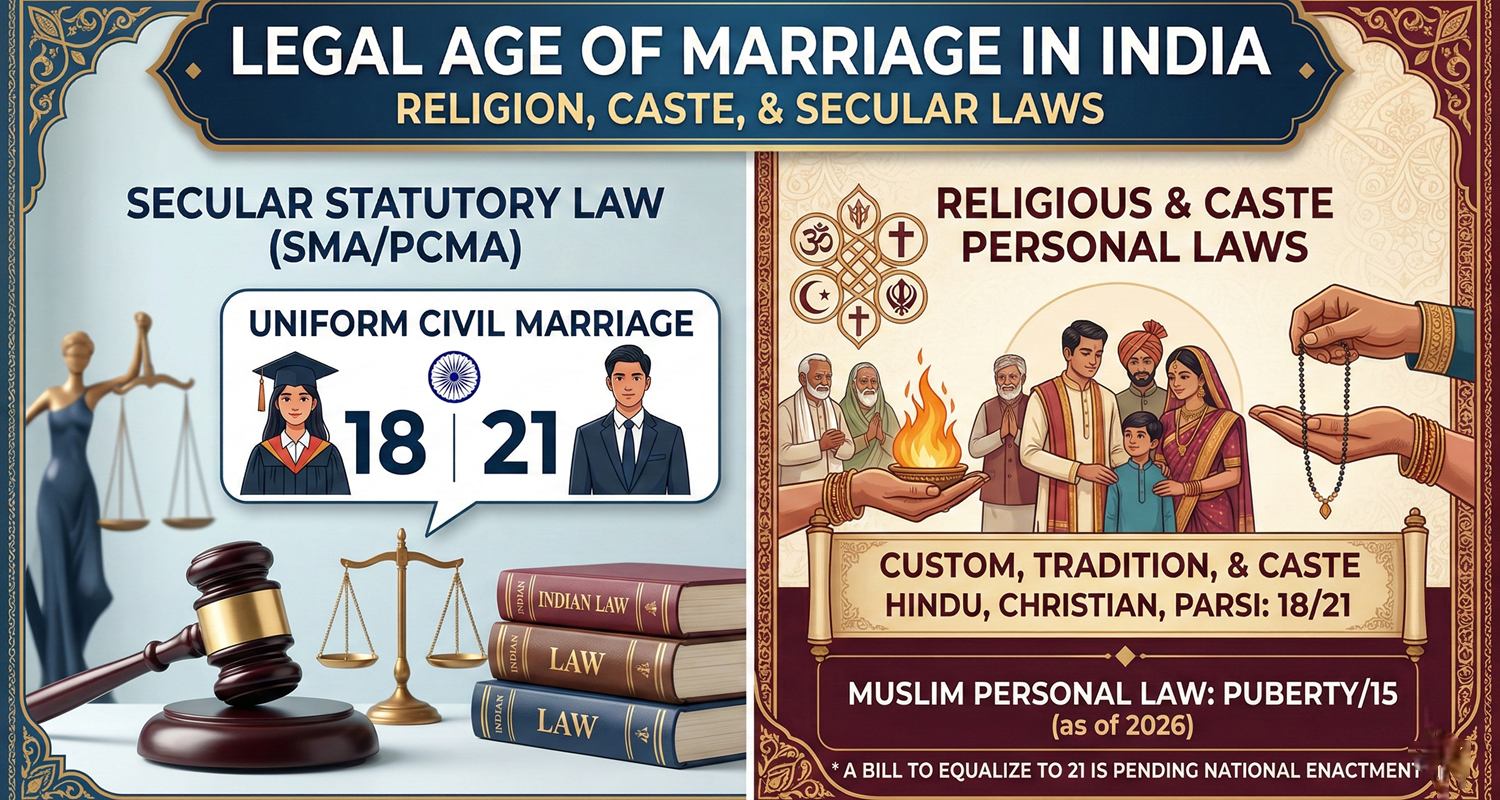
The secular framework governing marriage and consent is anchored by the Prohibition of Child Marriage Act (PCMA) 2006 and the Special Marriage Act (SMA) 1954. The PCMA defines a child as a male who has not completed twenty-one years of age and a female who has not completed eighteen years of age. A child marriage is voidable at the option of the contracting party who was a child at the time of the marriage. The law historically allowed the minor party to apply for an annulment within two years of attaining the age of majority. The penal provisions are notably stringent, imposing imprisonment for up to two years and monetary fines up to 1 lakh Rupees.
Religious Personal Laws
The Constitution of India guarantees citizens the right to freely profess religion. The minimum age requirements for marriage diverge across different religious communities. The Hindu Marriage Act 1955 stipulates that the bridegroom must have completed twenty-one years of age and the bride must have completed eighteen years of age. Under Muslim Personal Law, governed by the Shariat Application Act 1937, a Muslim who has attained puberty is legally competent to enter into a valid marriage contract. Puberty is legally presumed to occur at the age of fifteen years. This puberty threshold creates a legal contradiction with the secular PCMA and the Protection of Children from Sexual Offences (POCSO) Act 2012.
Caste Hegemony and Tribal Customs
Caste endogamy is rigorously enforced. In North India, extra-legal social councils known as Khap Panchayats wield power over local residents. These councils prohibit specific marriages and enforce their edicts through social boycotts and violence. In contrast, tribal areas protected by the Sixth Schedule and special constitutional provisions operate on indigenous autonomy. Articles 371A and 371G guarantee autonomy to Nagaland and Mizoram respectively. Secular laws regarding the age of marriage face jurisdictional hurdles in these regions.
Comparative Law Matrix
| Legal Framework | Female Age | Male Age | Key Provisions |
|---|---|---|---|
| Prohibition of Child Marriage Act 2006 | 18 Years | 21 Years | Secular penal law. Renders underage marriages voidable at the option of the minor. |
| Special Marriage Act 1954 | 18 Years | 21 Years | Facilitates inter-faith and inter-caste marriages. Subject to a 30-day public notice. |
| Hindu Marriage Act 1955 | 18 Years | 21 Years | Customary exceptions apply only to consanguinity, not to age. |
| Muslim Personal Law (Shariat) | Puberty (Presumed 15) | Puberty (Presumed 15) | Minors married by guardians possess the Option of Puberty to annul the union. |
| Indian Christian Marriage Act 1872 | 18 Years | 21 Years | Individuals between 18 and 21 require parental consent to marry under this Act. |
| Uttarakhand Uniform Civil Code 2024 | 18 Years | 21 Years | Standardizes age across religions. Mandates online registration. Exempts Scheduled Tribes. |
| Assam Repealing Bill 2024 | 18 Years | 21 Years | Eliminates traditional Qazis from registration. Strictly enforces secular age limits. |
Legislative Proposals for Gender Parity
The Prohibition of Child Marriage (Amendment) Bill
The Union Government introduced legislation to raise the minimum legal age of marriage for women from eighteen to twenty-one years. This proposal seeks to establish uniformity across genders and apply a single age standard across all religious communities.
Supporters state this change will lower maternal mortality rates and improve female labor force participation by giving women more time to complete higher education. Critics argue that simply raising the legal age without improving educational infrastructure will criminalize poor families. The bill is currently under review by a Parliamentary Standing Committee.
Judicial Precedents and Statutory Conflicts
High Courts across India frequently address petitions where the Protection of Children from Sexual Offences (POCSO) Act conflicts with Muslim Personal Law. The legal landscape is highly fragmented.
The Supremacy of POCSO
Several high courts have ruled that the POCSO Act is a special legislation designed specifically to protect minors from sexual abuse. These rulings state that secular criminal law must override religious customary laws. Under this interpretation, sexual relations with any person under eighteen constitutes statutory rape regardless of marital status.
Protection of Personal Law
Conversely, other courts have granted protection to underage couples married under Muslim Personal Law. Some benches have ruled that a fifteen-year-old girl who has attained puberty is legally competent to marry. The Supreme Court of India is currently adjudicating these conflicting interpretations to establish a uniform constitutional standard.
International Human Rights Obligations
CEDAW Mandates
India ratified the Convention on the Elimination of All Forms of Discrimination Against Women in 1993. This treaty requires state parties to specify a minimum age for marriage and to make the registration of marriages compulsory in an official registry.
UN Convention on the Rights of the Child
This convention defines a child as any human being below the age of eighteen years. The varying domestic age limits across different Indian religious laws create friction with these international standards. Human rights bodies advocate for a uniform age of eighteen to ensure free consent.
Socio-Economic Drivers of Early Marriage
Legal prohibitions fail to stop early marriages when structural poverty dictates familial decisions. In many marginalized communities, a daughter is viewed as an economic liability. The dowry system directly influences the timing of marriage because families often demand smaller dowries for younger brides.
Education as a Deterrent
Dropping out of secondary school significantly increases the likelihood of a girl being married before the age of eighteen. The lack of safe transport to schools in rural areas forces parents to keep their daughters at home. Data shows that access to higher education correlates directly with delayed marriage. Financial independence gives women the agency to negotiate the timing of their marriage.
Medical and Psychological Consequences
Maternal and Infant Mortality
Early marriage directly correlates with early pregnancies. The physical immaturity of adolescent mothers increases the risk of complications during childbirth. Statistics show a higher rate of maternal mortality among teenage brides compared to women in their twenties.
Infants born to teenage mothers experience higher rates of low birth weight; infant mortality; and severe stunting. Frequent and closely spaced pregnancies deplete maternal nutrition and cause long-term psychological distress.
Systemic Enforcement Failures
Legislative bans require robust administrative implementation. Law enforcement agencies often ignore the Prohibition of Child Marriage Act due to political pressure or local sympathies.
- Mass Marriages Large-scale community weddings on auspicious dates proceed with minimal police intervention. Authorities struggle to verify the ages of hundreds of couples simultaneously.
- Documentation Deficits The lack of reliable birth certificates in rural districts complicates prosecutions. Families frequently use forged school documents or rely on physical appearance assessments to bypass legal scrutiny.
State Welfare Interventions
Conditional Cash Transfer Programs
Several state governments bypass punitive enforcement by offering direct financial incentives. The Kanyashree Prakalpa in West Bengal provides cash transfers to girls who remain in school and remain unmarried until age eighteen. This economic approach directly addresses the financial burden parents perceive regarding their daughters.
Similar schemes exist in Bihar and Haryana. Direct benefit transfers demonstrate higher success rates in delaying marriages than police intervention alone. These policies recognize that economic empowerment is the most reliable method for social reform.
Intersectional Vulnerabilities
National averages obscure deep disparities across caste lines. Dalit and Adivasi girls report the highest rates of underage marriage nationwide.
Economic Precarity
Landless agricultural laborers face extreme economic instability. They often arrange marriages for their daughters early to reduce household expenses. The intersection of severe poverty and caste-based discrimination severely limits alternative options for these families.
Upper-Caste Variances
Upper-caste communities generally exhibit lower rates of early marriage. This correlates directly with better access to capital, inherited wealth, and urbanization. Families in these demographics prioritize tertiary education over immediate matrimonial alliances.
The Digital Information Shift
Mobile Penetration and Awareness
Mobile internet access introduces new variables into marriage dynamics. Grassroots organizations use social media applications to educate young women about their legal rights and reproductive health risks. Access to digital information provides young people with tools to resist forced marriages.
Conversely, digital platforms occasionally facilitate unregulated matchmaking. In certain rural sectors, informal brokers use messaging apps to arrange alliances where age verification is completely absent, bypassing state monitoring systems entirely.
Administrative Loopholes and Document Fraud
The Role of Falsified Affidavits
Perpetrators frequently utilize fraudulent age documentation to circumvent the Prohibition of Child Marriage Act. Local officials occasionally issue falsified birth certificates under political or financial pressure. Affidavits sworn before notaries routinely declare a minor as an adult.
Marriage registrars in remote areas often accept these documents without rigorous verification. The burden of proof then shifts to the victims. They must endure lengthy court battles to prove their actual age using school leaving certificates or medical bone age assessments.
Interstate Bride Trafficking
Uneven sex ratios across different states create highly localized marriage markets. This demographic imbalance directly fuels the cross-border movement of underage brides.
The Demand in Northern States
States with historically low female sex ratios face a severe deficit of local women. Agents transport minors from poverty-stricken regions in eastern India across state lines. They sell these young girls into forced marriages with older men. These victims face extreme isolation because they cannot speak the local language and lack any familial support network. Local police forces struggle to track these unregistered cross-border unions.
Grassroots Mobilization
Community Watch Groups
Non-governmental organizations operate directly within vulnerable districts to intercept illegal unions before they occur. Field teams establish community watch groups to monitor school dropout rates. A sudden withdrawal from education serves as the primary indicator of an impending underage marriage.
Peer educators work to alter patriarchal mindsets through direct dialogue with village elders and parents. These community-led interventions yield better long-term results than punitive police actions because they address the root socio-cultural anxieties driving the practice.
Template Formats
Below are standard formats for legal procedures related to secular marriage registration and annulment.
Notice of Intended Marriage
Under Section 5 of the Special Marriage Act 1954
To,
The Marriage Officer for the District of [District Name]

We hereby give you notice that a marriage under the Special Marriage Act 1954 is intended to be solemnized between us within three calendar months from the date hereof.

1. Name: [Groom's Name]
Condition: Unmarried / Widower / Divorced
Occupation: [Occupation]
Age: [Age in Years]
Dwelling Place: [Address]

2. Name: [Bride's Name]
Condition: Unmarried / Widow / Divorced
Occupation: [Occupation]
Age: [Age in Years]
Dwelling Place: [Address]

Witness our hands this [Date] day of [Month], [Year].

Signature 1: _________________
Signature 2: _________________
Petition for Annulment
Under the Prohibition of Child Marriage Act 2006
In the Court of the District Judge at [District Name]

Case No: ________ of [Year]

[Name of Petitioner], aged [Age], residing at [Address]
... Petitioner

Versus

[Name of Respondent], aged [Age], residing at [Address]
... Respondent

Petition for Annulment of Voidable Marriage

The petitioner respectfully states:
1. That the marriage between the petitioner and the respondent was solemnized on [Date] at [Location].
2. That at the time of the marriage, the petitioner was [Age] years old, which is below the legal age of marriage.
3. That the petitioner has now attained the age of majority and chooses to exercise the option to annul the marriage within the statutory timeframe.

Prayer:
The petitioner prays that the Hon'ble Court may be pleased to pass a decree annulling the marriage between the petitioner and the respondent.

Date: [Date]
Signature of Petitioner: _________________
Frequently Asked Questions
Legal Disclaimer
The information provided on Evaakil.com does not, and is not intended to, constitute legal advice. All information, content, and materials available on this site are for general informational purposes only. Laws and regulations change rapidly. Readers should contact their attorney to obtain advice with respect to any particular legal matter. Only your individual attorney can provide assurances that the information contained herein is applicable or appropriate to your particular situation.