 By
By Indian statutes do not explicitly govern live-in relationships, leaving unmarried partners in a legal grey area regarding property rights and financial support.
While the Supreme Court recognizes these unions under Article 21, the absence of a marriage certificate often complicates asset division and maintenance claims during separation. A Cohabitation Maintenance Agreement serves as a binding private contract, establishing clear terms for debt liability, expense sharing, and property ownership before conflicts occur.
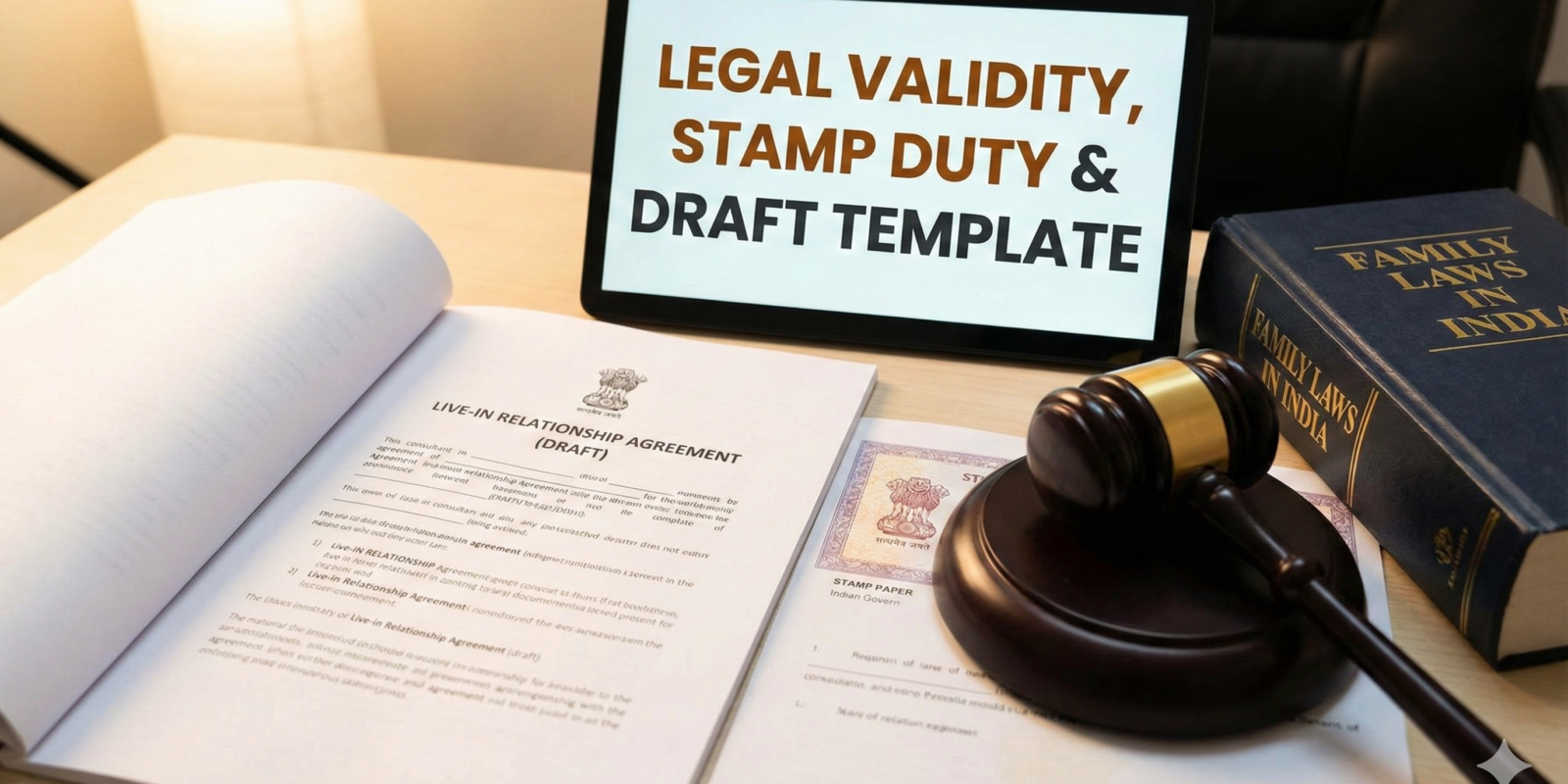
This analysis examines the enforceability of such agreements under the Indian Contract Act, 1872, and their standing against the Protection of Women from Domestic Violence Act (PWDVA). We address the specific registration procedures for West Bengal, the tax risks associated with inter-partner transfers, and the potential impact of a future Uniform Civil Code. A standardized drafting template is included to help partners formalize their intent and protect their individual interests.
Procedural Efficacy of Cohabitation Maintenance Agreements in India
Domestic relationships in India are shifting. As traditional marital norms evolve, the “Cohabitation Maintenance Agreement” functions as a necessary private law instrument. It outlines financial support, property division, and shared responsibilities.
The Legal Anchor
The Supreme Court of India recognizes live-in relationships under Article 21. However, courts distinguish between transient “walk-in” relationships and those “in the nature of marriage.” The latter attracts statutory protection.
The Indra Sarma Criteria Visualization
Relative weightage of factors courts use to validate a relationship.
Judicial Precedent Matrix
Agreements are interpreted through the lens of specific Supreme Court rulings. These three cases form the “validity triangle” for any cohabitation contract.
D. Velusamy v. D. Patchaiammal
Established that not all live-in relationships get maintenance. The relationship must meet the “nature of marriage” test: shared household, pooling of resources, and social representation.
S. Khushboo v. Kanniammal
Clarified that living together is not a criminal offense. This ruling allows partners to sign agreements without fear of self-incrimination regarding “immoral trafficking” or adultery statutes.
Badri Prasad v. Dy. Director
Held that a strong presumption of marriage arises from long-term cohabitation (50 years in this case). An agreement helps *rebut* this if the parties specifically intend NOT to be married.
The UCC Horizon: Mandatory Registration
The Uttarakhand Prototype (2024)
The Uniform Civil Code (UCC) passed in Uttarakhand creates a mandatory framework that may soon be replicated nationally or in other states.
Mandatory Registration
Under UCC Section 378 (Uttarakhand), partners must register their live-in relationship with the Registrar within 1 month. Failure triggers a jail term of up to 3 months or a fine.
Implication for Agreements
A private cohabitation agreement will no longer stay private. It will likely become a supporting document for the official registration. Drafting must now align with statutory requirements to avoid rejection by the Registrar.
Key Components of the Agreement
Click the tabs below to understand the essential clauses required for a valid agreement.
Operational Banking Protocols
An agreement is useless if your financial behavior contradicts it. To prevent “commingling” of funds—which courts construe as an intent to share all assets—adopt the Three-Account System.
Partner A (Solo)
Salary, Inheritance, Personal Investments
The “Operating” Joint
Rent, Utilities, Groceries, Travel
Do not store savings here.
Partner B (Solo)
Salary, Inheritance, Personal Investments
The PWDVA Override Check
The Protection of Women from Domestic Violence Act, 2005 (PWDVA) contains a “Shared Household” provision (Section 17) that can override eviction clauses in your agreement.
| Agreement Clause | PWDVA Reality | Drafting Solution |
|---|---|---|
| “Partner B must vacate the premises within 7 days of breakup.” | Likely unenforceable if B has no other place to go. Courts view this as “Economic Abuse.” | Provide 30-60 days notice AND specify a budget for “Alternative Accommodation” rent for 3 months. |
| “Partner B has no right to the house owned by A.” | Under Satish Chander Ahuja (2020), she has a right to residence even in in-laws’ homes if it’s a shared household. | Explicitly state that residence is a license, not a tenancy or ownership right, revocable upon relationship termination. |
The Taxation Trap: Section 56(2)(x)
Warning: The “Relative” Loophole
In a legal marriage, gifts between spouses are tax-exempt. In a live-in relationship, partners are not considered “relatives” under Section 2(41) of the Income Tax Act.
The Rule
If Partner A transfers money or property worth more than ₹50,000 to Partner B in a financial year without consideration, the entire amount is taxable as “Income from Other Sources” for Partner B.
The Agreement Strategy
The Cohabitation Agreement must characterize these transfers as “Shared Household Expense Reimbursement” or “Loan Repayments” (with documented evidence) rather than “Gifts” to avoid this tax liability.
Clause Anatomy: Precision Audit
Weak Drafting (Ambiguous)
“Partner A will provide reasonable support to Partner B after separation.”
- What is “reasonable”? Subjective to judicial whim.
- No timeline specified (Perpetual liability?).
- No adjustment for inflation or future income changes.
Robust Drafting (Specific)
“Partner A shall pay ₹25,000/month for 12 months post-separation, solely for rent assistance. This obligation ceases if Partner B cohabits with a third party.”
- Fixed Cap: Amount and Duration defined.
- Purpose Bound: Earmarked for rent.
- Termination Trigger: Ends if new relationship starts.
Procedural Mechanics in West Bengal
Executing these documents in Kolkata involves specific stamp duty implications under the West Bengal Stamp Act.
| Instrument Type | Schedule IA Article | Stamp Duty (WB) | Registration Fee |
|---|---|---|---|
| Affidavit / Declaration | Article 4 | Rs. 10 (Executed on Rs. 20-50 paper) | N/A (if notarized) |
| General Agreement | Article 5 | Rs. 10 (General) | Rs. 7 to Rs. 20 |
| Property Transfer | Article 5(d) | 6% (< 1 Cr) / 7% (> 1 Cr) | 1.1% of Market Value |
Dispute Resolution Protocol
Litigation (Courts)
- • Public Record: Personal details become public property.
- • Adversarial: Pits partner against partner.
- • Timeline: Family courts take 3-5 years.
Private Mediation
- • Confidentiality: Proceedings are private.
- • Cost Effective: Hourly rates vs. retainer fees.
- • Control: Parties control the outcome.
Process Visualization
The drafting and execution lifecycle. This chart visualizes the logical flow from negotiation to police verification.
Digital Evidence Checklist
In the absence of a marriage certificate, your digital footprint proves the relationship.
Frequently Asked Questions
Yes, provided it meets the criteria of the Indian Contract Act 1872. The object must be lawful. While it cannot override statutory rights like Section 125 CrPC, courts use it as evidence of intention.
Yes. You can register it under Section 18 of the Registration Act 1908 (Optional Registration) at the ADSR office.
Absolutely. A notarized declaration or agreement serves as valid proof of the relationship for the police, reducing harassment.
Model Agreement Structure
Below is a standardized template tailored for compliance with the Indian Contract Act (1872) and relevant West Bengal procedural norms. Copy and adapt this structure with legal counsel.
COHABITATION AND MAINTENANCE AGREEMENT
THIS DEED OF AGREEMENT is made and entered into at Kolkata on this ____ day of ________, 202__.
BETWEEN
MR. [PARTNER A NAME], son of [Father’s Name], aged about __ years, residing at [Full Address, Kolkata – Pin Code], hereinafter referred to as the “FIRST PARTY”.
AND
MS. [PARTNER B NAME], daughter of [Father’s Name], aged about __ years, residing at [Full Address], hereinafter referred to as the “SECOND PARTY”.
WHEREAS:
- Both parties are majors, of sound mind, and not disqualified by law from entering into a contract.
- The parties share a mutual bond of affection and have voluntarily decided to cohabit in a shared household located at [Address] (“Shared Household”).
- The parties wish to define their respective financial rights, obligations, and property ownership to prevent future disputes and clarify that this arrangement does not constitute a formal marriage under the Hindu Marriage Act, 1955, or Special Marriage Act, 1954, unless solemnized later.
NOW THIS DEED WITNESSES AS FOLLOWS:
1. SEPARATE PROPERTY REGIME
It is agreed that all assets, movable or immovable, acquired by either party in their individual names prior to or during this cohabitation shall remain their sole and absolute property. The mere fact of cohabitation shall not create any joint ownership rights.
(Refer to Schedule A for First Party’s Assets and Schedule B for Second Party’s Assets)
2. FINANCIAL CONTRIBUTION & MAINTENANCE
2.1. Shared Expenses: Rent, utilities, and grocery expenses shall be borne in the ratio of [e.g., 50:50 or 60:40] via a specific Joint Bank Account [Account Details].
2.2. No General Maintenance: Except as provided herein, neither party shall be liable to pay monthly maintenance to the other during the relationship. Both parties are financially independent.
3. TERMINATION & SEPARATION
3.1. Notice Period: Either party may terminate this domestic arrangement by giving [30/60] days’ written notice.
3.2. One-Time Settlement (Optional): In the event of separation initiated by the First Party, a one-time rehabilitative support of Rs. [Amount] shall be paid to the Second Party to cover relocation costs. This does not waive statutory rights under the DV Act but shall be offset against such claims.
4. DISPUTE RESOLUTION
In the event of any dispute arising out of this agreement, the parties agree to first undergo private mediation for a period of 45 days before approaching any court of law. The seat of mediation shall be Kolkata.
IN WITNESS WHEREOF, the parties have signed this deed on the day, month, and year first above written.
__________________________
SIGNED: FIRST PARTY
__________________________
SIGNED: SECOND PARTY
WITNESSES:
1. __________________________ (Name & Address)
2. __________________________ (Name & Address)