 By
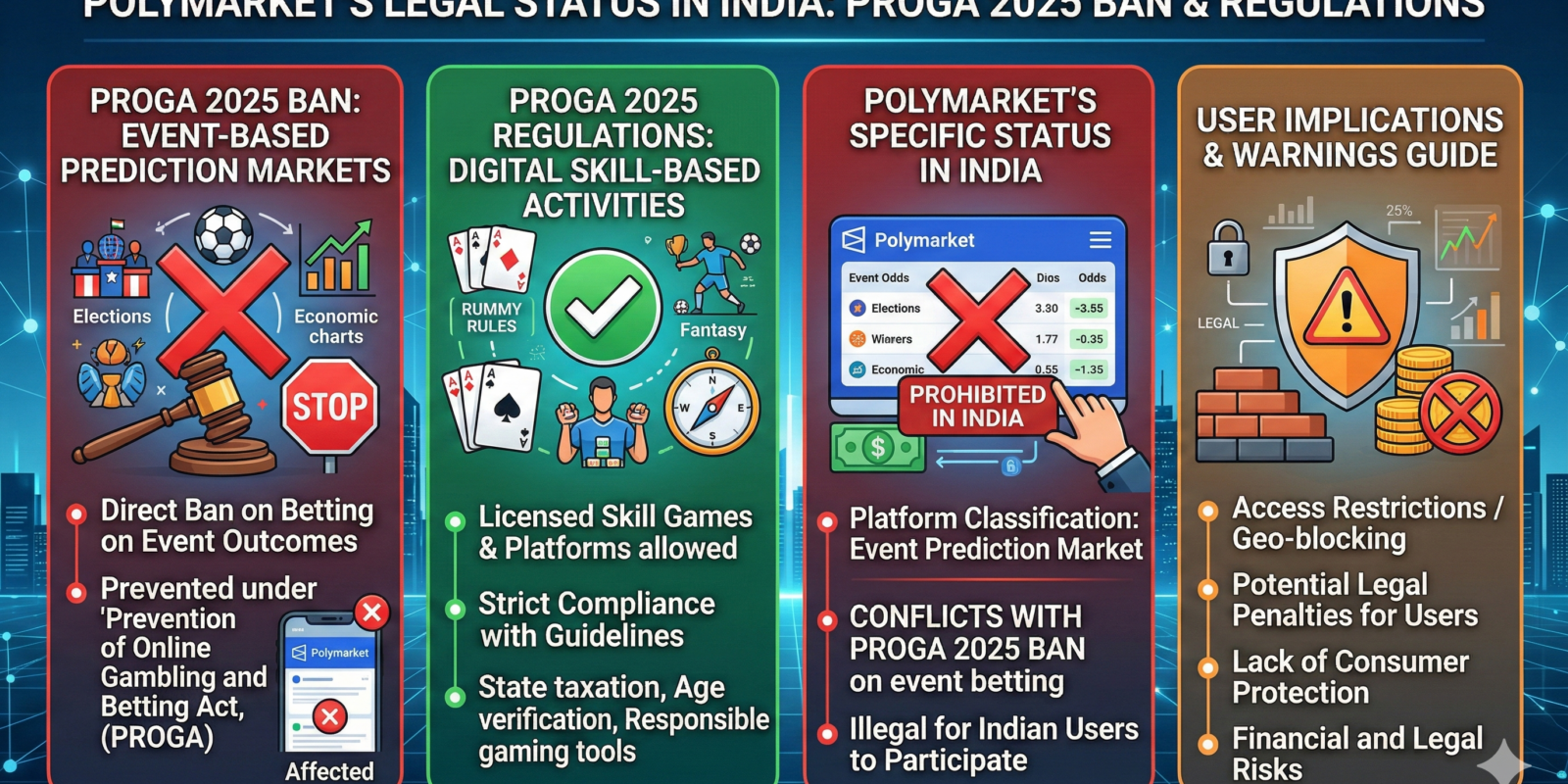
By The Indian government prohibits Polymarket. Regulators classify decentralized prediction markets as illegal online money games under the Promotion and Regulation of Online Gaming Act 2025.
This legislation replaces older state laws and establishes a nationwide ban on platforms where users wager cryptocurrency on future events. The Ministry of Electronics and Information Technology blocks access to these offshore networks.
Using these applications exposes Indian residents to penalties under foreign exchange and anti money laundering laws. This report details the specific legal mechanisms enforcing the current ban.
Polymarket in India is Banned
A thorough analysis of the legal status of decentralized prediction markets under PROGA 2025. Updated till February 2026.
Decentralized finance and sovereign regulatory frameworks conflict globally. Polymarket is at the center of this issue. It operates as a decentralized prediction market built on blockchain technology. The platform allows users to trade shares based on the binary outcomes of future real-world events. Regulatory bodies across the globe classify these platforms as unlicensed gambling, illegal financial derivatives, or tools for market manipulation.
The legal status of Polymarket in India is clear. The Indian government passed the Promotion and Regulation of Online Gaming Act 2025 (PROGA). This act created a nationwide prohibition on all online money games. The law collapsed the old judicial distinction between games of skill and games of chance. It criminalizes any online platform where users stake money or its equivalent expecting a reward.
The Ministry of Electronics and Information Technology (MeitY) officially blocked Polymarket. MeitY classifies it as an unauthorized offshore gambling platform operating against domestic financial and gaming regulations.
The Operational Architecture of Polymarket
Polymarket does not act like a traditional bookmaker. It operates as an Automated Market Maker on the Polygon blockchain.
- Users purchase Yes or No shares.
- The price of these shares fluctuates between USD 0.01 and USD 0.99.
- If a Yes share trades at USD 0.65, the market assumes a 65 percent probability of the event happening.
- Winning shares are redeemed for USD 1.00 via smart contracts.
- Polymarket does not hold user funds. Users maintain self-custody using Web3 wallets.
- The primary currency used is USD Coin (USDC).
Comparing Traditional Betting vs Polymarket
| Feature | Traditional Betting Exchanges | Polymarket |
|---|---|---|
| Custody of Funds | Centralized (held by platform) | Non-custodial (user Web3 wallet) |
| Settlement Currency | Fiat currency (INR, USD) | Cryptocurrency (USDC) |
| Execution Mechanism | Centralized matching engine | Blockchain smart contracts |
| Market Resolution | Internal corporate decision | Decentralized Oracles |
Jurisprudence and the PROGA 2025 Law
The Old Regime
The Public Gambling Act of 1867 regulated gambling historically. It exempted games of mere skill. The Supreme Court established the Dominant Factor Test. Courts upheld activities like betting on horse racing or rummy if skill outweighed chance. This created fragmented state laws. West Bengal allowed games of skill. Telangana banned all real-money games.
PROGA 2025
The Promotion and Regulation of Online Gaming Act 2025 abandoned the skill versus chance argument entirely. Section 5 prohibits all online money games. The law explicitly defines an online money game as any platform where a user wagers money or virtual tokens expecting a reward.
Interactive Data: State Regulatory Stance (Pre-2025)
Filter by state regulation status:
| State | Regulatory Stance | Key Legislation |
|---|---|---|
| West Bengal | Permitted games of skill | West Bengal Gambling Act 1957 |
| Sikkim | Licensed online games | Sikkim Online Gaming Act 2008 |
| Telangana | Absolute prohibition | Telangana Gaming Act 2017 |
| Tamil Nadu | Absolute prohibition | TN Prohibition of Online Gambling Act 2022 |
Financial Law Violations
Using Polymarket exposes Indian residents to massive legal risks under financial laws.
Foreign Exchange Management Act (FEMA)
Converting Indian Rupees into stablecoins for offshore betting violates FEMA. The Reserve Bank of India bans sending funds out of India for gambling. Buying USDC to use on Polymarket bypasses sovereign capital controls.
Prevention of Money Laundering Act (PMLA)
The Ministry of Finance requires crypto exchanges to register with the Financial Intelligence Unit. Polymarket lacks a corporate entity to enforce Know Your Customer rules. It remains entirely non-compliant. Authorities freeze domestic bank accounts linked to offshore crypto betting.
Taxation on Digital Winnings
India taxes digital winnings severely. Users face flat rates with no basic exemptions or set-offs allowed.
Technical Enforcement and ISP Blocking
MeitY utilizes the Information Technology Act to execute technical blocks against offshore platforms.
DNS Blackholing
Internet Service Providers receive confidential orders to blackhole domain name requests. Users attempting to load the site face standard connection timeouts.
Network Monitoring
The Computer Emergency Response Team monitors network traffic. They look for virtual private network signatures attempting to bypass regional restrictions.
Deep Packet Inspection
Telecom operators implement Deep Packet Inspection. This technology detects and drops connections connecting directly to known Polymarket smart contract endpoints on the Polygon network.
The Burden on Virtual Digital Asset Providers
Local cryptocurrency exchanges face strict compliance mandates regarding outgoing transfers.
Platforms registered with the Financial Intelligence Unit must screen outgoing wallet addresses. If a user attempts to withdraw USDC to an address associated with an unregulated prediction market, the exchange must halt the transaction immediately.
Repeated attempts trigger Suspicious Transaction Reports. The Enforcement Directorate analyzes these reports to track capital flight and enforce the Foreign Exchange Management Act. Users risk having their domestic bank accounts frozen if they interact with blacklisted addresses.
Legal Alternatives for Speculation
Retail traders looking for lawful speculation must use regulated financial instruments.
SEBI Regulated Markets
- The Securities and Exchange Board of India regulates the domestic derivatives market.
- Users can trade options and futures on the National Stock Exchange or Bombay Stock Exchange.
- These instruments require complete KYC verification and settle strictly in Indian Rupees.
- SEBI explicitly warned the public against unregulated opinion trading applications in late 2025.
- Only registered brokers hold the legal authority to offer financial speculation services to Indian citizens.
Resolution Mechanics and Oracle Risks
Polymarket relies on the Universal Market Access protocol. This protocol resolves disputes through a decentralized token holder vote.
Indian regulatory bodies reject this mechanism. They classify decentralized oracles as unverified third parties lacking legal accountability. Financial authorities demand centralized audit trails. The absence of a registered clearing house makes the platform incompatible with the Securities Contracts Regulation Act.
Criminal Penalties and Prosecution
Operator Liability
Operating an online money game carries a prison sentence of up to three years. Hosting infrastructure or providing liquidity pools falls under this category. Directors of involved entities face corporate criminal liability.
User Liability
Users facilitating transactions face fines up to five hundred thousand Rupees. The Enforcement Directorate treats repeated offshore transfers as money laundering. These offenses are non bailable. The court requires the accused to prove the funds were not used for illegal digital betting.
Impact on Indian Web3 Developers
India hosts a large number of blockchain developers. The prohibition affects their ability to contribute to decentralized prediction markets.
Writing code for blocked platforms creates legal risk. Developers participating in decentralized autonomous organizations governing these protocols face scrutiny. Law enforcement monitors code repositories and social channels linked to banned applications. Indian contributors must geofence their products to avoid domestic legal entanglements.
Global Regulatory Context
India is not alone in banning Polymarket.
- France: Banned via ANJ directive.
- Portugal: Banned by Gaming Authority.
- United States: Faces active lawsuits in Nevada, Massachusetts, and Tennessee.
- Singapore: Blacklisted by the GRA.
Frequently Asked Questions
Compliance Notice Template
This template format can be used by corporate entities to notify employees regarding the prohibition of offshore digital assets trading on company networks.
MEMORANDUM
DATE: [Insert Date]
TO: All Employees
SUBJECT: Prohibition of Access to Blocked Digital Platforms

Under the Promotion and Regulation of Online Gaming Act 2025,
accessing offshore online money games is prohibited.

Company policy forbids the use of corporate networks, devices,
or VPNs to access blocked platforms, including decentralized
prediction markets.

Failure to comply will result in disciplinary action and
potential reporting to relevant authorities.