
 By
By Unpaid invoices cripple small businesses. When a client accepts your services and then ignores your payment reminders, the situation feels hopeless. Many business owners assume their only choices are writing off the debt entirely or fighting a drawn-out battle in civil court.
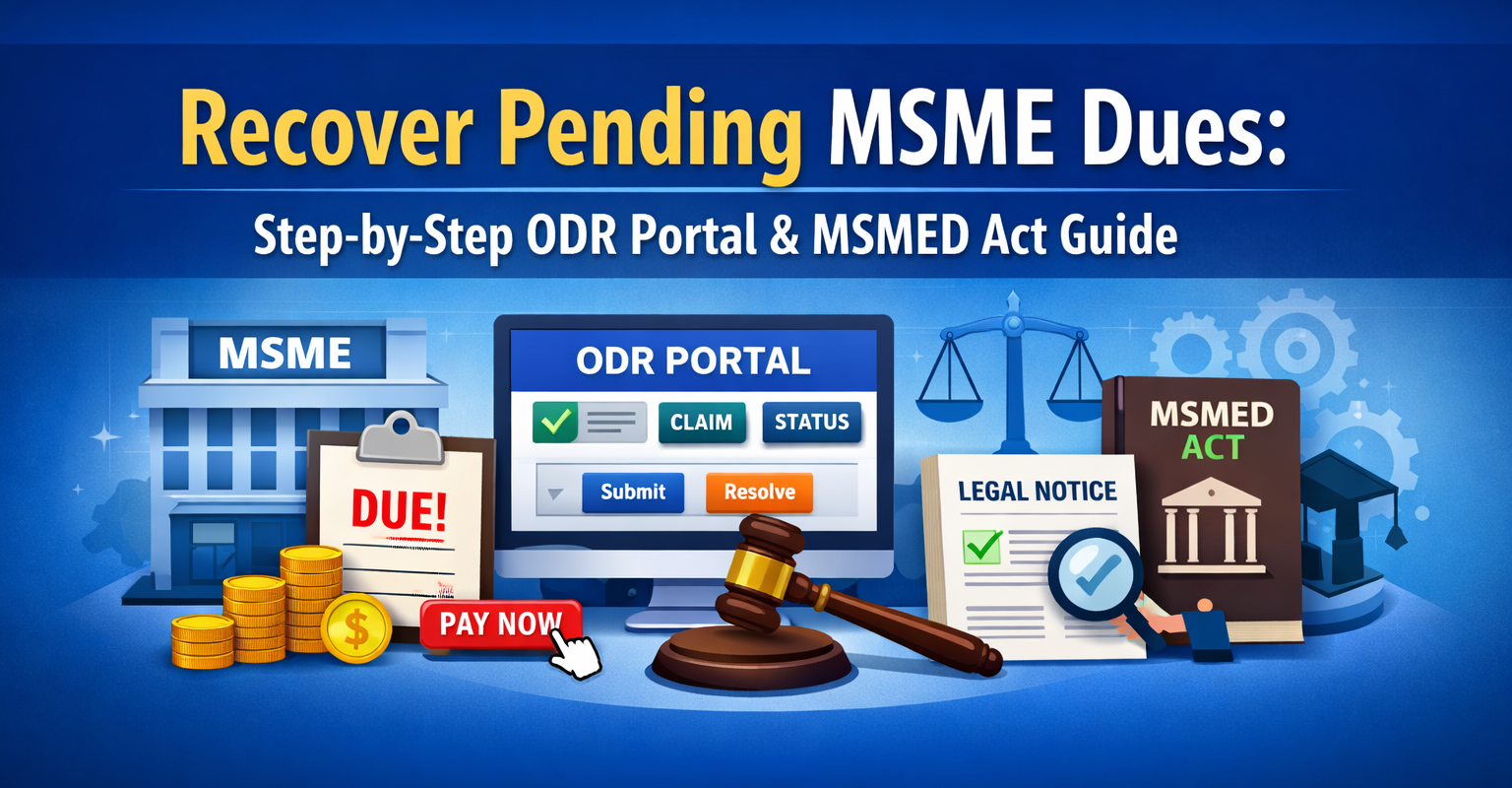
The Micro, Small and Medium Enterprises Development (MSMED) Act of 2006 offers a faster, legally binding alternative. By utilizing the official MSME ODR Portal, registered businesses can enforce a strict 45-day payment rule and legally demand compound interest on delayed invoices at three times the RBI bank rate.
This guide explains exactly how to register a default case, transition from online notices to the physical Facilitation Council, and secure a final arbitration award to recover your money.
How I Recovered My Agency Dues Using The MSME Act
A step-by-step procedure for business owners in West Bengal relying on the ODR Portal and the West Bengal Micro Small Enterprises Facilitation Council. Updated till February 2026.
The Agency Perspective: Escaping the Begging Cycle
I run a corporate video agency.
Like many other small business owners, I have faced situations where clients take the service and then go silent when the invoice is due. I used to think my only options were begging the client or expensive legal battles that last years.
I recently discovered the MSME ODR Portal. Right now, I am in the middle of a recovery case through the Portal. My case has reached the Facilitation Stage. I wanted to share the exact procedure I found because there is very little clear information available online.
The 45 Day Rule
The Micro Small and Medium Enterprises Development Act of 2006 regulates commercial credit periods. Section 15 of the Act states that a buyer must pay you within 45 days of accepting goods or services. This time limit applies regardless of any other conditions in your contract.
If the buyer fails to pay within 45 days, Section 16 states they must pay compound interest with monthly rests. The rate is set at three times the bank rate notified by the Reserve Bank of India. The Finance Act of 2023 also added Section 43B(h) to the Income Tax Act. This section states that delayed payments to MSMEs cannot be claimed as tax deductions by the buyer.
Penalty Estimator
Calculate the estimated statutory interest a buyer owes you. The MSME Act mandates compound interest at 3x the RBI bank rate (currently estimated around 19.5% annually for this calculation).
What You Need Before Filing
You can start this process yourself. You need the following items ready before logging into the portal.
- A Valid Udyam Certificate: You must have this certificate before the invoice date. The Supreme Court ruling in Silpi Industries confirms that retroactive registration does not qualify for protection under this specific law.
- The Invoices: This is the primary evidence of the debt.
- Communication Proof: A formal Purchase Order is preferred. WhatsApp chats and email threads also work as valid proof of delivery and agreement if a formal order is missing.
- A Notarized Affidavit: West Bengal procedural rules require a sworn affidavit on a Rs 10 non-judicial stamp paper if you do not have a formal written purchase order.
Eligibility Checker
Select your enterprise metrics to confirm you qualify under the revised MSME rules.
The Portal Process
The Ministry of MSME retired the old Samadhaan system. As of late 2025, all new cases go through the ODR Portal. When you register a case, the system follows a specific sequence.
Pre-MSEFC Phase: The portal sends an automated notice via email and SMS to the buyer. This initiates the Digital Guided Pathway. The buyer receives 15 days to settle the amount out of court. The portal calculates the principal liability and the statutory interest. This notice often forces an evasive client to pay the invoice.
Unmanned Negotiation: If the buyer responds but wants to negotiate, the portal opens a virtual room. You can agree to a modified payment schedule here using Aadhaar-based electronic signatures.
Visual Process Flow
This chart outlines the steps from unpaid invoice to final recovery.
Physical Filing in Kolkata
If the buyer ignores the digital notices, the case moves to the formal West Bengal Micro Small Enterprises Facilitation Council. You must physically visit a local MSME Facilitation Centre. In Kolkata, these are located at Shilpa Sadan on Camac Street or the New Secretariat Building.
You must submit multiple sets of printed documents. These sets include your formal application, invoice copies, the notarized affidavit, proof of delivery, and a ledger certified by a Chartered Accountant. The CA certificate is mandatory to verify the compound interest calculations.
You have to pay an administrative filing fee via Demand Draft. The fee structure depends on the claim amount.
| Total Claim Amount (Principal + Interest) | WBMSEFC Filing Fee (Government Fee) |
|---|---|
| Up to ₹5,00,000 | ₹3,000 |
| ₹5,00,001 to ₹25,00,000 | ₹3,000 + ₹300 per Lakh exceeding ₹5 Lakhs |
| ₹25,00,001 to ₹1,00,00,000 | ₹9,000 + ₹150 per Lakh exceeding ₹25 Lakhs |
The MSEFC Legal Stages
Once the fee is processed, the case enters formal legal proceedings. The law limits these stages to specific timeframes.
Phase A: Facilitation. A neutral conciliator leads a negotiation between you and the buyer. The law requires this phase to finish within 90 days. If you reach an agreement, it becomes a binding legal order.
Phase B: Arbitration. If the buyer refuses to agree during facilitation, the case transitions to Arbitration. The Council acts as a judge and reviews the evidence. The Council passes a final legal order called an Arbitral Award. This phase must also conclude within 90 days.
Execution Procedures
If the buyer refuses to pay after the Council issues the Arbitral Award, you initiate Execution Proceedings. The award has the same legal weight as a civil court decree.
You can file an Execution Petition in a Civil Court. The court can seize the buyer’s property or freeze their bank accounts to pay you. Alternatively, Rule 20 of the West Bengal MSEFC Rules allows the District Collector to recover the money as an arrear of land revenue. The Collector can issue distress warrants and auction assets quickly.
You must act fast. If the buyer files for bankruptcy under the Insolvency and Bankruptcy Code before you execute the award, your claim might be canceled by the National Company Law Tribunal.
The 75 Percent Security Rule
Buyers sometimes challenge the MSEFC order in civil court to delay payment. Section 19 of the Act forces the buyer to deposit 75 percent of the total awarded amount before the court will even hear their appeal. This rule protects small business owners from endless legal delays initiated by large corporations.
The 15-Day Quality Dispute Rule
Many buyers try to avoid payment by claiming the service or product was defective months after delivery. The MSMED Act anticipates this tactic. Section 15 clearly states that any objection regarding the quality of goods or services must be made in writing within 15 days of delivery.
If the buyer fails to raise a formal written dispute within this 15-day window, they legally lose the right to withhold payment based on quality issues. The Council will dismiss their delayed complaints and proceed with the recovery order.
Crucial Invoice Additions
You can strengthen your legal position by formatting your invoices correctly before a dispute ever happens. A properly formatted invoice removes the buyer’s ability to claim ignorance.
Mandatory Invoice Elements
- Udyam Registration Number: Print this clearly at the top of every invoice next to your GST number.
- Statutory Warning Clause: Add a specific payment terms footnote. Example text: “We are a registered MSME under the MSMED Act 2006. Payments delayed beyond 45 days will attract compound interest at 3x the RBI bank rate under Section 16 of the Act.”
- Acceptance Clause: State that terms and quality are deemed accepted if no written dispute is raised within 15 days.
Top Reasons ODR Cases Get Rejected
Not all cases filed on the portal are accepted. The Facilitation Council reviews applications strictly and will dismiss cases for specific administrative errors.
- Unregistered Status at Transaction Date: If your Udyam certificate was generated after the date on the disputed invoice, the Council cannot help you. The protection is not retroactive.
- Works Contracts: Pure goods and services are covered. Complex civil construction contracts or “works contracts” are often rejected because they fall under different legal jurisdictions.
- B2C Transactions: The MSME Act protects business-to-business debt. If you sold a service to an individual consumer without a registered business entity, the Council will reject the claim.
The Limitation Act Time Bar
The Limitation Act of 1963 strictly applies to MSME recovery cases. You have exactly three years from the invoice due date to file your claim on the portal. If you wait beyond this period, the Council will dismiss your case immediately.
Business owners often make the mistake of waiting too long while negotiating informally. Do not let the buyer stretch email threads past this statutory deadline. Once the three years expire, the legal right to recover the debt through this specific administrative process vanishes.
Inside The Arbitration Hearing
If your case reaches the physical hearing stage, do not expect a traditional courtroom. The West Bengal MSEFC operates out of standard government boardrooms. You will sit across a table from the Council members and the buyer’s representatives.
The environment is formal but administrative. The Council Chairman will ask you to explain the outstanding amount and present the CA certified ledger. They will then ask the buyer to justify the delayed payment. You must bring all original physical documents to this meeting, including the stamped invoices, the delivery proofs, and the original affidavit.
Summary
It is a much faster route than traditional litigation. If you are a small business owner, stop chasing people on calls and start using the legal tools available to you. The MSMED Act provides a structured and legally binding framework designed specifically to protect your working capital.
Standard Document Templates
1. Communication Proof Format (Email)
Subject: Final Delivery of Services and Pending Invoice Reference [Number]

Dear [Client Name],
This email confirms the delivery of the services agreed upon on [Date].
Please find the final files attached.
Invoice [Number] for the amount of [Amount] is attached to this email.
Kindly process the payment within the agreed timeframe to avoid statutory
interest under the MSMED Act 2006.

Regards,
[Your Name]
2. Affidavit Requirements (West Bengal)
Your Rs 10 non-judicial stamp paper affidavit must declare the following facts.
- Your firm is registered under the MSMED Act as a Micro or Small Enterprise.
- The buyer placed an order verbally or via digital communication on a specific date.
- You delivered the services or goods on a specific date.
- The buyer accepted the delivery without any written disputes regarding quality.
- No other court cases are active regarding these specific invoices.
Frequently Asked Questions
Can I use this process if I am a trader?
No. The MSEFC route is restricted to manufacturing and service enterprises. Traders are not eligible to file delayed payment claims on the portal.
Do I need a lawyer to file on the ODR Portal?
You do not need a lawyer to start the Pre-MSEFC process. You can upload the invoices and documents yourself. You may want legal representation during the physical Arbitration stage.
What happens if the buyer ignores the ODR notices?
If the buyer ignores the digital notices for 15 days, the negotiation phase fails. You then proceed to physical filing at the local Council to begin formal legal proceedings.
Can I claim interest on invoices that are five years old?
There are time limits based on the Limitation Act. Usually, you should file within three years from the date the payment became due.