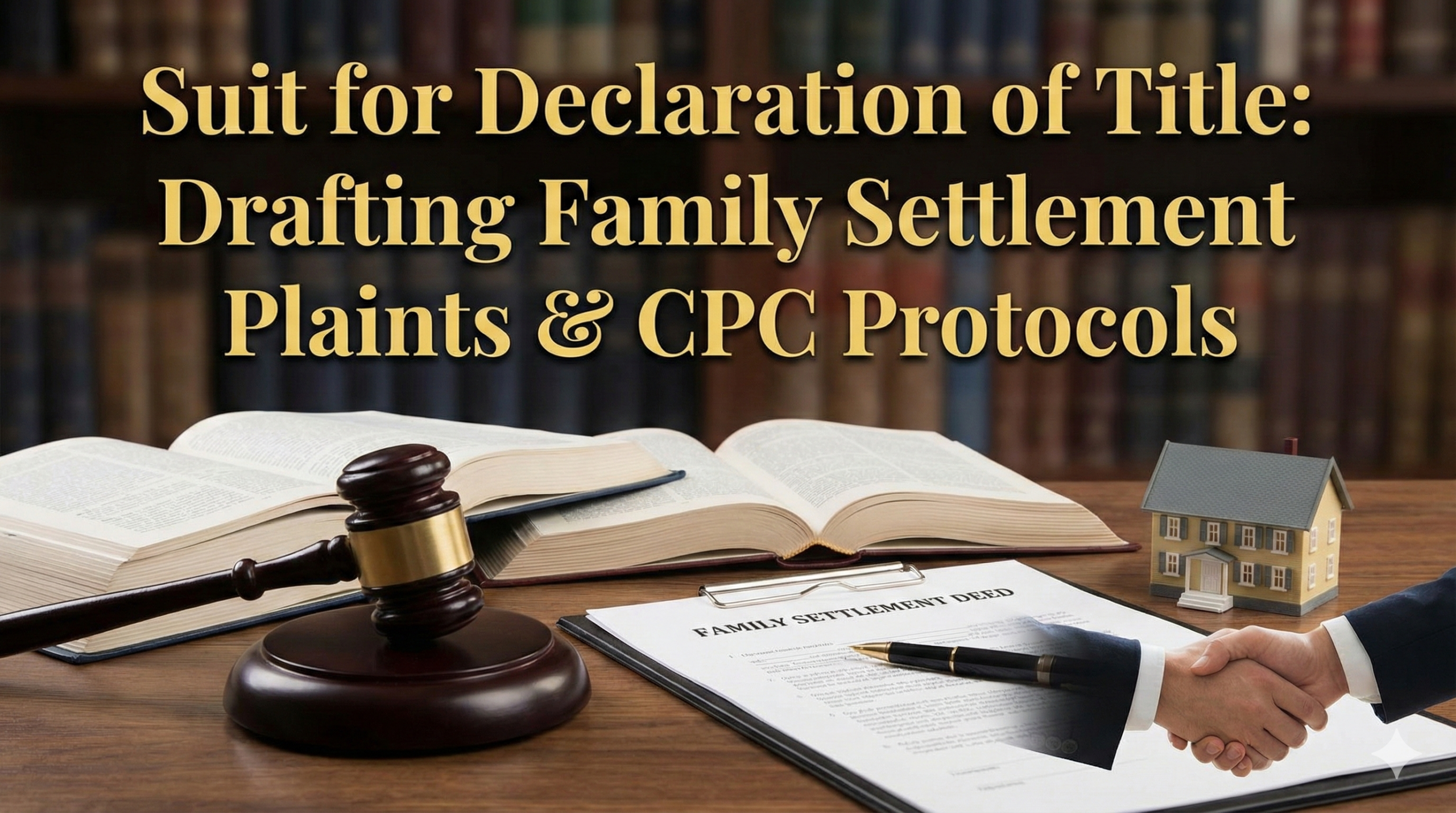

In the precise landscape of Indian Civil Litigation, a drafting error is often fatal to the cause of action. A common procedural anomaly arises when a Suit for Declaration of Title is drafted using the terminology of an Affidavit—ending with a ‘Deponent’s Verification’ rather than a ‘Plaintiff’s Prayer.’ This structural flaw, combined with the careless use of terms like ‘Relinquishment’ in Family Settlements, can trigger mandatory registration requirements under Section 17 of the Registration Act, rendering the suit inadmissible.
This protocol provides a rigorous framework for converting a defective draft into a CPC-compliant Plaint. We analyze the critical distinction between Article 58 and 65 of the Limitation Act, the necessity of seeking consequential relief under Section 34 of the Specific Relief Act, and the correct valuation strategy to ensure your property dispute survives the threshold stage of civil adjudication.
The Family Settlement Suit: Converting an Affidavit into a Plaint
Procedural errors in drafting can result in the immediate dismissal of a civil suit. This protocol outlines the mandatory conversion of a “Deponent’s Affidavit” into a “Plaintiff’s Plaint” for North Indian land disputes.
The adjudication of property rights in India relies heavily on technical precision. A draft document titled “Suit of Declaration” which ends with a “Verification on Oath” by a “Deponent” is a procedural anomaly. It conflates two distinct legal instruments: the Plaint and the Affidavit. This fundamental error affects jurisdiction, court fees, and admissibility.
Under the Specific Relief Act (1963) and the Code of Civil Procedure (1908), a suit must be instituted by a Plaint. The Affidavit acts merely as supporting evidence. We present a rigorous analysis of how to restructure such a draft to ensure it survives the threshold stage of civil litigation.
1. The Visual Logic of Title Suits
Before drafting, one must understand the flow of legal requirements for a Declaratory Suit based on Section 34 of the Specific Relief Act.
2. The Plaint vs. Affidavit Conflict
The primary defect in many amateur drafts is the use of affidavit terminology in the main pleading. The court takes cognizance of a Plaint, not an Affidavit. The differences are structural and substantive.
| Feature | Plaint (The Suit) | Affidavit (The Evidence) | Type |
|---|---|---|---|
| Signatory | Signed by the Plaintiff | Signed by the Deponent | Structural |
| Objective | To institute the suit and seek relief | To swear that facts are true | Legal Effect |
| Ending Clause | Prayer Clause (Reliefs sought) | Verification of Truth | Structural |
| CPC Order | Order VII | Order XIX | Legal Effect |
3. The “Relinquishment” Trap
The most dangerous error in drafting a family settlement suit is the verb “Relinquish.” Under the Registration Act, 1908, any document that extinguishes a right in immovable property worth over ₹100 must be registered. If the Plaint states that the defendant “relinquished” their share via the Memorandum, the suit will fail for want of registration.
To succeed, the Plaint must argue that the settlement was oral and the document merely acknowledged a past transaction. This aligns with the Supreme Court’s ruling in Kale v. Deputy Director of Consolidation.
4. The Section 34 Proviso (The Possession Hurdle)
Section 34 of the Specific Relief Act contains a proviso that often kills suits drafted by novices: “Provided that no court shall make any such declaration where the plaintiff, being able to seek further relief than a mere declaration of title, omits to do so.”
In plain English: If you are not in physical possession of the land, you cannot simply ask the Court to “Declare you the owner.” You must ask for “Declaration of Ownership AND Recovery of Possession.” Failing to ask for possession will lead to dismissal.
5. The Evidence Ecosystem: What to Attach
A Plaint without supporting documents is toothless. Based on Indian evidence law, these are the non-negotiable annexures required at the time of filing.
6. Drafting Workbench: Comparative Analysis
We analyze common defects in the original text (red) and provide the correct CPC-compliant formulation (green).
Module A: The Cause of Action (Para 7)
“That the cause of action… arose on each and every dates when plaintiffs requested… and finally on _____.”
Issue: “Each and every date” is vague. Limitation starts from a specific date of “clear and unequivocal threat” to the right. Vague dates invite a rejection under Order VII Rule 11 (Barred by Law).
“That the cause of action arose initially on [Date] when the family settlement was orally arrived at. It arose subsequently on [Date] when the Defendants, for the first time, unequivocally refused to acknowledge the Plaintiff’s title, thereby necessitating this suit.”
Fix: Fixes a specific date for the “Refusal” to start the 3-year limitation clock (Article 58).
Module B: Verification (Order VI Rule 15)
“Verified that the contents of our above affidavit are true…”
Issue: This is Affidavit language. A Plaint verification must distinguish between “Personal Knowledge” and “Legal Advice”.
“Verified that the contents of Paras 1 to 6 are true to my knowledge, and Paras 7 to 8 (Legal) are true based on information received and believed to be true. Last Para is the Prayer to this Hon’ble Court.”
Fix: Complies strictly with CPC Order VI Rule 15 requirements.
7. The Limitation Clock: Article 58 vs. 65
Limitation is not just about time; it is about the “Nature of Relief.” Choosing the wrong article can time-bar your suit instantly.
| Context | Article 58 (Declaration) | Article 65 (Possession) |
|---|---|---|
| Time Limit | 3 Years | 12 Years |
| Trigger Event | When the right to sue “first accrues” (Denial of title). | When the possession of defendant becomes “adverse” to plaintiff. |
| Application | Use when you are in possession but your title is clouded. | Use when you have lost possession and need to recover it based on title. |
| Risk | High. “First accrues” is strictly interpreted. Repeated denials do not reset the clock. | Low. Burden of proof is on Defendant to prove Adverse Possession. |
8. Precedent Repository
When arguing the admissibility of an unregistered family memorandum, cite these authorities.
9. Trial Strategy: Proving the Oral Settlement
Drafting the Plaint is only 10% of the battle. The real challenge is proving an “Oral Settlement” during the evidence stage. Since there is no registered deed, the Court relies entirely on oral testimony.
The “Who, When, Where” Test
Prepare your witnesses to answer these specific cross-examination questions. Inconsistencies here will lead to the suit’s dismissal.
Who mediated the settlement? Was it the village Sarpanch or a respected elder? They must be examined as a witness (PW-2).
If the Plaint says settlement happened on “10th March,” but the witness says “End of March,” the discrepancy is fatal.
Did it happen at the ancestral house or the Tehsil office? If Tehsil, why wasn’t it registered?
Family settlements require “Love and Affection” or “Family Peace” as consideration, not money. Mentioning cash exchange makes it a Sale, requiring stamp duty.
10. Reconstructed Drafting Protocol
Below is the corrected template. It strips the affidavit format and inserts the mandatory legal clauses for Jurisdiction, Valuation, and Prayer.
A. The Valuation Clause (Missing in Drafts)
Courts require a specific statement on value to determine jurisdiction and revenue.
B. The Corrected “Settlement” Factum
This phrasing avoids the Section 17 Registration Act trap.
C. The Mandatory Prayer Clause
A civil court cannot grant relief that is not explicitly requested. A suit ending in “Hence this suit” is defective.