 By
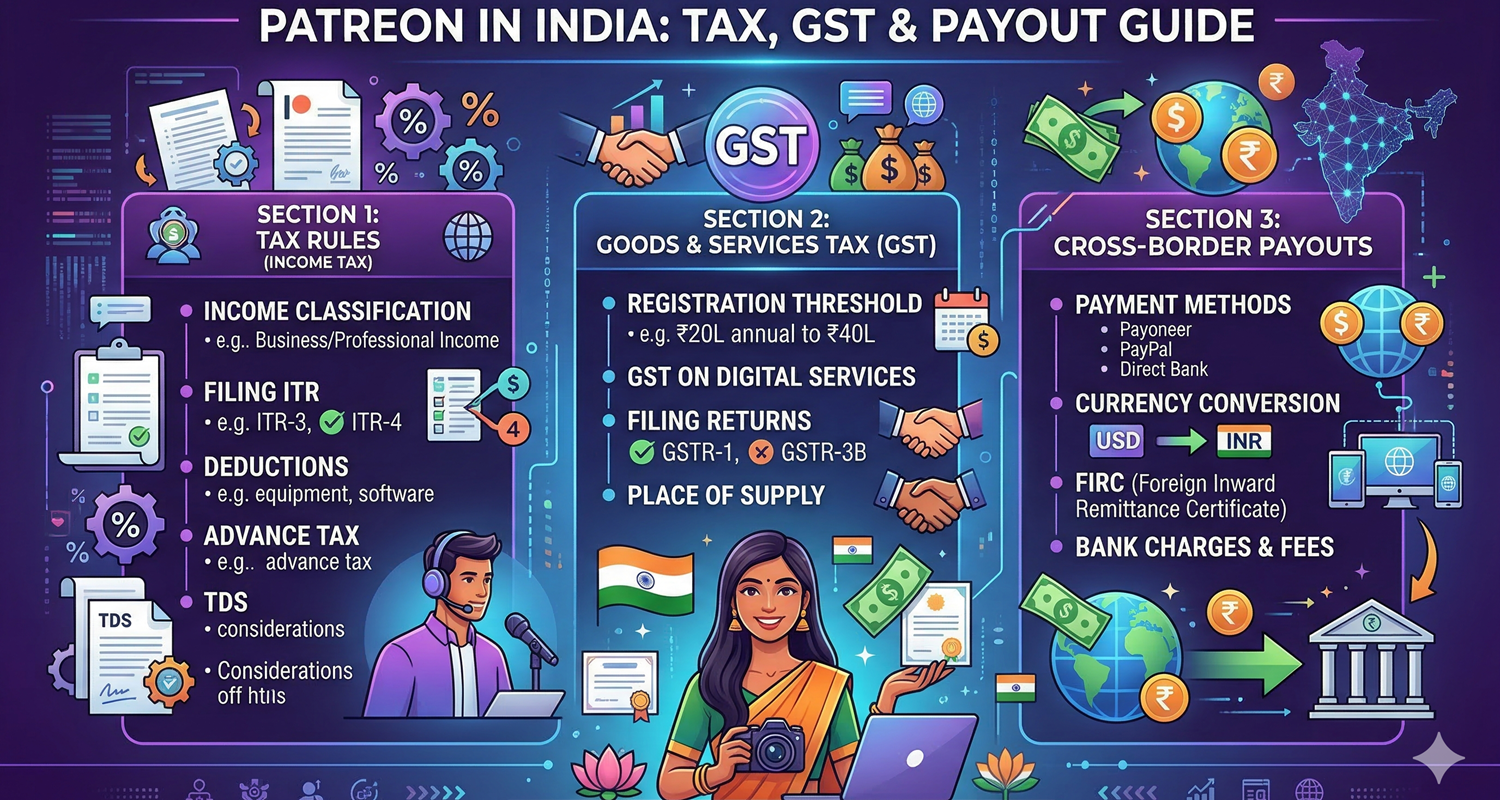
By Earning international revenue through Patreon requires Indian digital creators to manage a specific set of financial regulations.
The Reserve Bank of India strictly monitors cross border transactions, and local tax laws classify subscription income as an export of services. Operating without understanding these rules leads to failed payments, heavy platform deductions, and compliance issues.
This manual explains the exact steps to build a legal monetization setup. Read on to figure out FEMA export declarations, GST requirements, the actual cost differences between Payoneer and PayPal, and how to handle local recurring payment failures.
Cross Border Monetization for Digital Creators in India
Regulatory rules, financial networks, and operational protocols for Indian professionals utilizing Patreon and international platforms.
The Regulatory Architecture
The Reserve Bank of India governs the repatriation of digital creator earnings through the Foreign Exchange Management Act of 1999. Patreon income is classified as commercial revenue from the Export of Services. It is not a donation.
FEMA 2026 Modernization
The Foreign Exchange Management Regulations of 2026 took effect recently. These rules replace fragmented documents with a single Export Declaration Form applicable to all software and digital services. You must file this form within thirty days of the end of the month you receive the payout.
Service exporters have a fifteen month window from the date of the invoice to realize their foreign proceeds. AD Banks can restrict future exports if proceeds remain unrealized beyond one year from the due date. For transactions under 1 million INR per invoice, AD Banks permit the closure of open entries based on a self declaration.
Goods and Services Tax Mandates
Providing digital content for a subscription is defined as a supply of services under the Central Goods and Services Tax Act. Since the platform and patrons are mostly outside India, this qualifies as an Export of Services. Export revenue requires legal filings to be exempt from indirect tax.
You must obtain a Goods and Services Tax Identification Number if your annual turnover exceeds 20 Lakhs INR. For Special Category States, the threshold is 10 Lakhs INR. Operating above these limits without a GSTIN violates statutory rules.
Letter of Undertaking Process
International services attract an 18 percent Integrated Goods and Services Tax. To process foreign income without paying this tax upfront, you must file a Letter of Undertaking via Form GST RFD 11 on the digital tax portal before the financial year begins.
Filing this form makes the transaction a Zero Rated Supply. You can then claim an Input Tax Credit refund on business expenses like computing hardware or internet infrastructure.
Filter: Find Your SAC Code
Direct Taxation Details
Net income from Patreon is taxable under the Profits and Gains from Business or Profession category. Under the 2026 New Tax Regime, the basic exemption limit is 4,00,000 INR. If your taxable income is 12,00,000 INR or below after deductions, you can claim a full rebate under Section 87A.
The government tracks inward remittances. Every remittance routed through a bank is tagged with your Permanent Account Number and Aadhaar details. This data appears in your Annual Information Statement.
Presumptive Taxation Scheme (Section 44ADA)
Digital creators can declare 50 percent of their gross receipts as profit under Section 44ADA of the Income Tax Act. This removes the requirement to maintain detailed accounting books or track individual business expenses. You must file Income Tax Return Form 4 to use this scheme.
The maximum limit for this scheme is 75 Lakhs INR annually. This higher limit applies only if your cash receipts do not exceed 5 percent of your total gross receipts. Since Patreon pays directly to your bank account digitally, you automatically meet this non cash requirement.
Cross Border Payout Economics
Patreon accrues funds in USD. You must route these funds through payment processors like PayPal or Payoneer to clear them into an Indian bank account in INR.
The Attrition of Creator Capital
The gross pledge undergoes four platform deductions before reaching your bank.
- Patreon deducts a fee between 5 and 12 percent.
- Payment processing fees cost 2.9 percent plus 0.30 USD for standard payments.
- Patreon applies a 2.5 percent currency conversion fee if the patron pays in a non USD currency.
- Payout fees range from 0.50 USD to a percentage of the total amount based on the intermediary used.
Payoneer versus PayPal
| Metric | PayPal India | Payoneer (Bank Transfer) |
|---|---|---|
| Patreon Payout Fee | 1 percent of transfer | Flat 0.50 USD or 1.55 percent plus 0.25 USD |
| FX Spread Markup | 3 to 4 percent | 0.5 to 2 percent |
| Settlement Velocity | 1 to 5 business days | 3 to 5 business days |
| FIRA Generation | Manual request required | Automated per transaction |
Payoneer provides virtual receiving accounts that simulate local banking details. Payoneer generates digital FIRAs automatically for every transaction. PayPal requires manual requests and fees for individual transaction certificates. Choosing Payoneer generally yields a higher INR payout per USD earned due to the narrower foreign exchange spread.
RBI Mandates and Local Alternatives
The RBI implemented regulations for processing recurring payments. The rules require an Additional Factor of Authentication for all recurring transactions. Banks must send an alert 24 hours prior to any recurring charge.
Global platforms like Patreon process subscriptions asynchronously. Their billing engines clash with the RBI mandate. This causes recurring payments from Indian consumers to fail frequently. Patreon acknowledges they cannot guarantee successful processing for members located in India.
Bifurcating Your Payment Systems
Because international platforms struggle with Indian debit cards, creators divide their payment links based on the user’s geographic location.
Use Patreon for audiences located in the United States and Europe. Use domestic platforms like Cosmofeed or Razorpay Payment Pages for Indian audiences. These native Indian tools integrate Unified Payments Interface AutoPay. UPI AutoPay processes recurring mandates in full compliance with RBI regulations without failing.
The iOS Platform Rules
Patreon integrates Apple in app purchases on the iOS platform. Apple levies a 30 percent commission on these transactions. Patreon increases the price of the membership tier shown to iOS users by approximately 43 percent to offset this fee.
Apple aggregates these funds and remits them on a delayed schedule. Patreon imposes a 75 day pending period on funds originating from iOS. You must wait two and a half months to withdraw these funds.
Structuring Your Creator Entity
Most Patreon creators in India operate as Sole Proprietors. This structure links your business income directly to your personal Permanent Account Number. You pay taxes according to individual income slabs.
As your recurring revenue grows, you might consider registering a Limited Liability Partnership or a Private Limited Company. A registered company limits your personal liability. It requires compliance with the Ministry of Corporate Affairs. You must file annual returns and conduct statutory audits. Moving from a personal Patreon account to a corporate one requires updating your tax interviews and payout details with Patreon.
Tier Strategy and Purchasing Power Parity
Patreon lacks native purchasing power parity pricing. A tier priced for a United States audience often exceeds the budget of an Indian supporter. You cannot offer identical benefits at different prices on the same platform.
Creators solve this by offering digital parity across separate platforms. You can maintain high value tiers on Patreon in USD for global audiences. You can create identical benefit tiers on a local Indian platform using INR via UPI. You must clearly state the availability of regional pricing in your public posts. Do not violate the terms of service of any platform regarding exclusive content hosting.
Platform Features and Logistics
Patreon offers native video hosting for eligible creators. This allows you to host exclusive video content directly on the platform instead of using unlisted YouTube links. Indian creators face no geographic restrictions for using native video.
If you offer physical merchandise tiers, you must handle international shipping. Shipping physical goods from India requires an Import Export Code from the Directorate General of Foreign Trade. Courier services mandate detailed customs declarations for every package. Many creators use third party print on demand services located in the United States or Europe to bypass domestic shipping logistics entirely.
Accounting and Reconciliation Logistics
Reconciling international revenue requires specific accounting practices. Software like Zoho Books or Tally Prime handles multi currency transactions. You must record the income in USD on the invoice date. The software calculates the forex gain or loss upon the actual bank settlement date in INR. This difference gets recorded under a dedicated forex discrepancy ledger.
You should maintain a strict audit trail. Link your Patreon CSV export, the Payoneer settlement statement, and the Indian bank statement. This three way matching prevents issues during income tax scrutiny.
Intellectual Property Considerations
Protecting digital assets across borders presents specific legal hurdles. The Indian Copyright Act of 1957 protects original literary, dramatic, musical, and artistic works. Registration is not mandatory but serves as prima facie evidence in court.
Patreon honors the Digital Millennium Copyright Act. If someone redistributes your gated content on other websites, you must file a DMCA takedown notice with the hosting provider of the infringing site. Patreon provides basic tools to report unauthorized scraping of your page. External leaks require your direct intervention.
Operational Dos and Don’ts
Compliance Checklist
Frequently Asked Questions
You do not need to register for GST if your turnover is under 20 Lakhs INR. You still must declare the income on your Income Tax Return. If your net income is below 12,00,000 INR under the 2026 regime, you can claim a full rebate.
If you maintain detailed books of accounts, use ITR 3. If you opt for the Presumptive Taxation Scheme under Section 44ADA to declare 50 percent of your income as profit, you must file ITR 4.
The RBI requires a One Time Password authentication for recurring payments. Patreon uses an asynchronous billing system that does not support continuous manual authentication. This causes banks to decline the transaction.
No. If you physically reside in India and produce the content there, you are subject to the IT Act Section 67A. Patreon geo blocks the content based on your location and will ban your account.
Yes. You can register your Patreon account under a corporate entity. You must provide the corporate Permanent Account Number and the business banking details during the setup process.
No. An Import Export Code is only mandatory when you physically ship tangible goods across the Indian border. Digital services and downloadable products do not require this code.
Disclaimer: The information provided on Evaakil.com does not constitute legal, tax, or financial advice. Regulatory rules, including FEMA directives and GST guidelines, are subject to change. Always consult with a certified chartered accountant or legal professional in India before making financial decisions or filing tax returns regarding cross border digital revenue.