 By
By Managing post-tax returns requires converting notional market movements into realized financial events. Tax harvesting operates strictly within the boundaries of the Income-tax Act in India.
The strategy is entirely legal when executed with undeniable commercial substance. Investors deliberately sell and repurchase assets to utilize the Rs 1.25 lakh annual long-term capital gains exemption or to offset short-term losses against recognized profits.
This analysis breaks down the statutory rules, specific anti-avoidance measures, and execution mechanics applicable under the current tax regime and the incoming Income-tax Act 2025.
Financial Jurisprudence
Legality, Mechanics, and Regulatory Boundaries of Tax Harvesting in India
A direct analysis of the 1961 and 2025 Income Tax legislations and recent judicial rulings updated till February 2026.
Evaakil Legal Research Desk
Published February 2026
Managing post-tax returns is a primary requirement for portfolio administration. Capital markets generate unrealized gains and losses. Tax legislation strictly addresses realized financial events. Tax harvesting converts notional market movements into realized events to manage legal tax liabilities.
The Current Statutory Reality
Tax harvesting is completely legal in India. The strategy operates within the bounds of the Income-tax Act 1961 and the incoming Income-tax Act 2025. You must execute transactions with commercial substance. Artificial loss creation or circular trading attracts scrutiny from revenue authorities.
The system distinguishes between prudent portfolio management and deliberate fiscal subterfuge. Specific Anti-Avoidance Rules and the General Anti-Avoidance Rule monitor market behavior.
Mechanics of the Harvest
The tax code treats unrealized and realized events differently. A depreciated asset represents a paper loss. You cannot use this paper loss to offset tax liabilities until you sell the asset. Tax harvesting is the calculated sale of these positions.
Loss Harvesting
You sell underperforming equities or mutual funds currently trading below their acquisition cost. This converts a notional deficit into a recognized capital loss. You then use this recognized loss to offset capital gains generated from profitable asset sales during the identical financial year.
India lacks a blanket wash sale restriction for generic equities. You can repurchase the asset shortly after the sale. You retain your desired portfolio exposure and reduce your tax burden. Unadjusted losses carry forward to subsequent assessment years for a maximum of eight years.
Gain Harvesting
Gain harvesting exploits specific statutory exemptions. The tax code provides an annual tax-free threshold for Long-Term Capital Gains derived from listed domestic equities. Following recent budgets, this limit is Rs 1.25 lakh per financial year.
This exemption expires annually. You cannot carry it forward. Investors deliberately sell appreciated assets to realize exactly up to Rs 1.25 lakh in capital gains before March 31. They immediately reinvest the proceeds back into the identical assets. This resets the acquisition cost to the current higher market price without incurring capital gains tax.
Visualizing the Impact: Infographic Analysis
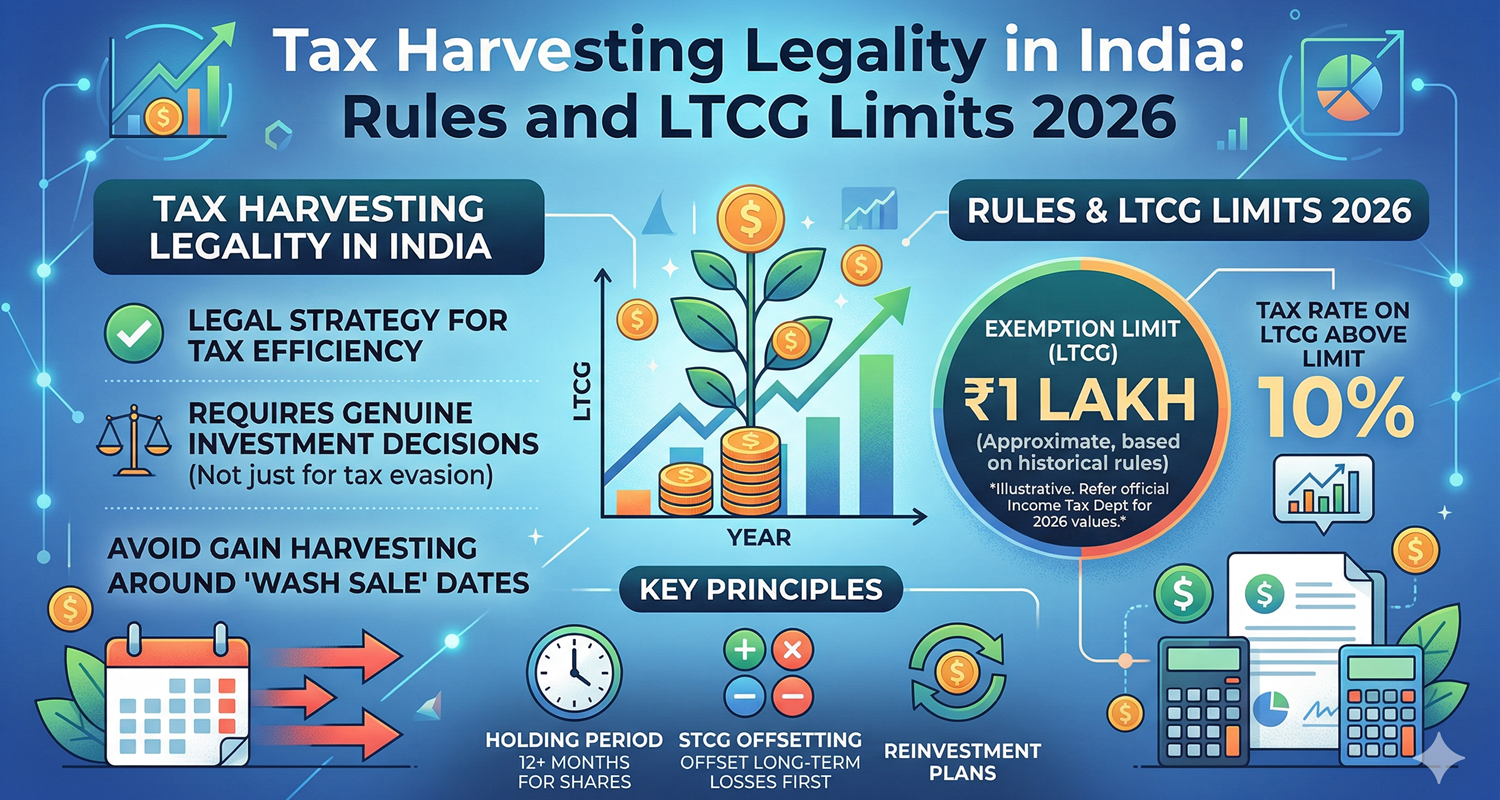
The chart below demonstrates the tax liability comparison between a static portfolio and an actively harvested portfolio utilizing the Rs 1.25 lakh annual exemption and loss adjustments.
The Budget Transition and Rate Modifications
The legislation simplified holding periods and altered tax rates. Listed securities require a 12-month holding period to qualify as long-term assets. Unlisted equities, real estate, and physical gold require a 24-month holding period.
Tax Rate Comparison Matrix
| Asset Classification | Holding Period | Previous Rate | Current Rate | Statutory Exemption |
|---|---|---|---|---|
| Short-Term Capital Asset | Under 12 Months | 15 Percent | 20 Percent | Nil |
| Long-Term Capital Asset | Over 12 Months | 10 Percent | 12.5 Percent | Rs 1.25 Lakh |
Note: Indexation benefits for all long-term capital gains were entirely removed.
Set-Off Rules and Hierarchies
The Income Tax Act mandates a strict hierarchy for setting off losses. Any deviation renders the tax filing illegal.
Short-Term Capital Losses
Highly flexible. You can legally set off a realized short-term capital loss against both Short-Term Capital Gains and Long-Term Capital Gains. You should prioritize offsetting the 20 percent short-term gains first.
The Income-tax Act 2025
The Income-tax Act 2025 comes into effect on April 1, 2026. It replaces the 1961 Act. It introduces the concept of the Tax Year, replacing the previous dualistic terms of Previous Year and Assessment Year.
The new legislation deliberately preserves the mathematical principles governing capital gains taxation. Clause 108 replaces Sections 70 and 71 maintaining the set-off rules. Clause 111 replaces Section 74 maintaining the eight-year carry forward mechanism.
Regulatory Boundaries and Legal Precedents
The legality of tax harvesting depends on the presence of commercial substance. India has no direct 30-day wash sale rule like the United States. You can sell a depreciated asset on a recognized exchange and repurchase it almost immediately.
Specific Anti-Avoidance Rules
The tax code contains specific interventions to prevent systemic abuses. Section 94 of the 1961 Act and Clause 175 of the 2025 Act prohibit dividend stripping and bonus stripping.
- Dividend Stripping: Acquiring securities within three months prior to a dividend record date and liquidating them within three months after the record date invalidates the capital loss up to the dividend amount received.
- Bonus Stripping: Purchasing shares three months prior to a bonus issue and selling the original shares within nine months after the record date while holding the bonus shares results in the disallowance of the loss.
General Anti-Avoidance Rule
The General Anti-Avoidance Rule targets aggressive tax evasion schemes lacking economic substance. To invoke this rule, the revenue authorities must prove the transaction is an Impermissible Avoidance Arrangement.
A crucial statutory safeguard exists. Rule 10U explicitly stipulates a monetary threshold. The authorities cannot invoke the General Anti-Avoidance Rule if the total tax benefit from the arrangement does not exceed Rs 3 crore in the relevant financial year. This protects standard retail investors completely.
The Anvida Bandi v. DCIT Case
The Telangana High Court issued a decisive ruling in 2025 regarding tax harvesting. The taxpayer sold unlisted shares realizing a massive gain. She subsequently bought and sold listed shares at a loss near the financial year end to offset the gain.
The revenue authorities argued this was an Impermissible Avoidance Arrangement lacking commercial substance. The High Court rejected this argument. The Court established that open market transactions executed through registered demat accounts possess undeniable commercial substance. The specific timing of a trade to secure a tax advantage does not attract punitive provisions.
Execution and Compliance
The tax administration utilizes a data-driven faceless assessment model. You must use the First-In First-Out accounting method. When selling a portion of your holdings, the system assumes you sold the earliest acquired units.
You must document all trades meticulously in Schedule CG of your Income Tax Return. The data you manually report must reconcile perfectly with your Annual Information Statement. Discrepancies automatically trigger a computerized scrutiny notice.
The Transaction Cost Reality
Executing a tax harvest incurs statutory and broker-level fees. You must calculate the Securities Transaction Tax, stamp duty, exchange transaction charges, and brokerage commissions. The tax savings must exceed these execution costs to make the exercise profitable.
High-frequency harvesting of small amounts often results in a net financial deficit. The administrative burden and physical trading costs outpace the statutory tax benefits.
Harvesting Viability Calculator
Input your proposed harvest amount and estimated execution costs to determine the net tax benefit.
Includes brokerage, STT, and exchange fees.
Gross Tax Saved
Rs 12500.00
Execution Costs
Rs 250.00
Net Financial Benefit
Rs 12250.00
Mutual Fund Classification and Section 50AA
The revenue department classifies mutual funds strictly by their domestic equity exposure. Funds holding over 65 percent domestic equity qualify as equity-oriented. These funds benefit from the 12.5 percent long-term capital gains rate and the Rs 1.25 lakh exemption.
Funds falling below this threshold face different taxation rules under Section 50AA. Debt mutual funds and international funds acquired after April 1, 2023, are taxed at your applicable income tax slab rate. Loss harvesting with these debt instruments requires exact matching against similar slab-rate taxable gains.
Foreign Assets and Global Harvesting
Foreign stocks held by resident Indians fall under unlisted equity rules. They require a 24-month holding period for long-term classification. You cannot apply the Rs 1.25 lakh domestic equity exemption to foreign stocks.
Any capital gains generated from foreign equities are taxed at a flat 12.5 percent if held long-term. Short-term gains are taxed at your applicable slab rate. You must declare these assets in Schedule FA of your tax return.
Corporate Actions and Cost Apportionment
Stock splits and mergers alter the First-In First-Out calculation. The Income-tax Act dictates that the holding period of shares acquired through a merger includes the holding period of the original company shares. During a stock split, the original acquisition cost divides proportionally among the new total quantity of shares. You must apply these adjusted costs when calculating your capital gains for a harvest.
Inherited Assets and Grandfathering
Receiving a portfolio through inheritance or a gift is not a taxable transfer. The acquisition cost for the current owner becomes the original cost paid by the previous owner. The holding period includes the time the previous owner held the asset. The grandfathering clause from January 31, 2018 applies if the previous owner acquired the equity before that date. This clause protects gains made up to that specific date from taxation. You must calculate the peak price on January 31, 2018 to determine the actual taxable gain before executing a sale.
Virtual Digital Assets Restriction
The taxation of Virtual Digital Assets operates under Section 115BBH. The government mandates a flat 30 percent tax on all crypto gains. The law prohibits setting off crypto losses against standard capital gains. You cannot offset a loss from one cryptocurrency against a gain from a different cryptocurrency. Tax harvesting is legally invalid for all crypto assets.
Hindu Undivided Family Multiplier
A Hindu Undivided Family operates as a distinct tax entity separate from its individual members. An individual can legally manage a personal portfolio and a separate portfolio under the family structure. The family entity receives its own independent Rs 1.25 lakh annual exemption for long-term capital gains. You must execute trades independently. Transferring funds or securities directly between the personal account and the family account triggers Section 64 clubbing provisions; this nullifies the tax separation.
Systematic Investment Plans and Tranche Accounting
When an investor uses a Systematic Investment Plan, the asset management company allots units on different dates. The First-In First-Out rule applies to each specific tranche. Selling a lump sum amount means the system liquidates the oldest units first. You must calculate the holding period and acquisition cost for each individual installment independently to accurately report gains and losses.
Non-Resident Indian Tax Deductions
Non-Resident Indians face strict Tax Deducted at Source regulations. Brokers must deduct tax at the maximum applicable rate at the time of the sale transaction. The Rs 1.25 lakh basic exemption limit for long-term capital gains does not apply at the source deduction stage for these individuals. The individual must file an income tax return to claim a refund later. This mechanism causes a temporary cash flow deficit and restricts immediate capital reinvestment.
Sovereign Gold Bonds versus Physical Assets
Physical gold requires a 24-month holding period for long-term classification. Capital gains on physical gold attract a 12.5 percent tax rate. Sovereign Gold Bonds operate differently. Redemption at maturity after eight years is entirely exempt from capital gains tax. Selling these bonds on the secondary exchange market before maturity triggers standard capital gains rules based on the specific holding period of the buyer.
Automated Harvesting Execution
Programmatic trading interfaces allow automated execution of harvest trades. Software scans the portfolio for positions meeting specific loss parameters or long-term gain exemption limits. The system executes a sell order and a subsequent buy order. The user must ensure these automated trades do not violate exchange limits on self-matching or circular trading.
Frequently Asked Questions
Intraday equity trading is classified as a speculative business. Losses from intraday trades can only be set off against speculative profits. They cannot offset standard short-term or long-term capital gains from your delivery-based portfolio.
Unlike the US which mandates a 30-day waiting period, Indian law does not have a general wash sale rule. For delivery-based trades on public exchanges, you can sell a stock and repurchase it the next trading day without invalidating the loss, provided it is not an off-market circular trade.
Filing your return on or before the original due date is a strict legal requirement to carry forward unabsorbed capital losses. If you file a belated return, you immediately and permanently forfeit the right to carry those losses forward to subsequent years.
Template Formats for Record Keeping
Maintain a trade log format before filing your taxes to ensure alignment with the First-In First-Out accounting method and your Annual Information Statement.
Internal Harvesting Ledger Template
Asset Name: [Company Name / Mutual Fund Scheme]
ISIN Code: [12-Digit Identifier]
Acquisition Date (FIFO Basis): [DD/MM/YYYY]
Acquisition Value per Unit: [Rs Amount]
Sale Date: [DD/MM/YYYY]
Sale Value per Unit: [Rs Amount]
Total Units Sold: [Quantity]
Classification: [Short-Term / Long-Term]
Realized Loss/Gain: [Total Rs Amount]
AIS Match Status: [Verified / Pending]
Legal Disclaimer
The information contained in this document is provided for educational and informational purposes only. It does not constitute legal or financial advice. Tax laws are subject to change by legislative action and judicial interpretation. Readers must consult with a registered Chartered Accountant or legal professional regarding their specific financial circumstances before executing any tax harvesting strategies. Evaakil.com assumes no liability for financial actions taken based on this generalized content.