 By
By Indian succession laws tightly regulate who controls a married woman’s assets. A husband’s legal claim to his wife’s inherited property depends entirely on the applicable personal law, the exact source of the real estate or funds, and whether the wife is living or deceased. During her lifetime, a woman holds absolute autonomy over her Stridhan and inherited wealth.
Complex legal disputes frequently arise during divorce settlements or when a childless wife dies without a registered will. The laws vary wildly across different groups.
For example, under Section 15 of the Hindu Succession Act, property a woman inherits from her parents returns directly to her father’s lineage if she dies childless, completely bypassing the husband.
The following details the specific inheritance fractions, tax implications, and legal precedents governing spousal property rights across Hindu, Islamic, Christian, and regional civil codes.
Husbands Rights to Wifes Inherited Property in India
Updated till Feb 2026. A detailed analysis of property succession based on religion and regional civil codes.
Indian property law depends heavily on religion. The rules determining a husbands right to his wifes inherited property change based on the specific personal law or civil code under which the couple married. The origin of the property and whether the wife is alive or deceased dictate the outcome.
There is no universal matrimonial property concept in India outside of specific regions like Goa. Assets acquired or inherited by a woman belong exclusively to her during her lifetime. She can manage, sell, or write a will for her inherited property without her husbands permission.
Lifetime Autonomy and Stridhan
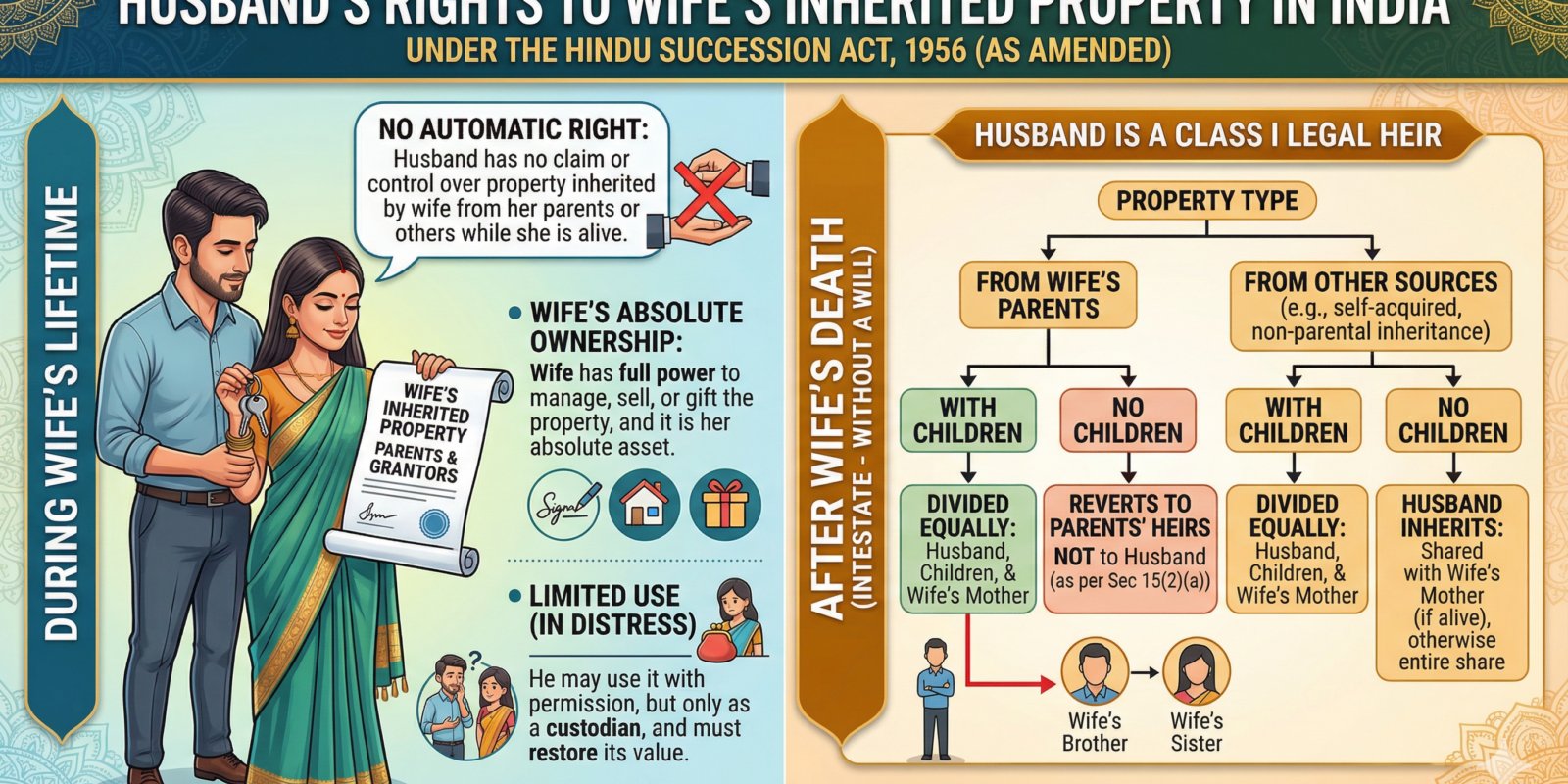
During a marriage, a husband has no legal title or administrative control over property his wife inherited from her parents. This is protected by laws like Section 14 of the Hindu Succession Act 1956. This section declares that female Hindus hold property as full owners.
This protection extends to Stridhan. Stridhan includes gifts, jewelry, and money given to the wife by her relatives before or during the marriage. The husband cannot claim ownership of Stridhan. The Supreme Court of India reaffirmed this in the 2024 case Maya Gopinathan v. Anoop S.B. The court ordered a husband to pay a heavy compensation for misappropriating his wifes jewelry. A husband can only use Stridhan during severe financial emergencies and must repay the exact value later.
Interactive Rule Finder
Select the applicable religion or law to view the specific succession rules when a wife dies without a will.
The Hindu Source Rule
The most litigated aspect of these rules is Section 15 of the Hindu Succession Act. If a Hindu woman dies without a will, the law looks at where she got the property.
Under Section 15(2)(a), if she inherited property from her father or mother and dies without children, the property returns directly to her fathers heirs. The husband is completely bypassed. His legal claim is extinguished. The Andhra Pradesh High Court affirmed this exact scenario in March 2026. The court ruled the husband derived no title over property the childless wife inherited from her parents.
Conversely, if she inherited property from her husband or father-in-law and dies childless, Section 15(2)(b) dictates the property goes to the husbands heirs. The law forces the property to stay within the original family line.
Hindu Succession Source Rules
Visualizing inheritance paths when a Hindu wife dies intestate. Notice how the presence of children overrides the source origin.
When Children Are Present: The Legal Shift
If a married woman dies without a will and leaves behind children, the inheritance laws change significantly across all religious codes. The presence of direct descendants prioritizes the immediate nuclear family over the extended lineage.
Hindu Succession Act
The origin of the wife’s inherited property no longer matters. Section 15(2) of the Hindu Succession Act, which normally sends property back to the father’s or husband’s heirs when a woman is childless, is completely deactivated.
Instead, Section 15(1)(a) takes over. The inherited property is divided equally among the husband and the children. If a child has already passed away but left their own children behind, those grandchildren step into their parent’s shoes to claim that share.
Example: If a wife leaves behind a husband, one son, and one daughter, the property is split into three equal parts. The husband receives a one-third absolute share.
Islamic Law (Shariat)
The presence of lineal descendants triggers a strict reduction in the husband’s fixed inheritance fraction. Instead of receiving a one-half share, the husband’s portion is reduced to exactly one-fourth of the total estate. The remaining three-fourths is distributed among the children according to Islamic inheritance fractions.
Christian Law (Indian Succession Act)
The husband receives a mandatory one-third share of the deceased wife’s property. The children inherit the remaining two-thirds. This two-thirds portion is divided equally among all surviving children.
Parsi Law
The inheritance rules treat the surviving spouse and children uniformly. The widower and each child receive an equal share of the property. If there is a husband and two children, each receives one-third of the estate.
Goa Civil Code
The community property rules remain intact regarding the husband’s baseline ownership. The husband retains his fifty percent co-ownership of the communal marital assets. The deceased wife’s fifty percent share is then inherited equally by her children.
Coparcenary Rights and Ancestral Property
The 2005 amendment to the Hindu Succession Act made daughters equal coparceners in Hindu Undivided Family property. A married woman retains this status independently. Her husband acquires no interest in her coparcenary share.
He cannot demand a partition of her family estate. If she receives a physical share of real estate after her family partitions the property, it becomes her absolute individual property. The husband has no say in how she manages this specific real estate during her lifetime.
Commingling Assets and Joint Purchases
Wives sometimes deposit inherited funds into joint bank accounts with their husbands. This creates severe legal complications. Indian courts do not automatically assume a gift to the husband. The Benami Transactions Act governs these financial disputes.
If a wife buys real estate using her inherited money but registers the deed jointly with her husband, she must maintain clear bank records. These records must show the source of funds. Clear documentation prevents the husband from falsely claiming a fifty percent share during a dispute or divorce settlement.
Tax Rules for Spousal Income
Inheriting property does not trigger an inheritance tax in India. The government abolished estate duty years ago. However, if a wife earns rental income from her inherited property, she must pay income tax on that specific amount.
If she transfers the property to her husband without adequate financial compensation, the income clubbing provisions of the Income Tax Act apply. The tax department will add the rental income back to the wifes total taxable income. She will be forced to pay taxes on revenue collected by her husband.
Bank Nominations Versus Legal Heirs
A common dispute arises when a wife names her husband as a nominee in her bank accounts containing inherited funds. The Supreme Court established that a nominee is merely a trustee. Naming the husband as a nominee does not make him the absolute owner of the money after her death.
He simply holds the funds until the legal heirs claim them based on the applicable succession laws. If the funds originated from the wifes parents and she died without children, her fathers heirs possess a superior legal claim over the husband despite his status as the bank nominee.
Protection from Husbands Creditors
A husbands financial liabilities do not transfer to his wife under Indian civil law. Banks and private creditors cannot attach or auction a wifes inherited property to recover loans defaulted by the husband. The wifes distinct legal identity shields her assets.
A husband acting as a guarantor for a business loan cannot pledge his wifes inherited land as collateral. The bank requires her explicit, written, and registered consent to create any valid mortgage on her property.
Comparison Table: Husband’s Share
This table outlines the exact fraction a husband inherits from his wifes estate if she dies without a will.
| Legal System | Condition | Husband’s Share |
|---|---|---|
| Hindu Law | Property inherited from wife’s parents. Wife has no children. | Zero (Reverts to Father’s Heirs) |
| Hindu Law | Wife has children (regardless of property origin). | Equal share with children |
| Sunni Muslim Law | Wife has children. | 1/4 Share |
| Sunni Muslim Law | Wife has no children. | 1/2 Share |
| Christian Law | Wife has children. | 1/3 Share |
| Parsi Law | Wife has children. | Equal share with children |
| Goa Civil Code | Upon marriage (Community Property). | 50% Co-ownership |
Landmark Judgments
The following Supreme Court and High Court rulings define modern property jurisprudence regarding spousal rights.
| Case Name | Year | Core Ruling |
|---|---|---|
| Maya Gopinathan v. Anoop S.B. | 2024 | A husband holding his wifes Stridhan acts as a trustee. He must repay misappropriated assets with financial compensation. |
| Kamal Anant Khopkar v. Union of India | 2026 | Ongoing constitutional challenge regarding gender bias in Section 15 of the Hindu Succession Act. |
| Vineeta Sharma v. Rakesh Sharma | 2020 | Daughters possess equal coparcenary rights by birth regardless of whether the father was alive during the 2005 amendment. |
Non Resident Indian Property Jurisdiction
Wives holding NRI status face specific regulations under the Foreign Exchange Management Act. An NRI wife can inherit immovable property in India. Her foreign citizenship does not strip away her property rights under Indian succession laws.
If a foreign court issues a divorce decree granting the husband a share of her Indian real estate, Indian civil courts may refuse to enforce it. Indian courts hold exclusive jurisdiction over immovable property located within Indian borders.
Divorce and Maintenance
During a divorce, an Indian husband possesses no automatic legal right to claim a share of his wifes exclusively owned inherited property. The title remains inviolate.
However, Section 24 of the Hindu Marriage Act 1955 is gender-neutral. If a husband is financially destitute or unable to maintain himself, he may petition the court for maintenance. The court can compel a wealthy wife to utilize her inherited wealth to support him during the proceedings or as permanent alimony.
Mutual Consent Settlements
Couples often negotiate the division of assets during a mutual consent divorce. A wife might voluntarily transfer a portion of her inherited property to the husband to finalize the separation quickly.
The courts permit this voluntary transfer. The wife must execute a registered gift deed or a relinquishment deed to make the transfer legally valid. A mere verbal agreement recorded by a family court judge is insufficient to transfer property titles.
Rights During Legal Separation
A formal decree of judicial separation does not sever the marital bond. If a wife inherits property while separated, the standard succession rules still apply.
A husband retains his inheritance rights unless a final divorce decree is issued before her death. Separation agreements cannot override statutory inheritance laws unless accompanied by a registered relinquishment deed.
Property Mutation Process
Upon a wifes death without a will, the legal heirs must update the municipal records. This process is called mutation. The husband cannot unilaterally transfer the property into his name.
He must obtain a legal heir certificate or a succession certificate from a civil court. He must submit no-objection certificates from the children or other legal heirs to the local registrar to successfully update the land title.
Effect of the Husbands Remarriage
Once a husband legally inherits a share of his deceased wifes property, the title vests in him completely. If he decides to remarry later, he does not forfeit this inherited share.
The property remains his absolute asset. He can pass this property on to his new wife or children from the second marriage through his own will.
Tribal and Customary Law Exemptions
The Hindu Succession Act does not automatically apply to recognized Scheduled Tribes under Article 366 of the Constitution. Tribal communities follow uncodified customary laws.
These local customs often severely restrict a husbands right to inherit property from his wife. Tribal councils prioritize keeping land within the original bloodline or clan, ensuring outsiders cannot acquire tribal land through marriage.
Grounds for a Husband to Challenge a Will
A wife can execute a registered will leaving her property to anyone she chooses. If she excludes her husband entirely, his only recourse is to file a civil suit seeking to invalidate the document.
He must prove specific legal defects in court. He might attempt to claim she lacked mental capacity at the exact moment of signing. Alternatively, he could allege another beneficiary used fraud or undue pressure to force her signature. Indian courts require strong evidence like medical records or witness testimonies to discard a properly registered will. Mere disappointment with the inheritance amount is not a valid legal ground to sue.
Frequently Asked Questions
Can a husband sell his wifes inherited property?
What happens if a couple marries under the Special Marriage Act?
Can a husband claim the wifes Stridhan?
Are these laws currently being challenged?
Legal Template Formats
Women can execute a formal Will to bypass the defaults of intestate succession. Below is a sample formatting block for a legal clause protecting individual property.
Disclaimer
The information provided on Evaakil.com is for general informational purposes only and does not constitute legal advice. Laws change frequently. Always consult a qualified advocate registered with the Bar Council of India for advice regarding your specific legal situation.