 By
By Handing over the keys to a buyer from another state does not end your ownership; it begins your highest period of risk. Until the VAHAN database reflects the new owner’s name, every accident, challan, or criminal act committed with that vehicle remains your legal burden.
This guide strips away the bureaucracy of inter-state sales, providing the exact legal frameworks—from Form 29 hacks to “As Is” agreements—required to firewall your liability the moment the car leaves your driveway.
Selling a Car Across States? Don’t Get Caught in the Liability Gap.
The gap between handing over your keys and the official name transfer is where lawsuits happen. Here is the legal armor you need for inter-state vehicle sales.
Selling a car to someone in a different state is not just a transaction. It is a complex legal migration. Unlike selling a phone or a watch, a car carries a government-registered identity. Until that identity changes in the VAHAN database, you remain the “owner” in the eyes of the law.
The Motor Vehicles Act of 1988 creates a dangerous distinction. You have the “Beneficial Owner” (the person driving the car) and the “Registered Owner” (the person on the RC). The Supreme Court ruling in Naveen Kumar v. Vijay Kumar (2018) made it clear: if the RC still has your name, you pay for the accident.
Visualizing the Risk Zone
This chart illustrates the “Danger Zone” where your liability remains active despite handing over the car. (Canvas renders on load)
⚡ Pre-Sale Technical Blocks
1. The HSRP Lockout
Most states (like Delhi, UP, Karnataka) now block NOC generation if your car does not have High-Security Registration Plates. The VAHAN portal checks the HSRP database automatically.
Action: Book HSRP online at least 15 days before listing the car.
2. The Challan Firewall
A single unpaid traffic fine of ₹100 freezes the entire transfer process. The system will reject your Form 28 application instantly.
Action: Check Parivahan site. Pay fines. Wait 48 hours for the database to update.
The Digital Trail: FASTag Liability
Most sellers forget the sticker on the windshield. If you hand over the car with your FASTag attached:
- Financial Drain: The buyer drains your wallet at every toll.
- Location Tracking: Toll data is surveillance data. If the car is used in a crime 500km away, your FASTag places your financial identity at the crime scene.
Action: Peel it off. Destroy it. Deactivate the wallet.
Prerequisite: The “Hypothecation” Hurdle
You cannot get an NOC (Form 28) if your car is “Hypothecated” to a bank on the RC. Even if you paid off the loan 2 years ago, the RTO doesn’t know until you tell them.
Step 1: Bank NOC
Get the “No Dues Certificate” and two copies of Form 35 signed by the bank.
Step 2: HP Termination
Submit Form 35 to your RTO to remove the “Hypothecation” stamp from your RC. Only then is the car truly yours to sell.
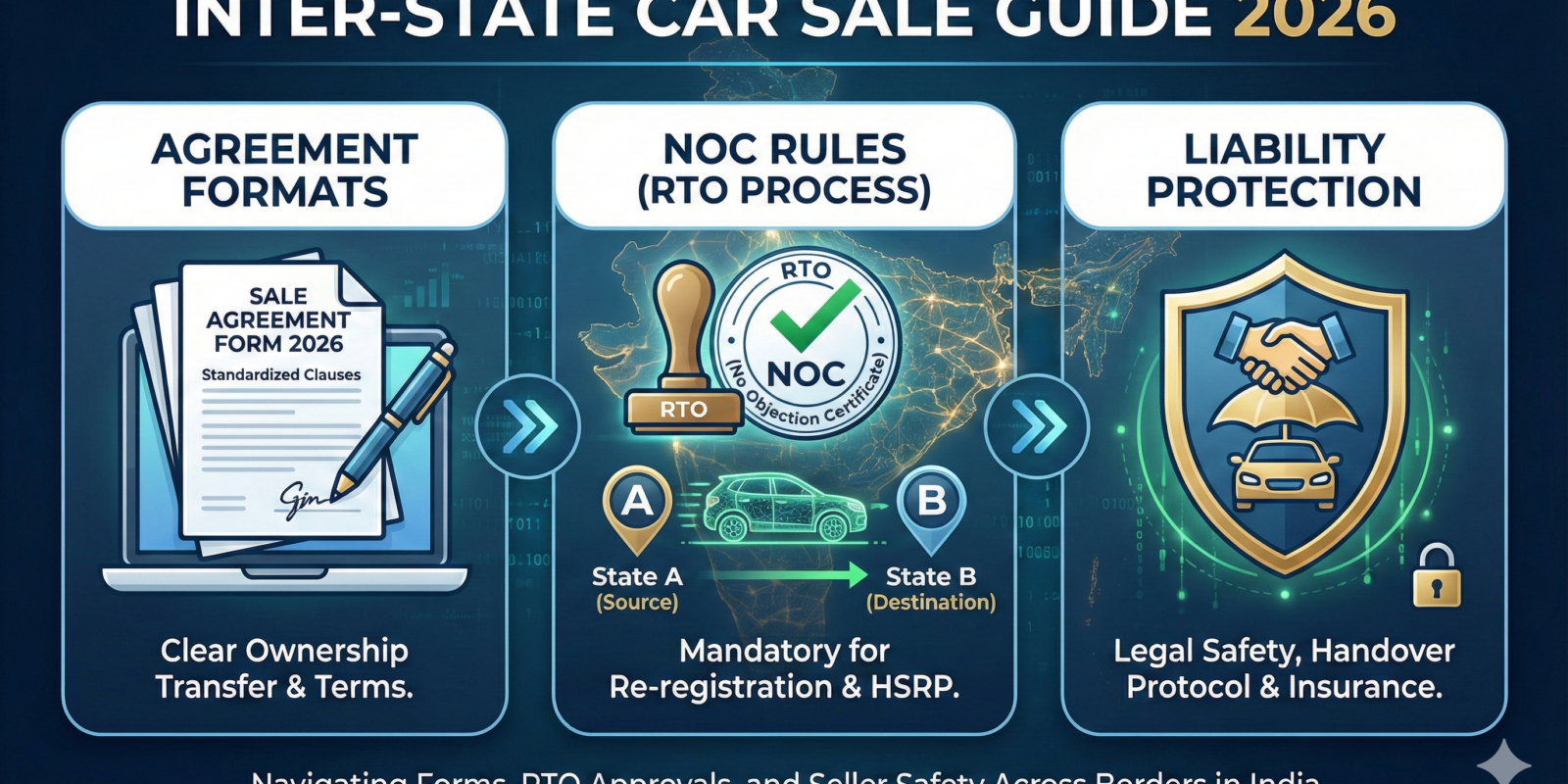
The Three Pillars of Defense
To protect yourself, you need three specific documents. A simple receipt is insufficient. You need a strategic legal architecture.
Sale Agreement
Defines the “As Is” condition and sets a strict deadline for re-registration. This is your strategic contract.
Delivery Note
Captures the exact minute of handover. This is your shield against criminal acts committed with the car.
Indemnity Bond
A financial promise. If you are forced to pay a third party, this bond allows you to recover that money from the buyer.
Decode: Form 29 vs. Form 30
Sellers often sign only one, leading to rejection. You need both.
Form 29
Notice of TransferThis is the Seller saying: “I have sold the car.” It requires two copies.
Form 30
Report of TransferThis is a joint report where the Buyer says: “I accept the transfer.” It requires one copy.
The “Section 50” Shield
RTOs are bureaucratic black holes. Often, files get lost, or the buyer simply delays the transfer to save on registration fees. You cannot force the buyer to go to the RTO, but you can force the RTO to acknowledge the sale.
The Registered Post Hack
Section 50 of the Motor Vehicles Act mandates that the seller must report the sale within 14 days. You fulfill this duty by sending a copy of the Form 29 (Notice of Transfer) and the Delivery Note to your local RTO via Registered Post with Acknowledgement Due (RPAD).
Why it works: The postal receipt and the signed acknowledgement card become legal proof in court that you discharged your duty. Even if the VAHAN database still shows your name, this receipt can exonerate you in accident liability cases.
Strategy: The “Retention Money”
Never take 100% payment upfront if you are unsure of the buyer’s intent. Hold back ₹10,000 to ₹20,000 as a retention amount. Tell the buyer: “I will transfer this amount to you once you send me the photo of the new RC.” This financial incentive ensures they don’t get lazy with the paperwork.
The Inter-State Workflow
| Stage | Action Required | Risk Level |
|---|---|---|
| 1. Negotiation | Verify Buyer KYC. Agree on Price. Check HSRP/Challans. | Low |
| 2. Documentation | Sign Agreement, Delivery Note, Indemnity Bond. Sign Forms 29/30. | Medium |
| 3. NOC Application | Seller applies for Form 28 at home RTO. Clears e-challans. | Medium |
| 4. Transit | Buyer moves car to new state. Transit insurance is mandatory. | High |
| 5. Re-registration | Buyer pays new road tax. Submits NOC to new RTO. | Low |
The Scam Defense Grid
Inter-state sales attract fraudsters because the physical distance makes verification hard. Watch for these red flags.
The “Army Officer”
Scammer claims to be posted in a remote location. Sends photos of fake ID cards. Asks you to pay “shipping charges” to move the car.
The QR Code
Buyer says “Scan this code to receive token money.” QR codes are only for paying, never for receiving. You will lose money.
The Friday Cheque
Buyer deposits a cheque on Friday evening. You get an SMS. You hand over the car. Cheque bounces on Monday.
Special Case: The Delhi-NCR 10-Year Rule
Diesel cars over 10 years and Petrol cars over 15 years are “End of Life” in Delhi-NCR. They cannot be driven, only towed. You must obtain a specialized “NOC for Prohibited Vehicles” to sell them to designated districts in states like Rajasthan or Punjab. Selling them within NCR is illegal and carries a ₹10,000+ fine and seizure.
The NCB Goldmine: Don’t Sell Your Bonus
Your “No Claim Bonus” (NCB) belongs to YOU, not the car. If you have a 50% NCB, it can save you ₹15,000+ on your next car’s premium.
How to keep it: Submit the sale documents (Form 29/30) to your insurer and ask for an “NCB Reservation Letter.” This letter is valid for 3 years. The buyer only gets the Third Party cover; they must buy their own Own Damage cover.
Unlocking the Road Tax Refund
When you bought your car, you likely paid a “Lifetime Road Tax” (15 years) to your state. If you sell the car to another state after only 5 years, the original state owes you a refund for the remaining 10 years. This is a Pro-Rata Refund.
The Prerequisite
You can only claim this refund after the buyer has successfully registered the car in the new state and paid road tax there. You cannot claim it immediately upon sale.
The Documents
1. Copy of Old RC (Surrendered).
2. Copy of New RC (State B).
3. Proof of new tax payment.
4. Bank details for transfer.
Interactive Seller’s Checklist
Legal Templates
Copy these drafts. Fill in the bracketed information. Print on stamp paper where necessary.
Legal Tip: Jurisdiction Clause
The Agreement template below now includes a “Jurisdiction Clause” to ensure any legal battles happen in your city, not the buyer’s.
Frequently Asked Questions
No. For inter-state transfers, the destination RTO will strictly refuse registration without an NOC (Form 28) from the original RTO. Without it, the car cannot be legally transferred.
Conventionally, the Seller pays for the NOC (clearing their own dues), and the Buyer pays the Road Tax and re-registration fees in the new state. This should be clarified in the agreement.
This is the worst-case scenario. You must send Form 29 (Notice of Transfer) via Registered Post to your RTO immediately after the sale. If the buyer defaults, you can use the postal receipt and your Delivery Note to prove you sold the vehicle, though it may require a legal battle.
Only for Third Party liability, and only for 14 days deemed transfer. The buyer must apply to the insurance company with a transfer fee within 14 days. Comprehensive cover does not transfer automatically.