 By
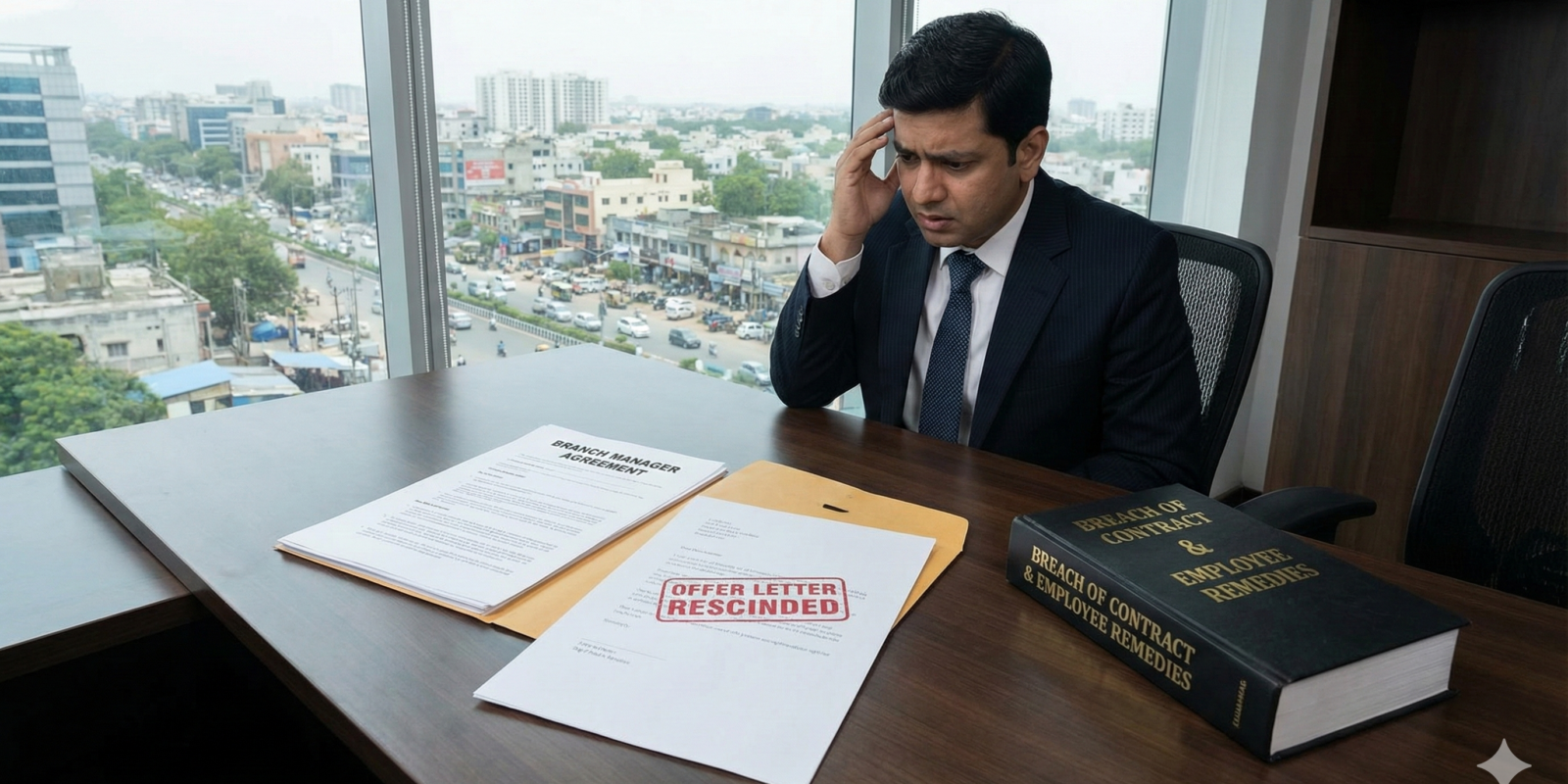
By The email arrives just days before your joining date: “We regret to inform you…” For professionals who have already resigned from previous roles, an offer letter rescission creates an immediate financial and professional crisis.
Under Indian law, specifically the Contract Act of 1872, a signed offer is not merely a proposal—it is a binding agreement. While employers frequently cite “at-will” employment or “market conditions” to justify withdrawal, the judiciary recognizes the doctrine of Promissory Estoppel when a candidate suffers detrimental reliance.
This analysis defines the legal boundary between a valid withdrawal and a sueable breach, outlining the specific damages you can claim for lost opportunity and unpaid notice periods.
Is Offer Letter Rescission Unlawful in India? Your Rights Explained.
When companies withdraw job offers after acceptance. We break down the legal reality of contracts. promissory estoppel. and how to claim damages.
Evaakil Legal Team
15 min read
Revoking an offer letter constitutes a breach of contract in India once the candidate accepts the offer. While the economy fluctuates. particularly in the IT and startup sectors. the practice of “offer revocation” leaves candidates in precarious positions. This guide analyzes your rights under the Indian Contract Act. 1872. and the Specific Relief Act. 1963.
The Core Principle
An accepted offer letter is a binding contract. Revocation after acceptance is not a “withdrawal”. it is a breach. You cannot typically force the company to hire you. but you can sue for monetary damages based on the salary you lost.
When Does an Offer Become a Contract?
Recruitment starts with an advertisement. which law classifiers as an “Invitation to Treat”. Your application is the “offer”. The company’s subsequent Offer Letter acts as a formal proposal under Section 2(a) of the Indian Contract Act.
A contract crystallizes at the moment of Acceptance. When you sign and return the offer. or email your acceptance. the proposal becomes a promise. Section 5 of the Act permits revocation only before your acceptance reaches the employer. Once you hit send. they are bound.
The “Conditions Precedent” Trap
Employers often include conditions. Common valid reasons for legal revocation include:
- Background Verification (BGV) Failure: Discrepancies in education or criminal history.
- Medical Unfitness: Relevant for specific industries.
- Fraud: Misrepresentation in your CV.
However. “business requirements” or “economic downturns” are rarely valid legal grounds to void a signed contract.
Promissory Estoppel: Your Main Shield
If you resigned from your previous job relying on the new offer. you triggered the doctrine of Promissory Estoppel. This legal principle prevents an employer from going back on their word when you have suffered a “detrimental reliance” (loss of current job) based on their promise.
Private Sector
Courts rarely order reinstatement. The remedy is damages. You can claim compensation for the period of unemployment caused by your resignation.
Public Sector (PSU)
High Courts can issue Writs. In Matthew Johnson Dara v. HURL (2024). the court ordered the PSU to hire the candidate because State actions must be fair and non-arbitrary.
The Jurisdiction Maze: Where to File?
Choosing the wrong court leads to immediate dismissal of your case. The distinction between a “Workman” and a “Non-Workman” is critical.
| Role Type | Legal Definition | Correct Forum | Estimated Timeline |
|---|---|---|---|
| Junior Tech/Clerical | “Workman” (Sec 2(s) ID Act) | Labour Court | 1-3 Years |
| Manager/Supervisor | Managerial/Administrative duties | Civil Court | 3-5 Years |
| State/PSU Employee | “State” under Article 12 | High Court (Writ) | 6 Months – 2 Years |
The “Summary Suit” Advantage (Order 37 CPC)
If you are a non-workman filing in Civil Court. you should not file a standard suit. Instead. file a Summary Suit under Order 37 of the CPC. This provision is for recovering “liquidated damages” (fixed amounts like notice pay). The employer cannot defend themselves automatically; they must apply for “Leave to Defend”. forcing a faster resolution.
Foreign Entities & Remote Offers
With the rise of global remote teams, many Indians receive offers from US or UK entities without an Indian registered office. If they revoke:
Jurisdiction: Section 20(c) CPC
Even if the offer letter says “Governed by Laws of California,” you can often sue in India under Section 20(c) of the Code of Civil Procedure. This section allows filing a suit where the “Cause of Action, wholly or in part, arises.” Since you received the offer email and acceptance email in India, part of the cause of action lies here. However, enforcing a judgment against a foreign entity without Indian assets is complex.
Digital Evidence & Admissibility
Most offer letters exist only as PDFs in emails. Under the Indian Evidence Act (and the Bharatiya Sakshya Adhiniyam 2023). electronic records are secondary evidence.
Crucial Requirement: Section 65B Certificate
Merely printing the email is insufficient. You must attach a certificate under Section 65B of the Evidence Act (or Section 63 of BSA). This is a self-signed affidavit stating that the computer used to print the email was working correctly and the data has not been tampered with. Without this. your offer letter is inadmissible in court.
The “Unstamped Contract” Trap
A frequently overlooked procedural hurdle in India is Stamp Duty. Under the Maharashtra Stamp Act and similar state laws, an employment contract (even in email form) creates rights and liabilities.
If you take an offer letter to court to claim damages, the opposing lawyer will immediately object that the document is “Unstamped”. Under Section 35 of the Indian Stamp Act, an unstamped document is inadmissible in evidence until the duty and a heavy penalty (often 10x the duty) are paid.
Strategy: Before filing suit, ensure you adjudicate the stamp duty on your offer letter printout at the local collector’s office to prevent delays during trial.
Damages: What Can You Claim?
Since specific performance (forcing them to hire you) is barred for personal service contracts under the Specific Relief Act (Section 14). your remedy is financial. Damages are calculated based on Section 73 of the Contract Act.
| Damage Type | Legal Basis | Typical Amount |
|---|---|---|
| Notice Period Pay | Contractual Notice Clause | 1 to 3 Months’ Salary |
| Loss of Opportunity | Section 73 ICA | Salary difference if lower paying job found |
| Relocation Costs | Actual Consequential Loss | Reimbursement of visa/moving fees |
| Mental Harassment | Tort / Defamation | Discretionary (₹50k – ₹5 Lakhs) |
Damages Estimator
Calculate potential claim value based on standard Indian legal precedents.
Estimated Claim Value
₹0
Breakdown: Notice Pay (Contractual) + Actual Damages (Unemployment gap) + Consequential Losses.
Interactive: The Revocation Analysis
Visualizing the legal flow of offer rescission and typical outcomes.
Sector Specific Nuances
IT Sector & NASSCOM: The National Skills Registry tracks employee data. If a company revokes an offer and falsely marks you as having failed BGV. you can sue for defamation. This occurred in Abhijit Mishra vs. Wipro.
“Workman” Definition: Most IT professionals and managers are not considered “workmen” under the Industrial Disputes Act before joining. Therefore. Labour Courts usually lack jurisdiction. You must file in Civil Court.
Judicial Precedents
Key Supreme Court and High Court rulings that define the landscape of employment damages.
| Case Name | Core Issue | Verdict Summary |
|---|---|---|
| S.S. Shetty v. Bharat Nidhi Ltd (SC) | Quantum of Damages | Damages for wrongful termination are usually limited to the notice period salary. |
| Kailash Nath Associates v. DDA (SC) | Liquidated Damages (Sec 74) | Even if a contract specifies a penalty amount, you must prove actual loss to claim it. |
| Jyoti Bros. v. Shree Durga Mining Co. | Telegram/Email Revocation | Revocation is effective only when it comes to the knowledge of the person (Section 4). |
Immediate Response Scripts
The moment you receive a revocation email, your reply sets the legal foundation. Do not reply emotionally. Use this “Without Prejudice” holding format.
The “Holding” Reply
“Dear HR,
I am in receipt of your email dated [Date] purporting to revoke my offer of employment.
Please note that a valid employment contract exists between us, as I have already accepted your offer on [Date]. Relying on this contract, I resigned from my previous employment. Your sudden revocation constitutes a breach of contract and causes me severe professional and financial damage.
I am legally advised that this action is unlawful. I urge you to reconsider immediately. This email is without prejudice to my legal rights and remedies.
Regards,
[Name]”
Action Plan & Templates
Before filing a lawsuit. you must send a formal Legal Notice. This often prompts a settlement.
Step 1: Evidence Collection
Ensure you have PDF copies of your Offer Letter. Acceptance Email (with timestamp). Resignation acceptance from previous employer. and the Revocation Email.
Step 2: Draft Legal Notice (Template)
Frequently Asked Questions
Can I force the company to hire me? ▼
Generally, no. Private companies cannot be compelled to employ someone against their will under the Specific Relief Act. However, PSUs (State entities) may be ordered to reinstate you if the revocation was arbitrary.
How much compensation can I get? ▼
Courts typically award the salary equivalent to the notice period mentioned in the offer letter (e.g., 3 months). You may also recover relocation expenses and nominal damages for mental distress.
Does this apply if I haven’t resigned from my old job? ▼
If you haven’t resigned or suffered financial loss, your claim for damages is weak. You must prove “detrimental reliance” to claim substantial compensation.
What is the limitation period to file a case? ▼
Under the Limitation Act, 1963, you have three years from the date the breach occurred (the date of the revocation email) to file a suit for damages.