 By
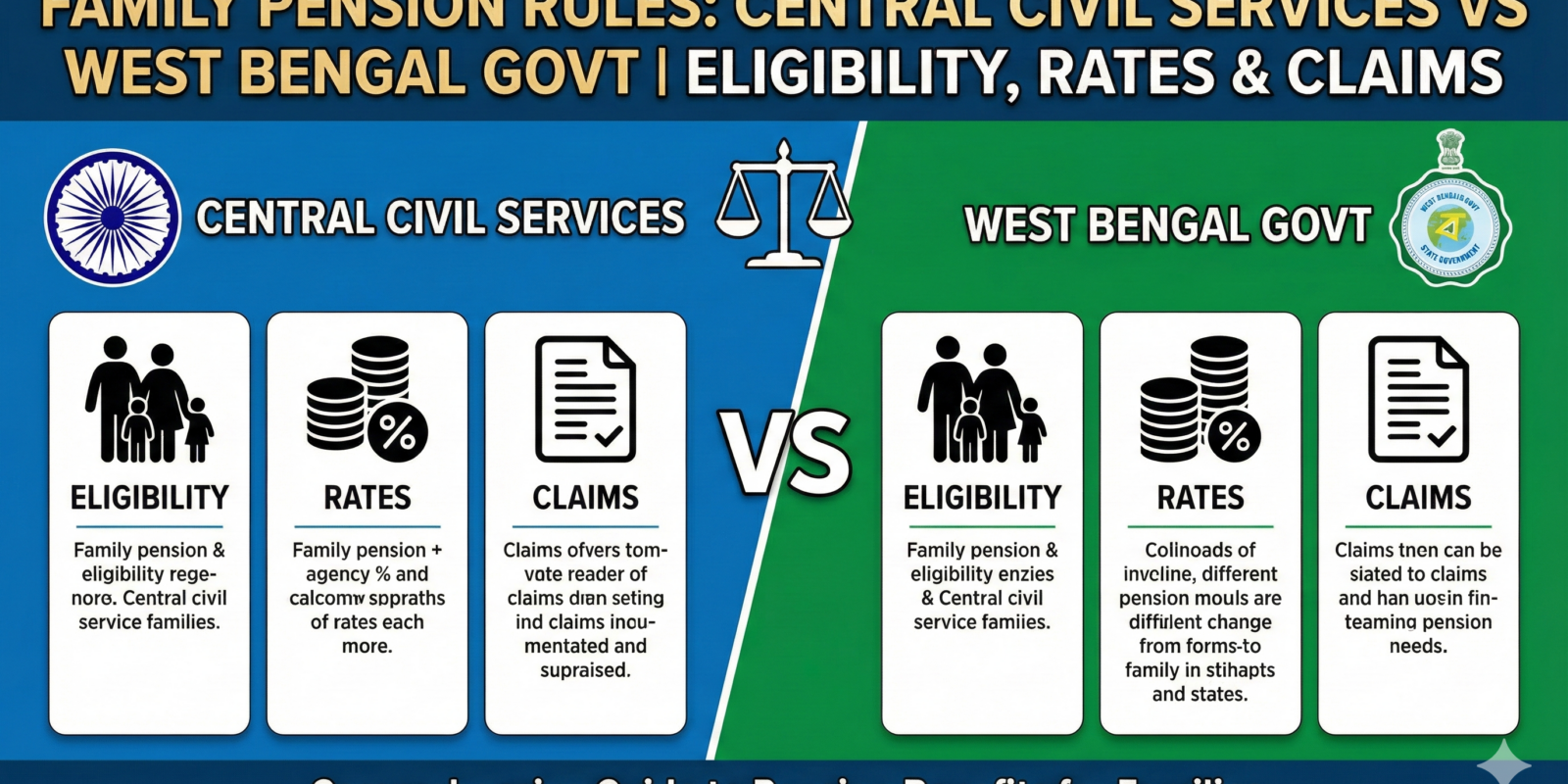
By Family pension acts as a statutory safety net, protecting dependents from financial instability when a government employee dies. While the intent remains consistent across jurisdictions, the execution differs sharply between the Union of India and the State Government of West Bengal.
Two families living next door to each other in Kolkata often face distinct financial futures depending on whether the breadwinner served the Centre or the State.
This report examines the specific regulatory disparities between the Central Civil Services (Pension) Rules, 2021, and the West Bengal Services (Death-cum-Retirement Benefit) Rules, 1971, as amended by ROPA 2019.
We break down the technical differences in income ceilings, the duration of enhanced pension rates, and the documentation required for unmarried daughters to establish eligibility.
Family Pension Frameworks: Central Civil Services and the State Government of West Bengal
Family pension acts as a statutory safety net. It protects dependents from financial ruin when a government employee dies. While the concept originates from a shared desire to maintain the dignity of the deceased’s family, the execution differs sharply between the Union of India (Central Government) and the State Government of West Bengal.
Two families living next door to each other in Kolkata might face entirely different financial futures depending on whether the breadwinner served the Centre or the State. This report examines these differences. We compare the Central Civil Services (Pension) Rules, 2021, against the West Bengal Services (Death-cum-Retirement Benefit) Rules, 1971, amended by ROPA 2019.
The Core Conflict
Central Rules: Dynamic income ceilings linked to inflation. Generous duration for enhanced pension.
State Rules: Fixed income ceilings (Welfare Cliff). Age-capped enhanced pension duration.
1. Regulatory Architecture
The rules governing your claim depend on the employer. Central employees fall under the CCS (Pension) Rules, 2021. These rules modernized the definition of family and removed patriarchal language regarding widowers.
West Bengal employees follow the WBS (DCRB) Rules, 1971. The state relies on “Memos” to update these rules. This creates a lag. For instance, benefits adopted by the Centre often take months or years to reflect in State notifications. The most recent major overhaul was the Revision of Pay and Allowances (ROPA) 2019.
The Income Ceiling Gap
Comparison of monthly income limits for dependents to remain eligible for family pension.
Data Source: 7th CPC (Centre) vs Memo No. 270-F (State)
2. Who Counts as “Family”?
Both systems use a hierarchy. If a higher priority member exists, lower priority members cannot claim.
Central Government
- Spouse: Primary beneficiary. Childless widows can remarry without losing pension if income is low.
- Unmarried Daughter: Eligible for life.
- Widowed/Divorced Daughter: Eligible for life (Category II).
- Siblings: Eligible if disabled and no other heir exists.
West Bengal Government
- Spouse: Primary. “Post-Retiral” spouses (married after retirement) are now eligible but require strict verification.
- Unmarried Daughter: Eligible for life (Memo 138-F).
- Siblings: Not eligible for pension (only gratuity).
- Parents: Eligible if income is below ₹9,000 fixed.
3. The Financial Trap: 67 Years vs 10 Years
A major divergence exists in the “Enhanced Rate” of pension. This rate (50% of last pay) helps families stabilize immediately after death. The “Normal Rate” is 30%.
Central Rule: The family receives the Enhanced Rate for 10 years, regardless of the deceased’s age.
State Rule: The Enhanced Rate lasts for 7 years OR until the deceased would have turned 67, whichever is earlier. If an employee dies at 66, the family gets the higher rate for only 1 year.
Impact of Age at Death on Enhanced Pension
Scenario: Employee dies at age 65. How long does the family get 50% pay?
Quick Estimator
Enter the Last Basic Pay of the deceased employee to calculate the base pension values (excluding Dearness Relief).
Enhanced Rate (50%): ₹0
Normal Rate (30%): ₹0
* Plus applicable Dearness Relief (DR). WB Min: ₹8,500. Central Min: ₹9,000.
4. The Unmarried Daughter’s Ordeal
West Bengal rules regarding unmarried daughters are procedurally intense. Unlike the Centre, where a simple self-declaration often suffices initially, the State mandates external validation.
The “Certification” Hurdle
If an unmarried daughter claims pension after the death of both parents, she must prove two things:
- Marital Status: A certificate from the BDO (Block Development Officer) or the SDO (Sub-Divisional Officer). Certificates from local Councilors or Panchayat Pradhans are frequently rejected by the AG (Accountant General) office without the counter-signature of an Executive Magistrate.
- Income Status: She must prove she does not earn more than ₹9,000/month. This often requires a formal Income Certificate from a Class I Gazetted Officer.
WARNING: If the daughter earns ₹9,001, she is disqualified entirely. There is no sliding scale.
5. The “25-Year” Ceiling for Sons
While unmarried daughters enjoy lifetime eligibility (subject to income), sons face a strict cutoff. Under both Central and State rules, a son is eligible for family pension only until he attains the age of 25 years or starts earning a livelihood, whichever is earlier.
The Disability Exception
If a son suffers from a mental or physical disability that renders him unable to earn a living, the age bar of 25 years is lifted. He becomes eligible for life. However, this requires a certificate from a competent Medical Board constituted by the Government.
6. Dearness Relief & Medical Coverage
The base pension is only half the story. The auxiliary benefits create a massive quality-of-life divide.
A. Dearness Relief (DR) Gap
Central Govt
50%+
of Basic Pension
West Bengal
14%*
of Basic Pension
B. Medical Security
Central (CGHS / FMA)
Pensioners residing in CGHS cities get cashless treatment at top private hospitals. Those outside these zones receive a Fixed Medical Allowance (FMA) of ₹1,000/month.
State (WBHS / Allowance)
The West Bengal Health Scheme (WBHS) offers cashless facilities up to ₹1 Lakh in empanelled hospitals. Opting out grants a meager Medical Relief of ₹500/month.
Critical Note on Commutation
Did the deceased pensioner commute a portion of their pension for a lump sum? It does not affect you. Family Pension is always calculated on the original Gross Basic Pay, not the reduced pension. The deduction for commutation dies with the pensioner.
7. The “Post-Retiral” Marriage Puzzle
Historically, spouses married after the employee’s retirement were ineligible for family pension. This rule has been struck down by various courts and subsequently amended.
Central Stance
The CCS Rules explicitly recognize post-retiral spouses. The only requirement is that the marriage must be legally valid and the details must be intimated to the Head of Office, even if the pensioner has already retired.
State Evolution
West Bengal previously denied these claims. However, following the Purnima Das judgment and subsequent memos (notably Memo No. 635-F(Pen)), post-retiral spouses are now eligible. Crucial: The marriage must be formally registered under the relevant Marriage Act to be accepted without hassle by the Accountant General (AG).
8. Myth Busting: Nomination vs. Rights
A common tragedy occurs when a pensioner nominates a brother or nephew, believing they will receive the family pension.
The Hard Truth
Family Pension overrides Nomination. It is a statutory right, not a property right. Even if the pensioner nominated his brother in the service book, if a valid widow exists, the pension must go to the widow. The nomination is only relevant for “Arrears of Pension” (Lifetime Arrears), not the monthly Family Pension itself.
9. The Lump Sum: Death Gratuity
Apart from the monthly pension, the family is entitled to Death Gratuity. This is a one-time tax-free payment.
| Parameter | Central Govt | West Bengal Govt |
|---|---|---|
| Max Limit | ₹20 Lakhs (Adjusts with DA) | ₹12 Lakhs (ROPA 2019) |
| Qualifying Service | < 1 Year: 2x Pay 1-5 Years: 6x Pay > 20 Years: 33x Pay (Max) |
Similar sliding scale, capped at 16.5 months of Pay. |
10. Taxation of Family Pension
Many claimants assume Family Pension is tax-free like Gratuity. This is incorrect. It is taxable under “Income from Other Sources”.
The Standard Deduction
Under Section 57(ii)(a), you are eligible for a standard deduction. Historically this was 33.33% or ₹15,000 (whichever is less). Update: Recent budgets have proposed raising this limit, but the principle remains: you do not pay tax on the entire amount.
TDS on Pension?
Banks generally do not deduct TDS on Family Pension. It is the responsibility of the recipient to calculate their total income and pay Advance Tax if their liability exceeds ₹10,000 per year.
11. The Roof Over Your Head
If the family resides in government quarters, the death of the allottee triggers a countdown.
- Central Rules: The family can retain the quarter for 2 years on payment of normal license fee. Further retention is usually not permitted and attracts heavy “Damages Rent”.
- West Bengal Rules: The standard retention period is often shorter (typically 6 months to 1 year depending on the specific Housing Board department). Families must apply for regularization immediately to avoid eviction notices.
12. Compassionate Appointment: The Reality
Often called “Died-in-Harness” schemes, these are not statutory rights but welfare measures. The objective is to save the family from immediate destitution.
Strictly capped at 5% of direct recruitment vacancies. Applicants are graded on a “Relative Merit Points” system (assets, family size, left-over service). Many deserving candidates wait years in the queue and are eventually rejected if the queue is too long.
Operates under Notification No. 251-EMP. A “Three-Member Committee” at the district level evaluates financial condition. While there is no strict 5% cap, the process is notoriously slow. Families must prove they are in “Indigent Circumstances” (income below a specific threshold).
13. Death on Duty: Extraordinary Pension (EOP)
If the death occurs strictly due to government duty (e.g., police action, accident while on tour), the rules change dramatically. This is called “Extraordinary Pension” or “Liberalized Family Pension”.
The Benefit Multiplier
Under EOP rules, the family receives 100% of the Last Pay Drawn until the date the deceased would have superannuated (retired). After that date, it reverts to the normal family pension rate (60% or 30%).
14. The “November” Protocol: Life Certificate
Every November, the pensioner/family pensioner must prove they are alive to continue receiving payments.
- Jeevan Pramaan (Digital): Central pensioners can use Face Auth or Biometrics from home. It is valid for 1 year from the date of submission (Video KYC is also popular now).
- WBIFMS (State Portal): West Bengal has integrated with Jeevan Pramaan but also maintains its own wbifms.gov.in portal. However, many State Treasuries still insist on physical appearance or a physical certificate signed by a Gazetted Officer for first-time family pensioners.
15. The Claim Timeline: What to Expect
The journey from application to the first credit in your bank account varies. Here is a realistic timeline for a West Bengal State case.
Submit Annexure II, Death Certificate, and photographs to the Head of Office (School/College/Office where deceased worked).
The Pension Sanctioning Authority (PSA) verifies service book and forwards the physical file to AG (Accountant General) Bengal.
The AG office audits the claim. If valid, they issue the PPO (Pension Payment Order). Bottleneck Alert!
The PPO reaches your Treasury. You must appear physically for “First Appearance”. The Bank then commences payment.
Am I Eligible?
Select the option that best describes the claimant (West Bengal Rules).
16. Procedural Requirements
Claiming the pension requires specific forms. The State system uses “Annexures” while the Centre uses standard “Forms”.
| Feature | Central Govt (CCS 2021) | West Bengal Govt (State) |
|---|---|---|
| Income Ceiling | ₹9,000 + Dearness Relief (Dynamic) | ₹9,000 Fixed (Memo 270-F) |
| Application Form | Form 14 (Head of Office) | Annexure II & III |
| Enhanced Pension Limit | 10 Years flat | 7 Years or till age 67 |
| Siblings | Eligible (if disabled) | Not Eligible |
| Divorced Daughter | Eligible (Strict dependency check) | Eligible (Requires Divorce Decree) |
| Life Certificate | Jeevan Pramaan (Digital First) | Physical/Digital (Nov 1 Deadline) |
17. When Things Go Wrong: Redressal
Pension files often get stuck due to minor discrepancies in names or missing signatures. Here is how to escalate the issue.
Central Mechanism
The Centre utilizes CPENGRAMS, a centralized portal monitored by the DoP&PW. Grievances filed here typically receive a response within 30 days.
Visit CPENGRAMS Portal →State Mechanism
West Bengal relies on the Directorate of Pension, Provident Fund and Group Insurance (DPPG). If administrative appeals fail, the next step is the West Bengal Administrative Tribunal (WBAT).
Physical Application RequiredInteractive Document Checklist
Ensure you have these before visiting the Bank or Treasury. Click to mark as done.
18. Templates for Application
Below are standard formats for the descriptive roll and application. Copy these to draft your application.
Frequently Asked Questions
Yes. If your spouse was an ex-serviceman and a state employee, you can draw both. However, the total amount is subject to a ceiling defined in ROPA 2019. The state will verify the military pension before releasing the full civil pension.
No. Under both Central and State rules, the turn of the daughter comes only after the spouse is deceased or ineligible. You cannot file an anticipatory claim. Her eligibility is judged based on her income at the time of your death.