 By
By The Ministry of Road Transport and Highways designed the BH Series to end the road tax refund nightmare. Yet, drivers in Karnataka, Telangana, and Kerala still face detention and fines.
The conflict is simple: the Centre controls the registration format, but States control the taxation rights. This guide examines the specific risks of driving a BH vehicle across state lines in 2026, calculates the real tax difference based on invoice value, and outlines the exact documentation required to prevent vehicle seizure under Section 47.
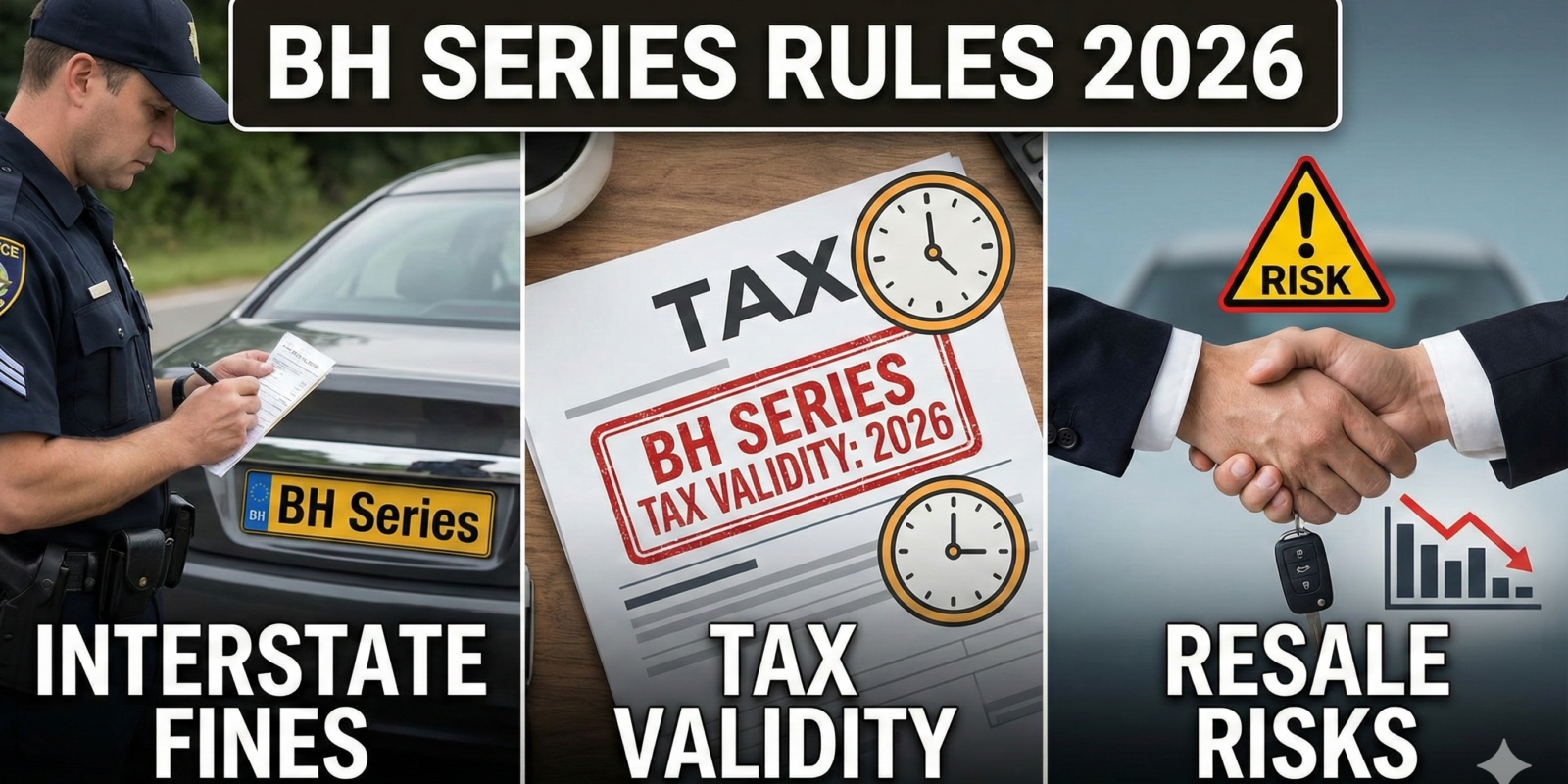
BH Number Plate Fines.
Are You Liable in Other States?
The Central Government promised seamless movement. State Governments demand revenue. We analyze the conflict between Central Rules and State Enforcement.
Check Your State RiskThe Legal Standoff
The Core Conflict
The Ministry of Road Transport and Highways (MoRTH) introduced the BH (Bharat) Series to stop re-registration hassles. The law states you do not need to re-register when moving states.
However. RTO officials in several states continue to fine drivers. They do not fine you for the plate itself. They fine you for tax differences. Recent court rulings in 2025 have complicated this further.
Why You Get Fined
- 01. Jurisdictional Resistance: States like Karnataka deny eligibility to private employees despite central rules.
- 02. Fiscal Disputes: Kerala High Court (2025) ruled states can demand the tax difference between Central and State rates.
- 03. Procedural Traps: Missed biennial payments or portal glitches lead to immediate vehicle seizure under Section 207.
The Law: Section 47 vs. GSR 594(E)
The root cause of RTO harassment lies in a conflict between two legal frameworks. Drivers must understand this distinction to argue their case effectively.
Motor Vehicles Act, Section 47
Mandates that any vehicle kept in a state for more than 12 months must be re-registered in that state. State RTOs use this section to fine BH users who stay long-term.
G.S.R. 594(E) (BH Notification)
This central notification explicitly exempts BH series vehicles from the Section 47 re-registration requirement. It overrides state rules by allowing tax payment online.
Analysis: While the Central notification overrides the Act in theory. State officials argue that Road Tax is a State Subject under the Constitution (List II, Seventh Schedule). This constitutional ambiguity is why fines persist.
The “Refund Myth”
Why BH was created: The Broken Refund System
Before BH, moving from Maharashtra to Karnataka meant paying Road Tax again in Karnataka and claiming a refund from Maharashtra.
The Theory
You pay new tax, submit proof to old RTO, and receive a pro-rata refund of the remaining years.
The Reality
Refunds take 2-5 years. They require physical visits, bribes, or “agents.” Most citizens simply abandoned their refund, paying double tax. BH solves this by removing the upfront 15-year payment.
Impact Calculator
Estimate Your Savings
Compare the “Pay-as-you-go” BH model vs the “Pay-Upfront” State model.
*State estimate assumes ~14% tax on Ex-Showroom price (Base + 28% GST).
The “Hidden” Tax Saving
Why BH is cheaper than you think
Most car buyers do not realize that BH Tax and State Road Tax are calculated on different base amounts.
Standard State Tax
Calculated on Ex-Showroom Price.
Includes GST (28%) + Cess (up to 22%). You are paying “Tax on Tax”.
BH Series Tax
Calculated on Invoice Price (Excluding GST).
The notification G.S.R. 594(E) explicitly excludes GST and Cess from the calculation base.
Visualizing the Tax Gap
States lose significant revenue with BH plates. This chart shows why local RTOs resist.
Comparison based on a vehicle with invoice value of 15 Lakhs over 15 years.
Anatomy of a BH Plate
- 24: Year of Registration (YY)
- BH: Bharat Series Code
- 5521: Random Computerized Number (0001 to 9999)
- AA: Alpha Series (AA to ZZ)
Interstate Risk Assessment Tool
Why Form 60 Gets Rejected
Even if you are eligible, RTOs often reject the application due to clerical errors in Form 60. Ensure your HR team avoids these specific mistakes:
The form requires addresses of offices in 4 states. You must include the GSTIN (Tax ID) for each of those 4 addresses to prove they are active legal entities.
The signatory must be authorized. RTOs reject forms signed by “Senior Manager.” It should ideally be “Head of HR” or “Authorized Signatory” with an official company stamp.
You must attach the Official Company ID Card of the employee along with Form 60. The ID card must match the current employer.
How to Pay Biennial Tax
The biggest panic point for BH owners is when the 2-year deadline approaches. Here is the workflow.
Go to Parivahan Sewa website. Select “Online Services” > “Vehicle Related Services”.
Select the state where the vehicle was originally registered, not where you currently live.
Click “Pay Your Tax”. Enter Reg No & Chassis No. Select “Biennial” tax mode.
If it says “Alert Not Available”, your previous RTO has not updated your records. You must visit the RTO physically.
The Eligibility Trap
What happens if you quit your job?
Eligibility for BH is not a lifetime status. It is checked periodically. You must prove eligibility every time you pay the biennial tax (every 2 years).
Scenario A: Same Employer
No issue. System auto-verifies or asks for a simple re-upload of Form 60.
Scenario B: New Employer (Non-Eligible)
If you move to a company with offices in fewer than 4 states, you lose BH eligibility.
Financial Reality
| Parameter | BH Series (Central) | State Registration (e.g. Karnataka) |
|---|---|---|
| Payment Model | Pay Every 2 Years | One-time Lifetime Payment |
| Initial Cost (15L Car) | ~ ₹30,000 | ~ ₹2,83,000 |
| State Revenue Impact | Deferral of revenue | Immediate cash flow loss |
| Refund on Transfer | Not needed | Difficult & Delayed process |
Tax Calculation Slabs
The BH tax is calculated on the Invoice Price (excluding GST/Cess). It is simpler than state calculations but varies by fuel type.
8%
Below ₹10 Lakhs
For Petrol/CNG vehicles. Diesel adds 2%. Electric subtracts 2%.
10%
₹10 – ₹20 Lakhs
Most mid-range SUVs fall here. Biennial tax is roughly ₹16,000 – ₹30,000.
12%
Above ₹20 Lakhs
Luxury segment. Significant savings compared to states charging 18-20% upfront.
The Resale Nightmare
Selling a BH car is complex. The buyer profile determines the cost.
Scenario 1: Buyer is BH Eligible
The process is smooth. The ownership transfers within the BH database. The buyer continues paying the biennial tax from the next cycle.
Scenario 2: Buyer is NOT Eligible
This is difficult. The car must be converted to a regular state registration.
- The buyer must pay the pro-rata state road tax (often a large sum).
- A new registration number is assigned (e.g., KA-01…).
- The BH number is surrendered.
Impact: This significantly lowers resale value as buyers refuse to pay the heavy state tax upfront.
Timeline of Judgments
Introduction of BH Series
MoRTH issues notification G.S.R. 594(E), effective from Sept 15, 2021.
Karnataka High Court Ruling
Court directs the state to register vehicles of private employees, rejecting the state’s attempt to restrict BH to central government staff only.
MoRTH Advisory
Central government issues strong advisory to states to comply with BH rules and stop demanding extra proofs.
Kerala High Court (Fiscal Autonomy)
In a blow to BH owners, the HC observes that states may have the right to levy the difference in tax, as taxation remains a state subject.
The Defense Kit
Form 60
The Working Certificate. Your employer certifies your transferability. This is your primary shield against “eligibility” fines.
Tax Receipt
Always carry the latest biennial tax receipt. An expired receipt justifies immediate vehicle seizure under Section 207.
MoRTH Advisory
Print the March 18, 2024 Advisory. It explicitly instructs states to stop harassing BH owners.