 By
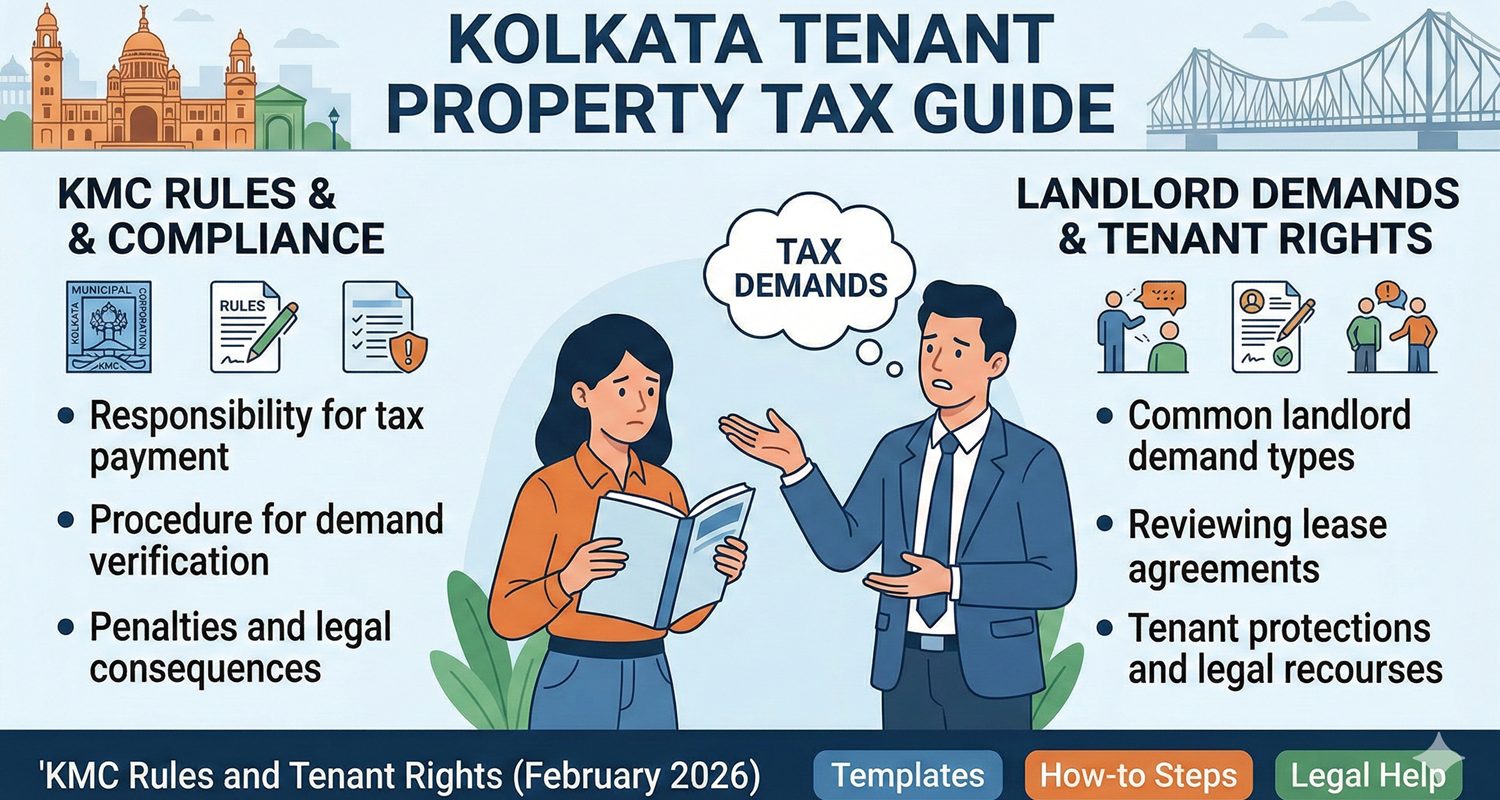
By Renting a flat in Kolkata comes with specific financial rules that many occupants misunderstand. If your landlord suddenly asks you to pay the municipal property tax bill, you need to know exactly what the law says before handing over any money. Many tenants assume paying society maintenance and utility bills exempts them from municipal taxes.
However, the Kolkata Municipal Corporation Act and the West Bengal Premises Tenancy Act establish strict rules about who pays what. This guide breaks down your exact legal liability, explains how to handle aggressive tax demands near your lease expiration, and shows you how to protect your security deposit from illegal deductions.
Property Tax Liabilities in Residential Tenancies Within the Kolkata Municipal Corporation Jurisdiction
Renting a residential flat in Kolkata creates specific legal obligations regarding municipal taxation. The Kolkata Municipal Corporation Act of 1980 and the West Bengal Premises Tenancy Act of 1997 require tenants to share the property tax burden with property owners.
Calculate Your Tax Liability
Select your tenancy type to see how the Kolkata Municipal Corporation allocates the property tax burden.
Residential Allocation
Under Section 230(a) of the KMC Act, the property owner recovers exactly 50% of the total residential property tax from the occupier. The landlord pays the primary bill to the KMC and collects half from the tenant.
The Statutory Mandate
Many tenants assume that if a rent agreement is completely silent regarding property taxes, they are free from this financial obligation. The law states otherwise. Section 5(8) of the West Bengal Premises Tenancy Act makes it a mandatory statutory duty for a tenant to pay their share of the municipal tax.
The Supreme Court of India confirmed in the Popat and Kotecha Property case that a tenant’s failure to pay their portion of the municipal tax is treated exactly the same as a default in paying rent. This specific default provides valid legal grounds for the landlord to initiate eviction proceedings.
Maintenance Charges vs. Municipal Property Tax
A frequent source of conflict arises when a tenant pays a rent sum that is stated to be “inclusive of society maintenance”. Tenants wrongly believe this covers the property tax. These are two completely different legal concepts.
| Feature | Society Maintenance Charges | Municipal Property Tax |
|---|---|---|
| Collecting Authority | Private Housing Society or Residents Welfare Association. | Kolkata Municipal Corporation. |
| Fund Usage | Internal upkeep, private security, common area electricity, elevators. | Public infrastructure, city roads, municipal drainage, waste management. |
| Legal Impact | An “inclusive” rent clause prevents the society from billing the tenant directly. | An “inclusive of maintenance” clause provides zero protection against property tax demands. |
Leave and License Agreements
Landlords in specific urban areas sometimes avoid standard rent agreements. They require occupants to sign a “Leave and License” agreement under the Indian Easements Act. This practice allows landlords to bypass the protective rent control laws entirely.
These agreements are occasionally paired with demands for extremely large security deposits. Landlords use these high deposits to intimidate occupants into accepting unverified financial demands. A standard residential security deposit normally ranges between two to three months of rent.
| Parameter | Rent Agreement (WBPTA) | Leave & License Agreement |
|---|---|---|
| Legal Status | Transfers exclusive legal possession to the tenant. | Grants mere permission to use the property. |
| Eviction Process | Requires valid statutory grounds proven in Civil Court. | Terminates automatically. Occupant becomes a trespasser upon expiry. |
| Tax Liability | Strict 50% tenant liability enforced by statute. | Governed entirely by the written contract terms. |
The Unit Area Assessment System
The KMC calculates property tax using the Unit Area Assessment system. This formula relies on several objective factors rather than arbitrary rental estimates.
Base Value
Determined by the neighborhood category ranging from premium areas to economically weaker sections.
Usage Factor
Applies different multipliers based on whether the property is used for residential or commercial purposes.
Occupancy Factor
The KMC applies a higher tax rate if a property is rented out compared to a self-occupied property.
Tenant Safeguards and Legal Remedies
Tenants must never pay a tax demand based on a verbal request or a simple text message. You have the right to request official documentation to verify the exact mathematical calculation.
1. The Apportionment Certificate
Under Section 230 of the KMC Act, tenants can apply to the KMC Assessment Department for an official certificate of apportionment. This document provides a government sanctioned calculation of your exact liability. Statutory administrative fees apply per occupant per period.
2. Rent Controller Deposits
If a tenant asks for official tax documents and the landlord responds by refusing to accept the monthly rent, the tenant must act quickly. Under Section 21 of the WBPTA, the tenant can legally deposit the rent with the Rent Controller. This legal action prevents the landlord from claiming a rent default to force an eviction.
3. Jurisdictional Limits
The Supreme Court ruled in the EIH Limited vs. Nadia A Virji case that statutory tax payments do not alter the base rent amount. A landlord cannot add the property tax onto the base rent to push the total amount above the WBPTA protection limits.
Communication Template
If you receive an unverified demand for property tax, you can use the following format to request proper documentation.
The Lump-Sum Deposit Trap and Intimidation
Landlords frequently use large lump-sum deposits to bypass standard rental norms. In many older city districts, owners force occupants into “Leave and License” agreements rather than standard leases. Instead of the customary two-month rent deposit, they demand massive sums ranging from 1 to 1.5 lakh rupees.
Owners use these inflated deposits as financial leverage. If an occupant refuses to pay an arbitrary property tax demand, the owner simply threatens to withhold the massive deposit upon move-out. This tactic forces compliance outside the legal framework. Tenants feel trapped because fighting for the deposit in civil court takes years. You must document every demand in writing to protect your deposit from illegal deductions.
Handling Demands Near Lease Expiry
When a tax notice arrives just months before an agreement expires, landlords often tie the tax payment to the renewal itself. Your current agreement expiring in June gives you a specific window to act.
Do Not Pay Blindly
Never pay a new tax demand based on a verbal request. Demand the official Kolkata Municipal Corporation property tax receipt and the Section 230 Apportionment Certificate. If they refuse, do not hand over cash.
Negotiate the Renewal
Use the upcoming June expiration to your advantage. Refuse to sign the renewal agreement unless the new document explicitly states whether the base rent is “inclusive of all municipal property taxes.”
The 11-Month Agreement Trap
Landlords routinely execute rental contracts for exactly 11 months to avoid mandatory registration and stamp duty. When a property tax dispute arises, an unregistered document creates a distinct disadvantage for the occupant.
The West Bengal Premises Tenancy Act requires registered documents for tenancies exceeding one year. If you stay for 1.5 years on consecutive 11-month unregistered contracts, your exact legal standing requires careful documentation. You must demand the KMC apportionment certificate before paying any tax share. Your specific liability terms are not formally recorded in a registered public deed, making verbal agreements entirely unenforceable.
Calculating Proportionate Share in Multi-Story Buildings
A common accounting error occurs when a landlord presents a single municipal tax bill for an entire multi-story building. If you rent one flat in a three-story building, you do not owe 50% of the entire building’s total tax.
Your liability is limited strictly to your occupied floor area. You must divide the total covered area of the building by your specific flat’s square footage. Apply this percentage to the total tax bill, then halve it to find your legal 50% share under the statute. Never pay a blanket demand without seeing the exact area calculation provided by the KMC assessment department.
How to Handle Formal Eviction Notices Over Tax Defaults
If you refuse to pay an undocumented tax demand, a landlord might send a formal legal notice threatening eviction. Do not ignore this document. A formal written reply is mandatory.
Your written response must state clearly that you are entirely willing to pay your statutory share immediately upon receiving the official KMC Section 230 certificate. Documenting your willingness to comply with the law, contingent entirely on the landlord providing valid municipal records, protects you against claims of willful default in rent control courts.
The Maintenance Inclusion Illusion
You stated that society maintenance is included in your rent and the owner pays it directly to the association. Landlords often use this arrangement to confuse occupants. Society maintenance covers private amenities like security guards and elevators.
Municipal property tax is a statutory government levy. Paying a combined rent amount does not automatically exempt you from the municipal tax. Unless your rent agreement explicitly contains the exact phrase “inclusive of all municipal property taxes”, the law presumes you must pay your 50 percent share independently of the private maintenance fees.
Immediate Action Plan Before June Expiry
Since your second agreement expires this June, you possess significant negotiation power right now. Do not wait for the landlord to draft the third agreement. Take these specific steps immediately.
Demand Proof
Ask for the KMC bill via email or formal letter. Refuse any chat screenshots or handwritten calculation notes.
Hold Payment
Do not pay the requested tax amount yet. Continue paying your base rent and utilities exactly on time to prevent default claims.
Draft Renewal
Tell the owner you will only sign the June renewal if the new contract explicitly clarifies the property tax liability in writing.
Agreement Audit Checklist
Review your current agreement immediately. Look for these specific terms to understand your exact legal standing before you speak with your landlord.
-
1
Check the “Taxes” Clause Does the document explicitly mention “Municipal Taxes” or “Corporation Taxes”? If it is completely silent, the statutory 50% rule under the West Bengal Premises Tenancy Act applies.
-
2
Verify Utilities vs. Taxes Paying electricity and gas directly has zero legal bearing on property tax liability. These are usage utilities. Property tax is a municipal levy on the physical structure.
-
3
Review Deposit Forfeiture Terms Read the termination clause. Does the landlord have the written right to deduct “unpaid dues” from your 1.5 lakh deposit? Ensure “dues” are strictly defined as unpaid rent or physical damage, not arbitrary tax demands.
Frequently Asked Questions
Can a landlord deduct property tax from my security deposit?
A landlord cannot unilaterally deduct arbitrary property tax demands from a security deposit without providing official KMC apportionment calculations. Security deposits are primarily for unpaid rent and property damage.
My agreement says rent is inclusive of all charges. Do I pay tax?
If the agreement explicitly states “inclusive of municipal property taxes”, the landlord has absorbed the cost. If it only says “inclusive of maintenance”, you are still liable for your statutory 50% share of the tax.
What if the building is very old and the tax is high?
The KMC Unit Area Assessment system uses an Age Multiplicative Factor which provides depreciation relief for older structures. However, your liability remains 50% of whatever the final assessed bill is for your residential unit.
We already pay electricity and gas directly. Does this cover our tax liability?
No. Electricity and gas are consumption-based utilities. You pay for what you use. Property tax is a government levy on the real estate itself. Paying utilities directly does not exempt you from municipal tax obligations.
Can the landlord demand 100% of the tax if the agreement is silent?
No. If you have a standard rent agreement and the contract is silent on property taxes, the West Bengal Premises Tenancy Act strictly caps the tenant’s liability at 50% of the residential tax amount. Demand the official KMC calculation.