
 By
By Independent software consultants operating under the Section 44ADA presumptive taxation scheme benefit heavily from classifying their tech output as zero-rated supplies. Problems frequently surface during the annual Letter of Undertaking (LUT) renewal when GST field officers demand physical Foreign Inward Remittance Certificates (FIRC) as proof of foreign exchange realization.
Because modern payment gateways like Wise, Stripe, and Payoneer aggregate and convert funds offshore, the final deposit into an Indian bank account appears as a standard domestic IMPS transfer. Local banks legally cannot issue a physical FIRC for these IMPS transactions, leaving exporters trapped between outdated tax demands and modern banking mechanics.
This guide breaks down the exact regulatory procedures to resolve this deadlock. You will learn how to obtain a No Objection Certificate (NOC) from aggregator platforms, force your local bank branch to generate an Inward Remittance Message (IRM) in the RBI’s EDPMS portal, and draft a legally sound response to GST scrutiny notices.
GST Export Compliance for Cross-Border Tech Remittances via OPGSPs
Solving the FIRC and IMPS routing problem for software consultants using Section 44ADA.
Independent software consultants in India face a specific regulatory conflict. Operating under the Section 44ADA presumptive taxation scheme is highly beneficial. Classifying tech output as a zero-rated supply under the Goods and Services Tax framework eliminates domestic tax liabilities on foreign income.
Filing a Letter of Undertaking allows you to export without upfront IGST payment. The conflict occurs during LUT renewal. GST field officers ask for a physical Foreign Inward Remittance Certificate as proof of foreign exchange realization.
When funds arrive from a client in Singapore through a payment gateway like Wise or Payoneer, the final deposit into your local bank account appears as an Indian Rupee IMPS transfer. Local banks refuse to issue a FIRC for an IMPS transfer. This guide explains the exact legal steps and documentation required to resolve this dispute and secure your LUT renewal.
Statutory Architecture of Service Exports
Section 2(6) of the IGST Act dictates five conditions for a service to qualify as an export. The central dispute involves proving the receipt of convertible foreign exchange. The Reserve Bank of India permits receiving export proceeds in INR if routed through authorized cross-border payment platforms.
| Statutory Condition | Requirement under Section 2(6) | Software Consulting Application |
|---|---|---|
| Supplier Location | Supplier located in India. | Consultant operates via Indian GSTIN. |
| Recipient Location | Recipient located outside India. | Client incorporated in a foreign jurisdiction. |
| Place of Supply | Place of supply is outside India. | Default location is the recipient location. |
| Currency | Receipt in convertible foreign exchange or permitted INR. | The core FIRC dispute. Funds must trace to foreign origins. |
| Distinct Persons | Parties are independent entities. | Principal-to-principal consulting basis. |
Financial Routing Mechanics
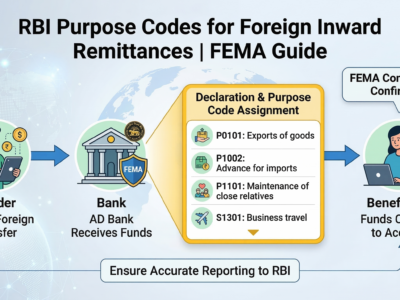
Payment platforms aggregate small-value payments to reduce international wire fees. This process changes the nature of the transaction by the time it reaches your local bank. The graphic below explains why the final leg appears as a domestic transfer.
Interactive Visualization: The OPGSP Remittance Pathway
The Obsolescence of the Physical FIRC
GST officers often demand outdated documents. Physical FIRCs are obsolete for regular trade. RBI Circular AP (DIR) No. 74 from May 2016 restricted physical FIRCs entirely to capital account transactions like Foreign Direct Investment.
Your bank is legally prohibited from issuing a physical FIRC for a software consulting invoice. You must provide a digital alternative recognized under the Export Data Processing and Monitoring System.
FIRA / FIRS
Foreign Inward Remittance Advice. The digital advice slip detailing the remittance, exchange rate, and purpose code. Issued by the converting bank or payment platform.
e-FIRC (IRM)
Inward Remittance Message. A digital ledger entry logged directly into the RBI EDPMS database by the bank.
e-BRC
Electronic Bank Realization Certificate. Generated by linking the IRM to specific export invoices on the DGFT portal.
Procedural Resolution: The NOC Framework
Because your local bank only sees an IMPS transfer, they need a No Objection Certificate from the bank that actually converted the foreign currency. Select your payment provider below to see the specific procedure.
Payoneer Workflow
- Payoneer automatically generates a combined FIRA and NOC document.
- Log into your Payoneer portal 24 to 72 hours after the transaction clears.
- Download the official PDF document.
- Submit this document alongside your commercial invoices to your local AD bank.
- Request your local bank to generate an IRM in the EDPMS system based on the provided NOC.
Wise Workflow
- Wise provides specific NOCs for business account transfers.
- Navigate to the completed transfer in your Wise dashboard.
- Download the NOC PDF. This document explicitly names the partner bank utilized for conversion.
- Download the corresponding transaction receipt.
- Submit the NOC, receipt, and export invoices to your local bank’s Foreign Exchange Operations department.
Stripe & PayPal Workflow
- Download the detailed Remittance Advice from your dashboard.
- Contact customer support explicitly requesting an official NOC regarding the specific transfer ID.
- Once the NOC is provided by their partner bank, compile it with your commercial invoices.
- Submit the packet to your local AD bank with a formal letter requesting e-FIRC generation.
High Court Precedents
GST officers cannot reject LUT renewals based solely on administrative formatting issues. The High Courts enforce the substance over form doctrine.
- Mavenir Systems v. Union of India (2025): Karnataka High Court ruled that alternative documents proving offshore fund origins fulfill statutory requirements. Refunds cannot be denied on assumptions.
- Gujarat High Court Ruling: A certificate from a Chartered Accountant certifying the realization of foreign exchange is valid proof. The CA must generate a Unique Document Identification Number.
- Transformative Learning Solutions (2025): Delhi High Court stated that foreign exchange certificates do not need to match invoice-wise. Aggregated platform payouts are acceptable.
FEMA 2025/2026 Rules
The RBI Foreign Exchange Management Regulations enacted in late 2025 provide significant compliance relief.
- 15-Month Realization Window: The timeline for realizing export proceeds is extended to 15 months from the date of export.
- Self-Declaration Rule: For entries up to 10 lakh INR, banks are authorized to close export entries in EDPMS based solely on a quarterly self-declaration from the exporter. This bypasses the complex NOC requirement for smaller invoices.
Adjudication Risks and Penalties
Failing to respond to the ASMT 10 notice within the stipulated 30 days triggers formal adjudication. The GST department will issue a Show Cause Notice under Section 73 or Section 74 of the CGST Act.
If the adjudicating officer denies your export status due to lack of remittance proof, the software service is automatically treated as a regular domestic supply. This classification shift attracts a flat 18 percent tax liability on your gross foreign receipts.
The department will mandate interest at 18 percent per annum calculated from the original invoice date. Operating under the Section 44ADA presumptive taxation scheme becomes financially unviable if this heavy tax burden falls entirely on your net income margins.
The EDPMS Generation Process
Exporters often misunderstand the internal banking workflow. Once you submit the NOC and commercial invoices, your local bank branch must access the internal RBI Export Data Processing and Monitoring System.
The bank verifies the foreign inward remittance advice provided by the payment aggregator. They manually create an Inward Remittance Message against your specific GSTIN and Importer Exporter Code.
You must follow up directly with the foreign exchange desk or trade finance division of your local branch. Regular retail banking staff lack the training and access required for this specific trade procedure.
Key Action Items
- Locate your AD Code branch.
- Request direct contact details for the Trade Desk.
- Track the IRM status within 15 days of NOC submission.
- Request a printed screenshot of the closed EDPMS entry.
Evaluating Alternative Remittance Channels
Relying entirely on aggregators causes continuous documentation friction. Consider shifting clients to direct bank wire transfers using the global SWIFT network.
| Remittance Channel | FIRC Automation | Cost Structure | Best For |
|---|---|---|---|
| Aggregators (Wise, Payoneer) | Manual NOC required | Low percentage based fee | Frequent low value invoices. |
| Direct SWIFT Wire | Automatic IRM Generation | High flat fee per transaction | High value retainer contracts. |
| Foreign Currency Account (EEFC) | Instant Trade Compliance | Requires specific bank approval | Large scale consulting firms. |
A direct SWIFT transfer lands in your Indian bank account strictly in foreign currency before local conversion. Your AD bank processes the conversion and automatically generates an electronic FIRC. For high value monthly invoices, SWIFT is functionally superior and eliminates routine compliance delays.
The SoftEx Form Requirement
Software Export Declaration Form requirements frequently confuse independent consultants. The Software Technology Parks of India oversees IT exports. If you export software or IT services via data communication links, the RBI mandates filing a SoftEx form to certify the export value.
Many freelance consultants providing advisory services assume they are exempt. The RBI strictly requires SoftEx for IT and ITES exports regardless of the business size. AD banks require the STPI certified SoftEx form alongside your FIRC to close the export cycle in the EDPMS.
Small value individual transactions under 25000 USD face less scrutiny but remain legally bound by the Foreign Exchange Management Act. Consultants should register as Non-STPI units to file these declarations periodically and avoid retroactive penalties during bank audits.
Claiming Unutilized Input Tax Credit
Consultants utilizing the LUT route do not charge IGST on their foreign invoices. You might still pay standard GST on domestic business expenses like laptops, cloud servers, software subscriptions, and internet bills.
Section 54 of the CGST Act allows exporters to claim a cash refund of this unutilized Input Tax Credit. Processing this refund requires filing Form RFD-01 on the GST portal.
The FIRC Dependency
The tax officer will strictly demand the FIRC or valid NOC documents to verify the foreign exchange realization before approving any cash disbursement. Fixing your FIRC documentation workflow directly enables you to recover these operational tax costs and improve your net profit margins under Section 44ADA.
Income Tax vs GST Data Reconciliation
Operating under Section 44ADA requires strict data symmetry across tax portals. The analytics engine of the Central Board of Direct Taxes cross-references your PAN data with the GSTIN network.
The gross receipts declared in your Income Tax Return must match the total zero-rated supply values reported in your GSTR-1 and GSTR-3B filings. A variance between your income tax filing and GST turnover will automatically generate a scrutiny notice.
Currency Fluctuation Rule:
Differences often arise from currency exchange rate variations. Always record your GST invoice value using the exact INR amount credited to your bank account on the date of realization. If you booked the invoice at an estimated exchange rate, you must issue a debit or credit note in the GST portal to reconcile the final received amount.
The Bank Escalation Matrix
Local bank officials frequently reject requests for IRM generation because they lack training on OPGSP regulations. Do not accept a verbal refusal from retail branch staff.
Regional Trade Desk
Bypass the retail branch manager. Send a formal email directly to the regional Nodal Officer for Foreign Exchange Operations attaching your NOC and the RBI Circular AP (DIR) No. 74.
Principal Nodal Officer
If the Trade Desk fails to act within 15 days, escalate the ticket to the Principal Nodal Officer of the bank. State clearly that their failure to update the EDPMS portal is jeopardizing your statutory GST compliance.
RBI Banking Ombudsman
If the bank does not resolve the issue within 30 days, file a formal grievance on the RBI CMS portal. Select the category for Deficiency in Service regarding Foreign Exchange. Banks face regulatory penalties for ignoring EDPMS obligations and will act immediately upon receiving an Ombudsman notice.
GST Portal Data Entry Errors
Software consultants often trigger notices due to basic clerical errors during monthly return filing. Even with perfect bank documents, incorrect data entry will cause the system to deny your LUT benefits.
- Wrong Table in 3B: Always report export turnover in Table 3.1.b of Form GSTR-3B. Using Table 3.1.a classifies the income as a domestic taxable supply and demands standard tax payment.
- Incorrect SAC Code: Verify that your commercial invoices utilize the correct Service Accounting Code. IT consulting services typically fall under SAC 998311.
Invoice Reference Check
When applying for LUT renewal via Form RFD-11, the portal checks your past compliance history. Ensure every export invoice uploaded in GSTR-1 has the specific flag marked “Export without payment of tax”.
Reply Template for GST Notice
If you receive an ASMT-10 or RFD-03 notice demanding a FIRC, use this structured legal language in your electronic response via the GST portal.