 By
Indian payroll compliance underwent a complete statutory overhaul in 2026. The repeal of the Income-tax Act, 1961 on April 1, 2026 brought the Income-tax Act, 2025 and the Income-tax Rules, 2026 into force, replacing the old Previous Year and Assessment Year terminology with a single period called Tax Year 2026-27. Months later, on September 17, 2026, the Ministry of Labour and Employment issued Notification No. S.O. 5109(E) under the Code on Social Security, 2020, raising the mandatory Employees’ Provident Fund (EPF) wage ceiling from ₹15,000 to ₹25,000 per month.
Most online salary calculators still run on outdated 1961 Act formulas and legacy ₹1,800 monthly provident fund caps. As a result, salaried employees and HR teams regularly miscalculate monthly take-home pay, Tax Deducted at Source (TDS), and regime break-even thresholds.
Four specific statutory shifts directly alter payslip math in Tax Year 2026-27:
- Renumbered Tax Provisions: The default New Tax Regime now sits under Section 202(1), the ₹75,000 standard deduction falls under Section 19(1) (Table: Sl. No. 2), tax rebates and marginal relief move to Section 156, and specified ₹1.5 lakh investments map to Section 123 read with Schedule XV.
- Eight-City 50% HRA Cap: Rule 279 of the Income-tax Rules, 2026 expands the 50% House Rent Allowance (HRA) exemption ceiling beyond Mumbai, Delhi, Kolkata, and Chennai to include Bengaluru, Hyderabad, Pune, and Ahmedabad for Old Regime taxpayers.
- Higher EPF Deductions: The ₹25,000 EPF wage ceiling raises maximum mandatory monthly employee and employer provident fund contributions from ₹1,800 to ₹3,000, requiring split-month proration in September 2026 and reducing monthly net take-home pay from October 2026 onward.
- The 104% Marginal Relief Tax Cliff: For New Regime taxable incomes between ₹12,00,001 and ₹12,70,588, Section 156(2)(b) caps base tax at 100% of income above ₹12,00,000, but the mandatory 4% Health and Education Cess pushes the effective marginal tax rate to ₹1.04 per rupee earned. Without a Section 124(2) Employer NPS deduction, a ₹50,000 appraisal inside this corridor reduces monthly in-hand pay.
This technical audit and interactive CTC calculator verify each statutory rule against the operative 2025 Act, map state-wise Professional Tax rules, and provide ready-to-use compliance templates for payroll teams and salaried taxpayers.
Statutory Validation and System Architecture for Indian Payroll and CTC Calculators in Tax Year 2026-27
A technical verification of the Income-tax Act, 2025, Rule 279 eight-city HRA expansion, the September 17, 2026 EPF wage ceiling revision to ₹25,000, and the 104 percent marginal relief tax cliff.
Replaced the 1961 Act on April 1, 2026. Consolidates Previous Year and Assessment Year into a single Tax Year 2026-27.
Bengaluru, Hyderabad, Pune, and Ahmedabad join Mumbai, Delhi, Kolkata, and Chennai at the 50% Basic + DA threshold.
Notification S.O. 5109(E) dated September 17, 2026 raised mandatory monthly PF deduction caps from ₹1,800 to ₹3,000.
Between ₹12,00,001 and ₹12,70,588 taxable income, Section 156(2)(b) plus 4% cess costs ₹1.04 tax per ₹1.00 earned.
1. Executive Summary and Statutory Validation Matrix
On April 1, 2026, the Indian direct tax system replaced the Income-tax Act, 1961 and the Income-tax Rules, 1962 with the Income-tax Act, 2025 (Act No. 30 of 2025, amended by the Finance Act, 2026) and the Income-tax Rules, 2026 (Notification No. 22/2026, G.S.R. 198(E) dated March 20, 2026). Later in the year, on September 17, 2026, the Ministry of Labour and Employment issued Notification No. S.O. 5109(E) under the Code on Social Security, 2020, raising the Employees’ Provident Fund (EPF) monthly wage ceiling from ₹15,000 to ₹25,000. Through December 2026, year-end payroll audits show that many online salary calculators still apply outdated 1961 section references and ₹1,800 PF limits.
Our legal and mathematical verification of the five developer observations confirms that every core claim is accurate. Production payroll software requires three specific calculation adjustments: handling mid-month EPF proration for September 2026, checking when actual rent paid triggers the 50% HRA cap, and applying Section 124(2) employer National Pension System (NPS) contributions to remove the marginal relief tax cliff.
| Claim Area | Developer Post Assertion | Verification Status | Primary Statutory Authority (2026-27) | Payroll Engine Requirement (Dec 2026 Audit) |
|---|---|---|---|---|
| 1. Act 2025 & Tax Year | Income-tax Act, 2025 is active; FY 2026-27 is Tax Year 2026-27; Sec 87A is 156, New Regime is 202, Standard Deduction is 19, Sec 80C is 123. | Validated (Exact) | Income-tax Act, 2025: Sections 1(3), 19(1), 123 (r/w Schedule XV), 156, and 202. | Map Standard Deduction to Section 19(1) (Table: Sl. No. 2) and link Section 123 to Schedule XV. |
| 2. HRA 50% Metro List | Bengaluru, Hyderabad, Pune, and Ahmedabad qualify for the 50% HRA cap alongside the 4 older metros under Rule 279 (Old Regime). | Validated (Exact) | Income-tax Act, 2025: Schedule III (Table: Sl. No. 11) r/w Rule 279 of Income-tax Rules, 2026. | The 50% cap alters tax only when annual rent exceeds 50% of (Basic + DA). Form 124 replaces Form 12BB. |
| 3. EPF Ceiling Hike | EPF wage ceiling rose from ₹15,000 to ₹25,000 on Sept 17, 2026; monthly PF rises from ₹1,800 to ₹3,000 from October, cutting take-home pay. | Validated with Nuance | MoLE Notification No. S.O. 5109(E) dated Sept 17, 2026 under Sec 2(89) of Code on Social Security, 2020. | Effective Sept 17, 2026. September payroll uses either a split-month base (₹19,667 / ₹2,360 PF) or full ₹25,000 base. |
| 4. Marginal Relief Cliff | Between ₹12,00,000 and ~₹12,70,588 taxable income, marginal relief plus 4% cess costs ₹1.04 tax per ₹1.00; a ₹13.4L to ₹13.9L hike cuts monthly pay by ~₹163. | Validated (Exact) | Income-tax Act, 2025: Section 156(2)(b) r/w Section 202(1). | A ₹49,000 taxable pay increase inside this zone incurs ₹50,960 tax, reducing net pay by ₹1,960/year (₹163.33/month). |
| 5. Professional Tax | Professional tax is not deductible when computing taxable income under the New Tax Regime. | Validated (Exact) | Income-tax Act, 2025: Section 202(2)(a)(iv) disallowing Section 19(1) (Table: Sl. No. 1). | Subtract PT from net cash take-home in both regimes, but deduct from taxable income only in the Old Regime. |
2. Income-tax Act, 2025 Section Directory and Interactive Filter
The Income-tax Act, 2025 (Bill No. 104 of 2025, Presidential assent on August 21, 2025, effective April 1, 2026) contains 536 sections across 23 chapters and 16 schedules. It removes the dual terms “Previous Year” and “Assessment Year.” Every financial period starting April 1 is now designated as a “Tax Year.” For April 1, 2026 to March 31, 2027, all TDS certificates, challans, and payroll reports use the label Tax Year 2026-27.
Use the interactive filter below to inspect the exact statutory mapping between the repealed 1961 Act and the operative 2025 Act.
| Provision Name | Repealed 1961 Act | Operative 2025 Act | Regime Applicability | Tax Year 2026-27 Parameter |
|---|---|---|---|---|
| Default New Tax Regime Slabs | Section 115BAC | Section 202(1) (Chapter XIII) | New Regime Default | 7 slabs: 0% up to ₹4L; 5% (₹4L to ₹8L); 10% (₹8L to ₹12L); 15% (₹12L to ₹16L); 20% (₹16L to ₹20L); 25% (₹20L to ₹24L); 30% above ₹24L. |
| Standard Deduction on Salary | Section 16(ia) | Section 19(1), Table Sl. No. 2 | Both Regimes | ₹75,000 in New Regime (u/s 202); ₹50,000 in Old Regime. |
| Professional Tax Deduction | Section 16(iii) | Section 19(1), Table Sl. No. 1 | Old Regime Only | Up to ₹2,500/year allowed in Old Regime; barred in New Regime by Section 202(2)(a)(iv). |
| House Rent Allowance (HRA) | Section 10(13A) & Rule 2A | Schedule III (Sl. No. 11) & Rule 279 | Old Regime Only | 50% of (Basic + DA) for 8 specified cities; 40% for all other cities. |
| Income Tax Rebate | Section 87A | Section 156(1) & 156(2)(a) | Both Regimes | Sec 156(1): Up to ₹12,500 (Old Regime, income up to ₹5L). Sec 156(2)(a): Up to ₹60,000 (New Regime, income up to ₹12L). |
| Marginal Relief on Rebate | Proviso to Section 87A | Section 156(2)(b) | New Regime Specific | Limits base tax before cess to excess taxable income over ₹12,00,000 (active up to ₹12,70,588). |
| PF, PPF, ELSS, Life Insurance | Section 80C | Section 123 r/w Schedule XV | Old Regime Only | Aggregate deduction capped at ₹1,50,000 per Tax Year. |
| Employer NPS Contribution | Section 80CCD(2) | Section 124(2) | Both Regimes | Up to 14% of (Basic + DA) in New Regime (preserved u/s 202(2)(a)(xii)); 10% in Old Regime. |
| Medical Insurance Premium | Section 80D | Section 126 | Old Regime Only | Up to ₹25,000 for self/family plus ₹25,000 (or ₹50,000 for senior citizen parents). |
| Savings & Deposit Interest | Sections 80TTA / 80TTB | Section 153 | Old Regime Only | Up to ₹10,000 for savings interest (non-seniors); ₹50,000 for deposit interest (seniors). |
| Employee Declaration Form | Form 12BB (Rule 26C) | Form No. 124 (Rule 205) | Both Regimes | Mandatory landlord relationship disclosure for HRA and Annexure A-2 proofs for LTA. |
3. Eight-City HRA Expansion under Rule 279 and Binding Rent Thresholds
Under the repealed Rule 2A of the 1962 Rules, only Mumbai, Delhi, Kolkata, and Chennai qualified for the 50% salary limit when computing House Rent Allowance exemptions. Under Rule 279 of the Income-tax Rules, 2026 (operationalizing Schedule III, Table Sl. No. 11 of the Income-tax Act, 2025), four additional cities now qualify for the 50% tier: Bengaluru, Hyderabad, Pune, and Ahmedabad. Every other city remains at the 40% tier.
Where City Cap % = 50% for Mumbai, Delhi, Kolkata, Chennai, Bengaluru, Hyderabad, Pune, Ahmedabad; and 40% for all other locations.
A critical mathematical check for software engineers: when an employer already pays HRA equal to 50% of Basic + DA, raising the city limit from 40% to 50% in Bengaluru, Hyderabad, Pune, or Ahmedabad only increases the tax exemption if the second formula limb (Rent minus 10% of Basic) exceeds 40% of Basic. That means annual rent must exceed 50% of (Basic + DA) to see any tax benefit from Rule 279, and reaches the full 10% extra deduction when annual rent equals or exceeds 60% of (Basic + DA). Additionally, employees claiming HRA must submit Form No. 124 under Rule 205, stating their relationship with the landlord alongside the landlord’s PAN whenever annual rent exceeds ₹1,00,000.
4. The September 17, 2026 EPF Wage Ceiling Revision and Split-Month Mechanics
On September 17, 2026, the Ministry of Labour and Employment issued Notification No. S.O. 5109(E) under Section 2(89) of the Code on Social Security, 2020, raising the mandatory EPF wage ceiling from ₹15,000 to ₹25,000 per month. At the 12% statutory contribution rate, the capped monthly deduction increased from ₹1,800 to ₹3,000.
Because the notification took legal effect immediately on September 17, 2026 rather than October 1, 2026, payroll systems closing the September 2026 Electronic Challan-cum-Return (ECR) cycle faced a mid-month boundary. Employers across India adopted one of two compliant methods for September 2026: a pro-rata split-month base (16 days at ₹15,000 = ₹8,000, plus 14 days at ₹25,000 = ₹11,667, totaling a ₹19,667 wage base and ₹2,360 PF deduction) or applying the full ₹25,000 ceiling (₹3,000 PF deduction) for the whole month of September to avoid shortfall interest under Section 127. From October 2026 through March 2027, the steady-state monthly deduction is ₹3,000. Under Section 2(88) of the Code on Social Security, 2020, the 50% allowance add-back rule also ensures that any employee with gross pay of ₹50,000 or more per month has a deemed statutory wage base of at least ₹25,000.
| EPF & EPS Statutory Component | April 2026 to August 2026 (5 Months) | September 2026 Split-Month (16d @ ₹15k + 14d @ ₹25k) | September 2026 Full-Month Option | October 2026 to March 2027 (6 Months) |
|---|---|---|---|---|
| Statutory EPF Wage Ceiling Base | ₹15,000 / month | ₹19,667 / month | ₹25,000 / month | ₹25,000 / month |
| Employee EPF Deduction (12%) | ₹1,800 / month | ₹2,360 / month | ₹3,000 / month | ₹3,000 / month |
| Employer EPS Share (8.33% Max) | ₹1,250 / month | ₹1,638 / month | ₹2,083 / month | ₹2,083 / month |
| Employer EPF Share (3.67% Diff.) | ₹550 / month | ₹722 / month | ₹917 / month | ₹917 / month |
| Employer EDLI (0.5%) + Admin (0.5%) | ₹150 / month (₹75 + ₹75) | ₹197 / month | ₹250 / month (₹125 + ₹125) | ₹250 / month (₹125 + ₹125) |
| Total Monthly Employer Outgo (13%) | ₹1,950 / month | ₹2,557 / month | ₹3,250 / month | ₹3,250 / month |
5. Mathematical Proof of the 104% Marginal Relief Cliff (₹12.0L to ₹12.71L)
Under Section 202(1) of the Income-tax Act, 2025, slab tax on a taxable income of ₹12,00,000 is ₹60,000 (0% up to ₹4L, 5% on ₹4L to ₹8L = ₹20,000, and 10% on ₹8L to ₹12L = ₹40,000). Section 156(2)(a) grants a full ₹60,000 rebate at ₹12,00,000, resulting in zero tax. Once taxable income crosses ₹12,00,000, the 15% slab rate applies to income above ₹12,00,000, and the taxpayer shifts to Marginal Relief under Section 156(2)(b).
Marginal Relief Rebate u/s 156(2)(b) = Slab Tax – (Y – 12,00,000)
Break-Even Upper Boundary: 60,000 + 0.15 x (Y – 12,00,000) = Y – 12,00,000 ==> 0.85 x (Y – 12,00,000) = 60,000 ==> Y = ₹12,70,588.24
Total Tax Payable in Relief Zone (with 4% Health & Education Cess) = 1.04 x (Y – 12,00,000)
Effective Marginal Tax Rate = d(Total Tax)/dY = 1.04 (104% tax rate, or -₹0.04 net pay per +₹1.00 earned)
Because the 4% Health and Education Cess is added after deducting the Section 156(2)(b) marginal relief rebate, every ₹1.00 of taxable income between ₹12,00,001 and ₹12,70,588 incurs ₹1.04 in tax. Across the entire ₹70,588.24 corridor, net annual take-home pay drops by ₹2,823.53 (₹235.29/month). In the developer’s test case of a ₹50,000 CTC hike from ₹13.4L to ₹13.9L, where ₹49,000 flows into taxable income inside the relief corridor, total tax rises by ₹50,960 (1.04 times ₹49,000), cutting annual take-home pay by ₹1,960, or ₹163.33 per month.
| Payroll & Tax Line Item | Scenario A: Capped PF (₹3,000/mo) + ₹1k Gratuity Adj. | Scenario B: Pure Fixed PF Cap (+₹50,000 Taxable) | Scenario C: Uncapped PF at 12% of Basic (40% CTC) |
|---|---|---|---|
| Pre-Hike CTC to Post-Hike CTC | ₹13,40,000 to ₹13,90,000 (+₹50,000) | ₹13,15,000 to ₹13,65,000 (+₹50,000) | ₹13,40,000 to ₹13,90,000 (+₹50,000) |
| Employer PF & Non-Taxable CTC Deductions | ₹64,000 to ₹65,000 (+₹1,000) | ₹36,000 to ₹36,000 (₹0 change) | ₹64,320 to ₹66,720 (+₹2,400) |
| Gross Taxable Salary | ₹12,76,000 to ₹13,25,000 (+₹49,000) | ₹12,79,000 to ₹13,29,000 (+₹50,000) | ₹12,75,680 to ₹13,23,280 (+₹47,600) |
| Less: Standard Deduction u/s 19(1) | ₹75,000 to ₹75,000 | ₹75,000 to ₹75,000 | ₹75,000 to ₹75,000 |
| Net Taxable Income (Inside Relief Zone) | ₹12,01,000 to ₹12,50,000 (+₹49,000) | ₹12,04,000 to ₹12,54,000 (+₹50,000) | ₹12,00,680 to ₹12,48,280 (+₹47,600) |
| Total Tax Payable (Base + 4% Cess) | ₹1,040.00 to ₹52,000.00 (+₹50,960.00) | ₹4,160.00 to ₹56,160.00 (+₹52,000.00) | ₹707.20 to ₹50,211.20 (+₹49,504.00) |
| Annual Net In-Hand Change | -₹1,960.00 / year | -₹2,000.00 / year | -₹4,304.00 / year |
| Monthly Net In-Hand Change | -₹163.33 / month | -₹166.67 / month | -₹358.67 / month |
6. State Professional Tax Rules and Additional 2026-27 Allowances
Under Section 19(1) (Table: Sl. No. 1) of the Income-tax Act, 2025, Professional Tax (up to ₹2,500 per year under Article 276(2) of the Constitution) is deductible from taxable salary only in the Old Tax Regime. Section 202(2)(a)(iv) bars this deduction in the New Tax Regime. However, employers must still withhold Professional Tax from monthly cash payouts in both regimes according to state commercial tax schedules.
| State / Union Territory | Operative Salaried Professional Tax Slab (Tax Year 2026-27) | Feb Top-Up / Cycle | Max Annual PT |
|---|---|---|---|
| Karnataka | Up to ₹24,999/mo: Nil; ₹25,000 and above: ₹200/mo for 11 months + ₹300 in February. | Yes (₹300 in Feb) | ₹2,500 |
| Maharashtra | Men: Up to ₹7,500: Nil; ₹7,501 to ₹10,000: ₹175/mo; Above ₹10,000: ₹200/mo (₹300 in Feb). Women: Exempt up to ₹25,000/mo; Above ₹25,000: ₹200/mo (₹300 in Feb). | Yes (₹300 in Feb) | ₹2,500 |
| West Bengal | Up to ₹10,000: Nil; ₹10,001 to ₹15,000: ₹110/mo; ₹15,001 to ₹25,000: ₹130/mo; ₹25,001 to ₹40,000: ₹150/mo; Above ₹40,000: ₹200/mo. | Monthly (12 Equal) | ₹2,400 |
| Telangana & Andhra Pradesh | Up to ₹15,000: Nil; ₹15,001 to ₹20,000: ₹150/mo; Above ₹20,000: ₹200/mo. | Monthly (12 Equal) | ₹2,400 |
| Gujarat | Up to ₹12,000/mo: Nil; Above ₹12,000/mo: Flat ₹200/mo. | Monthly (12 Equal) | ₹2,400 |
| Madhya Pradesh | Up to ₹18,750: Nil; ₹18,751 to ₹25,000: ₹125/mo; Above ₹25,000: ₹208/mo for 11 months + ₹212 in February. | Yes (₹212 in Feb) | ₹2,500 |
| Tamil Nadu & Kerala | Assessed on half-yearly gross salary (deducted in August and January), scaling up to ₹1,250 per half-year. | Half-Yearly Cycle | ₹2,500 |
| Delhi, Haryana, UP, Rajasthan, Punjab, Goa | No Professional Tax levied on salaried employees. | Not Applicable | ₹0 |
Additional Tax Year 2026-27 Statutory Changes Often Missed
- Section 124(2) Employer NPS Escape Valve: Section 202(2)(a)(xii) preserves the deduction for employer NPS contributions up to 14% of (Basic + DA) in the New Tax Regime (compared to 10% in the Old Regime). Allocating a small portion of CTC to Section 124(2) pulls taxable income back to ₹12,00,000 and eliminates the 104% marginal relief cliff.
- Updated Perquisites and Allowances under Income-tax Rules, 2026: Notification G.S.R. 198(E) raised tax-free employer meal voucher limits up to ₹1.05 lakh per year, raised transport employee exemptions to ₹25,000/month, and increased child education and hostel allowances 30-fold in the Old Regime. Conversely, Rule 15 tripled the notional taxable perquisite value for employer-provided motor cars.
- Regime Break-Even Thresholds & Surcharge Caps: Below ₹12.75 lakh gross salary, the New Regime incurs zero tax. At ₹15 lakh gross pay, an employee needs more than ₹5.44 lakh in Old Regime deductions (beyond the ₹50,000 standard deduction) to beat the New Regime. At ₹24 lakh and above, the break-even deduction requirement settles at ₹8.00 lakh total (₹7.50 lakh beyond standard deduction). Above ₹5 crore total income, the New Regime caps surcharge at 25%, whereas the Old Regime levies a 37% surcharge.
7. Production-Grade Tax Year 2026-27 CTC to In-Hand Calculator
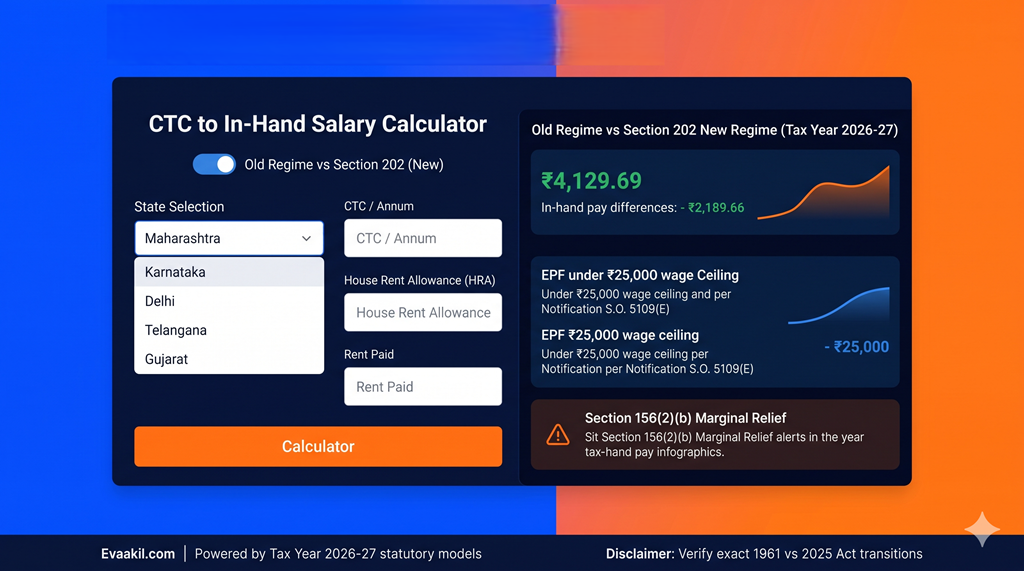
Adjust any compensation or deduction input below. The calculator updates both tax regimes, verifies the ₹13.4L to ₹13.9L hike cliff, and redraws the live regime comparison chart on the second HTML5 Canvas element.
Compensation & Statutory Settings
Deductions & Hike Simulator
| Line Item & Act 2025 Section | New Regime (Annual) | New Regime (Monthly) | Old Regime (Annual) | Old Regime (Monthly) |
|---|
8. Ready-to-Use Statutory Payroll Templates (Tax Year 2026-27)
HR teams, payroll engineers, and salaried employees can copy these three statutory templates updated for the Income-tax Act, 2025 and Income-tax Rules, 2026.
Template 1: Form No. 124 (Rule 205) Declaration
Replaces legacy Form 12BB for employee investment, Rule 279 HRA landlord relationship, and Annexure A-2 LTA submissions.
FORM NO. 124 [See Rule 205 of Income-tax Rules, 2026]
Statement of Claims by Salaried Employee for Tax Year 2026-27

1. Employee Name & PAN: [Enter Full Name] | [Enter 10-Digit PAN]
2. Tax Regime Selection: [ ] Section 202 Default New Regime  [ ] Old Tax Regime
3. House Rent Allowance Claim (Schedule III, Table Sl. No. 11 r/w Rule 279):
   - City Name & Tier: [Bengaluru / Hyderabad / Pune / Ahmedabad / Metro 50% / Other 40%]
   - Annual Rent Paid (₹): [Enter Amount]
   - Landlord Name & PAN (Mandatory if Rent > ₹1,00,000): [Name] | [PAN]
   - Statutory Relationship with Landlord: [None / Specify Familial or Legal Relation]
4. Leave Travel Allowance (Annexure A-2 Attached):
   - Mode of Travel & Digital Payment Reference: [Enter PNR & UPI/Bank Ref]
5. Chapter VIII Deductions (Old Regime Only):
   - Section 123 r/w Schedule XV (EPF/PPF/ELSS): ₹ [Amount]
   - Section 126 (Health Insurance): ₹ [Amount]
6. Section 124(2) Employer NPS Contribution (Allowed up to 14% in New Regime): ₹ [Amount]
Template 2: Section 124(2) NPS Restructuring Request
Formal email to HR/Payroll to remove the 104% marginal relief tax cliff between ₹12,00,001 and ₹12,70,588 taxable income.
Subject: Request for Salary Restructuring under Section 124(2) Employer NPS - Tax Year 2026-27

Dear Payroll & Compensation Team,

For Tax Year 2026-27, my projected net taxable income under the default New Tax Regime (Section 202 of the Income-tax Act, 2025) after the ₹75,000 Standard Deduction u/s 19(1) stands at ₹[Enter Taxable Income, e.g., 12,50,000].

Because this falls inside the Section 156(2)(b) marginal relief corridor (₹12,00,001 to ₹12,70,588), the 4% Health and Education Cess creates an effective marginal tax rate of 104% on the amount above ₹12,00,000.

Pursuant to Section 202(2)(a)(xii) read with Section 124(2) of the Income-tax Act, 2025, employer NPS contributions up to 14% of (Basic + DA) are deductible in the New Tax Regime. Please allocate [Enter %, e.g., 9.5%] of my Basic Salary (₹[Enter Amount]/year) toward Employer NPS under Section 124(2) from the upcoming payroll cycle.

Regards,
[Employee Name & Employee ID]
Template 3: September 2026 EPF Split-Month Notice
Payroll communication explaining Notification No. S.O. 5109(E) dated September 17, 2026 and the ₹25,000 EPF wage ceiling.
PAYROLL COMPLIANCE NOTICE: EPF WAGE CEILING REVISION (S.O. 5109(E))
Statutory Authority: Ministry of Labour and Employment Notification No. S.O. 5109(E) dated 17 September 2026 under Section 2(89) of the Code on Social Security, 2020.

1. Statutory Ceiling Change: Effective 17 September 2026, the mandatory monthly EPF wage ceiling increased from ₹15,000 to ₹25,000.
2. September 2026 Payroll Treatment:
   - Days 1 to 16 (16 days @ ₹15,000 cap): Pro-rata base = ₹8,000 (PF @ 12% = ₹960)
   - Days 17 to 30 (14 days @ ₹25,000 cap): Pro-rata base = ₹11,667 (PF @ 12% = ₹1,400)
   - Total September 2026 Blended Base = ₹19,667 | Employee PF = ₹2,360
3. Steady-State Deduction from October 2026:
   - Monthly Wage Ceiling Base = ₹25,000
   - Employee EPF (12%) = ₹3,000/month
   - Employer EPS (8.33%) = ₹2,083/month + Employer EPF (3.67%) = ₹917/month