 By
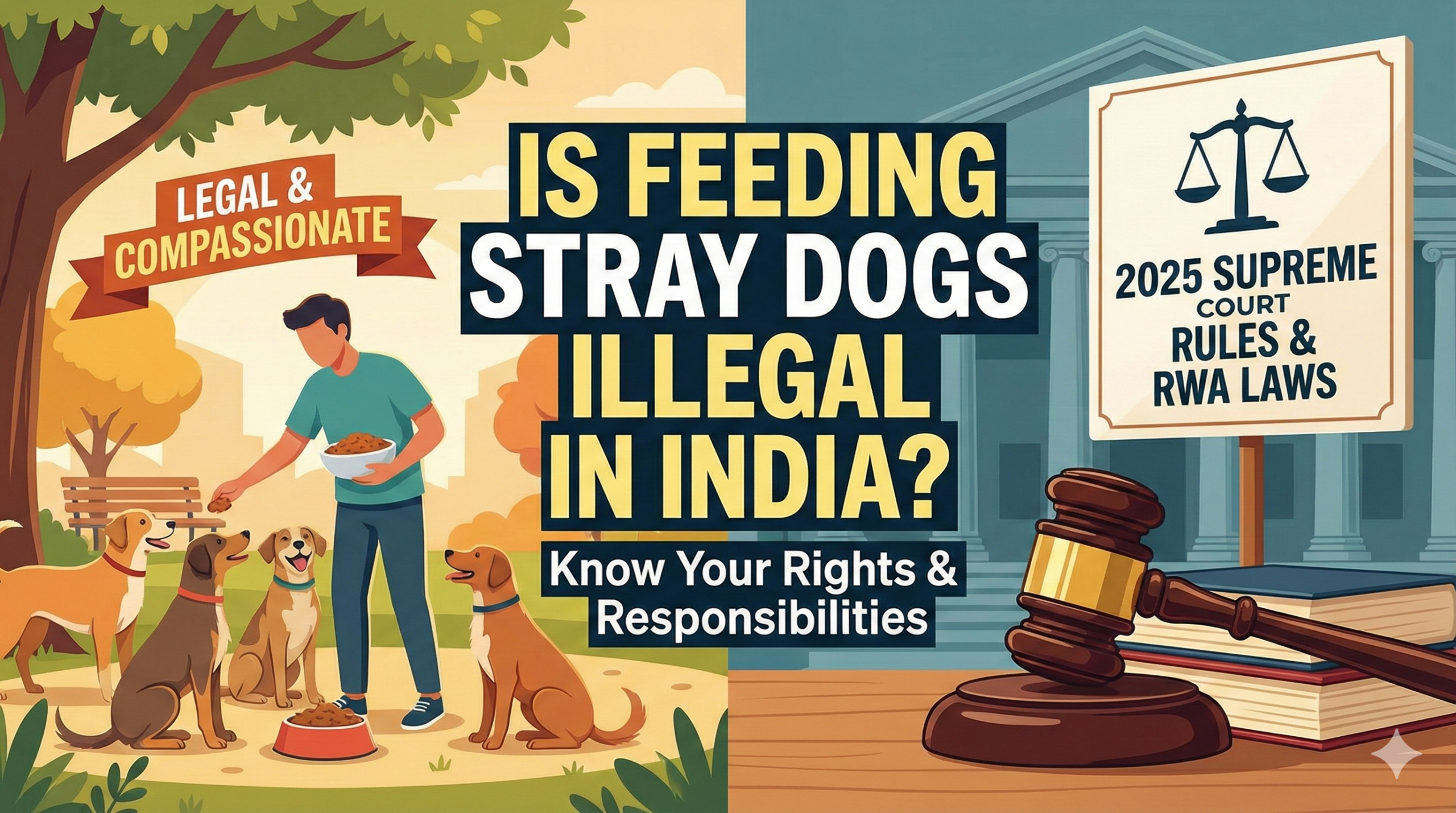
By Stop guessing if your neighbor can call the police because you fed a community dog. The short answer is no—feeding is a protected constitutional duty.
The long answer involves specific timings, strict location boundaries, and new 2025 Supreme Court directives that ban feeding in schools but mandate “Designated Spots” in residential colonies.
We break down the Prevention of Cruelty to Animals Act, explain how to file an FIR against harassment, and provide the exact legal steps to handle RWAs that try to overstep their authority.
Is It Illegal to Feed Stray Dogs in India? A 2025 Legal Guide
Quick Answer: No, it is not illegal. Feeding stray dogs is a constitutional duty and a protected right. However, new 2025 Supreme Court orders restrict where you can feed. Feeding inside hospitals or schools is now banned. Feeding in residential areas is legal but must happen at “Designated Feeding Spots”.
Stray dogs, often called community dogs, are an integral part of Indian streets. The legal question of feeding them has shifted from a simple “yes or no” to a complex set of rules about time and place. As of late 2025, the Supreme Court of India has redefined these boundaries to balance animal welfare with public safety.
This guide covers the Constitution, the Prevention of Cruelty to Animals (PCA) Act, the Indian Penal Code (IPC), and the critical Supreme Court orders from August and November 2025.
The Hierarchy of Animal Rights
Visualizing the flow of authority from the Constitution to Local Bodies.
Constitutional & Statutory Rights
The right to feed animals is rooted in the Constitution of India. Article 51A(g) establishes a fundamental duty for every citizen to have compassion for living creatures. The courts have interpreted this not as a passive feeling, but as an active duty. Feeding is the most direct expression of this compassion.
Furthermore, Article 21, which guarantees the Right to Life, has been expanded by the judiciary to include animals. Animals have a right to live with dignity and freedom from hunger. Denying food to street dogs violates their fundamental right to life.
The PCA Act and IPC Shields
Two major laws protect both the dog and the feeder.
- PCA Act, Section 11(1)(h): Failure to provide food is cruelty. If a Resident Welfare Association (RWA) prevents access to food, they commit a crime.
- PCA Act, Section 11(1)(i): Abandonment is a crime. Relocating a dog denies it access to its food source and constitutes abandonment.
- IPC Section 428/429: Killing or maiming an animal is punishable by up to five years in jail.
- IPC Section 503/506: Criminal Intimidation. Threatening a feeder is a cognizable offense.
Explore Legal Provisions
Article 51A(g)
Fundamental duty of every citizen to show compassion to living creatures. This is the legal basis for the “right to feed”.
IPC Section 429
Mischief by killing or maiming animals. Punishable by imprisonment up to 5 years. Applies if neighbors poison or attack dogs.
IPC Section 506
Punishment for Criminal Intimidation. Used against individuals who threaten feeders with physical harm.
SC Order Aug 22, 2025
Mandates “Designated Feeding Spots”. Vacated earlier order that banned the release of strays.
SC Order Nov 7, 2025
Bans feeding inside sensitive zones: Schools, Hospitals, Railway Stations.
Landmark Judgments Archive
When dealing with police or RWA committees, citing specific High Court and Supreme Court judgments often carries more weight than general arguments. Here are the three most critical judgments to download and keep.
Ruling: The court explicitly stated that stray dogs have a right to food and citizens have a right to feed. It mandated that RWAs and authorities must designate feeding spots. It also noted that dogs are territorial and cannot be simply “removed” to shelters.
Ruling: While this case was about Jallikattu (bull-taming), the Supreme Court expanded the scope of Article 21 (Right to Life) to include animals, granting them the right to live with dignity and protection from unnecessary pain.
Ruling: The court held that no authority can ban the feeding of birds or animals. It emphasized that “nuisance” cannot be a ground to stop the feeding of hungry animals, provided hygiene is maintained.
Evolution of Dog Law: A Timeline
Understanding the history helps clarify why current laws exist. The shift has moved from “killing” to “sterilization”.
Introduction of the “No Kill” policy. Municipalities stopped mass culling and shifted to Animal Birth Control (ABC).
Supreme Court landmark ruling extending Article 21 (Right to Life) to animals, granting them “honor and dignity”.
Made RWAs legally responsible for designating feeding spots. Explicitly banned relocation of dogs.
Clarified feeding zones. Banned feeding in public institutions (Hospitals/Schools) to reduce conflict.
The Feeder’s Code of Conduct
While you have a right to feed, you also have a duty to feed responsibly. The law protects responsible feeding, not nuisance creation. Courts have increasingly frowned upon unhygienic feeding practices.
- Time Management: Feed during low-traffic hours (late night or early morning). This avoids conflict with residents fearful of dogs.
- Hygiene is Non-Negotiable: You must clean the feeding spot after the dogs eat. Leftover food attracts rodents and disease, giving RWAs a valid legal ground to complain.
- Sterilization Responsibility: If you feed them, you must ensure they are sterilized. Feeders are the best people to catch friendly dogs for the municipality’s ABC program.
- No ‘Pack’ Formation: Avoid feeding multiple packs in one spot. Distribute food in smaller piles to prevent food aggression between dogs.
The Shield of AWBI: The “Colony Caretaker” Card
Many serious feeders obtain an identification card from the Animal Welfare Board of India (AWBI). This card designates you as a “Colony Caretaker”.
Application Process: You can apply via the AWBI website or through recognized NGOs. You must pledge to assist with the sterilization (ABC) and vaccination of the dogs in your care.
RWA Bye-Laws vs. National Law
A common point of conflict is when an RWA passes a resolution (AGM meeting) to ban feeding or fine dog owners. It is vital to understand the legal hierarchy.
RWA Power Limits
Visualizing what RWAs can and cannot do.
| RWA Action | Legal Validity | Legal Reasoning |
|---|---|---|
| “Feeding Banned” Notice | Void | Violates Art 51A(g) & ABC Rules 2023. RWA bye-laws cannot override Central Law. |
| Fining Pet Owners/Feeders | Illegal | RWAs are not statutory bodies; they have no taxation or penal powers. |
| Designating Feeding Spots | Valid | ABC Rules 2023 mandate RWAs to create spots in consultation with feeders. |
| Using Lift Charges for Pets | Illegal | Consumer courts have ruled this as “Unfair Trade Practice”. |
The ABC of Sterilization: A Legal Mandate
The “Animal Birth Control” (ABC) program is the only legal method to control stray dog populations. Relocation (picking up a dog and dumping it elsewhere) is strictly prohibited under law. Understanding this cycle is crucial to stopping illegal relocations by your RWA.
The Legal Cycle of Sterilization
The dog MUST return to the pickup point. No exceptions.
Where Can You Feed?
The location is now as important as the act.
| Location Type | Legal Status | Condition |
|---|---|---|
| Residential Colonies | Legal | Must use Designated Spots agreed by RWA. |
| Public Streets | Legal | Away from traffic and heavy footfall. |
| Inside Schools/Colleges | Illegal | Strict ban by SC Nov 7 Order. |
| Inside Hospitals | Illegal | Sanitation priority. |
| Railway/Bus Stations | Illegal | Safety priority. |
The Protocol for Fixing a Designated Spot
Disputes often arise when RWAs refuse to allot a spot or allot a spot near a garbage dump. Here is the legal protocol for fixing a spot.
Visualizing the Ideal Feeding Zone
A legally compliant spot protects both dogs and residents.
- Identify a Low-Traffic Area: Choose a service lane, a dead-end, or a back gate. It must be away from children’s play areas and entry gates.
- Written Proposal: Send a formal letter to the RWA suggesting 2-3 specific spots. Do not make verbal requests.
- AWBI Intervention: If the RWA rejects all reasonable spots, you can approach the local Animal Welfare Board of India (AWBI) representative. Their decision on the spot is final and binding on the RWA.
- Distance Rule: The spot must be within the dog’s natural territory. You cannot force a dog to walk 500 meters to eat; they will not cross territorial lines.
Checklist: Are You a Legally Protected Feeder?
Use this interactive audit to see if your feeding practices would stand up in court.
Medical Records: Your Legal Shield
In a court of law, a “Caregiver” is defined by their actions. If you only feed but do not provide medical care, your legal standing is weak. Maintaining a simple Health Book for your community dogs is your strongest defense against accusations of “nuisance.”
What to document:
- Photos: Clear photo of the dog (face and side profile).
- Sterilization Status: Date of surgery and the NGO that performed it.
- Vaccination Record: Dates of Anti-Rabies Vaccination (ARV) and the 9-in-1 vaccine.
- Deworming Schedule: Dates when deworming tablets were given.
State Variations: The “7 to 7” Rule
Different states enforce these rules differently. West Bengal has adopted one of the strictest Standard Operating Procedures (SOPs).
In Kolkata and surrounding areas, feeding is restricted to specific time slots: before 7:00 AM and after 7:00 PM. Feeding outside these hours or outside designated zones is treated as “littering” under Section 272 of the West Bengal Municipal Act.
Delhi has identified over 290 feeding spots. The emphasis here is on consultation between RWAs and feeders to find mutually acceptable locations that minimize conflict.
Myth vs. Reality: Common Misconceptions
Click on the cards below to reveal the legal reality.
Tenant Rights: Eviction Threats
A common tactic used by landlords is threatening eviction if a tenant feeds dogs. This is legally termed “Coercion”.
- Unenforceable Clauses: Any clause in a rent agreement that forbids a lawful activity (like feeding animals) is void ab initio (invalid from the start) as it violates public policy.
- Harassment: If a landlord cuts water or electricity to force you to stop feeding, it is a criminal offense.
- Remedy: Obtain a stay order from a civil court against eviction based on “nuisance” claims that are actually just lawful feeding.
What To Do If Harassed?
Feeders often face intimidation. Below is the visual roadmap for conflict resolution followed by legal templates.
Conflict Resolution Roadmap
Follow this step-by-step escalation matrix.
Handling Aggression: The Legal Protocol
Not every dog that barks is “dangerous”. The law distinguishes between “nuisance” and “ferocious” behavior. If a dog actually bites, do not panic. Follow this protocol.
- Isolation, Not Killing: The municipality must pick up the dog for observation (usually 10 days) to check for rabies.
- No Vigilante Justice: Beating the dog in retaliation is a non-bailable offense under IPC 429.
- Proof Required: A medical report of the bite is necessary for the municipality to act. Mere complaints of “fear” are not sufficient grounds for removal.
Digital Evidence & Surveillance
If you are being harassed by neighbors while feeding, your smartphone is your best legal tool. Under Section 65B of the Indian Evidence Act, electronic records are admissible in court.
- CCTV: Install cameras pointing at the feeding spot to prove you are cleaning up and that dogs are not attacking anyone.
- Body Cams: Many feeders now wear body cameras. The mere presence of a camera often stops abusive behavior.
- Record Everything: Video evidence is your strongest asset.
- Call 100: If threatened with physical violence, generate an official police record (Daily Diary entry).
- Send a Legal Notice: A formal letter citing SC orders often stops harassment without needing to go to court.
- File an FIR: Use IPC Sections 503, 506, and 509 (if applicable) for persistent threats.
Filing an FIR: A Step-by-Step Guide
Police often refuse to register FIRs for “dog matters”. Here is how to ensure your complaint is registered.
- Step 1: The Daily Diary (DD) Entry. Even if they don’t file an FIR, insist on a DD entry. This documents the incident in the station’s official record.
- Step 2: Written Complaint. Do not just talk. Submit a written complaint addressed to the SHO (Station House Officer). Get a “Received” stamp on a photocopy.
- Step 3: Specific Sections. Mention specific IPC sections (506 for Intimidation, 429 for Killing/Maiming). Vague complaints get vague responses.
- Step 4: The 154(3) Application. If the SHO refuses to act, send the complaint via Registered Post to the Superintendent of Police (SP) or DCP under Section 154(3) CrPC.
Frequently Asked Questions
No. RWAs do not have statutory authority to levy fines for feeding. Such penalties are legally unenforceable and can be challenged before the Registrar of Societies.
Only for sterilization or if the dog is suspected of rabies. Under the ABC Rules 2023, sterilized dogs must be released back to the exact same spot. Permanent removal is illegal except for aggressive dogs as defined by the protocol.
While you may not be arrested, you risk fines for “littering” under municipal acts (especially in West Bengal). It also weakens your legal standing if a dispute arises. Stick to designated spots for maximum protection.
Scientific consensus suggests that “managed feeding” combined with sterilization reduces population. Starvation causes dogs to become aggressive and roam further for food. Regular feeding makes catching them for sterilization easier.