 By
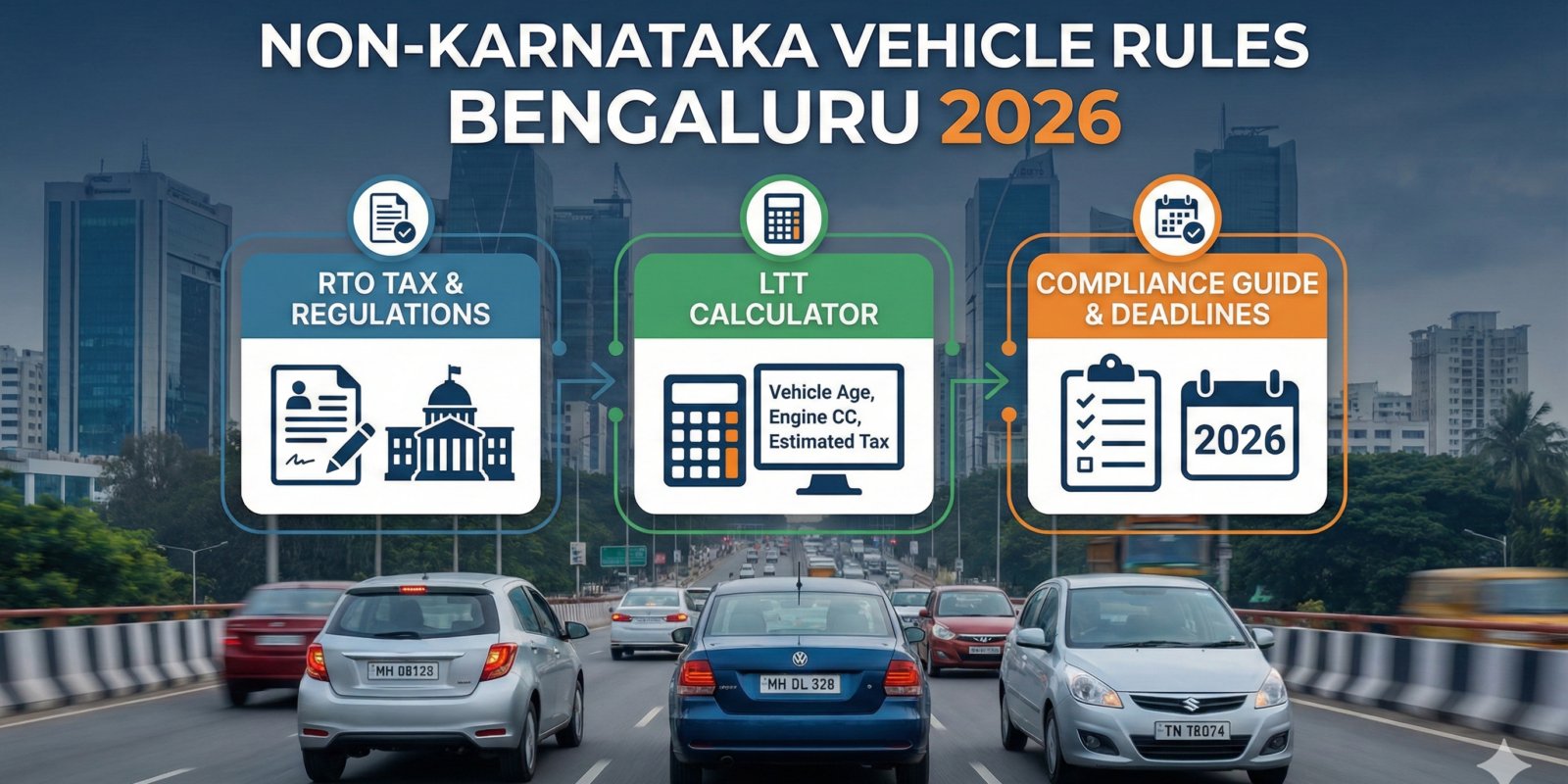
By Driving a vehicle with out-of-state registration plates in Bengaluru presents a specific legal challenge in 2026. The friction between the Central Motor Vehicles Act, which allows a 12-month transit period, and the Karnataka Motor Vehicles Taxation Act, which demands tax payment after 30 days, continues to confuse vehicle owners.
With the Transport Department integrating ANPR cameras and digital tracking to identify tax liability, understanding the technical boundaries of the law is necessary to avoid vehicle seizure and heavy penalties.
This report examines the current enforcement standards, tax calculations, and the legal standing of the BH Series for private employees.
Non-Karnataka Vehicles in Bengaluru.
The 2026 Compliance Overview.
A technical guide to the interplay between Federal mobility provisions and State taxation laws. An objective analysis of enforcement strategies, tax slabs, and legal frameworks.
Executive Summary
The regulatory environment for out-of-state vehicles in Bengaluru requires careful navigation in 2026. The Karnataka Transport Department continues to enforce the Karnataka Motor Vehicles Taxation (KMVT) Act 1957, often interpreted alongside the Central Motor Vehicles Act 1988.
While federal law provides a framework for temporary inter-state movement, state enforcement focuses on identifying vehicles that have effectively migrated. The 2026 strategy relies on data integration and surveillance to determine tax liability.
Vehicle owners are advised to maintain verifiable records of their movement and entry dates.
Data Visualization
Tax Liability vs Vehicle Age (Depreciation)
2026 Enforcement Observations
1. The Federal-State Legislative Framework
Legislative Context
A legislative overlap exists regarding “temporary stay” versus “permanent migration”. The Central Motor Vehicles Act (1988) permits vehicles to ply in another state for up to 12 months without re-registration (Section 47).
Conversely, Karnataka exercises its powers under the State List to tax vehicles used within its jurisdiction. The state contends that vehicles using infrastructure for extended periods (defined locally as exceeding 30 days) are liable for the Lifetime Tax (LTT).
Current Enforcement Context
The Transport Department conducts regular checks to ensure compliance. The objective is to identify vehicles that have permanently relocated but retain out-of-state registrations to avoid the higher LTT rates in Karnataka (13-18%).
The focus is often on high-value vehicles where the tax differential is significant, though all vehicle categories are subject to the same rules.
LEGAL ARCHITECTURE COMPARISON
| Provision | Central MV Act 1988 | Karnataka KMVT Act 1957 |
|---|---|---|
| Core Mandate | Section 47: 12-month window for inter-state movement. | Section 3: Authority to levy tax on vehicles “suitable for use” in state. |
| Time Limit | 12 Months before re-registration is mandatory. | 30 Days before LTT liability accrues (per 2014 Amendment). |
| Judicial Status | Federal Law (Parliamentary Act). | 30-day rule declared unconstitutional in 2016 (Jagadev Biradar). Appeal is pending. |
| 2026 Status | Often cited by vehicle owners. | Enforced pending final Supreme Court verdict. |
2. Judicial Landscape: The Jagadev Biradar Case
On March 10, 2016, the Karnataka High Court delivered a judgment declaring the “30-day rule” unconstitutional, stating that the State Legislature cannot negate provisions of a Central Act enacted under the Concurrent List.
Current Legal Status (2026):
- The matter is sub-judice in the Supreme Court of India.
- There is no explicit stay on the High Court’s judgment.
- RTO officials generally operate under the interpretation that the filing of the appeal allows for continued enforcement of the state act.
- Enforcement now emphasizes the verification of the “date of entry” to determine if the vehicle has exceeded the permissible limits.
LTT Estimator 2026 (Indicative)
DISCLAIMER: This tool provides an estimate based on published slabs. Final assessment rests with the RTO.
*Includes Cess. Excludes potential penalties.
3. Financial Considerations: Transfer vs. Sale
Paying the LTT can be a significant expense. Owners should evaluate their options based on vehicle age, duration of stay, and financial depreciation.
Factors Favoring Sale in Home State
- ➜ Vehicle is > 7 years old (Resale value drops sharply after 8 years).
- ➜ Estimated LTT exceeds 35% of current market value.
- ➜ Model is discontinued (Spare parts scarcity adds to maintenance).
- ➜ Planned stay in Bangalore is short-term (< 3 years).
Factors Favoring Transfer & Payment
- ➜ Vehicle is < 3 years old (Depreciation loss on sale exceeds tax cost).
- ➜ High-value or niche vehicle with low liquidity in the used market.
- ➜ Employer reimbursement for transfer costs is available.
- ➜ Personal/Sentimental value outweighs financial calculation.
4. Guidelines for RTO Interactions
COMPLIANCE ADVISORYInteractions with RTO inspectors should be conducted respectfully and factually. The outcome often depends on the clarity of the documentation provided.
Step 1: The Stop
Pull over safely when signaled. Ensure you are in a safe location.
Step 2: Document Production
Present valid documents (RC, Insurance, PUC, DL). Digital formats via DigiLocker or mParivahan are legally recognized under Section 139 of the MV Act.
Step 3: Establishing Context
“How long have you been here?”
Provide accurate, truthful information regarding your arrival. If you are a visitor, state so clearly. Misrepresentation of facts can lead to legal complications.
Verifiable Evidence
To substantiate a claim of temporary visit/recent entry, the following documents are typically requested:
- Toll Receipts: FASTag history or physical receipts showing date of entry.
- Fuel Bills: Receipts from your home state dated recently.
- Service History: Local service records dated > 12 months ago may be viewed as evidence of long-term stay.
- Parking Stickers: Permanent resident stickers from local apartments may contradict claims of being a temporary visitor.
5. The 2026 Enforcement Mechanism
ANPR Technology
Automatic Number Plate Recognition (ANPR) systems at toll plazas assist in tracking vehicle movement patterns and identifying frequent travelers.
Data Integration
Access to centralized databases allows officials to verify PUC issuance dates and insurance renewals to establish the vehicle’s location history.
Documentation Review
The onus is generally on the vehicle owner to provide proof of entry. In the absence of proof, authorities may proceed based on available circumstantial evidence.
6. Procedures Following Vehicle Impoundment
If a vehicle is detained for non-payment of tax (under Section 207), the following procedural steps typically apply:
Obtain the official seizure memo (Form F/Mahazar), which details the reason for detention and vehicle inventory.
The RTO will issue a demand notice calculating the LTT, applicable cess, and any penalties.
Owners may pay the demanded amount or challenge the seizure through appropriate legal channels (e.g., High Court).
Upon payment or court order, a Release Order is issued. Verify the vehicle’s condition before retrieving it.
7. Penalty Structure
Non-compliance with taxation rules can lead to financial penalties under Section 192A of the MV Act and relevant state provisions.
| Violation Context | Potential Financial Implication | Legal Reference |
|---|---|---|
| Late Payment | Interest @ 1.5% per month (approx) | KMVT Act Provisions |
| Unauthorized Use (> 12 mo) | Tax Amount + Penalty (often equal to tax) | Section 192A / Section 207 |
| Incorrect Information | Fines varies by offense | MV Act / IPC Sections |
8. The BH Series Status
The BH (Bharat) Series was introduced to facilitate seamless movement for employees with transferable jobs. It allows for tax payment in biennial installments.
Current Implementation: While valid nationwide, the issuance of BH series in Karnataka for private sector employees has faced procedural scrutiny. However, vehicles validly registered under BH series in other states are generally recognized, provided the biennial tax payments are up to date.
NOTE ON COMPLIANCE
Always ensure your BH series tax payments are current. A lapsed payment renders the vehicle liable for action similar to a standard out-of-state vehicle.
Compliance Measures
- ➜ Record Keeping: Maintain a physical file of toll and fuel receipts.
- ➜ Validation: Ensure Fastag data accurately reflects your movement history.
- ➜ Digital Copies: Keep DigiLocker updated to ensure document availability during checks.
9. Community Reporting & Parking
In addition to official enforcement, vehicle owners should be aware of community-level regulations.
RWA Guidelines
Resident Welfare Associations (RWAs) in large apartment complexes often have internal bylaws regarding parking allocation. Some may restrict permanent parking slots for non-KA vehicles. Residents should review their association’s bylaws carefully.
Mitigation Steps
Ensure your rental or lease agreement explicitly covers parking rights. If disputes arise regarding registration, residents can cite relevant court judgments or seek legal counsel. Maintaining amicable relations and adhering to community parking rules is recommended.
10. Standard Templates
DISCLAIMER: These are generic formats. Official forms may vary.
Form 28 (NOC Request)
Required from original RTO to migrate registration.
Change of Address (Form 27)
Submitted to Bangalore RTO after tax payment.
11. Refund Process Overview
Upon paying LTT in Karnataka, vehicle owners are typically eligible for a pro-rata refund of the tax paid in the state of original registration. This process involves coordination between two state transport departments.
Prerequisites
- Re-registration in Karnataka must be complete (KA number plate assigned).
- The original RTO must receive the “CRTI” (Certificate of Registration Transfer Intimation) from the Bangalore RTO.
Common Challenges
- Inter-RTO Communication: Delays in sending/receiving the CRTI are common. Manual follow-up is often required.
- Processing Time: Refunds are dependent on the original state’s budget and verification processes, often taking considerable time.
Procedural Advice
- Engaging a representative in the city of original registration can facilitate the physical movement of the file.
- Maintain copies of all transfer documents.